Bishops Play Church Queens as Pawns

COMMENTARY

IT is an astonishing thing that historians will look back and puzzle over, that in the 21st century, American women were such hunted creatures.

Even as Republicans try to wrestle women into chastity belts, the Vatican is trying to muzzle American nuns.

Who thinks it’s cool to bully nuns? While continuing to heal and educate, the community of sisters is aging and dying out because few younger women are willing to make such sacrifices for a church determined to bring women to heel.

Yet the nuns must be yanked into line by the crepuscular, medieval men who run the Catholic Church.

“It’s not terribly unlike the days of yore when they singled out people in the rough days of the Inquisition,” said Kenneth Briggs, the author of “Double Crossed: Uncovering the Catholic Church’s Betrayal of American Nuns.”

How can the church hierarchy be more offended by the nuns’ impassioned advocacy for the poor than by priests’ sordid pedophilia?

How do you take spiritual direction from a church that seems to be losing its soul?

It has become a habit for the church to go after women. A Worcester, Mass., bishop successfully fought to get a commencement speech invitation taken away from Vicki Kennedy, widow of Teddy Kennedy, because of her positions on some social issues. And an Indiana woman named Emily Herx has filed a lawsuit saying she was fired from her job teaching in a Catholic school and denounced as a “grave, immoral sinner” by the parish pastor after she used fertility treatments to try to get pregnant with her husband.

Cardinal Timothy Dolan of New York recently told The Wall Street Journal that only “a tiny minority” of priests were tainted by the sex abuse scandal. But it’s a global shame spiral. The church leadership never recoiled in horror from pedophilia, yet it recoils in horror from outspoken nuns.

In Philadelphia, Msgr. William Lynn, 61, is the first church supervisor to go on trial for child endangerment. He is fighting charges that he may have covered up for 20 priests accused of sexual abuse and left in the ministry, often transferred to unwitting parishes.

Somehow the Philadelphia church leaders decided that the Rev. Thomas Smith was not sexually motivated when he made boys strip and be whipped playing Christ in a Passion play. Somehow they decided an altar boy who said he was raped by two priests and his fifth-grade teacher was not the one in need of protection.

Instead of looking deep into its own heart and soul, the church is going after the women who are the heart and soul of parishes, schools and hospitals.

The stunned sisters are debating how to respond after the Vatican’s scorching reprimand to the Leadership Conference of Women Religious, the main association of American Catholic nuns. The bishops were obviously peeved that some nuns had the temerity to speak out in support of President Obama’s health care plan, including his compromise on contraception for religious hospitals.

The Vatican accused the nuns of pushing “radical feminist themes,” and said they were not vocal enough in parroting church policy against the ordination of women as priests and against abortion, contraception and homosexual relationships.

In a blatant “Shut up and sit down, sisters” moment, the Vatican’s doctrinal office, the Congregation for the Doctrine of the Faith, noted, “Occasional public statements by the L.C.W.R. that disagree with or challenge positions taken by the bishops, who are the church’s authentic teachers of faith and morals, are not compatible with its purpose.”

Pope Benedict, who became known as “God’s Rottweiler” when he was the cardinal conducting the office’s loyalty tests, assigned Archbishop J. Peter Sartain of Seattle to crack down on the climate of “corporate dissent” among the poor nuns.

When the nuns push for social justice, they’re put into stocks. Yet Archbishop Sartain has led a campaign in Washington to reverse the state’s newly enacted law allowing same-sex marriage, and he’s a church hero.

Sister Simone Campbell, executive director of Network, a Catholic lobbying group slapped in the Vatican report, said it scares the church hierarchy to have “educated women form thoughtful opinions and engage in dialogue.”

She told NPR that it was ironic that church leaders were mad at sisters over contraception when the nuns had committed to a celibate life with no families or babies. Given the damage done by the pedophilia scandals, she said, “the church’s obsession, at times, with the sexual relationships is a serious problem.”

Asked by The Journal if the church had a hard time convincing the flock to follow its strict teachings on sexuality, Cardinal Dolan laughed: “Do we ever!”

Church leaders behave like adolescent boys, blinded by sex. That’s the problem with inquisitors and censors: They become fascinated by what they deplore.

The pope needs what the rest of us got from nuns: a good rap across the knuckles.

Complete Article HERE!

The Case for Gay Acceptance in the Catholic Church

The death penalty no longer applies to people who divorce or sleep with women during their periods, as described in the Bible. So why can’t attitudes on homosexuality change as well?

COMMENTARY
On St. Patrick’s Day I had the pleasure of speaking to about 350 Catholics who gathered together to attend a conference put on by New Ways Ministry, which is an effort to support the LGBT community in the Catholic Church. The women and men I spoke to included nuns and priests, children who had come out and parents who wanted to be supportive. Two female priests gave me special blessing and I left the meeting inspired by the devotion of those who attended.

New Ways Ministry has a critical mission, since changing the Church will help those who suffer from ill treatment not only here in the United States but around the world, where the Church has so much clout. The Church has millions of members in Africa and South America, where being gay or lesbian can lead to a death sentence.

Worse, the Church’s own teaching encourages bigotry and harm. Just last year, my father’s memorial, the Robert F. Kennedy Center for Justice and Human Rights, gave its human rights award to Frank Mugisha, a gay activist in Uganda whose good friend had just been brutally killed in his own home. American missionaries have encouraged the discrimination Mugisha suffers. Refuting their religious arguments is critical, and so is making a moral and religious case for gays. What we need is a transformation of hearts and minds, not merely a change of laws.

The Catholic Church’s attitude towards homosexuality is at odds with its tradition of tolerance and understanding. The actual practice of the Church is true to this tradition. What other institution separates men and women and encourages them to live together in monasteries and convents where they can develop deep relationships with those who share their kind of love?

The fight for the dignity of the LGBT community is a fight for the soul of today’s Church. Some conservatives see the hierarchy’s current, traditional teaching on sex as the Church’s defining position. They don’t really like to talk about, or even be reminded of, the Church’s teachings on immigration, or protection of the environment, or the greed that produces financial meltdowns, all of which they would find distastefully liberal.

For them there is only one issue — sex, or pelvic politics as some call it. The Pope himself pointed this out on in visit to Mexico, where he said that “not a few Catholics have a certain schizophrenia with regard to individual and public morality…. In public life they follow paths that don’t respond to the great values necessary for the foundation of a just society.”

If we wish to change the Church, we must first convey our views in language, images, and theology that reach people where they are. And secondly, we should make it clear that disagreement with the hierarchy is a critical part of our history.

The fact that so many Americans see themselves as religious, as God-loving church goers, means we have a better chance of reaching them if we use a language, a book, and symbols they understand. Polls find that 85 percent say that they believe in God and 50 percent claim that they go to church every Sunday. The fact that only 25 percent do just goes to show that you can’t trust everybody’s self-reporting.

In The Good Book: The Bible’s Place in Our Lives, the recently deceased Peter Gomes describes interviews with 400 people who had been jailed for hate crimes against gays. None felt remorse. They thought gays were the devil, so fighting them was cause for pride, not shame or regret. Laws are important, but the moral case can be even more compelling.

When my father visited South Africa in 1966, he spoke with students in Cape Town about apartheid. They defended the abhorrent practice by pointing to Biblical passages that suggested that discrimination was fine. In an effort to reach them, my father asked, “Suppose you die, and you go up to heaven, and you enter the pearly gates, and suppose, just suppose when you get there, you find that God is black.” Today we can ask, “Suppose God is gay.”

My father grasped, as did John Kennedy and Martin Luther King, that in America the leader who wishes to enlarge freedom’s sphere must appeal to an audience’s religious beliefs as well as to their understanding of American liberty. This is what I wrote about in my book, Failing America’s Faithful. While researching it, I gained many insights into the Church and its history of both prejudice and tolerance.

The Great Awakening of the 1740s gave people the idea that they could find God within themselves and need not trust preachers. As one perceptive British writer pointed out, if they don’t need rectors, soon they won’t need British rulers. Sure enough, once Americans got used to trusting themselves, they did rebel. Then the Second Great Awakening, in the 1850, instilled in Americans the idea that not only did the divine reside within them, it also resided in women and slaves. The Abolitionist movement grew from that religious revival, as did the suffragettes.

A few years ago, I read the Bible from Genesis to Revelations, and to me the biggest revelation was how misogynistic it was. That made me realize that the Catholic Church was on to something when it allowed only educated priests to read the Bible. My mother’s generation was prohibited from reading the Bible, and when I told my grandmother that my father used to read the Bible to us, she was shocked, “Catholics don’t read the Bible,” she said. The Church figured that people could take passages out of context and come to unwarranted conclusions. This changed after Vatican II and now Catholic parishes offer Bible study classes.

But those outrageous passages did not deter either the abolitionists or the suffragettes. They boldly rejected them as cultural detritus. Instead, they asserted that the primary message was that all people were made in God’s image. Thus we are born to be free.

Unfortunately, a century later, in the 1970s, feminists and gay rights activists did not adopt the same strategy and tactics. I think this happened because their movement grew out of the non-religious part of the civil rights movement. Recall that the civil rights movement was split between the followers of Reverend Martin Luther King on the one hand and Stokely Carmichael and the Black Panthers on the other. The latter group felt that religion was weak. Why turn the other cheek? Why not fight back? This secular strain also attracted many intellectuals who were, to put it bluntly, uncomfortable with religion.

Happily, that has now changed. Women have entered schools of theology and can now show that Jesus was one of the first great feminists. Mary Magdalene is no longer thought of as a prostitute but as the “apostle to the apostles.” Gays, though, are still excluded.

Progressive Christian and Jewish believers have accepted gay rights. Theologians now argue that verses in Leviticus that call for the killing of men who sleep with men apply only to a particular historical moment. The death penalty no longer applies to people who divorce, curse their parents, or sleep with women during their period — rules that are also in Leviticus.

Obviously, some people continue to read scripture simply to sustain their preexisting prejudice against homosexuality and homosexuals. But theologians now point out that the word “homosexual” didn’t even exist until the 19th century, and it wasn’t included in the Bible until 1946.

Choose your passage. King David talks about sleeping with his friend Nathan as “better than sleeping with a woman.” The Ten Commandments don’t mention homosexuality. Nor does Jesus. In fact, our Lord teaches us that love of God and love of our fellow human being are the two most important commandments. He doesn’t exclude the love that one man can have for another, or one woman for another.

The 2000-year-old passages favored by Church authorities don’t hold up as being anti-gay. Not only is the hierarchy — the Church’s cardinals and bishops — imposing its own interpretations, its views are harmful to many men and women. I would hope that the lens through which one reads scripture would be one of love and openness to others, not fear and anger and meanness.

Contrary to conservative propaganda, though, the Vatican is not immovable. It has a long history of changing position to follow new understandings of society and morality. Usury is no longer a sin. Women are no longer considered “the devil’s gateway.” Railroads are no longer cursed as the work of the devil, and teaching that there is such a doctrine as “freedom of conscience” does not merit censure, as it did for John Courtney Murray in the 1950s: In fact, Vatican II now recognizes “freedom of conscience.” Pope John Paul II apologized for the Church’s treatment of women and its persecution of Galileo. Sex between husband and a wife is no longer just for procreation but has value in itself.

That history can continue with its position on gays — and the laity has a critical role to play in pushing for these changes. As Cardinal John Henry Newman, the foremost 19th-century Catholic theologian asserted, bishops have at times “failed in their confession of the faith.” There can be instances of “misguidance, delusion, hallucination.” He said that the body of the faithful has the “instinct for truth.”

Already, I have witnessed that instinct for truth in the argument over contraception. Despite the hierarchy’s position, 98 percent of Catholic women in the United States use contraception. I believe that Human Vitae was the Holy Ghost’s way to teach us that we must use our conscience, and not lazily rely on the hierarchy when it is in error.

At this time, when the hierarchy does not want to recognize that we are all made in the image and likeness of God, and that the one of the two most critical commandments is to love one another, it is critical to assert that God loves the LGBT community equally. Sometimes the Church moves slowly, sometimes quickly. The point is to make sure the voices of dissent are not quiet and the Holy Spirit can be heard.

Complete Article HERE!

Holy Wisdom Monastery provides church services for disaffected local Catholics

Alice Jenson’s faith took an irreversible turn six years ago.

It was Nov. 5, 2006, and she was contributing to Mass at St. Joseph’s Catholic Church in Madison as a lay person, reading Bible passages from the lectern.

The same day, Madison Bishop Robert Morlino required all priests to play a recorded message from him explaining his position on three issues state residents would vote on that week, including a ban on same-sex marriage, which he supported.

When the priest hit “play,” Jenson walked out.

“It was the first time I’d ever outwardly gone against what I was raised to follow,” said Jenson, 67.

She found a new religious home at Holy Wisdom Monastery, a former Roman Catholic monastery in the town of Westport, just outside Madison. Its Sunday service, offered by the sisters who live there, retains many elements of a traditional Catholic Mass but diverges in sometimes startling ways.

Women can lead the service and preach the sermon. Gay relationships are warmly embraced. All parishioners, not just Catholics, can consume the communion wine and bread because the service is ecumenical, meaning welcoming of all Christian traditions.

It’s an alternate universe of sorts — what some think a Catholic Mass might look like today if the liberal spirit of Vatican II in the 1960s had taken root and flowered.

“We’re doing what the hierarchical church was afraid to complete,” said Jim Green, a longtime Holy Wisdom parishioner who is gay and describes himself as “a Catholic in exile.”

The service, called Sunday Assembly, is attended by people from many denominational backgrounds but has become especially popular with Catholics displeased with Morlino or church doctrine in general. Membership doubled in five years to 335, and parishioners estimate a majority are Catholics who left their regular parishes.

Detractors say the parishioners strayed too far from Catholicism to warrant the label.

Approach evolves
Though many self-described Catholics attend Holy Wisdom, it’s no longer an official Catholic Mass.

A little history: In the 1950s, a group of Benedictine nuns opened a high school at the site for girls in the Madison Catholic Diocese. Benedictines belong to a monastic religious order regulated by the canon law of the Catholic Church. Masses at the site were led by Catholic priests, often provided by the diocese.

In 1966, the nuns closed the school and turned the buildings into a Christian retreat center. The sisters, spurred by the Benedictine tradition of hospitality, gradually made the service more inclusive to all Christians. Lay people, especially women, took on greater roles.

In 2000, the Benedictine sisters went a step further, welcoming a Protestant woman to live with them. “When we chose to open our community to Protestant women, it meant other doors closed,” said Sister Mary David Walgenbach, the monastery’s head.

The sisters sought independence from the Catholic Church, and the Vatican granted it in 2006. Consequently, they no longer are tied to the local diocese. They remain affiliated with a Benedictine federation, but they have a special status, not a full membership, because of their ecumenism.

Bishop’s request
When the sisters disassociated from Rome, Bishop Morlino asked them to no longer celebrate Mass at the site so as not to cause confusion, said Brent King, a diocesan spokesman.

“Many people had visited (the monastery) over the years, and the bishop felt it would take time for people to understand that it was no longer a Roman Catholic institution,” King said, adding the bishop “was in no way unfriendly toward their desire to start a non-Catholic ecumenical community.”

The sisters understood the bishop’s position and stopped calling the service a Catholic Mass in 2006, Walgenbach said. Priests ceased to lead the service.
Today, the sisters describe the Sunday Assembly as being “for the celebration of Eucharist,” a term most commonly used to refer to Catholic communion. However, Walgenbach said some Protestant churches also use it. To many people, the service still has the essence of a Catholic Mass.

“You wouldn’t know it wasn’t a Catholic church, except for the person officiating,” said parishioner Pat Hobbins-Kemps, 64. A lifelong Catholic, she said she left her regular parish partly out of a lack of opportunities for women to lead.

Finding a home
Trisha Day, 66, said she came to Holy Wisdom after growing tired of sermons that focused on politically charged issues such as abortion and homosexuality while saying little about social justice and the poor.

Jeanne Marquis, 68, found Holy Wisdom after the terrorist attacks of Sept. 11, 2001. “I needed someone to talk about forgiveness instead of retaliation,” she said. “I needed a place where I was encouraged to ask questions.”

Ann Baltes, 44, a lifelong Catholic, said she sought a place where she and her husband, Bill Rosholt, a Lutheran, could participate in communion together.

Are these parishioners still Catholic? The answers vary.

Jenson says she’s not. “Too much divides us.”

Day calls herself “a transitional Catholic,” unsure where she’ll end up. Green said his Catholic identity can’t be taken from him. “The church is the people of God, not the institution,” he said.

Joanne Kollasch, one of the three Benedictine sisters who live at the monastery, said she “is a Catholic and will remain a Catholic,” adding, “I don’t like to be thought of as less Catholic because I’m ecumenical.”
Said Walgenbach: “The Catholic spirituality is bigger than the Roman Catholic Church.”

Both sisters said they respect the Catholic Church and Morlino and don’t seek controversy.

Detractors
Syte Reitz, a member of Madison’s Cathedral Parish who blogs about Catholic issues, said disaffected Catholics are free to start their own churches, but they shouldn’t confuse people by suggesting they still are faithful Catholics.

“Does it matter whether they are errant Catholics or not Catholics?” asks Reitz. “No matter what we label them, the laws of right and wrong and of morality still stand, and they and others will suffer from the mistakes that they make.”

Reitz said because a male priest is not presiding over the Eucharist, the bread is not being turned into the body of Christ, thus depriving attendees of the Catholic Church’s central sacrament.

King, the diocesan spokesman, said for Catholics to fulfill their obligation to attend Mass on Sundays, they must attend a Catholic Mass validly offered by an ordained Catholic priest.

Does the Holy Wisdom service qualify?

“In charity, we must respond that it does not,” he said.

Complete Article HERE!

Vatican ruled by ‘omerta’ code of silence, whistle-blower claims

The Vatican is ruled by a climate of fear and an ‘omerta’ code of silence, a whistle-blower has claimed.

The mole claims to be one of more than 20 people within the Holy See who have leaked sensitive documents to the Italian media in the last few weeks, in an affair that has been compared to the WikiLeaks scandal and dubbed “Vati-leaks”.

The unidentified man, who said he had worked in the Vatican for more than 20 years, made the claims in an interview to be aired on Italian television on Wednesday night.

His face was hidden and his voice digitally distorted when he appeared on the TV channel, La7.

According to extracts of the interview, the whistle-blower said the Vatican was engulfed in intrigue, secrecy and a climate of intimidation.
“Maybe there is a kind of omerta to prevent the truth from surfacing. Not because of a power struggle but maybe because of fear,” he added.

He claimed to have worked in the State Secretariat, which is led by the powerful but unpopular Secretary of State, Tarcisio Bertone, who is reported to have fallen out of favour with the Pope and his supporters.

The whistle-blower said the Vatican is a place where “you can commit a murder and then disappear into the void” – a reference to a murky scandal in the Swiss Guard in 1998, when a young soldier shot dead the corps’ commander and wife before apparently committing suicide.

The mother of Cedric Tornay, 23, the alleged assassin, has never accepted that her son would have committed suicide and has called on Pope Benedict XVI, 84, to reopen the case, amid speculation that the real killer of the three may never have been caught.

There have been long-standing accusations of an official cover-up by the Roman Catholic Church, with numerous conspiracy theories put forward for a possible motive.

The leaks have embarrassed the Vatican in recent weeks, with claims of corruption and nepotism, questions over the transparency of the Vatican bank and unconfirmed reports of an assassination plot against the Pope within the next 12 months.

The whistle-blower dismissed suggestions that documents were being leaked in exchange for money.

“Something like that is inconceivable for me. That would mean betraying what we believe in,” he said.

He urged the Vatican to reinvestigate “with zeal” one of its most enduring mysteries – the kidnap of teenager Emanuela Orlandi nearly 30 years ago.
Over the years it has been claimed that Miss Orlandi was kidnapped so that she could be used as a bargaining chip for the release from prison of Mehmet Ali Agca, the Turkish gunman who tried to kill John Paul II in St Peter’s Square in 1981.

Another theory is that the girl’s father, a Vatican employee, had stumbled on documents that connected the Vatican bank with a criminal gang in Rome and that she was kidnapped in a bid to silence him.

It has even been suggested that the kidnapping was carried out on the orders of a Catholic archbishop, Paul Marcinkus, the disgraced head of the Vatican bank, known as the ‘Istituto per le Opere di Religione’. Marcinkus, an American, died six years ago.

Complete Article HERE!

Former North Side Catholic nun gets ordained

The Nun’s Story …

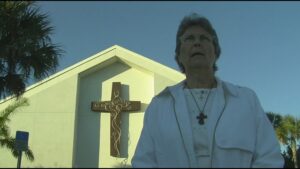
A former North Side Catholic nun was ordained a priest recently in an unsanctioned church ceremony in Fort Myers, Fla.

She was immediately ex-communicated from the Catholic church.

“I reject that,” said Judy Beaumont, 74 — the former Sister Mary Daniel — who grew up in Rogers Park before becoming a Benedictine nun who taught theology at St. Scholastica Academy.

Beaumont, who is now referred to as Pastor Judy, was ordained by the Association of Roman Catholic Women Priests.

“We are following our conscience and we are full loyal members of the church,” said Beaumont.

“We will do everything we can to bring about a new way of inclusivity in the church,” said Beaumont, who is now the 11th priest ordained by her group.

The key differences in the women’s “ordination” ceremony are:

† They don’t take a vow of obedience to the bishop. (“It basically denies you the ability to follow your conscience.”)

† Their bishop is a woman, who serves as a spiritual adviser.

† They don’t take a vow of celibacy and allow married, single, grandmothers, gay and straight women into the priestly fold.

† Rather than always referring to God as a “he,” their church language is more inclusive. The “Our Father” prayer reads “Our Mother/Father, who art in heaven.”

“The institutional church will not hire any of us to do church ministry, so we do what we can ministering in hospitals and to the homeless,” she said. “We hold Sunday mass in “church” houses and live on donations. “Stepping outside the institution is hard.”

Two more women are being ordained priests in the next few days, Beaumont added. “I didn’t decide I wanted to become a priest, it was a calling,” she said.

Complete Article HERE!

Contraception’s Con Men

COMMENTARY
By a revolting combination of con men and fanatics, the current primary race has become a demonstration that the Republican party does not deserve serious consideration for public office. Take the controversy over contraceptives. American bishops at first opposed having hospitals and schools connected with them pay employee health costs for contraceptives. But when the President backed off from that requirement, saying insurance companies can pay the costs, the bishops doubled down and said no one should have to pay for anything so evil as contraception. Some Republicans are using the bishops’ stupidity to hurt the supposed “moderate” candidate Mitt Romney, giving a temporary leg up to the faux naïf Rick Santorum; others are attacking Barack Obama as an “enemy of religion.”

Pusillanimous Catholics—Mark Shields and even, to a degree, the admirable E. J. Dionne—are saying that Catholics understandably resent an attack on “their” doctrine (even though they do not personally believe in it). Omnidirectional bad-faith arguments have clustered around what is falsely presented as a defense of “faith.” The layers of ignorance are equaled only by the willingness of people “of all faiths” to use them for their own purposes. Consider just some of the layers:

The Phony Religious Freedom Argument

The bishops’ opposition to contraception is not an argument for a “conscience exemption.” It is a way of imposing Catholic requirements on non-Catholics. This is religious dictatorship, not religious freedom.

Contraception is not even a religious matter. Nowhere in Scripture or the Creed is it forbidden. Catholic authorities themselves say it is a matter of “natural law,” over which natural reason is the arbiter—and natural reason, even for Catholics, has long rejected the idea that contraception is evil. More of that later; what matters here is that contraception is legal, ordinary, and accepted even by most Catholics. To say that others must accept what Catholics themselves do not is bad enough. To say that President Obama is “trying to destroy the Catholic Church” if he does not accept it is much, much worse.

To disagree with Catholic bishops is called “disrespectful,” an offense against religious freedom. That is why there is a kind of taboo against bringing up Romney’s Mormonism. But if Romney sincerely believed in polygamy on religious grounds, as his grandfather did, he would not even be considered for the presidency—any more than a sincere Christian Scientist, who rejects the use of medicine, would be voted for to handle public health care. Yet a man who believes that contraception is evil is an aberrant from the American norm, like the polygamist or the faith healer.

The Phony Contraception Argument

The opposition to contraception has, as I said, no scriptural basis. Pope Pius XI once said that it did, citing in his encyclical Casti Connubii (1930) the condemnation of Onan for “spilling his seed” rather than impregnating a woman (Genesis 38.9). But later popes had to back off from this claim, since everyone agrees now that Onan’s sin was not carrying out his duty to give his brother an heir (Deuteronomy 25.5-6). Then the “natural law” was fallen back on, saying that the natural purpose of sex is procreation, and any use of it for other purposes is “unnatural.” But a primary natural purpose does not of necessity exclude ancillary advantages. The purpose of eating is to sustain life, but that does not make all eating that is not necessary to subsistence “unnatural.” One can eat, beyond the bare minimum to exist, to express fellowship, as one can have sex, beyond the begetting of a child with each act, to express love.

The Roman authorities would not have fallen for such a silly argument but for a deep historical disrelish for sex itself. Early Fathers and medieval theologians considered sex unworthy when not actually sinful. That is why virgin saints and celibate priests were prized above married couples. Thomas Aquinas said that priests must not be married, since “those in holy orders handle the sacred vessels and the sacrament itself, and therefore it is proper (decens) that they preserve, by abstinences, a body undefiled (munditia corporalis) (Summa Theologiae, Part 3 Supplement, Question 53, article 3, Response). Marriage, you see, makes for defilement (immunditia). The ban on contraception is a hangover from the period when the body itself was considered unclean, as Peter Brown overwhelmingly proved in The Body and Society (1988).

The Phony “Church Teaches” Argument

Catholics who do not accept the phony argument over contraception are said to be “going against the teachings of their church.” That is nonsense. They are their church. The Second Vatican Council defines the church as “the people of God.” Thinking that the pope is the church is a relic of the days when a monarch was said to be his realm. The king was “Denmark.” Catholics have long realized that their own grasp of certain things, especially sex, has a validity that is lost on the celibate male hierarchy. This is particularly true where celibacy is concerned.

There was broad disagreement with Pius XI’s 1930 encyclical on the matter. Pope Paul VI set up a study group of loyal and devout Catholics, lay and clerical, to make recommendations. The group overwhelmingly voted to change the teaching of Pius XI. But cardinals in the Roman Curia convinced Paul that any change would suggest that the church’s teachings are not eternal (though Casti Connubii had not been declared infallible, by the papacy’s own standards).

When Paul reaffirmed the ban on birth control in Humanae Vitae (1968) there was massive rejection of it. Some left the church. Some just ignored it. Paradoxically, the document formed to convey the idea that papal teaching is inerrant just convinced most people that it can be loony. The priest-sociologist Andrew Greeley said that Humanae Vitae did more damage to the papacy than any of the so-called “liberal” movements in Catholicism. When Pius IX condemned democracy and modern science in his Syllabus of Errors (1864), the Catholic historian Lord Acton said that Catholics were too sensible to go crazy every time a pope does. The reaction to Humanae Vitae proves that.

The Phony “Undying Principle” Argument

Rick Santorum is a nice smiley fanatic. He does not believe in evolution or global warming or women in the workplace. He equates gay sex with bestiality (Rick “Man on Dog” Santorum). He equates contraception with the guillotine. Only a brain-dead party could think him a worthy presidential candidate. Yet he is praised by television pundits, night and day, for being “sincere” and “standing by what he believes.” He is the principled alternative to the evil Moderation of Mitt Romney and the evil Evil of Newt Gingrich. He is presented as a model Catholic. Torquemada was, in that sense, a model Catholic. Messrs. Boehner and McConnell call him a martyr to religious freedom. A young priest I saw on television, modeling himself on his hero Santorum, said, “I would rather die than give up my church’s principles.” What we are seeing is not a defense of undying principle but a stampede toward a temporarily exploitable lunacy. Acton to the rescue!

Complete Article HERE!

Catholic League: Jewish Rabbis Even Greater Abusers Than Catholic Priests

COMMENTARY

Bill Donohue, the head of the pedophile priests supporting Catholic League, in an attempt to deflect attention from the regular, serious, and unresolved sexual transgressions, sexual assault, and child rape within the Catholic Church, today pointed the finger at Orthodox Jewish Rabbis, saying, “[t]he most serious cases of the sexual abuse of minors currently taking place are among Orthodox Jewish rabbis in Brooklyn.” Donohue, proving the ludicrousness of the existence and purpose of his entire organization, lambasted Jay Leno for a joke he made last night about an L.A. Bishop who recently resigned after revealing he had fathered two children. Donohue claims also that Leno has “a long track record of bashing Catholicism.” So, rather than work to fix the root causes of systemic and felonious issues within the Church, Donohue chooses instead to attacks its critics, hoping, praying that no one will notice the Catholic Church’s role and reputation in America is rapidly diminishing, even among America’s Catholics.

Jay Leno, according to the Catholic League, Thursday said, “I thought bishops could only move diagonally. I didn’t know they could move up and down.”

Donohue’s group added,

When making these remarks, Leno gestured with his hands, waving them side to side, and then up and down.

Leno went on to say, “Isn’t it amazing the bishop of L.A. confessed to fathering two children? But, hey, he didn’t use birth control, so at least he followed the church rules. Ya gotta give him credit for that.”

“The most serious cases of the sexual abuse of minors currently taking place are among Orthodox Jewish rabbis in Brooklyn, yet Leno would never tell a joke at their expense,” Donohue said in a statement. “The rate of HIV/AIDS among homosexuals is 50 times higher than in the rest of the population, yet Leno would never tell a joke at their expense. [Note: making such jokes would be equally offensive.] But if there is one wayward Catholic clergyman, it’s not only acceptable to ridicule him, it’s okay to mock the teachings of the Catholic Church.”

(The disclaimer above is Donohue’s, not ours.)

Donohue offered no proof of his allegations, nor did he offer any compassion, help, or hope for any victims, regardless of religious affiliation.

Donohue, who earlier this month claimed that rape victims of the Catholic Church’s pedophile priests are “professional victims,” and “a pitiful bunch of malcontents” unable to move on, apparently is learning that we’re watching his every word. In the past, Donohue would not have inserted the HIV/AIDS disclaimer.

In fact, just two months ago, Donohue called AIDS a “self-inflicted wound,” claiming that if “homosexuals” followed the teachings of the Church they would not “self-destruct.”

But Donohue’s default position of trying to point the finger elsewhere is offensive and misguided. No doubt there are child abuse problems in the Jewish community also, but Donohue neither works for the Jewish community, nor the Islamic community, nor any other community.

If Donohue spent his time working to prevent abuse, working to help victims of child rape by the Catholic Church — rather than, say, assist Archbishop Dolan to bash 16-year old abuse victims — then perhaps he would be qualified to point fingers and call his organization the “Catholic League.” Because right now, it’s merely a league of one extraordinary bigot.

Complete Article HERE!

Disobedient priests plan global movement

A parish priest who encouraged clergymen to be “disobedient” towards the Vatican plans to go international.

Helmut Schüller of the Preachers’ Initiative said yesterday (Sun) that “2012 will be the year of internationalisation”. Schüller – who previously headed Caritas Austria – said the Austrian Roman Catholic Church should “finally take members seriously”.

Schüller criticised the Vatican due to its conservative approach towards key topics of the 21st century and said the institution resembled an “absolutist monarchy”. The head of the parish of Probstdorf in the province of Lower Austria stressed that his initiative “receives a lot of approval from Catholic reform movements all over the world.”

Schüller claimed some weeks ago that the Preachers’ Initiative currently consisted of 370 members. He said yesterday there were no plans for further talks with the highest representative of the Roman Catholic Church of Austria, Viennese Archbishop Christoph Cardinal Schönborn. The archbishop condemned the word disobedience as a “term of fight” last month. Schönborn said it was “burdened with a negative connotation”.

Schönborn said it was not true that he opposed all kinds of reforms of the Church. He admitted that there was the need to rethink certain decisions and opinions but also made clear that he was against the crucial points of Schüller’s agenda.

The Preachers’ Initiative, which was established more than half a year ago, calls on the Vatican to allow priests to give Holy Communion to people who married a second time at registry offices after getting divorced following church weddings. The group also says women should be allowed to become Catholic priests.

Austria is one of the Roman Catholic Church’s most significant strongholds in Europe. Around 5.4 million Austrians are members of the Church. The number of people leaving the Church declined by 32 per cent from 2010 to 2011. More than 58,600 people quit their membership last year. Around 65 per cent of adult residents of the country are part of its Catholic Church – down sharply from 1981 when the same applied to 84 per cent.

The budget of Austria’s Catholic Church was strained in 2011 due to declining membership numbers meaning receding financial support but also compensatory payments to victims of sexual and physical abuse. The Church paid 6.4 million Euros altogether to 456 people who came forward to inform special commissions dealing with the issue that they suffered abuse at boarding schools and other institutions run by the Church.

The Church was also in the news recently due to discussions over whether it should be allowed to charge people who left it. Maximilian Hiegelsberger of the Austrian Association of Farmers’ section in Upper Austria said the Church could tax everyone regardless of whether they were members or not. Hiegelsberger argued that every resident of the country benefited by the Church’s activities in some way. He also made aware of abbeys’ positive effects on the domestic tourism industry.

The Social Democrats (SPÖ) rejected his appeal while St. Pölten Diocese Bishop Klaus Küng said it was an idea worth discussing in his opinion. Hiegelsberger is a member of the conservative People’s Party (ÖVP) which has formed a federal government coalition with the SPÖ since 2007. The SPÖ emphasised it would not support his initiative. The party branded Hiegelsberger’s suggested post-Church membership fee as a “forced charge”.

The Austrian Catholic Church generated 394 million Euros with the so-called Church tax in 2010. The sum Church members have to transfer depends on their salaries. Unemployed people and everyone with a comparably small income do not have to pay anything.

Complete Article HERE!

Batley schoolboy with Down’s Syndrome barred from first Holy Communion

THE Roman Catholic Church is preventing a seven-year-old boy with Down’s Syndrome from taking his first Holy Communion.

Little Denum Ellarby goes to church, knows who Jesus is and is old enough to take part in the special ceremony.

But he will not be joining children of his age at Holy Communion preparation classes or on the big day itself at St Mary’s Church in Batley.

The diocese has written to Denum’s parents saying their son is not yet ready as he has ‘limited concentration’ and does not enjoy Mass.

His parents have now accused the Catholic Church of discriminating against him because of his disability.

Mum Clare, of Crown Flatt Way, Dewsbury, said: “I feel really let down by the Catholic faith. If I don’t stick up for him, no-one will.”

Seven-year-old Denum is a pupil at St Mary’s Catholic Primary School in Batley.

The Reporter Series understands that at the age of about seven, pupils from St Mary’s School are invited to take First Communion classes at St Mary’s Church.

But Mrs Ellarby said she never received an invite and by the time her family heard about the classes they had missed the first meeting.

Parish priest Fr Mungovin declined to comment about Denum, as did St Mary’s School and the Vicar General.

In a statement, a Diocese spokesman said: “Often Baptism is celebrated for babies in order to bring them into the life of the Church but they only proceed to the Sacrament of First Communion when they take part in the Church’s life and understand the Church’s faith in regard to these Sacraments. Denum’s family has not participated in the regular life of the Church or in the preparation preceding First Communion.

“We hope that this will change as Denum grows and we are working with him and his family to help him achieve this.”

Xanthe Breen, of the Down’s Syndrome Association, has been speaking to the family about their concerns.

She said: “It’s not something we have ever heard of before. It’s a shame all parties can’t come to a compromise.”

Complete Article HERE!

It’s not easy to talk to the Pope

Don’t ya just love it?

When speaking to the Pope, you may not speak about yourself, and when the meeting is over you may not reveal the contents of the face-to-face conversation. In a papal audience or the brief exchange during the “baciamano,” the Pope must not be asked personal questions – only questions of general interest. To approach him, one must await the ceremonial gesture or the prelate who accompanies the Pope, according to the circumstances. For example, in audiences granted to lay and religious personnel of Vatican congregations, universities, ecclesiastical courts, and pontifical councils (sometimes accompanied by family), the prefect or the president, accompanied by the head of the department, introduces each individual to the Pope, just as the superior of the order or head of a community does when they are welcomed by or are welcoming the Holy Father. The order of presentation and the names admitted to the “baciamano” are arranged with the protocol office of the Secretary of State, then with prefecture of the Pontifical House to ensure compliance.

People in canonically irregular situations may not be received, and therefore cannot appear on the list of guests proposed by the Vatican Secretary of State. For example, an audience was denied to an international personality like Sophia Loren because she was civilly married to a man who was still religiously married in the eyes of the Church. The same applies to those who belong to ancient families of apostates, as in the case of the French spouse of the Queen of Denmark.

The entourages of leaders may not include their unmarried partners or their partner’s relatives. In December 2007 this touched off a small diplomatic incident in the Vatican Palaces, when President Sarkozy tried in vain to bring Marysa Bruni Tedeschi, mother of Carla Bruni, with his entourage so she could meet the Pope.

You must not be the first to speak to the Pontiff. The Holy Father is spoken to only in response to his greeting or one of his questions. You should not come too close to his person. If you are invited to breakfast or dinner (where a tailcoat is obligatory and morning dress is forbidden), you may give the Pope a very important gift, such as a valuable work of art or a considerable donation to one of the Pontiff’s charities, or a more simple gift. For example, St. Josemaria Escrivà de Balague once gave a crate of oranges to Paul VI, who had invited him to breakfast in the papal apartment. This contrasts with the protocol that heads of state or government, upon leaving an audience with the Holy Father, publically express praise and appreciation. The Pope will be judged by history, and so it is considered inopportune and improper to praise him excessively, as an Italian Prime Minister, in an extreme gaffe, chose to do after a private meeting with John Paul II in his private library. As with other monarchs, etiquette (and in Spain it is actually a law) prohibits people from touching the Pope.

The relatives and institutional colleagues of a head of state or government are eligible to be a part of his entourage. In great pontifical ceremonies, such as the recent beatification of Karol Wojtyla at Saint Peter’s, only the Head of Delegation may greet the Pope at the end of the event.

What would Jesus do?

Complete Article HERE!