Roman Catholic leaders need to get rid of their groupthink

By Lisa Miller

Recent events prompt a stating of the obvious. The Roman Catholic Church is not now, nor has it ever been, a democracy. It values neither free speech nor freedom of the press. Its leaders are not elected officials, so they do not sweat opinion polls. Roman Catholic bishops and cardinals do not represent the interests of their members, and members, if dissatisfied with their leadership, cannot vote those leaders out. The next pope, the Vatican press office continually reminds us, will be selected not by the 115 cardinals who will soon be sequestered in the Sistine Chapel, but by God.

But in the 21st century, this blatant disregard of democratic principles rankles. Even the cardinals from the United States showed uncharacteristic irritation when their daily news conferences in Rome were canceled last week. Italian newspapers had published leaked accounts of the closed-door meetings at which the voting cardinals are gathering pre-conclave and painted the leadership of the church as divided, rancorous and political. No one accused the Americans of leaking outright, but the news conferences abruptly stopped, and the U.S. cardinals weren’t happy. “In true old-style Catholic school teacher fashion, someone talks and everybody stays after school,” Sister Mary Ann Walsh, spokeswoman for the U.S. Conference of Catholic Bishops, told the Associated Press.

After decades of sex scandals, financial improprieties and rumors of further financial scandals to come, the American cardinals had been demanding more transparency from the church’s governing body, the Curia. “Obviously, we want to know and learn as much as we can relative to governance in the Church, and the Curia is part of that issue,” said Cardinal Daniel DiNardo of Houston. “So, certainly we want to discuss and learn what we can, and I think that will go on as long as the cardinals feel they need the information.”

When their news conferences were shut down, the USCCB issued a news release: “The U.S. Cardinals are committed to transparency.” Others in the College of Cardinals, the statement seemed to be saying, not so much.

Transparency is not just a post-Enlightenment, democratic ideal. It’s a post-Watergate value, learned the hard way. Corrupt leaders betray the faith and trust of generations to come. Healing and renewed trust in authority happens only when all the secrets have finally been revealed. No one understands this better than Americans, who have gotten used to seeing their government and business leaders apologize, express remorse, and — sometimes cynically, sometimes not — remediate their sins before re-committing themselves to power. The church’s continued refusal to do this after wave upon wave of revelations of abuse of innocents and corporate malfeasance infuriates even her most loyal members.

Institutions as wide-ranging as Google and the Barnes Foundation in Philadelphia have made transparency a core value. A group called Transparency International ranks countries on the basis of the perceived corruption in their governments. (The United States is 19th, after the United Kingdom but before Chile.) How is it in a world such as this, the men at the Vatican’s highest levels continue to close ranks and insist not only on their own authority but also on their own moral privilege? How is it that the church can continue to be faced with evidence that it abused children and insist that it protects the weak and the vulnerable?

A rereading of Jonathan Haidt’s wonderful book “The Righteous Mind” (just out in paperback) is illuminating here. Groups of like-minded people reinforce their own beliefs. And worse. They convince themselves that those beliefs are moral, even righteous. Individuals “lie, cheat and cut corners quite often when we think we can get away with it,” he writes, “and then we use our moral thinking to manage our reputations and justify ourselves to others. We believe our own post hoc reasoning so thoroughly that we end up self-righteously convinced of our own virtue.”

Groups are worse. Evolutionarily speaking, “group selection pulls for cooperation, for the ability to suppress antisocial behavior and spur individuals to act in ways that benefit their groups. Group-serving behaviors sometimes impose a terrible cost on outsiders.” In other words, in the most powerful groups, people work together — suppressing individual quirks and desires — to protect the group. And then they overlay that group-serving behavior with a moral righteousness that explains and exonerates their ruthlessness. Democratic values — openness, transparency, diversity, free exchange of ideas — do not come naturally to groups, Haidt explains. The brilliance of the American experiment is that it created the freedom for many different groups to thrive.

But then Haidt issues this warning, which the men who run the church would do well to heed: The most effective groups take good care of the people within them.

And the group known as the Catholic Church includes all of its believers, not just the cardinals.

Complete Article HERE!

Lesbian provisions prompt Catholic bishops to oppose Violence Against Women Act

File under: Cut Your Nose Off To Spite Your Face!

By Lauren Markoe

Five key Catholic bishops are opposing the newly authorized Violence Against Women Act for fear it will subvert traditional views of marriage and gender, and compromise the religious freedom of groups that aid victims of human trafficking.

The act, to be signed into law by President Obama on Thursday (March 7), is intended to protect women from domestic violence, sexual assault and human trafficking, and allows the federal government to spend money to treat victims and prosecute offenders.

But for the first time since the original act became law in 1994, it spells out that no person may be excluded from the law’s protections because of “sexual orientation” or “gender identity” — specifically covering lesbian, transgender and bisexual women.

That language disturbs several bishops who head key committees within the U.S. Conference of Catholic Bishops that deal with, among other issues, marriage, the laity, youth and religious liberty.

“These two classifications are unnecessary to establish the just protections due to all persons. They undermine the meaning and importance of sexual difference,” the bishops said in a statement released by the USCCB on Wednesday.

“They are unjustly exploited for purposes of marriage redefinition, and marriage is the only institution that unites a man and a woman with each other and with any children born from their union,” the statement continued.

The bishops also take issue with the lack of “conscience protection” for faith-based groups that help victims of human trafficking, an addition they sought after the Obama administration decided in 2011 to discontinue funding for a Catholic group that works with trafficking victims, many of whom were forced to work as prostitutes.

The administration instead funded other groups that, according to the Department of Health and Human Services, could provide a full range of women’s health services, including referrals for contraception or abortion, both of which the Catholic Church opposes.

“Conscience protections are needed in this legislation to ensure that these service providers are not required to violate their bona fide religious beliefs as a condition for serving the needy,” reads the statement of the bishops, who have supported previous versions of the act.

The statement was signed by:

— Bishop Stephen E. Blaire of Stockton, Calif., chairman of the Committee on Domestic Justice and Human Development

— Archbishop Salvatore J. Cordileone of San Francisco, chairman of the Subcommittee for the Promotion and Defense of Marriage

— Bishop Kevin C. Rhoades of Fort Wayne-South Bend, Ind., chairman of the Committee on Laity, Marriage, Family Life and Youth

— Archbishop William E. Lori of Baltimore, chairman of the Ad Hoc Committee for Religious Liberty

— Archbishop Jose H. Gomez of Los Angeles, chairman of the Committee on Migration

The bill passed the Senate 78 to 22 on Feb. 12, and the House passed it on Feb. 28 on a vote of 286 to 138, with no Democrats in opposition. Some Republicans objected to the bill for reasons similar to the bishops’.

Complete Article HERE!

Former Catholics say rigid church forced them to leave

Opposition to female ordination and the prohibition on marriage for priests are among the factors causing an exodus from the Catholic Church.

By: Leslie Scrivener
Joanna Manning, former nun, award-winning religion teacher, advocate for the poor and activist-intellectual, was battle-weary.

For decades she had challenged the Catholic Church, arguing for women’s ordination, the right of priests to marry and accountability in repeated sexual abuse crises.

So Manning, once the public face of the reform movement in Catholic Canada and a persistent burr in the side of the church establishment, decamped a decade ago.

She is now a priest in the Anglican Church.

“I did go through a period of grieving for the loss of the vision I’d grown up with after Vatican II,” says Manning, now 69, referring to the 1962-1965 council to modernize the church. “But the church hierarchy had shut down and retreated . . .”

Critics say the Catholic Church hierarchy is disconnected from many if not most of its followers on issues of reform. Theologian Hans Kung writes that a recent poll in Germany shows 85 per cent of Catholics say priests should be allowed to marry, 79 per cent say divorced persons should have permission to remarry in the church and 75 per cent favour ordaining women.

“There’s a catastrophic shortage of priests, in Europe and in Latin America and Africa,” Kung wrote in the New York Times last week. “Huge numbers have left the church or gone into ‘internal emigration,’ especially in the industrialized countries.”

Around the world there are 49,000 parishes without a resident priest pastor.

The question, says Kung, author of the forthcoming book Can the Church Still Be Saved? , is whether cardinals, gathering to elect a new pope — likely in the next 10 days — will discuss progressive issues, or be “muzzled, as they were at the last conclave, in 2005, to keep them in line.”

In Canada many churches have closed and priests have been brought in from other countries to serve. The Catholic Register has reported that in the Archdiocese of Halifax, elderly priests have been brought out of retirement to serve in parishes.

In the sprawling diocese of London, 42 Catholic churches — including half those in Windsor — closed between 2006 and 2008. About one-third of the remaining parishes are “clustered” or share a priest. Declining attendance, the shortage of priests and the high costs of maintaining old buildings have all contributed to the shuttering, says Connie Paré, the diocese’s director of pastoral planning. “It was a very painful process.”

Speaking from her Bloor West home, Manning recalls of her break with Catholicism that she “had put too much energy into something in which I could see no future.” Her spiky white hair, jeans and purple jacket, worn with a clerical collar, contribute to her youthful appearance. “At my age I could no longer give my life over to resisting.”

She looked elsewhere for a place to practise her faith and found, about 10 years ago, San Lorenzo Anglican church on Dufferin St., which has a Spanish-speaking congregation.

“I’d been in exile and alien in my own church,” says Manning, who received horrific hate mail for her views. “Finally, I’d found a place where I was accepted for who I was without having to check anything at the door, including my brain.”

About five years after she joined the San Lorenzo community, Manning, who is single and has two adult sons and two grandchildren, was unprepared when her fellow parishioners suggested she consider the Anglican priesthood. “It was like I was surprised by the Spirit.”

Women have been ordained as Anglican priests in Canada since 1976.

Manning was ordained in 2011. More than half of those who attended the service were Catholic.

Among them was Ted Schmidt, retired teacher, author and former editor of the Catholic New Times. “This was a woman so far ahead of the institutional leadership she would be shot as the enemy,” says Ted Schmidt, a church progressive. “She’s a prophetic person.”

Manning now works as an assistant curate at two parishes, the inner city All Saints Sherbourne and All Saints Kingsway. She finds herself living with a “deep, abiding joy. A place where I can exercise all my gifts.”

She compares her present state to 10 years ago. “My energies were being drained by struggle. I felt a real outsider. I’d been rejected and was on the fringes of the church. Today my energy is so positive, I feel a flowering . . . at my age to have a second chance to do God’s work in the world.”

The Anglican Church has also attracted Catholic men who wanted to marry and raise families as much as they wanted to be priests. The Rev. Canon Joseph Asselin has been the rector of St. Cuthbert’s Anglican Church in Oakville for the past 13 years.

He was raised Catholic — and was a student of Ted Schmidt — and was so committed that as a young person never once missed Sunday mass over 20 years. His mother continues to attend mass up to four times a week.

Asselin was steeped in Catholic social teaching, he says, and was taught to challenge the culture of consumerism and materialism. His experiences in the church were positive. “I was so happy to have healthy role models and mentors.”
But he could never consider being a priest in the Catholic Church. “This could never happen because I always wanted to be a husband and father. Probably, what I find the greatest joy in is being a father.”

He and his wife, Maureen, an elementary school teacher, have a teenage daughter and son, whose photos adorn his church office.

“The Catholic Church is turning its back on a lot of people who have a genuine calling to be priests, and they are the poorer for it,” says Asselin, 49. “No surprise,” he adds, “women can have the same calling.”
He counts many Catholics in his congregation and has married divorced Catholics who do not want to go through painful, lengthy annulments.

“I am able to relate to families here, with all the joys and challenges of being in a family,” he says.
He adds that the Anglican Church has options for men who feel the calling to live celibate lives as monks.

“When you see priests not leading sexually health lives, it saddens me, because they have been asked to a live a life that is not really for them.”

A radical option for Catholic women who feel called to the priesthood is to be ordained in the Catholic Church.
The price is excommunication.

Monica Kilburn-Smith, a 52-year-old Calgary hospice chaplain and mother of two, is a member of the Roman Catholic Womenpriests group, and was ordained in 2008. “The first priests and bishops in our movement were ordained by male bishops in full communion with Rome, who did this out of their own conviction/conscience that it was wrong for women to be refused this sacrament,” she explains.

Pope John Paul II said that the church has no authority to ordain women, using the argument that the first apostles were all men.

Later, Pope Benedict XVI declared that anyone taking in a woman’s ordination was committing a grave sin.

Kilburn-Smith’s St. Brigid of Kildare Catholic Faith Community is growing, she says, with 200 on the mailing list and up to 60 coming to a monthly service held in a United church. By the fall she hopes to say mass twice monthly.

“When women come to mass for the first time and see a woman in vestments and all that represents, on the surface and at deeper levels, it hits them and makes them cry,” says Kilburn-Smith. “It’s not about me; it’s seeing a woman as a person as a representative of God.”

The movement is not just about getting women into the priesthood, but also about a renewed church for the 21st century.

Why not leave the church and join a denomination that ordains women? “To leave women’s voices out just seems wrong,” Kilburn-Smith says.

“If you see something isn’t right, and you feel called in your own faith, why would you go? The Anglican Church changed because women were ordained. It didn’t come from the hierarchy.”

Complete Article HERE!

Flocks and shepherds

As a conclave gathers to elect a pope, many in the Catholic church want change

WANTED: man of God; good at languages; preferably under 75; extensive pastoral experience; no record of covering up clerical sex abuse, deeply spiritual and, mentally, tough as old boots. It is a lot to ask, but that is the emerging profile of the man many of his fellow-cardinals would like to see replace Benedict XVI as the next pope.

On March 4th the princes of the church began a series of preliminary “general congregations”, the first step to electing a pontiff. They have much to discuss. After four sessions, they had still not—as expected—fixed a date for the Conclave, the electoral college, made up of cardinals below the age of 80, which will actually choose the next pope.

The papal spokesman, Father Federico Lombardi, said the members of the general congregation, who include older cardinals, are not “hurrying things”. By March 6th, when they adjourned, the assembly had heard 51 speeches. As Father Lombardi tactfully put it, they spoke “freely and with rather effective colour”. That is code for candour—even bluntness. Indeed, given the crises the church faces, delicacy might seem remiss.

The procedure is usually to identify the main threats facing the church and then find the cardinal best able to deal with them. Of the subjects cited by Father Lombardi, half concerned the Vatican itself. Deeper questions include the loss of religious faith in Europe; the challenge from evangelical Protestantism in Latin America; persecution of Christians in the Middle East and clerical sex abuse. But none is as pressing as the turmoil in the Roman Curia, the church’s central administration.

Benedict, intellectually fearless yet personally timid, was unable to keep order. Many in Rome believe that was the true reason for his departure. The Curia has become a battleground. Prelates loyal to the secretary of state, Cardinal Tarcisio Bertone, who in many cases were appointed by him or come from his native region of Piedmont, are at furious odds with papal diplomats who resented the appointment of a secretary of state with no knowledge of their business. Other feuds abound too. The leaking of documents by the pope’s butler, Paolo Gabriele, though apparently motivated by genuine dismay at decisions taken in the Vatican, was entwined with this venomous plotting and squabbling.

Following the will of God
The findings of an investigative panel of three cardinals will cast a long shadow over the conclave. Last month an Italian newspaper wrote of a ring of gay prelates, some being blackmailed by outsiders. In the first general congregation, three cardinals—reportedly all Europeans—demanded (in vain) access to the findings. If the report will indeed be kept secret until it is handed to the new pope, it is unclear who made that decision. Secrecy fosters suspicions that the contents are dreadful.

The episode may also strengthen the resolve of the mainly English- and German-speaking cardinals who want a vigorous pope to clean up the Curia. This was last reformed under Paul VI, who reigned from 1963 to 1978. Cardinal George Pell, the burly archbishop of Sydney, said he wanted “a strategist, a decision-maker, a planner, somebody who has got strong pastoral capacities already demonstrated so that he can take a grip of the situation.”

For I have sinned

Among those watching the decision making in Rome with apprehension, fear and optimism is the Catholic priesthood. In many countries, their declining and ageing ranks are beset by the revelation of past scandals—both at the parish and at the top. This week Scotland’s most senior cleric, Cardinal Keith O’Brien, admitted that his sexual conduct at times “has fallen below the standards” expected of him. A radio interview by his former counterpart in England and Wales, Cardinal Cormac Murphy O’Connor, marked by a nervous laugh and opaque language, compounded the ire.

Victims of sexual abuse believe the reckoning has barely begun. They want not just proper investigation, but apologies and punishments—and in some cases cash. For them, Benedict exemplified the secretive, cautious response that aggravated the misconduct. It will be hard for any new pope to meet their expectations.

Along with frustrations of church politics and shame about misconduct, attendance at mass is falling. In America it has declined by over a third since 1960. In Britain data from the 2011 census show a similar trend, with numbers of Christians down 12 percentage points since 2001. Average Sunday attendance has fallen for the past 20 years. In mostly Catholic Italy only 39% attend on a monthly basis.

But parish life goes on. Timothy Radcliffe, the former head of the Dominican order, says priests are mostly happy, albeit overstretched. After a peak of 110 vocations in England and Wales in 1996, the figure dropped to a mere 19 in 2006. But this year 38 ordinations are expected. In a reversal of the old days of Western missionaries, many were born overseas. Father Stephen Wang, of Allen Hall seminary in London, counts men from Africa, India and Australia in this year’s cohort of 54.

Movements such as “Youth 2000” and World Youth Day encourage vocations through what has been called “evangelical Catholicism”, says Father Wang, in which the faith is “more confident” about presenting itself. Traditionalist groups such as the Priestly Fraternity of St Peter or the Institute of Christ the King are attracting younger members. The provost of the Brompton Oratory, a traditionalist church in central London, is Father Julian Large, a 43-year-old former journalist who draws a youthful following.

The brighter shore

In some respects the woes of the church in the West seem far away from the parts of the world where it is thriving. In a leafy sanctuary from the heat and frenzy of Abidjan, Côte d’Ivoire’s biggest city, Father Aurel da Silva sits under a tree on the tidy front lawn of a monastery. On the wall behind him hangs an oversize portrait of Michel Nielly, who a half-century ago established it as a beachhead for the Dominican order. Today it houses some 30 seminarians from across the region and its small wooden chapel attracts Abidjan’s elites for Sunday mass.

Near the guardhouse, employees raise money for local charities by selling mushrooms that grow in the monastery’s garden. Ceramic water filters distributed to the poor are also displayed prominently. A pink leaflet posted on a bulletin board advertises job-training programmes for unemployed youth. When violence engulfed Côte d’Ivoire after its disputed 2010 presidential election, the towering St Paul’s cathedral in the heart of Abidjan sheltered nearly 2,000 people.

The rapidly growing African Catholic church, says Father da Silva, has great ambitions as a social force. But autonomy must be the watchword. The doctrinal debates and papal intrigue in Rome hardly concern him. “I haven’t spent time in Rome, but I don’t need to,” he says. “What I do here is more important.”

Some of his seminarians have softer attitudes to the Vatican, but they insist that the church’s social message is secondary: spirituality comes first. The African church is no hotbed of liberalism. Its leading contender for the papacy, the Ghanaian cardinal Peter Turkson, is widely regarded as a conservative in the mold of Benedict.

But one of Father da Silva’s older colleagues stakes out a more radical position. The church must evolve, he says. His priorities are: the end of clerical celibacy, women’s ordination, and, above all, greater tolerance for dissent: “You have to accept other people’s way of thinking.”

Those views chime across continents and oceans. In the beautiful, desolate west of Ireland is the village of Moygownagh, the home parish of Father Brendan Hoban. He is a co-founder of the Association of Catholic Priests, which aspires to represent the 2m Irish people who attend mass at least once a month. It is campaigning for an end to celibacy, “inclusive ministry” (code for women priests) and a rethinking of sexual teaching, especially on contraception.

Nearly a quarter of Ireland’s 4,500 priests (and probably a higher share of its able-bodied, energetic ones) has joined. It is in touch with similar bodies in Austria, where a grass-roots initiative among priests incurred a papal rebuke last year, as well as France, the Czech Republic, Australia and the United States.

The Irish association has special credibility. It speaks for a country where the hierarchy is reeling from horrific revelations about abuse in church-run institutions and clerical cover-ups, but where the population, despite the onrush of secularism, remains relatively pious by the standards of the rich world.

The village exemplifies both the crisis and strength of Irish Catholicism. Half of its residents attend weekly mass and most of the remainder look to the church for rites of passage, from first communion to anniversary masses for the dead. Despite the recession, generous donations are paying for church refurbishment.

Moygownagh belongs to a small diocese with 32 priests serving 22 parishes; that number sounds high, and it reflects a flood of vocations in the 1960s and 1970s. But only seven priests are under 55. Father Hoban is nearly 65. When he retires, he expects that the village will be left without a priest of its own for the first time in centuries. In his parents’ time, he recalls, a local farming family would be proud if a son joined the priesthood. Now, he says, even a “faithful Catholic family might panic” if a son announced a similar vocation. “They would feel he was embarking on a life of stress, isolation and low social prestige.”

Almost all the church’s recent woes can be ascribed, in Father Hoban’s view, to the top-down decision-making which has marked the past two papacies. Like many Catholic liberals, he feels that the trouble started when the church hierarchy hijacked the devolutionary reforms of the second Vatican council and blocked change or implemented it badly.

The result, viewed from an Irish village, is that “Rome doesn’t listen to the national bishops; the bishops don’t tell Rome the truth because Rome doesn’t want to hear it; the bishops don’t listen to the priests, the priests haven’t listened enough to the people.” With lay involvement, the child-abuse cover-ups would not have happened. He does not want the church to be “literally democratic”, but nor should it “preserve structures inherited from the Roman empire.”

What do priests of his school expect from the conclave? “In some ways we don’t hope for that much, because all the cardinals have been appointed under the present order. But we hope that some can see the dysfunctionality of the Vatican in its present form…the cardinals need to bite the bullet and appoint somebody who can challenge the Curia.”

Complete Article HERE!

Catholic Patriarchy: What the Papal Transition Means and What Feminists Can Do About It

By Mary Hunt

The obvious question is why any self-respecting feminist would worry about the Pope, the Roman Catholic Church, and its machinations. My simple answer is POWER. Religion is one of the many sources that shape how power is shared (or not) in this world. Feminists need to pay attention to the sharing of power if we think we are going to reshape the world in a more just and egalitarian way. As someone who speaks “Catholic,” indeed as a theologian rooted in the tradition, I think there is a lot of power in the balance at the moment, and I want to see it shared.
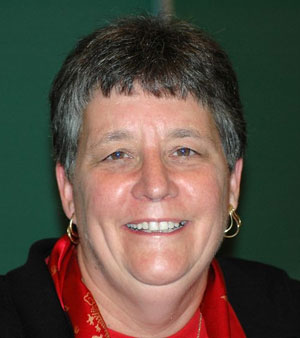
The papal transition underway in Rome is a classic example of patriarchy prancing for the world to see live and in color. It is without a doubt the biggest religious news story thus far in the 21st century, and there is not a woman in sight. Think about that in light of the media coverage. Apart from the many women reporters now in Rome, the players in this story are all men, all the time.

Of course women are seen in the vast crowds that flock to St. Peter’s Square or greeting the helicopter bearing the out-going pope at his new digs at Castel Gandolfo. But there are virtually no women in the big news of the papal transfer save the nuns who were relocated from their convent so that the Pope Emeritus will have a new place to live in his old neighborhood. They are symbolic of the problem I am underscoring, as I doubt they were consulted. Even the Virgin Mary was consulted!

Likewise, the story of the implosion of the patriarchal church (what Elisabeth Schüssler Fiorenza has better called “kyriarchy”[1]) is utterly devoid of women. Whether the Vatican banking scandal, sexual abuse, or episcopal cover-up, this has been a men’s show from the beginning, and they have done a royal job of making a mess.
I do not think women would necessarily have avoided these pitfalls. However, the historical fact is that as far as we know, women were not involved. Therein lies the most obvious place to start looking at this situation from a feminist perspective. Who else isn’t there and why? Young people, married people, out LGBTIQ people, more than a few men of color, the list is endless. Yet no one seems to notice, or if they do notice they do not seem to care. I notice and I care!

The Conclave will start soon. 115 mostly older men will select the successor to the man who named them as cardinal electors (virtually all of the cardinals were named by Benedict XVI or John Paul II for whom Benedict was the shadow pope for several years). Chances are good that the new pope will be even more conservative than the two before him. Perhaps he will be a little more charismatic, or a little better manager, maybe even from a developing country, but the fundamental conservative trajectory is set, not to be undone.

I would guess that he has already been selected. What organization the size of the Roman Catholic Church would be without a succession plan with an 86 year old CEO? I suspect he is already at work despite the many myths and stories of the secrecy and spirituality of the conclave, and now the display of robes in small, medium and large on hand to fit the fellow who is saddled with the impossible job of being pope. The current discussion, as far as I can tell, is really about what team will hold sway. All heads of Vatican offices must resign at the end of a papacy. So there are many personnel matters, i.e. who will have what power, being decided at the official meetings that began in Rome on March 4, 2013.

There are also lots of informal meetings going on constantly as the gentlemen reshuffle the deck. This is a power shift akin to when a Republican defeats a Democrat. There are a lot of careers and plenty of ideology at stake for which the actual pope is but a vivid symbol. The best analogy is electing a U.S. president because of whom s/he will elect to the Supreme Court. Think of how carefully they have to vet all of the players now that Scotland’s Cardinal O’Brien has been brought down by his former lovers. Skeletons in closets do tend to rattle when the stakes are high, and the stakes are high in terms of the power to shape the future direction of this big church.

No matter who is elected, the process is mortally flawed because it represents a model of church that is long out of date. Until and unless structural changes take place to develop a well integrated, representative governing model in which all members of the Catholic community—including women, married/partnered people, young people—are involved there will be no change. Beginning with local base communities and parishes, adult members need to have real decision-making power about personnel, money, property, sacramental, and social justice work. The same goes for dioceses and regions such that increasingly representative bodies make decisions that clerics cannot overrule. This includes people from the poorest most marginalized parts of the world whose well being and dignity ought to be the center of Catholic concern but clearly is not. We who are part of the community expect and demand that we exercise voice, vote, and responsibility in ministry and in governance.

I am not interested in the personal characteristics of a new pope, even in betting on the outcome of the papal horse race. That is the patriarchal frame of the discussion, which I think feminists need to reject. If I respond favoring Cardinal X over Cardinal Y, or if I sketch out the characteristics of a “kinder gentler” pope, then I am conceding that the model is acceptable. It is not.

I am interested in getting rid of the papacy and other trappings of monarchy in favor of a democratic, participatory model of church. Please don’t suggest that I become a Presbyterian. Though some of my best friends are Presbyterians, I am what a Catholic can and should look like in the 21st century. This is the change we need.

Even though my goal of dismantling the kyriarchy is unlikely to hold sway, I want to look at the religious significance of the elite, exclusionary approaches to governance that are playing out on worldwide television and web because they have a shaping influence. I try to forget what I know about all of the inner dealings of the Roman Catholic Church (electing a pope is like watching the law and sausage being made—not a pretty sight) and imagine what those who simply see the spectacle played out on screen think. I suspect that what people see is at once convincing and confusing.

The trope of tradition is very persuasive. Even though the most recent pope resigned and then made up new rules for the conclave that will replace him, most people do not see the clear elasticity of the church. Those in power reserve to themselves such conscience-bound decisions as resigning from the papacy, while women who make choices about their own bodies are labeled sinners. The gentlemen change the conclave rules with the wave of a Motu Proprio (“on his own impulse”) as they call it, but when we lay people decide on our own impulses to use birth control or to love in a same-sex way we are considered sinful.

The smoke and mirrors that the media report on draw people’s attention to mistaken notions of timeless, tradition-bound splendor. It is hard to compete with the costumes—everyone knows about the pope’s red shoes that signify the blood of the martyrs—the music, the buildings, the grounds for what appears to be God’s own realm. People love the quaint notion that the Cardinal electors will be locked away without their smart phones to let the Holy Spirit decide on the pope’s successor. I do not want to offend anyone, but I am realistic enough to think the deal is long done and the pageantry, not unlike the Wizard of Oz, is simply good for business.

What astounds me is why intelligent people, especially those in the media, are not scratching their heads in utter confusion about the whole scene. Shareholders, stakeholders have absolutely no input into the process. Imagine if this kind of election took place in Cuba or in Washington! I would think they would have some critical questions to ask—where are the women, where are the young people, where are more people of color who make up the growing majority in the church? Of a billion people this tiny cadre has all the power? What is wrong with this picture?

A great deal is wrong with it. The worst part, in my view, is the instrumentalization of religion, of people’s faith, to reinscribe and reinforce ways of being and acting as if they were the will of the divine. This is blasphemy. I make no such counter claim that my approach is what God wants. Rather, I assume that human beings can and should organize themselves in ways that reflect their most deeply held values. To see 115 men hold the power in a worldwide community is frightening because of what it means about their sense of the divine. Obviously they think God favors men over women, the few over the many, their privileged information over the sensus fidelium. Where they read this in Christian scripture is not clear. I respectfully disagree and urge us to change the power model as quickly as possible, beginning by withdrawing financial support from the institutional Roman Catholic Church.

There are deep social implications of the world’s largest Christian denomination modeling a monarchical way of being in an increasingly democratic world. Apart from looking ridiculous and offending people at every turn such that the second largest denomination in the US is ex-Catholics, the outcome of this exercise is to reinforce the power of patriarchy. If these men can act with impunity then other corporations can have few if any women in their boardrooms. If this monarchical model is acceptable, than governments do not need to allow their citizens voice and vote. If God wills the outcome of a papal election, then surely God wills wars, ecocide, and other human-made problems. I reject this theology.

It may be imputing too much power to the Roman Catholic Church to say that it shapes people’s worldviews. But there is virtually no other religious body—not Islam, not Judaism, not the World Council of Churches—that will be the focus of such attention, that will be able to foist its narrative on the world for free in the next few weeks. Given the fact that it is misogynist, exclusivist, kyriarchal in every sense of “lordship” over the majority, I think feminists need to reject it while still affirming the underlying fundamental values of love and justice.

Several feminist strategies are important for countering this approach and creating constructive new ways of being church that focus on participation, safety, and accountability. Keep it simple—stop, look, listen—as we say to children when we teach them to cross the street.

STOP the process.
There is no reason that the papacy cannot remain vacant for a time. Church history includes examples of deadlocked conclaves, lengthy meetings that lasted months unto years. Pope Benedict’s own resignation and subsequent change of conclave rules are evidence of the elasticity of customs and laws.

The current situation of the church is grave: sexual abuse and cover-ups, financial problems, loss of trust and transparency, tawdry sexual conduct, and most importantly, the wholesale exclusion of most members of the community, especially women, from decision-making. Given this gravity, the best solution is simply to call off the conclave. The energies and resources saved can be channeled into envisioning and constructing new, more inclusive ways of being church where safety and accountability are paramount.

LOOK at the facts.
Contemplative Catholic spirituality invites “a long loving look at the real.” Despite the pomp and pageantry of the papal transition, institutional Catholicism is in tatters. No amount of white smoke can obscure the corruption and infighting. No Gregorian chant can drown out the cries of those who have been abused. No reading of the Gospel can excuse the oppressive treatment of women and same-sex loving people.

By contrast, small base communities, some parishes, and many religious communities are robust places where sacraments and solidarity are the norm. Groups across the globe work on social justice, education, and health care based on Catholic commitments without institutional connections. The disconnect is profound between hierarchy and laity. Nonetheless, educated, willing, and capable Catholics abound who embrace the responsibility to be church despite the scandalous actions of the leaders.

LISTEN to the Spirit.
Catholics believe that the Holy Spirit infuses the world with grace. Rather than watch a new pope emerge from the delegates who have been handpicked by the previous two popes, it is time for new ways of organizing and governing the more than one billion members of the Catholic community. Contemporary culture of inclusion and participation demands it, and technology makes it possible.

One new model of church would include a team of people from around the world who represent various and sundry national/regional groups, different styles of worship and ministry, various lifestyles and families, religious and secular people. It would be a democratic assembly of equals, a global network of the people of God, who delegate the fruits of their decisions to ministers who carry out the will of the body in teaching and preaching, sacraments and social justice, finances and public witness.

For those who are not Catholic, this is a time to stop worrying about charges of anti-Catholicism and join voices with those of Catholic feminists who cry foul on the process and the product of the upcoming conclave. Those who have no stake in Catholicism can be helpful by asking the obvious questions of who is not included, involved, able to minister, make decisions, and otherwise exercise adult faith. There is no need to settle for the answer, “They do this because they are Catholic,” and be told if it is not your tradition to have no voice.

The stakes, when examined in global terms, are simply too high. If religions shape worldviews, then everyone has the right and responsibility to look critically at it and go about the communal task of creating something better.

Complete Article HERE!

Rome exhibition takes aim at the Church as papal vote looms

By Naomi O’Leary

As cardinals flock to Rome to choose the next pope, two artists have taken the opportunity to stage an exhibition taking aim at the wealth of the Roman Catholic Church and the sex abuse scandals that plagued Pope Benedict.

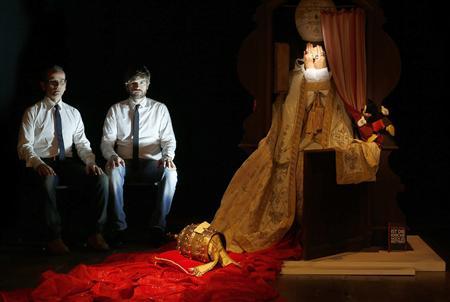
Italian artists Antonio Garullo (L) and Mario Ottocento pose next to their artistic protest in the form of a life-sized statue named “the unspeakable act”, during an exhibition in Rome March 5, 2013. REUTERS/Alessandro Bianchi

Held in an ancient building where Italy’s patron Saint Catherine of Siena died, “The Unspeakable Act” is a life-size model of Benedict in a confessional box, his sumptuous red and cream-coloured robes spread about him.

Installed on the stage of a darkly-lit theatre, the artwork is surrounded by eerie music and a track of Benedict announcing in Latin his decision to resign after eight years topped with the whispering sounds of people confessing their sins.

Benedict’s papal tiara lies on the ground and his bejewelled hands cover his face in apparent horror or shame at a phrase from the Gospel of St. Luke that lies open on his knee: “Let the little children come to me”.

The exhibition is the work of artists Antonio Garullo and Mario Ottocento who became famous for lampooning the scandals of the powerful in 2012 with an exhibit depicting a sleeping Prime Minister Silvio Berlusconi, his hand in his trousers and a satisfied look on his face.

“Too many scandals have been hidden by the Church. Even children were abused in the confessional,” Garullo told Reuters at a preview of the work on Tuesday.

“These jewels and rich clothes contrast with Christ, who was in rags. The Vatican even has a bank, which is hypocrisy.”

A folded paper tucked into the papal tiara represents the ‘Vatileaks’ scandal, when Benedict’s personal butler leaked documents alleging corruption in the Church’s business dealings

The artwork, that opens to the public on Wednesday, has personal importance for Garullo, 48, and Ottocento, 40, an artistic duo for 20 years who were the first Italian gay couple to be married when they wed in Holland in 2002.

Since then they have battled for their union to be recognised by authorities in Italy, which has no legal provision for same-sex couples, although a 2012 survey found 63 percent of Italians support equal rights for gays.

“I don’t understand how the pope could say in one of his last addresses that gay couples are a threat to world peace,” Garullo said. “I don’t understand how we are a threat.”

Their pope statue is surrounded by books by reformist Swiss theologian Hans Kueng and the late Cardinal Carlo Maria Martini, a liberal voice who urged the Church to modernise before his death last year, saying it was “200 years out of date”.

Garullo said the fact that Benedict is ignoring the books is a message to the Church to bring its teaching up to date.

“It shows the Church has remained 200 years in the past, and is not open to the modern world,” Garullo said.

Complete Article HERE!

Sex, power scandals to loom over Vatican pre-vote talks

By Tom Heneghan

The sex and power scandals haunting the Catholic Church look set to play a big role in meetings before next month’s papal election after two senior cardinals called on Tuesday for more internal debate about them.

A leading support group for victims of clerical sexual abuse also made what it called a “last-ditch plea” to Pope Benedict to use his authority before resigning on Thursday to discipline bishops who have protected predatory priests in their dioceses.

The abuse issue took on new urgency after Scotland’s Cardinal Keith O’Brien, accused of improper behaviour with young priests, quit as Edinburgh archbishop on Monday and pulled out of the Sistine Chapel conclave to elect a new pope.

A Scottish Catholic Media Office spokesman has said O’Brien was taking legal advice and contested the “anonymous and non specific” allegations against him.

Cardinal Cormac Murphy-O’Connor, now the only British prelate due to attend pre-conclave talks among cardinals at the Vatican next week, said in London the sexual abuse of children was the most serious scandal in the Church.

“That will be one of the main things the cardinals will be discussing,” said Murphy-O’Connor, who cannot vote because he is over 80 years old but can join the cardinal electors in their closed-door discussions about the challenges for the next pope.

French Cardinal Jean-Louis Tauran said in a newspaper interview that the cardinal electors, who number 115 after O’Brien stepped down, should also be informed about a secret report on Vatican corruption prepared for Pope Benedict.

The retiring pontiff has decided to reserve the report for his successor, but the three cardinals over 80 years old who drew it up will be allowed to inform the cardinal electors about some of its findings during next week’s consultations.

ASKING TO NAME NAMES

“The cardinal electors cannot decide to choose this or that name to vote for if they don’t know the contents of this dossier,” Tauran told La Repubblica newspaper.

“If it’s necessary, I don’t see why they should not ask for names,” said Tauran, a former Vatican foreign minister who now heads its department for interreligious dialogue.

Italian newspapers have been speculating for days about conspiracies and alleged sexual scandals inside the Vatican that may have influenced Benedict to become the first pope in some six centuries to step down rather than die in office.

The Vatican has accused these newspapers of spreading “false and damaging” rumours in an attempt to influence the cardinals who are starting to arrive in Rome for the pope’s farewell meeting with them on Thursday.

Two directors of the United States-based abuse victims’ network SNAP arrived in Rome on Tuesday to draw attention to their demands for tougher Church policies.

“We’re here to make a last ditch plea to Pope Benedict to use the remaining hours of his papacy to take decisive action to protect kids,” said David Clohessy, national director of the Survivors Network of those Abused by Priests.

He acknowledged that Benedict had met some abuse victims and made some strong statements condemning the molestation of minors by priests, but said he only acted under public pressure.

“We long for the day when Church officials announce that this cardinal or this bishop is being demoted because Church officials have found proof of wrongdoing and Church officials want to clean things up,” he told journalists.

SNAP saw no papal candidates ready to fire bishops for shielding wrongdoers, he said, but added: “It’s hard to believe there aren’t some cardinals who are grabbing their colleagues by the lapels and saying ‘We simply have to do better’.”

CATHOLICS CRITICAL OF ABUSE HANDLING

Spanish Cardinal Julian Herranz, one of the three who drew up the secret report for Benedict, echoed the Vatican attack on the media in an interview on Monday with the daily El Pais.

“This wanting to see snake pits, warring mafias, internal hatreds – all this is absolutely false,” he said.

Because conclaves are such secretive events, it is hard to see what effect the heightened public pressure over the abuse issue might have on the cardinals who will elect the next leader of the world’s 1.2 billion Catholics around the globe.

Italian newspapers, which dedicate several pages a day to the papal story, have begun mentioning Cardinal Sean O’Malley as a possible “clean hands” candidate because he was sent to Boston to deal with abuse scandals that erupted there in 2002.

But other factors could lead them to choose a man whose main strengths lie elsewhere, such as an aptitude to promote its “new evangelisation” drive, aimed at rekindling the faith in Europe and boost it in other regions.

Recent polls in two important national churches, in the United States and Germany, show that Catholics give their leaders low marks for their handling of the abuse crisis.

A Pew Forum poll last week showed U.S. Catholics have become increasingly critical, with those saying Benedict has done a poor job rising from 40% in 2008 to 63% now.

A survey in January for the weekly Die Zeit showed that only 28% of German Catholics polled believed the Church really wanted to clean up the mess the scandals have caused.

Complete Article HERE!

Church needs saving from its dysfunctional structure

By DIARMAID MACCULLOCH

The Catholic Church, aka the western church of the Latin rite, trades on tradition. That is what so fascinates many people: the lure of its continuity, the certainty, the serene provision of answers.

Pope Benedict XVI leads his last Angelus prayer before stepping down in Saint Peter's Square at the VaticanAs anyone mildly acquainted with its history will know, this is a series of illusions. Christian history, like all history, is a delicious Smorgasbord of unintended consequences, paradoxes, misunderstandings, sudden veerings in new directions.

If you like to call that the work of the Holy Spirit, then fine, but do note that the Holy Spirit delights in confounding human expectations and going its own way.

The church of Rome, having been around from near the start of the story, illustrates this general truth particularly well. Its prestige derives from possessing the tomb of the Apostle Peter, who probably never visited the city.

This Palestinian fisherman, who would have spoken a version of Aramaic, plus enough street-Greek to make himself understood in the forum, may have been illiterate in either language, but he is represented among the books of the Bible by two elegantly-penned Greek letters written by two different authors – he himself was neither of them.

The current position of the Roman Catholic Church as the largest section of world Christianity depends on a variety of later accidents. One of these – the French Revolution of 1789 – produced the modern papacy. Until then, the pope was one Italian prince among several others.

Certainly he was equipped with a dozen centuries and more of ideological baggage, bulging with his aspirations to be something universal.

But he shared his power in the church inescapably with European Catholic monarchs, prince-bishops of the Holy Roman Empire and a host of other fiercely independent local jurisdictions in cathedrals and the like, all of which were themselves the products of the happenstance of history.

The revolution dealt them a devastating blow. As its consequences unfolded, it swept nearly all away, and the first World War delivered the coup de grace.

To begin with, it looked as if the revolutionaries would do for the pope as well. Poor Pius VI died in a revolutionary prison in France, his death in 1799 being recorded by the local mayor (with chilling Jacobin wit) as that of “Jean Ange Braschi, exercising the profession of pontiff”. But the papacy drew on its historical resources and on revulsion in much of Europe against revolutionary brutality and destructiveness.

It very successfully played the tradition card to create something brand new: a monarchy for the whole western church, which increasingly eliminated competition from rival jurisdictions. The 19th century revival of Catholicism laid the foundations of the rock-star papacy of John Paul II, kissing airport tarmac and thrilling crowds with the force of his exceptional personality.

While popular participation in secular politics has grown throughout Europe and America over two centuries, precisely the reverse has happened in the church of Rome: it has eliminated any wider participation, even that of kings.

The post-revolutionary Vatican remodelled the church across the world, to eliminate independence in church government, local initiative or scholarship.

In Ireland, the process took up the later 19th century, to produce the variety of Catholic Church still easily within the memories of many, embodied by such prelates as the late and widely unlamented John Charles McQuaid.

The reforming work of the second Vatican Council (1962-1965) looked for a moment as if it would roll back this 19th-century innovation, but the curia’s bureaucrats in the Vatican were left to implement council initiatives, and we all know the results of that in the two pontificates of John Paul II and Benedict XVI.

Benedict, arch-traditionalist, expounding even this week a narrative of Vatican II in which nothing much happened at all to the church, has by his resignation set the church on yet another new path.

It is paradoxical but admirable that this sensitive and learned man has recognised the limits of his office. The all-powerful, all-providing papacy constructed after 1789 has simply been too much for any one man to embody, regardless of whether he is frail or old.

The cardinals whom John Paul and Benedict appointed to parrot the myth of enduring tradition will no doubt resist the implications, scrabbling around to find the most convincing representative of the post-French Revolution state of the hierarchy. But it is just possible that the Holy Spirit might seize them afresh.

Wouldn’t it be a wonderful surprise for the Christian world if they reached beyond the conclave and chose someone from beyond their ranks? That’s a big ask at the moment. But look back before the French Revolution, and we can find stories to help the church in framing a more workable version of its future than the present dysfunctional structure.

At the moment, the debate between Catholic “liberals” and “conservatives” is stuck around the second Vatican Council: what happened there? Not much? A lot? Even more than a lot, but frustrated by the Curia? Let’s recognise that the debate is much older than that.

A great many Catholics over the centuries have considered a monarchical papacy a very bad idea: particularly all those monarchs, prince-bishops, cathedral chapters. They constructed coherent theologies out of their convictions.

Historians use labels for these ways of thinking which have become merely pieces of historical jargon: Gallicanism; Cisalpinism; Conciliarism.

It’s a pity that these words now seem off-putting and archaic, because once they were living affirmations that the church’s future should be decided in broader arenas than a few chambers in the Vatican palace.

That future won’t resemble the past – it never does – so I’m not suggesting we restore the Holy Roman Empire, or the heirs of Louis XVI to the French throne. But history has rich resources to offer: showing how they did things in the past, so Catholics can find sensible solutions for what to do next.

In the middle of what any fool can see is a deep crisis in Catholic Church authority, let historians ride to the rescue.

Complete Article HERE!

Leading dissident priest slams covert pope selection process

A leading dissident Austrian priest whose call to disobey some Roman Catholic teachings drew a rebuke from Pope Benedict last year urged Church leaders to throw off their secrecy and canvas churchgoers on who should lead them next.

Rev. Helmut SchuellerRev. Helmut Schueller, head of a group of priests who openly challenge Church positions on taboo topics such as priestly celibacy and ordaining women, said selecting a successor to Benedict was a chance to embrace public debate.

“If things were going well, the conclave fathers would at least be going out to the Church grassroots and calling meetings to really hear what the faithful expect,” he told Reuters in a phone interview on Wednesday.

“I find inappropriate this whole method that the cardinals withdraw into their own circle and something leaks out now and then about who might be under consideration,” said Schueller, whose group is getting increasing attention abroad. “Most of the faithful know hardly anything about these people.”

Some 117 cardinals will enter a closed-door conclave at the Vatican in mid-March to elect a successor to Benedict, who stunned the world’s 1.2 billion Catholics on Monday by saying that he would step down on Feb 28.

There are no open campaigns or declared candidates for the post and cardinals are forbidden by Church law from revealing who they voted for. Many cardinals choose their favourite after a series of discreet contacts in the days before the election.

CODED LANGUAGE

One front-runner is Cardinal Christoph Schoenborn, whose deputy Schueller once was in the Vienna archdiocese. His decision to debate with rather than discipline his dissident priests may count against Schoenborn among hard-line cardinals.

Schueller said such an important decision required all the time and effort needed to form a broad consensus rather than letting a small group of top leaders decide this in secret.

“A billion Catholics are listening to what is (being discussed) in entirely secretive, coded language,” he complained, calling it undignified that the laity hear about the process only from journalists reporting from the Vatican.

“This passive waiting around is repugnant. It’s really time, and commensurate with the dignity of the faithful, that (the cardinals) put their cards on the table,” he said.

Reformist Austrian Catholics have for decades challenged the conservative policies of Benedict and his predecessor Pope John Paul, creating protest movements and advocating changes that the Vatican firmly rejects.

Benedict, who for over two decades before his 2005 election was the Vatican’s chief doctrinal enforcer, singled out the Austrian rebels for criticism last April while restating the church’s ban on women priests.

The German-born pontiff said he would not put up with open revolt from clerics and lay people.

VATICAN RULES UNCHECKED

Schueller said an outsider from Africa or Latin America would have his work cut out for him to take on Vatican insiders.

Two-thirds of today’s Catholics live in Latin America, Africa and Asia and Cardinal Peter Turkson of Ghana and Cardinal Odilo Scherer of Brazil are among those mentioned as candidates.

“The biggest problem is that the Vatican establishment rules unchecked over the global Church. Any pope who takes this on has to be well positioned…has to act strategically and has to get lots of cooperation from the bishops of the world,” he said.

But even support from a broad basis might not be enough for a new pope to put his stamp on the Church, he said.

“What good are (such) authorisations for the pope if the system quickly takes him prisoner? This is coming out more and more in the analyses and may have been a significant factor of the resignation” of Benedict, he said.

Complete Article HERE!

What kind of pope do Roman Catholics need?

By Cristina LH Traina

Selection of the next Pope will factor in a host of complicated variables as wings of the Church compete for ascendancy.

Pope Benedict XVI’s impending resignation has already fuelled all the usual speculation about candidates for his successor, accompanied by profiles, photos and odds of election. Behind the hoopla is the question, what sort of leader will really be best for the Church?

Benedict’s own admission that an elderly man cannot undertake the globe-trotting that effective relations require suggests that as a rule, a younger, healthier leader would be a wise choice. But the Church also faces the question what style of leadership would be most fruitful.

Despite the vision of Vatican Council II, which recommended collegial authority and granted the laity almost complete province over action in the world, Pope John Paul II’s and Pope Benedict XVI’s pontificates have echoed an ultramontane, top-down model in which the authority of the pope supersedes that of the bishops, individually or in national organisations.

History of papal power

Vatican I ratified the ultramontane model in an era in which the Roman Catholic Church felt besieged on all sides. The Church had just lost the Papal States and suffered long periods of anti-clericalism and persecution in Europe. The Council responded by absolutising the popes’ control over the one thing left to them: the Church. Over the next 50 years, popes declared a single standard of orthodoxy (the works of Thomas Aquinas) and published – and enforced – laundry lists of anathematised philosophical and political beliefs.

In earlier periods, strong central control could not be realised so easily in practice, except in cases like the Inquisition in which civil power could be conscripted. But when travel took place on foot, by horse, or by sailing ship, and all communications were carried by letter, people had to choose carefully what information to send up and down the chain of the hierarchy. Practices varied, and many “irregularities” simply went uncommented.

Flash forward to the present day, and ultramontanism becomes a little less forgiving. Photos, news reports and blog posts make their way across oceans in seconds or less. Not only does Rome have theoretical authority over every Catholic person and organisation, it has actual access to real-time information about them. This is not to belittle the silencings, excommunications, and even executions of earlier eras, or to overlook the inefficient contemporary Vatican bureaucracy, in which branches famously work at cross purposes. But strong central control combined with instant communication from every layer of the church in every corner of the world creates unprecedented micro-managerial possibilities.

Contemporary contradictions

Cue the debate over the next pope. So-called “conservative” Catholics will be cheering for a candidate who POPEX390continues Benedict’s line of strong Catholic identity. Conservatives, so the stereotype goes, will want a firm hand guiding a centralised, top-down hierarchy capable of overseeing of theology and charitable work all over the world. The ultramontane trend confirmed at Vatican I, and alive and well in the CEO model of the papacy, is their ideal.

A look back at Pope Benedict XVI’s career

In contrast, conventional wisdom says that so-called “liberal” Catholics will be hoping for a candidate who, like John XXIII 50 years ago, might surprise the world by changing direction. Liberals will want a decentralised, participatory structure that places most power in the hands of national bishops’ conferences, in collaboration with the laity. On this view, popes are good for inspiration, pastoral care and ecumenical diplomacy but too far removed from the local details of daily life to rule sensitively on regional questions.

Recent events seem to reinforce these stereotypes. Liberal Catholics took it amiss when the Congregation for the Doctrine of the Faith (CDF) undertook a comprehensive review of the Leadership Conference of Women Religious, the largest organisation of Catholic women major superiors. The CDF judged that rampant “radical feminism”, dissent and collaboration with questionable social justice organisations needed correction, and it appointed Seattle Archbishop Peter Sartain to oversee the “renewal” of the organisation.

Liberals viewed this as an attempt to silence the most educated and independent branch of American women religious. Conservatives held up the smaller Council of Major Superiors of Women Religious, which was not investigated, as an example of fidelity and obedience.

Similarly, when Benedict blocked Lesley Anne Knight’s run for a second term as director of the Catholic umbrella organisation Caritas Internationalis and issued his motu proprio on preserving the Catholic identity of Catholic charities, liberals fretted over Catholic groups’ losses of funds and of opportunities for collaboration with independent non-profits. Conservatives, on the other hand, heralded the increased oversight as an overdue means of ensuring the purity of Catholic teaching and of income streams.

The important exception seems to be the clerical sex abuse crisis. Here organs associated with American liberal Catholicism – Voice of the Faithful, The Survivors Network of those Abused by Priests, Call to Action, BishopAccountability.org, the National Catholic Reporter and others – have echoed conservatives in demanding authoritative, decisive action from the Vatican against bishops who facilitated and hid priestly sexual abuse. Catholics in Ireland and much of Europe, not to mention other parts of the world, have joined them in this demand.

Demand for clerical accountability

And here’s the contradiction. Catholics may not be able to have their cake and eat it too. Some conservative laypeople have laid aside ultramontanism to join the liberal demand for clerical accountability to laypeople, and liberals have joined the conservative chorus requesting action from Rome. Only a tough, centralised hierarchy that monitors all of its outposts carefully can take the strong action against bishops that liberal Catholics seek. A truly collegial model – perhaps a federation of strong national churches with a single spiritual leader, as in the Anglican Communion – would yield more adaptability at the local level but would not have the central power to depose transgressing bishops.

Thus liberal Catholics face a quandary. A pope strong and authoritative enough to purge transgressing bishops is likely to use his power as well to purge liberal theologians, nuns and clergy. A pope who opts for a collegial style more in keeping with Vatican Council II’s precedent will have to rely on his fellow bishops to monitor each other, something they have so far shown little willingness to do.

Conservatives face a similar quandary. What will ensure that the strong hierarchy they envision protects laypeople from clerical transgressions?

There is a third option, of course. If the Catholic Church had structures of accountability that operated from below rather than from above, it would not need to rely on benevolent ultramontanism to get rid of destructive bishops. The next pope could undermine the Vatican’s managerial authority even more radically by insisting that bishops share power collegially with priests, vowed religious and laypeople, and by instituting term limits for bishops like those observed by many Protestant communions. Benedict XVI’s resignation could be the precedent. Stranger things have happened.

Complete Article HERE!