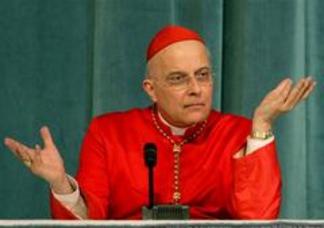
Cardinal Carlo Martini says Church ‘200 years behind’

Italian Cardinal Carlo Maria Martini has described the Roman Catholic Church as being “200 years behind” the times.

The cardinal died on Friday, aged 85.

Italian newspaper Corriere della Sera has published his last interview, recorded in August, in which he said: “The Church is tired… our prayer rooms are empty.”

Martini, once tipped as a future pope, urged the Church to recognise its errors and to embark on a radical path of change, beginning with the Pope.

Cardinal Martini
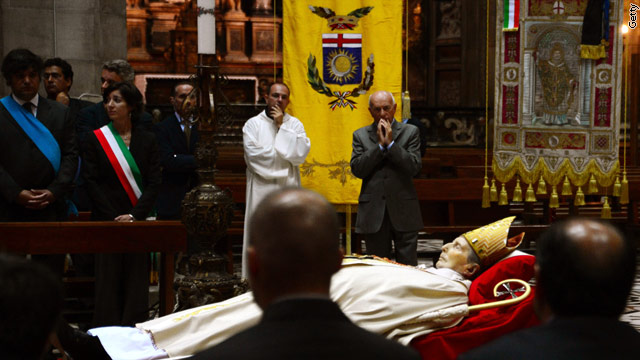
Thousands of people have been filing past his coffin at Milan’s cathedral, where he was archbishop for more than 20 years.

The cardinal, who had retired from the post in 2002, suffering from Parkinson’s Disease, is to be buried on Monday.

‘Old culture’

Martini, a popular figure with liberal stances on many issues, commanded great respect from both Pope John Paul II and his successor Pope Benedict XVI.

The cardinal – a member of the Jesuit religious order – was often critical in his writings and comments on Church teaching, says the BBC’s David Willey in Rome.

He was a courageous and outspoken figure during the years he headed Europe’s largest Catholic diocese, our correspondent says.

Cardinal Martini gave his last interview to a fellow Jesuit priest, Georg Sporschill, and to a journalist at the beginning of August when he knew his death was approaching.

The cardinal had returned to Italy from Jerusalem, where he had settled on retirement in 2002 to continue his biblical studies.

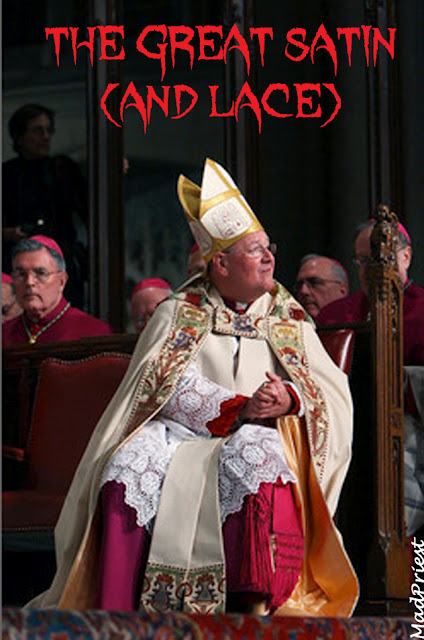
Catholics lacked confidence in the Church, he said in the interview. “Our culture has grown old, our churches are big and empty and the church bureaucracy rises up, our religious rites and the vestments we wear are pompous.”

Unless the Church adopted a more generous attitude towards divorced persons, it will lose the allegiance of future generations, the cardinal added. The question, he said, is not whether divorced couples can receive holy communion, but how the Church can help complex family situations.

And the advice he leaves behind to conquer the tiredness of the Church was a “radical transformation, beginning with the Pope and his bishops”.

“The child sex scandals oblige us to undertake a journey of transformation,” Cardinal Martini says, referring to the child sex abuse that has rocked the Catholic Church in the past few years.

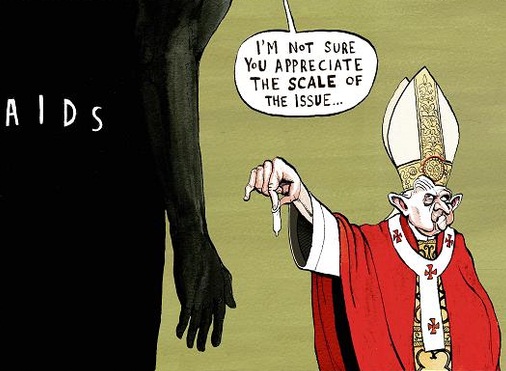
He was not afraid, our correspondent adds, to speak his mind on matters that the Vatican sometimes considered taboo, including the use of condoms to fight Aids and the role of women in the Church.

In 2008, for example, he criticised the Church’s prohibition of birth control, saying the stance had likely driven many faithful away, and publicly stated in 2006 that condoms could “in some situations, be a lesser evil”.

Complete Article HERE!

Archbishop Nienstedt’s latest marriage-amendment letter adds to Catholic turmoil

On Sunday, priests in a number of Twin Cities Roman Catholic parishes read a letter from Archbishop John Nienstedt re-stating the church’s support for the proposed constitutional amendment to ban same-sex marriage.

On Monday, Michael Bayly, the director of Catholics for Marriage Equality, noticed a spike in requests for the group’s lawn signs, which read, “Another Catholic Voting No.”

Some of the people who stopped by his south Minneapolis office to pick them up told him people had walked out of their churches during the reading. A parishioner at the nearby Church of the Annunciation said half a dozen left her service.

On Thursday, the Archdiocese of St. Paul and Minneapolis’s official publication, the Catholic Spirit, carried the text of the letter.

Meanwhile, the Facebook site “I am Catholic. I am Voting NO!” acquired a list of parishes where the letter was not read. The most prominent of the 17 churches listed: Minneapolis’ Basilica of St. Mary.

In the letter, Nienstedt asserts that the purpose of the ballot initiative has been misconstrued. “Our effort to support God’s unchanging plan for marriage is not a campaign against anyone, but rather a positive effort to promote the truth about marriage as a union between one man and one woman,” he writes.

“But the reality is that marriage is not ours to redefine, just as another human life is not ours to take,” the archbishop continues. “God is both the author of life and the author of marriage. It is this most fundamental understanding of the natural order that animates who we are as Catholics. … It is also why we fight to defend God’s plan for marriage, because his providence is as clear for what marriage is as it is for the dignity of each human life. …

“Now, Minnesota for Marriage needs your help to get the message out. We must ensure that Minnesotans know what is at stake and have the correct information about why they should vote ‘Yes’ for the marriage amendment. (Remember that if you leave the ballot box blank, the government votes ‘No’ for you!).”

The Archdiocese did not return calls seeking comment Thursday.

Bayly hears something different. “He seems to have softened his language about gay people,” he said, referring to Nienstedt. “They must have realized they’ve alienated people.”

“We know that some who are seeking to redefine marriage experience same-sex attractions,” the letter reads. “Our brothers and sisters living with same-sex attraction are beloved children of God who must be accepted with respect, compassion and sensitivity.

“Every sign of unjust discrimination in this regard must be avoided. People with same-sex attractions, like others in society, are productive citizens, community servants, good friends and our beloved family members.

“At the same time, however, it is important to know that the effort to ensure that the definition of marriage remains as between one man and one woman does not take away anyone’s existing rights or legal protections. As Catholics, we believe that all people should be able to visit loved ones in the hospital, pass on their property to whomever they choose and have access to employment, housing and the basic necessities of life. Saying ‘yes’ to God’s plan for marriage will not change any of this.”

In recent months, Catholics who either plainly disagree with the church’s stance on marriage rights for gays and lesbians or who are wrestling with their consciences have been increasingly visible. The conflicted parishioners have organized everything from informational meetings in borrowed, non-Catholic churches to vigils outside the Chancery.

Many were offended by Nienstedt’s decision to take a very active role in the campaign for the amendment. To date, Minnesota Catholic churches and groups have given $1 million to the vote-yes effort.

Others have been unhappy with statements that put their love for their church in opposition to their love for LGBT relatives and friends. One example: A letter Nienstedt penned for the Catholic Spirit soon after his 2007 ascension in which he warned that those “who actively encourage or promote homosexual acts … formally cooperate in a grave evil, and … are guilty of mortal sin.”

Still others were upset that in the run-up to the 2010 gubernatorial contest, Nienstedt distributed 400,000 DVDs, paid for by an anonymous donor and by the Knights of Columbus, urging Catholics to vote for the only candidate in the race opposed to same-sex marriage, Tom Emmer.

“That language and that approach has clearly been ditched,” said Bayly. Still, he added, “The fact that they can’t bring themselves to talk about gay people or lesbian people is offensive.”

The divide has put the church in the headlines numerous times in recent months. In late July, newspapers reported that Minnesota Secretary of State Mark Ritchie, himself the topic of amendment-related news stories, had been invited to speak at St. Joan of Arc Church in Minneapolis. Later stories reported that he was subsequently uninvited and then that his appearance had been postponed.

At the same time, some members of a group of 102 former priests that signed on to a statement opposing the amendment have disagreed publicly with the church’s depiction of its teachings.

“That conscience must rule is consistent with what all of us former priests learned in seminary,” Ed Kohler wrote in a letter published earlier this month in the Pioneer Press. “That conscience must rule is also consistent with the current Pope Benedict XVI — who taught, while still Father Joseph Ratzinger, that ‘Over the pope as the expression of the binding claim of ecclesiastical authority, there still stands one’s own conscience, which must be obeyed before all else, even if necessary against the requirements of ecclesiastical authority.’”

One active priest, Bob Pierson, told some 200 Catholics at an event in Edina that they can vote against a proposal to amend the Minnesota Constitution to ban gay marriage. Bayly and several other members of Catholics for Marriage Equality say they have been told the Archdiocese has ordered Pierson to stay silent on the issue from now on.

“There are groups of Catholics who are hungry for alternative perspectives on this,” Bayly said. “I’ve got a pretty well-full September of speaking engagements around the state.”

Complete Article HERE!

Catholic priest faces excommunication after launching new parish

A Milwaukee-area Catholic priest sanctioned this year for indirectly violating the seal of the confessional now faces excommunication after launching a new parish with a breakaway diocese a few miles away.

Father David Verhasselt, once a popular priest at St. Catherine of Alexandria Parish in Oconomowoc, was named pastor this month at the newly founded Holy Name of Jesus Evangelical Catholic Church in nearby Ashippun, taking at least some of his former parishioners with him.

The Archdiocese of Milwaukee said Verhasselt will be given an opportunity to reverse his decision and would incur “immediate excommunication” if he does not.

Verhasselt has declined repeated requests to be interviewed. But the Chicago-based Evangelical Catholic Diocese of the Northwest said he withdrew from the Roman Catholic Church in accordance with canon law.

“For the record, the Roman Catholic Church cannot declare a former member of its body ‘excommunicated’ after the fact,” it said in an email to the Journal Sentinel. “We are currently residing within the 21st century.”

Verhasselt’s departure is forcing a gut-wrenching decision for at least some of his former parishioners, many of whom still believe he was unjustly accused of breaching the confessional. Do they stay at St. Catherine’s or follow Verhasselt to his new spiritual home outside the Roman Catholic Church?

“I’m on the fence. I’ve been Roman Catholic and gone to church all my life. But I also love Father Dave,” said June Sawant.

“He’s the most wonderful man, so kind, so caring . . . he was born to be a priest.”

Those who follow a schismatic priest could face excommunication themselves, depending on the circumstances, according to canon lawyers. But that is unlikely to occur without a clear warning from the archbishop, said Father James Connell, a canon lawyer and former vice chancellor of the archdiocese.

No such warning has been issued.

Excommunication bars one from receiving the sacraments; it does not strip one of membership in the church, according to Connell.

“And the door remains open to repentance,” he said. “There is always the hope that they will return.”

Verhasselt had been on leave from St. Catherine’s since April 2010 after allegedly violating the seal of confessional, a charge many of his supporters believed was trumped up as the result of an ongoing feud with a priest in another parish.

Milwaukee Archbishop Jerome Listecki found Verhasselt guilty in March of an “indirect” violation – betraying the sin, but not necessarily the sinner – and sentenced him to a year of prayer and penance.

Verhasselt’s appeal to the Vatican’s Congregation for the Doctrine of the Faith was pending when he resigned to join the Chicago-based Evangelical Catholic Church, a small, dissident denomination not in communion with Rome.

Founded in 1995, the Evangelical Church has 17 parishes or missions in the United States and Ireland, according to spokesman Bill Morton.

It bills itself as “a welcoming community of faith rooted in the Catholic tradition,” but it breaks with Rome in key areas, including ordaining women, allowing married and gay clergy, and in offering the sacrament of marriage to same-sex couples.

Morton said Northwest Diocese Bishop James Wilkowski reviewed the documents involving the charges against Verhasselt and found no evidence of a breach.

Wilkowski presided over an Aug. 4 Mass in which Verhasselt professed his faith in his new denomination, and he is expected to complete the process of incardination by the end of the year.

Complete Article HERE!

“An unholy mess”

That’s what an in-depth, investigative piece in the Economist called the state of finances in the Catholic Church in America: an unholy mess.

It’s hard to decide what is most horrifying in this report of financial mismanagement, which looks at data made public through bankruptcy proceedings in several dioceses:

  • Some dioceses have raided priests’ pension funds to pay for sexual abuse damages and other costs. Under Cardinal Bernard Law, the archdiocese of Boston contributed nothing to its clergy retirement fund between 1986 and 2002, despite receiving an estimated $70 million to $90 million in Easter and Christmas offerings that many parishioners believed would benefit retired priests.
  • The same is true for parish savings. A parish in Wilmington, Del., sent $1 million to be deposited in what it thought was a separate account, but was really a pooled, general cash account for the diocese. The parish lost the money when the diocese struck a sexual-abuse settlement.
  • Cardinal Dolan and other New York bishops are spending an estimated $100,000 a year to well over $1 million, sources say, on lobbying the state assembly to prevent an extension of the statute of limitations on sexual abuse, which would result in more lawsuits and more dioceses declaring bankruptcy.
  • Creditors in the Archdiocese of Milwaukee bankruptcy case have questioned the motives behind a $35 million transfer to a trust and a $55.6 million transfer from archdiocese coffers to a fund for cemeteries, alleging the movement of such large amounts was a fraudulent attempt to shield cash from sexual-abuse victims.
  • Dioceses in bankruptcy are required to enlarge their assets to satisfy their creditors, yet some have tried to shrink the size of their assets, by closing parishes or undervaluing property. The Diocese of San Diego listed the value of a whole city block in downtown San Diego at $40,000, the price at which it had been acquired in the 1940s, rather than the the current market value, as required.
  • The church is going into debt to pay its bills, with tax-free municipal bonds, a subsidy more commonly associated with local governments and public-sector projects. State and local authorities have issued municipal bonds for the benefit of at least 50 dioceses in almost 30 states. In California, at least $12 billion has been raised through municipal bonds over the past decade, $9 billion of which went to hospitals.
  • Estimated spending by the church and entities owned by the church was around $170 billion in 2010, only 6% of that for parish and diocesan operations and 2.7% of it for charitable activities. The majority, 57%, is on health care networks, followed by 28% on colleges.
  • Catholic Charities USA and its subsidiaries employ distributed $4.7 billion to the poor in 2010, of which 62% came from local, state and federal government agencies.

Similar financial mismanagement was reported in “Render Unto Rome: The Secret Life of Money in the Catholic Church” by Jason Berry, who was quoted in the Economist article. It’s why more and more Catholics are considering whether this is an institution worthy of their donations.

Complete Article HERE!

Seattle marchers show support for activist nuns

Over the years, Patricia Patterson thought about joining protest marches in support of women’s rights or against war. But the cause that finally got her to take to the streets was nuns.

“It baffles me that a group of women who are among the … most compassionate are being, frankly, picked on by the Vatican,” Patterson said Sunday. She joined a throng of nearly 500 people who marched in support of the nuns’ group recently rebuked by the Catholic Church for promoting “radical feminist themes” at odds with official doctrine.

Patterson carried a picture of her aunt, a nun who had a major influence on her life. Other marchers carried flowers and sang hymns as they walked from Volunteer Park on Capitol Hill to St. James Cathedral, seat of the Archdiocese of Seattle.

But Seattle Archbishop J. Peter Sartain wasn’t home. He was in St. Louis for meetings with the Leadership Conference of Women Religious, an umbrella group that includes about 80 percent of women’s religious orders in the United States.

The Vatican put Sartain in charge of revamping the Leadership Conference to bring its practices more in line with Catholic orthodoxy.

After a four-day conference that concluded Friday, the nuns agreed to talk with Sartain but said they would not “compromise the integrity” of their mission.

Sartain praised the nuns’ work and contributions in a statement issued Saturday. “They deserve our respect, our support, our thanks and our prayers,” he wrote. He said he is committed to working with the Leadership Council in “atmosphere of prayer and respectful dialogue.”

Sister Cathy Beckley, who was cheered as she dashed back and forth in her red baseball cap, said the Vatican’s attack was hurtful to women who have devoted their lives to caring for people on society’s fringes.

In a report issued in April, Catholic Church officials chided the nuns and sisters for resisting some church teachings, including those that prohibit birth control and same-sex relationships.

Beckley, a Seattle social worker and member of the Sisters of the Holy Names of Jesus and Mary, said that when she worked on the streets with the poor and homeless, she never asked about their private lives.

Sunday’s turnout gave her hope that many Catholics agree with the sisters’ approach and value their service. “Clearly, a very significant segment of the church here in the U.S. and around the world is more progressive.”

Among their causes, the sisters of the Leadership Conference mounted a “Nuns on the Bus” tour this summer opposing cuts in federal spending for social and health services proposed by Wisconsin Rep. Paul Ryan — now running mate to Republican presidential candidate Mitt Romney. Catholic bishops also echoed those concerns.

Beyond politics, the split between the sisters and the Vatican reflects the struggle between Catholics who want the church to adapt to modern realities — such as the fact that the vast majority of Catholic women in America use birth control — and those who seek a more traditional path, several marchers said.

Christy Higgins, of Seattle, was a youngster in Catholic school when the Vatican II changes were adopted in the 1960s. She recalls her teachers trading their habits for street clothes, and she embraced the more open and inclusive outlook.

“The church is all of us, not just the Vatican, the bishops and the cardinals,” Higgins said, her shirt pinned with more than a dozen “I Stand with the Sisters” buttons.

The slogan is also the name of the Seattle group that organized Sunday’s march. “We were so upset about how the church hierarchy is treating the sisters,” said Gretchen Gundrum, a co-founder.

It’s easy for ivory-tower leaders — all of whom are men — to discount the hard decisions people face in their day-to-day lives, Gundrum said. “The nuns see the complexity. Morality is not black-and-white, no matter what somebody says.”

The same tensions have always been present in the Catholic Church, Gundrum added. Church leaders denounced Galileo for claiming the Earth revolves around the sun. They finally admitted he was right — nearly 400 years later.

“Our group hopes to shorten the amount of time it takes for them to come around,” Gundrum said.

Complete Article HERE!

Bishop Patricia Fresen on Excommunication to Ordination

Imprisoned for breaking apartheid law, excommunicated for breaking Vatican law, Bishop Patricia Fresen looks more sweet grandma than warrior ​— ​especially carrying the stuffed black sheep she presents with a smile: “We’re the black sheep of the church,” she said.

She’s no stranger to working the outskirts.

Raised “a proper white South African,” Fresen was stunned upon entering her convent after matriculation (and years of segregation), greeted by 55 women ​— ​15 of them black. “I didn’t know it would be racially mixed,” she says now. “It never occurred to me. But I became colorblind.”

That journey would prove significant. After university, Fresen ​— ​in Santa Barbara last week to teach a workshop at La Casa de Maria ​—  worked in the city of Welkom as principal of a school for whites. But by the 1970s, Fresen remembered she and her fellow Dominicans began thinking, “Something’s wrong; we can’t go on like this.”

Apartheid was law by then, but a debate — ​that would prove a theme of Fresen’s life ​— ​ensued. On one side were those who said they couldn’t change apartheid: “The law must change first,” Fresen recounted. She said the others believed, “We mustn’t follow an unjust law; we must follow our conscience.” Their bishop, Denis Hurley, agreed with the latter group. It was risky and illegal, but he believed breaking the law was the only way it would change.

Essentially ignored by the police, they had some wiggle room to plot. Bishop Hurley challenged the principals to bring black students into their schools. They spent a year preparing ​— ​ensuring white students’ families were comfortable, reaching out to black families, teaching black children English ​— ​all while keeping it out of the papers to hold trouble at bay, relying instead on the African drum to spread the word.

On the first day of school, Fresen was overcome watching the children ​— ​black, white, all in the same uniform ​— ​streaming in. But before the goosebumps could dissolve, the hairs on the back of her neck stood up: She heard the stomping of police boots approaching her office. They gave her a week to get in line.

One week later, they took her to prison. Not one child was sent away; today the school is flourishing.

Years later, after receiving her doctorate in theology in Rome, Fresen began teaching seminary ​— ​teaching men to be priests ​— ​in Pretoria. And a longing to be a Catholic priest herself began to nag. She shushed it as best she could, telling herself, “Don’t be stupid.”

In 2002, while teaching at Johannesburg’s Catholic university, she heard about the Danube Seven ​— ​seven women who were ordained Catholic priests on Germany’s Danube river. Two months later, fate intervened: Fresen was sent to Germany for a weeklong course. She spent a day with two of those women; they asked if she felt called to the priesthood. She said yes. They rendezvoused in Barcelona on August 7, 2003 (nine years to the day of our interview); Fresen was ordained.

And then, all hell broke loose. Her parish phoned the Vatican; the cardinal ordered her to recant. Or, he said, leave.

Heartbroken and staggered, she left. She lost her job, her congregation, her family, and moved to Germany.

Since then, she’s found a home, a community. She’s been ordained bishop (by proper apostolic succession ​— ​which means sympathetic male bishops are ordaining women, at great personal risk), ordains women, performs sacraments, and leads workshops.

She’s also been excommunicated. While in St. Louis performing an ordination (in a borrowed sacred space where these clandestine events take place: this time a Jewish synagogue), Cardinal Raymond Burke sent a cadre of “spies,” with cameras. (He followed up, excommunicating any identifiable participants.) Someone handed Fresen an envelope (she thought it might be a check): inside, a summons. She ignored it. Three weeks later, the mail carrier delivered an official decree of excommunication, “with my name beautifully written,” she says, eyes shining.

Burke was promoted.

As for the big question ​— ​why stay? ​— ​Fresen says she believes there are two churches: the hierarchy and the people. She believes the people, the ones who want reform ​— ​the separation of celibacy and priesthood, the ordination of women ​— ​are reaching a critical mass. And this: “If I left, nothing would change. The hierarchy would take no more notice of us. We can only make change if we stay, so we are not going away.”

Complete Article HERE!

Rainbow Sash Movement challenges San Francisco New Archbishop on Bigotry

Press Release

Rainbow Sash Movement challenges San Francisco New Archbishop on Bigotry

Bishop Cordileone has been appointed the next Archbishop elect of San Francisco. The sad situation at Most Holy Redeemer parish only emphasizes how deeply homophobia is ingrained in the culture of the Church. The Cathedral of Saint Mary of the Assumption will be the stage for all the world to see how the Church celebrates in a public fashion this culture of homophobia on October 4, 2012. The Archbishop’s instillation will be used as another launching pad to promote hate directed at the San Francisco LGBT Community,the national LGBT Community and women. The sad reality about this appointment is how far you can get in the church by promoting a closet mentality and hate of women. Integrity will apparently have no place at Bishop Cordileone’s Cathedral Eucharistic table.

People of good will and reason will understand this liturgical service for what it is, and will respond appropriately and non violently. The Rainbow Sash Movement (LGBT Catholics) is inviting San Francisco’s Drag Community, and the Catholic women’s community to stand with us both outside and inside the Cathedral as we witness this betrayal of the Church’s Social Justice Ministry at the installation ceremony at the Cathedral. The dignity of the human person apparently has more to do the with clothing you wear, the medication you use for family planning, and what gender you are than your relationship with God.

As we approach the 50th anniversary of Vatican II the Cathedral clergy and staff should hang their heads in shame over the part they are playing in the demise of Catholic Social Justice. Because justice will not flow from this installation of bigotry at the Cathedral it will not be a valid liturgy, and therefore will not be bound by the norms that guide the liturgical celebration. We will come to witness this abuse of Christ love for all people.

Contact Person:

Bill O’Connor
Rainbow Sash Movement

The Pope drops Catholic ban on condoms in historic shift

I wrote about this very thing in Part 4 of my five-part series on Catholic Moral Theology. Look for it —> Seismic Shift.

The Pope has signalled a historic shift in the position of the Roman Catholic Church by saying condoms can be morally justified.

After decades of fierce opposition to the use of all contraception, the Pontiff has ended the Church’s absolute ban on the use of condoms.

He said it was acceptable to use a prophylactic when the sole intention was to “reduce the risk of infection” from Aids.

While he restated the Catholic Church’s staunch objections to contraception because it believes that it interferes with the creation of life, he argued that using a condom to preserve life and avoid death could be a responsible act – even outside marriage.

Asked whether “the Catholic Church is not fundamentally against the use of condoms,” he replied: “It of course does not see it as a real and moral solution. In certain cases, where the intention is to reduce the risk of infection, it can nevertheless be a first step on the way to another, more humane sexuality.”

He stressed that abstinence was the best policy in fighting the disease but in some circumstances it was better for a condom to be used if it protected human life.

“There may be justified individual cases, for example when a male prostitute uses a condom, where this can be … a first bit of responsibility, to redevelop the understanding that not everything is permitted and that one may not do everything one wishes.

“But it is not the proper way to deal with the horror of HIV infection.”

The announcement is in a book to be published by the Vatican this week based on the first face-to-face interview given by a pope.

In the interview, he admits he was stunned by the sex abuse scandal that has engulfed the Catholic Church and raises the possibility of the circumstances under which he would consider resigning. The 83-year-old Pontiff says in passages published exclusively in The Sunday Telegraph today that he is aware his “forces are diminishing”.

However, he appears determined to fight for the place of faith in the public domain.

His language in attacking the use of recreational drugs in the West and its impact on the rest of the world is particularly striking.

He describes drug trafficking as an “evil monster” that stems from the “boredom and the false freedom of the Western world”. Most significant, however, are his comments on condoms, which represent the first official relaxation in the Church’s attitude on the issue after rising calls for the Vatican to adopt a more practical approach to stopping the spread of HIV.

The Pope’s ruling is aimed specifically at stopping people infecting their partners, particularly in Africa where the disease is most prevalent.

However, it will inevitably be seized upon by liberal Catholics in Britain who oppose the Church’s stance against contraception.

High profile Catholics such as Cherie Blair have stated publicly that they use birth control.

The Pope’s comments are surprising because he caused controversy last year by suggesting that condom use could actually worsen the problem of Aids in Africa.

He described the epidemic in the continent as “a tragedy that cannot be overcome by money alone, that cannot be overcome through the distribution of condoms, which even aggravates the problems”.

The Vatican amended an official version of the remarks to indicate that he said merely that condoms “risk” aggravating the problem.

However, there have been growing calls for the Church to clarify its position.

Theologians suggest that condoms are not a contraceptive if they are intended to prevent death rather than avoid life.

The Pope’s comments in the book, Light of the World, are likely to be welcomed by Catholic leaders in the West who have struggled to explain its current teaching.

Asked last year whether a married Catholic couple should use condoms where one of them had Aids, Archbishop Vincent Nichols, head of the Church in England and Wales, disclosed the confusion over the issue. “Obviously that’s a sensitive point and obviously there are different views on that,” he said.

Hardline Catholics are likely to be surprised and dismayed by the Pope’s comments as they argue that condoms can be used only as contraceptives.

There has been great anticipation before the book’s release, heightened by its author, Peter Seewald, who said in a teasing comment that it could be “a big sensation”.

“It is the first time that a Pope gives an account of himself in this form,” he said.
“It is the first personal interview with a pope in the Church’s history.”

The Pope gives his most personal account of the distress caused to him by the clerical sex abuse scandal, with particular reference to Germany and Ireland.

He says: “It was really almost like the crater of a volcano, out of which suddenly a tremendous cloud of filth came, darkening and soiling everything, so that above all the priesthood suddenly seemed to be a place of shame and every priest was under the suspicion of being one like that too.” He did not consider resigning over the crisis but does raise the possibility of a pope resigning if he were to lose his mental capacities.

“If a Pope clearly realises that he is no longer phys-ically, psychologically, and spiritually capable of handling the duties of his office, then he has a right and, under some circumstances, also an obligation to resign.” He tells of the last time he saw Pope John Paul II, his predecessor; talks of his reluctance to be Pontiff; and speaks of his increasing frailty.

“I had been so sure that this office was not my calling, but that God would now grant me some peace and quiet after strenuous years,” he says. While the Pope stresses the importance of dialogue with Islam, he nevertheless says the religion needs to “clarify … its relation to violence” and suggests it can be intolerant.

The Pontiff is highly critical of the “craving for happiness” in the West.

“I believe we do not always have an adequate idea of the power of this serpent of drug trafficking and consumption that spans the globe,” he says.

“It destroys youth, it destroys families, it leads to violence and endangers the future of entire nations.

“This, too, is one of the terrible responsibilities of the West: that it uses drugs and that it thereby creates countries that have to supply it, which in the end exhausts and destroys them.”

He continues: “A craving for happiness has developed that cannot content itself with things as they are.”

Talking about sex tourism, he says: “The destructive processes at work in that are extraordinary and are born from the arrogance and the boredom and the false freedom of the Western world.”

Complete Article HERE!

Drag Queens Prohibited at Most Holy Redeemer Parish

Nice goin’ (Archbishop) Sal; piss of the drag queens first thing out the gate.

A local gay recovery group will not be holding its annual fall fundraiser in the social hall of the Castro neighborhood’s Most Holy Redeemer Catholic Church after officials said that no drag queens would be allowed.

For the past couple of years the Castro Country Club has held its event in the church’s social hall and had drag queens as entertainment.

As a statement issued by the country club’s board of directors explained, the new no-drag-queen policy at the church is simply unacceptable.

“The Castro Country Club had planned to hold our third annual Harvest Feast on October 20, 2012, at Most Holy Redeemer Church, where we have held this and other events in the past,” the directors said in a statement.

But that changed when the club was notified by the church last week that they would not be able to hold the dinner if any drag queens were part of the program, the board said.

“In previous years, we have had Ivy Drip and Heklina, both well-known entertainers and community fundraisers, serve as emcees of the event, and we felt we could not in good conscience abide by the church’s new policy,” the board said.

“It is our organization’s policy to be inclusive and welcoming to all. Drag queens are no exception. We are currently seeking an alternative venue for the Harvest Feast, which provides an important source of revenue for our annual budget,” the board added.

Individual members of the country club declined to comment and referred to the board’s statement.

Most Holy Redeemer’s new pastor, the Reverend Brian Costello, confirmed over telephone on Monday, August 6, that drag queen performers and emcees are no longer permitted to participate in events at the church.
Costello said that during a telephone conversation with a Castro Country Club representative, when the topic of drag queens came up, he told the person, “That is not going to work under the present circumstances.”

“I said work with me. You can still have the dinner. You can have a regular emcee, but not drag queens on church property,” Costello said.

New leadership
It seems the directive is the result of several factors.

“I am the new pastor,” Costello added. “There is a new archbishop. The archdiocese told me straight out, ‘No drag queens.’”

The change of policy at Most Holy Redeemer was greeted with charges of discrimination, homophobia, and calls for compromise, even reconciliation.

“It’s really ridiculous and discriminatory,” said Zachary Davenport in a phone interview. “I mean it’s like, who’s next?”

Most Holy Redeemer Catholic Church in the Castro has banned drag queens, forcing the Castro Country Club to find a new venue for its fall fundraiser.
(Photo: Rick Gerharter)
The drag queen ban is personal for Davenport, who, in drag as Laybelline has served as emcee for a variety of sobriety-related nonprofit events held at Most Holy Redeemer.

“What constitutes drag?” he said. “If we want to get funny, let’s talk about the priests. Hello.”

Davenport also pointed to a nuanced landscape of gender identity and expression, which the new policy at Most Holy Redeemer seemingly blocks. “There are members of our community who express their gender all the time, and are not necessarily performing, but would say, ‘Yes, I am in drag,’” he said.

“Yes, I realize [Most Holy Redeemer] is a church. But it is in the Castro,” said Davenport. If, “the new archbishop is wanting to do away with drag queens and the gays,” then “look where you are. [The neighborhood] has a history of 30 to 40 years of being a safe place.”

A California native from Watsonville, Davenport, 28, who is not Catholic, added, “I know gay people who go to Most Holy Redeemer and love the church.”

Dignity San Francisco offered its take on the new policy at Most Holy Redeemer.

“This is an unfortunate development between Most Holy Redeemer and the Castro County Club,” said Ernest L. Camisa, treasurer of the Dignity/SF chapter, speaking for the organization by e-mail and over the telephone.

“It looks like the Archdiocese of San Francisco wants to protect its image by not condoning cross-dressers. By doing so they show that they care more for their image than they do for gay people trying to overcome alcohol addiction. Here the church looks like it values its own image more than it does human life. This is not Christian, but callous,” Camisa said.

A couple of Most Holy Redeemer parishioners declined to comment. No one from Castro Country Club was willing to speak on the record.

Reached by phone, George Wesolek, department head for communications and public policy for the archdiocese, said he was not in the policy conversation “loop.” Nonetheless, Wesolek acknowledged, the situation is “difficult pastorally,” particularly in “very divided and fractious church.”

Others weigh in
Meanwhile, across the country, the new no-drag queen policy has struck a chord among gay Catholic activists and those in ministry.

“I think this is a very difficult and complex time for not only the pastor and the people of Holy Redeemer parish, but also for members of the drag community. All three groups are an example of ordinary people being called to do some extraordinary things for their neighbors. The pastor and parish of Most Holy Redeemer have to be very careful not to throw out the baby with the water in the name of homophobia. Jesus, not homophobia, should guide us in this matter,” said Joe Murray, a founder of the Chicago-based the pro-LGBT Catholic Rainbow Sash Movement.

The Rainbow Sash Movement, stateside and abroad, advocates reception of Eucharist by visibly gay persons during Mass. The movement is best known for donning rainbow sashes on Pentecost and approaching the altar for communion during Mass that day.

At the same time, New Ways Ministry Executive Director Francis De Bernardo offered his assessment via e-mail correspondence.

“Drag is a historically-based, time-honored entertainment tradition that has existed, at least, since classical times,” he said.

“Canceling this program without any explanation or substantial reason is simply caving into fear of reprisals from higher authorities. If the [Most Holy Redeemer] community has supported this event for years, there has obviously been a relationship that has developed between the sponsoring organization and the parish, and it would be great if the two groups could work together to find some resolution. Reconciliation is what any and every parish should be about. If the parish does not offer a substantial intervening reason, we can only assume that other forces have had influence,” said DeBernardo.

Located just outside Washington, D.C., New Ways is a pro-gay Catholic ministry of education, healing, and reconciliation for LGBT Catholics, their families, friends, and the wider church.

For his part, Costello said the Castro Country Club event would have been in its third year at Most Holy Redeemer.

“It’s not a 20- to 25-year relationship,” he said.

Nonetheless, Costello lamented the course of events.

“I am big on compromising,” he said. But “[Castro Country Club] would not work with me. It was all or nothing. And they got nothing.”

Costello also said that with respect to drag queens, “We have had bad experiences, not only in church, but also the [social] hall.”

Still, “I feel bad because [Castro Country Club] do[es] good work in the community,” he said.

While Costello did not elaborate on any social hall “bad experience,” one church incident nearly five years ago caused a media stir.

During Sunday Mass on Sunday, October 7, 2007, Archbishop George Niederauer gave communion to two members of the activist group and drag troupe Sisters of Perpetual Indulgence, an indecent that angered, hurt, and even horrified some conservative Catholics, as well as it grabbed local and national headlines.

Called to task locally by the California Catholic Daily and a “90 years young” priest, the Reverend John Malloy, on A Shepherd’s Voice blog, Niederauer apologized for giving communion to gays dressed as nuns.

Attempts to reach the Sisters for comment on the recent change of policy at Most Holy Redeemer were unsuccessful.

Meanwhile, as recent as April 29, in a Shepherd’s Voice post Malloy blasted the “gay parish” for hosting an April 14 “drag show” to benefit the Castro Country Club, “a substance abuse treatment organization.”

“Hosting a drag show at [Most Holy Redeemer] is the equivalent of sending a case of wine to Castro Country Club,” wrote Malloy. “It is beyond irresponsible for the Archdiocese of San Francisco to allow it.”

And while local conservative bloggers and orthodox Catholic activists may well exacerbate tensions at Most Holy Redeemer, Rainbow Sash Movement’s Murray noted, “The appointment of Archbishop-elect [Salvatore] Cordileone has brought this matter to a head.”

And yet, said Murray, “Let’s be very clear homophobia in the church existed prior to this event.”

He went on to fault the teaching of the Catholic Church, the Catechism, “for saying on the one hand that homosexuals are to be welcomed and every form of unjust discrimination is to be condemned, while saying at the same time saying we are morally disordered for our love.”

“Either gay and lesbian people are welcome at Most Holy Redeemer or they are not. It’s that simple. If the tradition of Most Holy Redeemer is to allow for drag queens to raise money for charity, then to fault those who are raising the money in the name of homophobia, I think, speaks volumes to what type of ministry is going on at Most Holy Redeemer; and that deeply disturbs me. If that is the case, I like the parishioners of Most Holy Redeemer have been misled,” said Murray.

Complete Article HERE!

Cardinal George says mayor overstepped with Chick-fil-A remarks

Here is the pot calling out the kettle… This man has no shame!

Cardinal Francis E. George of Chicago says the city’s mayor showed contempt for many residents’ beliefs by stating that Chick-fil-A’s stance on marriage was against “Chicago’s values.”

“Recent comments by those who administer our city seem to assume that the city government can decide for everyone what are the ‘values’ that must be held by citizens of Chicago,” the cardinal wrote in a July 29 online post, responding to Mayor Rahm Emanuel’s assertion.

“I was born and raised here, and my understanding of being a Chicagoan never included submitting my value system to the government for approval,” Cardinal George wrote.

He wondered: “Must those whose personal values do not conform to those of the government of the day move from the city? Is the City Council going to set up a ‘Council Committee on Un-Chicagoan Activities’ and call those of us who are suspect to appear before it?”

“I would have argued a few days ago that I believe such a move is, if I can borrow a phrase, ‘un-Chicagoan.’”

The cardinal made his remarks on the Catholic Chicago blog after the mayor ventured into an ongoing controversy about the Chick-fil-A restaurant chain.

Many homosexual “marriage” advocates took offense at company president Dan Cathy’s support for “the biblical definition of the family unit” in a recent interview.

During a July 30 press conference, Mayor Emanuel said he stood by his July 25 statement that was interpreted by some as supporting a plan to bar the restaurant from the city’s First Ward.

After Alderman Proco Moreno said he would block the restaurant’s plan to open a new location, Emanuel issued a statement saying that “Chick-fil-A values are not Chicago values.”

“They disrespect our fellow neighbors and residents,” the mayor stated. “This would be a bad investment, since it would be empty.”

But a spokesman for the mayor told NBC 5 Chicago that Emanuel did not intend to stop Chick-fil-A from opening, despite his conviction that the Christian-run company’s values were not those of the city.

In Monday’s remarks, the mayor appeared to identify the city’s “values” with government policy on homosexual unions, saying: “When it comes to values, there’s a policy as it relates to gay marriage. The values of our city are ones that welcome and recognize that, and I will continue to fight for that.”

Emanuel’s statement also appeared to identify civil unions – which Illinois implemented in 2011 – with homosexual “marriage,” which has never been instituted in the state. The mayor personally supports a measure to redefine marriage, which was introduced in February but has stalled in the legislature.

In his response to the mayor on Sunday, Cardinal George spoke out on behalf of Catholics, and others, whose “values” do not include what he called “gender-free marriage.”

The cardinal stressed that authentic marriage exists prior to any decree of the state or Church, due to the complementarity of the two sexes and their procreative potential.

The natural definition of marriage is not “bigotry,” nor is it unique to a particular religion, he said.

“People who are not Christian or religious at all take for granted that marriage is the union of a man and a woman for the sake of family and, of its nature, for life,” Cardinal George noted. “The laws of civilizations much older than ours assume this understanding of marriage.”

But the Chicago archbishop also pointed to Jesus Christ’s teaching on marriage in the Gospel of Matthew, in which the Lord affirms marriage as the unbreakable union of a man and woman as “one flesh.”

The citation prompted him to pose a question as to whether Jesus’ own “values” were still welcome in Chicago by Mayor Emanuel’s standards.

“Was Jesus a bigot?” he asked. “Could Jesus be accepted as a Chicagoan?”

To answer your question, Francis; Jesus wasn’t a bigot. But the same can’t be said about you. Sheesh!

Complete Article HERE!