You talk about fancy dress…


The Gay Catholic Priests' Blog
A right-wing minister who has denounced New Orleans’s gay-oriented Southern Decadence festival has been convicted of obscenity for masturbating in a public park.
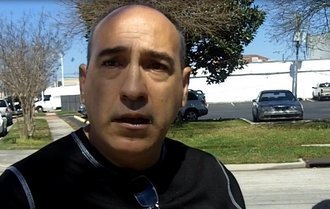 The Reverend Grant Storms, 55, was convicted of a single count yesterday in a Louisiana court, reports New Orleans’s Times-Picayune. He had been charged with obscenity for exposing himself while masturbating in his minivan, parked in Lafreniere Park in the New Orleans suburb of Metairie, on February 25, 2011. Storms, who has a lawn-mowing business, said he went to the park to take a break between jobs.
He had admitted to pleasuring himself, saying he finds it a thrill to do so in public, but denied exposing his penis. However, a nanny who was bringing children to the park for a picnic said she observed the exposure when she got out of her vehicle, parked next to his.
Shortly after his arrest, Storms had held a press conference, saying the Jefferson Parish sheriff’s deputies who arrested him were “maniacal” and “coercive.” But he also acknowledged he had viewed pornography that day and said, “I apologize deeply for my inappropriate, sinful actions.”
After finding Storms guilty, Judge Ross LaDart of the 24th Judicial District Court sentenced him to three years’ probation and ordered an evaluation, apparently to determine his mental health, the Times-Picayune reports.
In 2003, Storms, who has called himself a “Christian patriot,” made news when he led his small church congregation through New Orleans’s French Quarter to protest Southern Decadence, a gay festival held every Labor Day weekend. He railed against LGBT people as well as the city of New Orleans, which he called a “prostitute” for allowing the event. A local merchants’ association went to court for a restraining order to prevent Storms and his followers from using bullhorns. Storms has since apologized for the protest.
Complete Article HERE!
A man who accused disgraced priest Philip Magaldi of sexual abuse settled his claim Tuesday with the Fort Worth Roman Catholic Diocese, according to a news release.
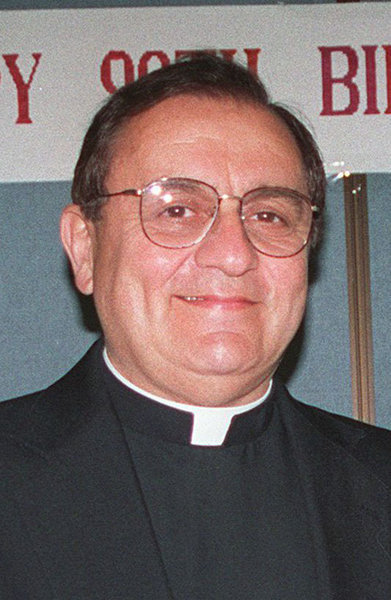
Terms of the settlement were not disclosed at the man’s request, the diocese said.
The man’s attorney, Tom McElyea, said the abuse occurred in Tarrant County and started in about 1994 when his client was 9.
Magaldi was being defrocked when he died in 2008. Before his death, the diocese announced that he was HIV positive. McElyea said his client does not have the virus.
As with two other known accusations against Magaldi, the man was subjected to enemas as part of his abuse, McElyea said.
In 1997, while serving at a parish in North Richland Hills, Magaldi was accused of paying a young man to give him enemas. Within two years, another man came forward to say Magaldi had given him enemas and had raped him as a boy.
People also claimed that Magaldi engaged in other inappropriate behavior, including “looking for minors” in Web chat rooms and possessing “pedophilic material,” according to court documents.
Bishop Kevin Vann, leader of the diocese, said in a statement that “he is deeply sorry for any sexual abuse this victim may have endured and suffered by Magaldi.”
McElyea said the diocese worked to resolve the matter and “hopefully my client can live a productive life.”
Magaldi served at St. John the Apostle Catholic Church in North Richland Hills. Besides accusations of sexual abuse, he was a convicted embezzler of church funds from his Rhode Island parish.
He had also been accused of perjury in 1985 at the second attempted-murder trial of socialite Claus von Bulow.
Complete Article HERE!
The Archdiocese of Portland has offered an open-ended loan to the Rev. Angel Armando Perez to cover legal fees as he fights an accusation that he fondled a 12-year-old boy.

Archbishop John G. Vlazny approved the loan to Perez this week, Archdiocese of Portland spokesman Bud Bunce said Friday. Police said Perez chased a 12-year-old boy down a Woodburn street early Monday while dressed only in his underwear.
Perez served a parochial vicar at St. Mary’s Catholic Church in Corvallis from May 2002 to July 2005.
“It’s available if he needs it,” Bunce said of the loan.
Bunce said he didn’t have details on the loan or how it would work. Parishioners in Woodburn also have begun to raise money for Perez’s defense, he said.
The Salem boy told investigators he ran from Perez’s church-owned house, with Perez chasing after him.
The 46-year-old parish priest at St. Luke Catholic Church made an initial appearance Tuesday in Marion County Circuit Court on accusations of sexual abuse, abuse of a child in the display of sexually explicit conduct, furnishing alcohol to a minor and driving under the influence.
Police said the boy told them the priest gave him a beer and he drank about half of it and that Perez also fondled him. Court documents filed after Perez’s arrest say the boy awoke to flashes and thinks the priest was taking cellphone photos of him.
Detectives wrote in their affidavit that the priest, a native of Mexico who has permanent legal residency in the U.S., told them he drank too much at a community event and doesn’t remember what happened after he and the boy watched a movie.
David Clohessy, director of the Survivor Network of those Abused by Priests, or SNAP, said the church will cover the cost of defense for priests “in the overwhelming majority of cases,” but it’s usually not called a loan.
Complete Article HERE!
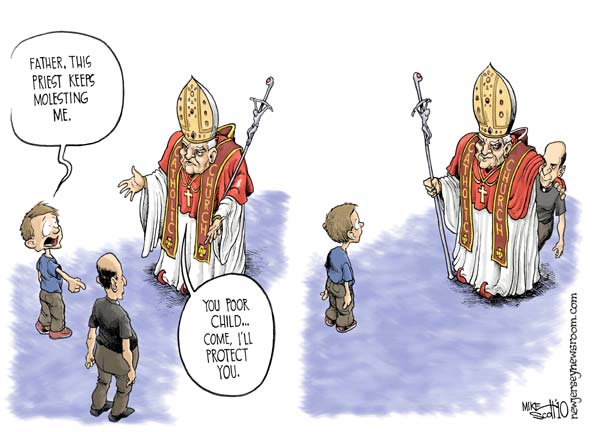
Over the years, Patricia Patterson thought about joining protest marches in support of women’s rights or against war. But the cause that finally got her to take to the streets was nuns.

“It baffles me that a group of women who are among the … most compassionate are being, frankly, picked on by the Vatican,” Patterson said Sunday. She joined a throng of nearly 500 people who marched in support of the nuns’ group recently rebuked by the Catholic Church for promoting “radical feminist themes” at odds with official doctrine.
Patterson carried a picture of her aunt, a nun who had a major influence on her life. Other marchers carried flowers and sang hymns as they walked from Volunteer Park on Capitol Hill to St. James Cathedral, seat of the Archdiocese of Seattle.
But Seattle Archbishop J. Peter Sartain wasn’t home. He was in St. Louis for meetings with the Leadership Conference of Women Religious, an umbrella group that includes about 80 percent of women’s religious orders in the United States.
The Vatican put Sartain in charge of revamping the Leadership Conference to bring its practices more in line with Catholic orthodoxy.
After a four-day conference that concluded Friday, the nuns agreed to talk with Sartain but said they would not “compromise the integrity” of their mission.
Sartain praised the nuns’ work and contributions in a statement issued Saturday. “They deserve our respect, our support, our thanks and our prayers,” he wrote. He said he is committed to working with the Leadership Council in “atmosphere of prayer and respectful dialogue.”
Sister Cathy Beckley, who was cheered as she dashed back and forth in her red baseball cap, said the Vatican’s attack was hurtful to women who have devoted their lives to caring for people on society’s fringes.
In a report issued in April, Catholic Church officials chided the nuns and sisters for resisting some church teachings, including those that prohibit birth control and same-sex relationships.
Beckley, a Seattle social worker and member of the Sisters of the Holy Names of Jesus and Mary, said that when she worked on the streets with the poor and homeless, she never asked about their private lives.
Sunday’s turnout gave her hope that many Catholics agree with the sisters’ approach and value their service. “Clearly, a very significant segment of the church here in the U.S. and around the world is more progressive.”
Among their causes, the sisters of the Leadership Conference mounted a “Nuns on the Bus” tour this summer opposing cuts in federal spending for social and health services proposed by Wisconsin Rep. Paul Ryan — now running mate to Republican presidential candidate Mitt Romney. Catholic bishops also echoed those concerns.
Beyond politics, the split between the sisters and the Vatican reflects the struggle between Catholics who want the church to adapt to modern realities — such as the fact that the vast majority of Catholic women in America use birth control — and those who seek a more traditional path, several marchers said.
Christy Higgins, of Seattle, was a youngster in Catholic school when the Vatican II changes were adopted in the 1960s. She recalls her teachers trading their habits for street clothes, and she embraced the more open and inclusive outlook.
“The church is all of us, not just the Vatican, the bishops and the cardinals,” Higgins said, her shirt pinned with more than a dozen “I Stand with the Sisters” buttons.
The slogan is also the name of the Seattle group that organized Sunday’s march. “We were so upset about how the church hierarchy is treating the sisters,” said Gretchen Gundrum, a co-founder.
It’s easy for ivory-tower leaders — all of whom are men — to discount the hard decisions people face in their day-to-day lives, Gundrum said. “The nuns see the complexity. Morality is not black-and-white, no matter what somebody says.”
The same tensions have always been present in the Catholic Church, Gundrum added. Church leaders denounced Galileo for claiming the Earth revolves around the sun. They finally admitted he was right — nearly 400 years later.
“Our group hopes to shorten the amount of time it takes for them to come around,” Gundrum said.
Complete Article HERE!
The Catholic Archdiocese of Detroit has indefinitely suspended the pastor of Sacred Heart Parish in Dearborn after he was arrested last week on suspicion of drunken driving.
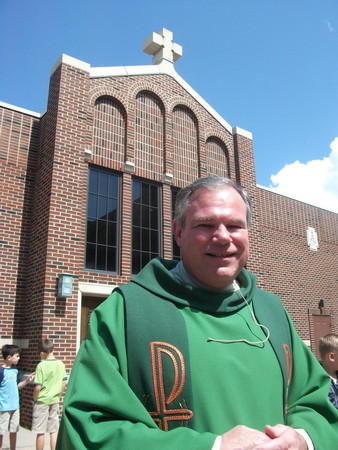
According to the archdiocese, the Rev. Peter Petroske was not wearing any clothes when he was arrested.
A knowledgeable city source told the Free Press that Petroske was arrested in the early hours of Friday morning about a block from his church on Michigan Ave. in Dearborn, and had a laptop computer with him in the car.
His blood alcohol level was just over the legal limit, the person said.
In a statement Tuesday, the Archdiocese said Petroske was put on leave effective Monday.
The statement said that when Petroske was arrested, he was alone in his vehicle and “was charged with driving under the influence of alcohol and indecent exposure. Archdiocesan officials met with parish staff on Monday to inform them of Father Petroske’s leave of absence.”
Archdiocese spokesman Joe Kohn said the leave is indefinite. He said he could not discuss the laptop but confirmed that Petroske was nude at the time of the arrest.
Dearborn Police Chief Ron Haddad declined comment, saying the matter is under investigation.
Complete Article HERE!
People don’t expect their priests and bishops to lie, but as Michelangelo Signorile’s recent post illustrated, clerics do lie. Some even make a virtue of it. I know this from experience, for I was ordained a Catholic priest on a lie.

In spring 2002 I walked with my spiritual director along the blacktop road encircling the seminary. He’d been my confessor and guide for two years, helping me discern God’s presence in all aspects of my life, intimate and mundane. Over our heads, a canopy of newborn leaves rustled in a sunny breeze, a welcome relief from the bitter fog that had engulfed the church and my vocational surety.
For the previous two months an unprecedented number of bishops and priests, starting with Cardinal Law of Boston, had fallen from grace for participation in the sexual abuse of children and the ensuing cover-up. Their duplicity was palpable in my knotted back and abdomen. In a few months I’d be ordained a priest. I didn’t want to do so on a lie.
“I’m coming out of the closet,” I said.
My spiritual director loosened his clerical collar and lit a cigarette. “Where’s this coming from?” he asked. A couple of chattering wrens whooshed past.
I backtracked through six years of seminary formation. At events I had hobnobbed with supposedly holy men, some of whom had been harboring pedophiles. A few had done the deed themselves. By shaking their hands, mine were dirty. I knew the ecclesiology, how the bishops’ authority stemmed from a direct line to Jesus, but they were still criminals. Who were they to declare homosexuals “intrinsically depraved”?
When I’d applied for seminary, the director of seminarians — the priest who’d recruited me — explained that orientation didn’t matter, only celibacy. But on my intake interviews he’d told me to answer “yes” when the archdiocesan psychologist asked if I was attracted to women, and “no” when he asked if I was attracted to men. It was for the greater good, he said. Frightened of being cast out and ashamed of my true nature, I had lied as instructed.
In light of the sexual abuse scandal, lying about my orientation was no longer acceptable. I thought of what a gay friend who’d left seminary had said. His words became my own: “I don’t know if I can separate my private and public selves. Isn’t integration the goal of spiritual direction?”
“Of course it is,” my spiritual director said, more gravelly than usual. He stopped and turned to me. A tree cast a web of shadows over his face. His strawberry nose grew flushed, as he gestured with his hands. “Here’s the thing, Rastrelli. You have to ask yourself: Am I going to be a gay priest, or a priest” — he rolled his fingers and cigarette through the air like a barrel — “who happens to be gay?”
“What’s the difference?” I turned my head to inhale, trying to avoid his secondhand smoke. “Either way I’m gay. It’s a part of me.”
“But are you gay first, and then a priest? Or a priest first, and then gay?” He smiled, satisfied with the distinction.
“Both/and.” I’d hit him with what he’d taught me in class. “Both/and” was the paradoxical answer for every ultimate question in Catholic theology: Scripture or tradition? Faith or works? Is Jesus divine or human? Are we sinful or good? is faith a solo or communal experience?
“Touché,” he said. We walked. He sucked his cigarette. “You’re a smart guy, Rastrelli. Give it some thought.”
I kicked a pebble onto the grass. “I have. I don’t want to lie about my sexuality.”
“It’s not lying if those asking don’t have a right to the information.”
He hadn’t even flinched. I wanted to shake the nicotine from his bones, to scream, “It was that kind of thinking that landed the bishops in the papers!” Still, part of me wanted him to be right. Silence was simpler, easier, and maybe my need to come out was just pride at work. My promise of obedience demanded that I surrender my ego. My vocation was about God, not my orientation. But couldn’t we priests be honest with one another? I had to try.
“Gay Catholics don’t have positive role models,” I said. “I don’t know of a single gay priest that’s healthy. Do you?” I stopped. He kept walking. This was as close as I’d ever come to asking him if he was gay. I suspected he was. He’d lived with another priest for decades. They vacationed and picked out carpeting together. They spoke about their cat as if she were their child. Even if he and his housemate weren’t having sex, they were a couple. I stepped in stride with him. “How am I supposed to be an integrated gay priest when I have no one to look up to? How does celibacy actually work?” I stopped again. “I’m asking you.”
He turned to me. His face became whiter than a funeral pall. “I’m sorry, Rastrelli, but that’s not a conversation I’m comfortable having with a student.”
He resumed his pace. I followed silently.
The breeze picked up. The undulating trees sounded like the ocean breaking on the shore. I choked back the urge to ask, “Are you gay?” I felt like a sinking ship in a fleet that had wandered into a minefield. After laying the mines himself, the fleet commander had ordered radio silence.
I didn’t want to drown alone. I didn’t want to hear him lie. I wanted the truth, but the truth was dangerous. Were I to come out amid sexual-abuse headlines, homophobic Catholics wrongly blaming gay priests for the scandal would demand my dismissal.
My spiritual director was right. Who were they to judge, to put my orientation before my vocation? They had no right to that knowledge. It was safer to be a priest who happened to be gay. Perhaps it was God’s will. The fear accompanying us back to the seminary told me so.
That day, I learned the unspoken rule passed down through generations of priests: the doctrine of justification for lying by clergy. I went on to be ordained a priest. I preached that “the truth will set you free” while living in silence and shame. After a long journey and much pain, I came out. I left the priesthood, finally refusing to live the lies that I’d been taught to venerate.
Complete Article HERE!
The ordination of Rev. Angel Perez in 2002 was significant for two reasons: He was the rare Mexico native among priests in Oregon and, in a year when the Catholic Church sex abuse scandals were making national news, he was the rare priest ordained period in the state.
A decade ago, Oregonian reporter Shelby Oppel wrote a profile of Perez that described his ascent from a seminary student in Mexico to the archdiocese in Portland. The piece, which follows in its entirety, was published on the front page on Aug. 5, 2002.
On Monday, Perez, now the parish priest at Saint Luke Catholic Church in Woodburn, was arrested after police responded to a complaint at about 1:30 a.m. Monday alleging inappropriate contact between the priest and a 12-year-old boy.
He faces accusations of sexual abuse, use of a child in a display of sexually explicit conduct and furnishing alcohol to a minor. Perez, 46, was booked into Marion County Jail Monday evening and remains held without bail. He is scheduled to be arraigned at 3 p.m. in Marion County Circuit Court, according to the jail.
Perez is only the second priest to face criminal charges in Oregon since 1983, when the Rev. Thomas Laughlin was convicted of molesting two boys in Multnomah County.
Complete Article HERE!
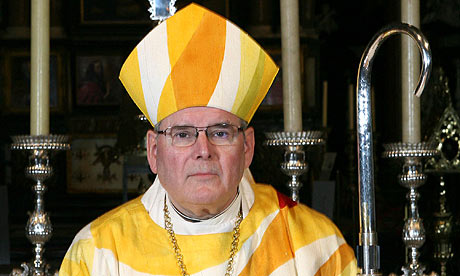
A Belgian lawyer said on Monday he had launched an inquiry into a new case of alleged sexual abuse by the former bishop of Bruges, Roger Vangheluwe, who has already admitted to having abused his under-age nephews.
“The present case concerns sexual abuse in the 1990s,” at a care home in Loker, in western Belgium near the French border, the lawyer, Walter Van Steenbrugge, said.
He said he had handed the allegations to a court in Brussels and lodged an inquiry with it. It was up to the court to decide whether the statute of limitations ruled out a prosecution, and if not, whether or not to prosecute the bishop, he added.
Vangheluwe, who was bishop of Bruges from 1984 to 2010, is the highest-ranking member of the Belgian Catholic Church to be involved in a child abuse scandal which resulted in 475 complaints of molestation by priests.
Vangheluwe admitted in 2010 that he had abused one of his nephews during the 1980s, when the nephew was a child.
That case was beyond the statute of limitations, but he was forced to resign as bishop and left Belgium under Vatican orders.
He caused outrage in 2011 when he told a Belgian TV station that he had also abused a second nephew but that he did not consider himself a paedophile.
Complete Article HERE!