Ex-Pope Benedict will have security and immunity by remaining in the Vatican

File under:  The real reason…Immunity!

By Philip Pullella

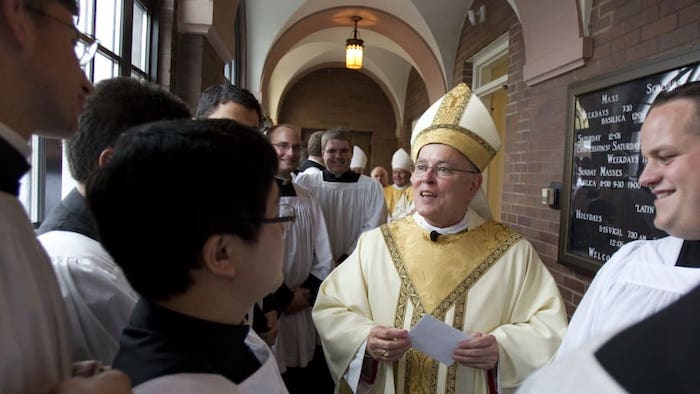
Pope Benedict’s decision to live in the Vatican after he resigns will provide him with security and privacy. It will also offer legal protection from any attempt to prosecute him in connection with sexual abuse cases around the world, Church sources and legal experts say.

“His continued presence in the Vatican is necessary, otherwise he might be defenseless. He wouldn’t have his immunity, his prerogatives, his security, if he is anywhere else,” said one Vatican official, speaking on condition of anonymity.

“It is absolutely necessary” that he stays in the Vatican, said the source, adding that Benedict should have a “dignified existence” in his remaining years.

Vatican sources said officials had three main considerations in deciding that Benedict should live in a convent in the Vatican after he resigns on February 28.

Vatican police, who already know the pope and his habits, will be able to guarantee his privacy and security and not have to entrust it to a foreign police force, which would be necessary if he moved to another country.

“I see a big problem if he would go anywhere else. I’m thinking in terms of his personal security, his safety. We don’t have a secret service that can devote huge resources (like they do) to ex-presidents,” the official said.

Another consideration was that if the pope did move permanently to another country, living in seclusion in a monastery in his native Germany, for example, the location might become a place of pilgrimage.

Complete Article HERE!

Cardinal Mahony used cemetery money to pay sex abuse settlement

By Harriet Ryan

The Archdiocese of L.A. took $115 million from its cemeteries’ maintenance fund in 2007, nearly depleting it. The move seems legal, but it was not announced, and relatives of the dead were not told.

Pressed to come up with hundreds of millions of dollars to settle clergy sex abuse lawsuits, Cardinal Roger M. Mahony turned to one group of Catholics whose faith could not be shaken: the dead.

Under his leadership in 2007, the Archdiocese of Los Angeles quietly appropriated $115 million from a cemetery maintenance fund and used it to help pay a landmark settlement with molestation victims.

The church did not inform relatives of the deceased that it had taken the money, which amounted to 88% of the fund. Families of those buried in church-owned cemeteries and interred in its mausoleums have contributed to a dedicated account for the perpetual care of graves, crypts and grounds since the 1890s.

Mahony and other church officials also did not mention the cemetery fund in numerous public statements about how the archdiocese planned to cover the $660-million abuse settlement. In detailed presentations to parish groups, the cardinal and his aides said they had cashed in substantial investments to pay the settlement, but they did not disclose that the main asset liquidated was cemetery money.

In response to questions from The Times, the archdiocese acknowledged using the maintenance account to help settle abuse claims. It said in a statement that the appropriation had “no effect” on cemetery upkeep and enabled the archdiocese “to protect the assets of our parishes, schools and essential ministries.”

Under cemetery contracts, 15% of burial bills are paid into an account the archdiocese is required to maintain for what church financial records describe as “the general care and maintenance of cemetery properties in perpetuity.”

Day-to-day upkeep at the archdiocese’s 11 cemeteries and its cathedral mausoleum is financed by cemetery sales revenue separate from the 15% deposited into the fund, spokeswoman Carolina Guevara said. Based on actuarial predictions, it would be at least 187 years before cemeteries are fully occupied and the church started to draw on the maintenance account, she said.

“We estimate that Perpetual Care funds will not be needed until after the year 2200,” Guevara wrote in an email.

The church’s use of fund money appears to be legal. State law prohibits private cemeteries from touching the principal of their perpetual care funds and bars them from using the interest on those funds for anything other than maintenance. Those laws, however, do not apply to cemeteries run by religious organizations.

Mary Dispenza, who received a 2006 settlement from the archdiocese over claims of molestation by her parish priest in the 1940s, said her great-uncle and great-aunt are buried in Calvary Cemetery in East L.A.

“I think it’s very deceptive,” she said of the way the appropriation was handled. “And I think in a way they took it from people who had no voice: the dead. They can’t react, they can’t respond.”

The fund dates to the tenure of Bishop Francis Mora, who opened Calvary in 1896. An official archdiocese history published in 2006 recounts how the faithful of Mora’s era were assured their money was “in the custody of an organization of unquestionable integrity and endurance” — the Catholic Church.

Over the next century, the archdiocese built more cemeteries, and each person laid to rest meant a new deposit into the maintenance account. By the time of the sex abuse settlement, there were cemeteries from Pomona to Santa Barbara and $130 million in the fund. Church officials removed $114.9 million in October 2007.

Complete Article HERE!

The Magdalene Laundries explained

What were the Magdalene Laundries?

Institutions where women were sent if they were regarded as “fallen women”.

Who was sent there?

The women who were committed to these homes included women who conceived out of wed lock, wards of state and so-called ‘promiscuous and flirtatious’ women.

Parents, social workers, judges, priests and members of the Gardai could recommend a woman to be sent to these workhouses.


Who ran the institutions in Ireland?

Four Catholic religious orders: The Sisters of Mercy, The Sisters of Our Lady of Charity, The Sisters of Charity, The Good Shepherd Sisters.

Why were they called laundries?

The institutions ran laundries and the women were used as unpaid labour.

Where were the laundries?

Laundries were located all over the country, sometimes outside of towns.

Who were these women?

No proper records were kept and the ‘inmates’ had their real names removed and were given a one-letter name or a number.

How long did the laundries operate in the country?

From 1922 to 1996, but some of the laundries operated as orphanages previously.

When did the last laundry close?

The Sisters of Our Lady of Charity Laundry on Sean McDermott Street in Dublin city centre closed in October 1996.

How many women were sent to the laundries?

No known figures as records were not kept, but an estimated 30,000.

How many children were adopted from the laundries?

Again, this is unclear but it is believed over 2,000 children ‘exported’ from the laundries to new homes, mainly to wealthy families in the US, usually for a payment from the families.

What do campaigners want?

The campaign group, Justice for Magdalenes, have fought for 10 years bring justice to Magdalene Laundry survivors. The group wants apology from the State for the abuse perpetrated towards girls and women in the laundries, a compensation scheme for survivors and the adoption and a statutory inquiry.

Why?

Campaigners claim there is evidence of State involvement and the State sent women to these institutions as a means of dealing with various social problems, such as illegitimacy, poverty, domestic, youth crime, infanticide and sexual abuse – at home and also by clerical orders.

What international pressure has come on the State?

The UN Committee Against Torture criticised successive government’s failure to apologise or compensate as of yet.

LA Cardinal Mahony ‘stripped of duties’ over sex abuse

A retired Los Angeles cardinal accused of mismanaging a child sex abuse crisis has been stripped of all administrative and public duties by his successor.

Retired Cardinal Roger Mahony, 76, has apologised for his “failure”, Archbishop Jose Gomez said on Thursday.


The Los Angeles archdiocese, the largest in the US, has released thousands of pages of files on priests accused of child molestation.

Cardinal Mahony retired in 2011, having run the archdiocese for 25 years.

In 2007 Los Angeles paid $660m (£415m) to alleged victims of abuse, the largest sex abuse payout on record.

Cardinal Mahony has publicly apologised for mistakes he made handling the clerical sex abuse issue.
‘They failed’

“I find these files to be brutal and painful reading,” Archbishop Gomez said in a statement. “The behaviour described in these files is terribly sad and evil.

“There is no excuse, no explaining away what happened to these children. The priests involved had the duty to be their spiritual fathers and they failed.”

He added that Bishop Thomas Curry, former vicar of the clergy who handled the cases of accused priests, had stepped down from his post as bishop of Santa Barbara.

The 12,000 pages of documents were released after Church records on 14 priests were unsealed as part of a civil case.

They showed both Bishop Curry and Cardinal Mahony had helped to shield accused priests from investigation in the 1980s.

A Church expert said the “very unusual” punishment showed how seriously the US Catholic hierarchy was taking the case.

“To tell a cardinal he can’t do confirmations, can’t do things in public, that’s extraordinary,” Jesuit scholar the Reverend Thomas Reese, a Georgetown University fellow, told the Los Angeles Times.

But a victims’ support group said Cardinal Mahony’s reprimand was too little, too late.

“When [Cardinal Mahony] had real power, and abused it horribly, he should have been demoted or disciplined by the Church hierarchy, in Rome and in the US,” said David Clohessy, director of the Survivors Network of Those Abused by Priests.

“But not a single Catholic cleric anywhere had the courage to even denounce him. Shame on them.”

The Catholic Church in the US has been embroiled in a series of child sex scandals over the past two decades.

A Church-commissioned report said more than 4,000 US priests had faced sexual abuse allegations since the early 1950s, in cases involving more than 10,000 children – mostly boys.

Complete Article HERE!

Mahony responds to ban: ‘Not once’ did successor raise questions

File under: It’s gettin’ nasty! The secret internal power struggle is beginning to seep into the public domain. There is no way that Gomez would attack Mahony without the explicit authorization of B-16. The pope is throwing Mahony under the bus. His thinking…better to sacrifice a cardinal and a bishop (Curry) than have this whole thing skink up the Vatican. This is SOOO fascinating. Regular folk, like us, almost never get to see this kind of ecclesiastical fight to the death. The long knives are out!

By: Joshua J. McElwee

Cardinal Roger Mahony, the retired archbishop of Los Angeles who was barred from public ministry by his successor over his handling of sex abuse, has issued a rare public response to the action.

Writing an open letter to Archbishop Jose Gomez, the archdiocese’s current leader, Mahony states that during his leadership the archdiocese became “second to none in protecting children and youth.”

“When you were formally received as our Archbishop on May 26, 2010, you began to become aware of all that had been done here over the years for the protection of children and youth,” Mahony writes to Gomez in the letter, which Mahony has made available on his personal blog.

“You became our official Archbishop on March 1, 2011 and you were personally involved with the Compliance Audit of 2012 — again, in which we were deemed to be in full compliance,” Mahony continues.

“Not once over these past years did you ever raise any questions about our policies, practices, or procedures in dealing with the problem of clergy sexual misconduct involving minors.”

Mahony, who became archbishop of Los Angeles in 1985 and was made a cardinal in 1991, was replaced by Gomez in 2011.

Typically seen as shying away from public criticisms of their peers, Catholic bishops rarely issue public responses to one another’s actions.

In a letter outlining his decision to ask Mahony to stay away from public ministry in LA, Gomez wrote Thursday that Mahony had failed to protect young people from sexually abusive priests.

The Gomez letter accompanied a release of extensive files concerning Los Angeles priests who had abused minors, most involving abuse that had occurred decades ago.

“I find these files to be brutal and painful reading. The behavior described in these files is terribly sad and evil. There is no excuse, no explaining away what happened to these children. The priests involved had the duty to be their spiritual fathers and they failed,” Gomez wrote.

“My predecessor, retired Cardinal Roger Mahony, has expressed his sorrow for his failure to fully protect young people entrusted to his care,” he added. “Effective immediately, I have informed Cardinal Mahony that he will no longer have any administrative or public duties.”

For his part, Mahony states in his letter to Gomez that Mahony’s understanding of sex abuse evolved over the years.

“Nothing in my own background or education equipped me to deal with this grave problem,” states Mahony. “In two years [1962 – 1964] spent in graduate school earning a Master’s Degree in Social Work, no textbook and no lecture ever referred to the sexual abuse of children. While there was some information dealing with child neglect, sexual abuse was never discussed.”

Writing of the era of the documents from the 1980s, Mahony writes that he began implementing “policies and procedures to guide all of us in dealing with allegations of sexual misconduct” in 1986.

He was given advice, Mahony states, “to remove priests from active ministry if there was reasonable suspicion that abuse had occurred, and then refer them to one of the several residential treatment centers across the country for evaluation and recommendation.”
“We were never told that, in fact, following these procedures was not effective, and that perpetrators were incapable of being treated in such a way that they could safely pursue priestly ministry,” Mahony states.

“I have stated time and time again that I made mistakes, especially in the mid-1980s,” Mahony writes.

“Unfortunately, I cannot return now to the 1980s and reverse actions and decisions made then. But when I retired as the active Archbishop, I handed over to you an Archdiocese that was second to none in protecting children and youth.”

Complete Article HERE!

Bishop snared in abuse scandal criticizes Catholic newspaper

Sour grapes, Bishop Finn? Retaliating against the NCR because they had the temerity to suggest that you step side because of your involvement in the clergy sex abuse scandal? Have you no shame?

By Matt Pearce
Bishop Robert W. Finn wishes the independent National Catholic Reporter weren’t so independent.

bishop-finn Finn is the bishop of the Roman Catholic diocese of Kansas City-St. Joseph in Missouri. The National Catholic Reporter is a 48-year-old not-for-profit newspaper based in Kansas City.

Finn was convicted in September of shielding priests from sexual-abuse allegations — prompting editorials from the newspaper calling for his resignation. Now, Finn, who is on probation, has taken to his own diocese’s journalistic bully pulpit to denounce the paper.

“In the last months I have been deluged with emails and other correspondence from Catholics concerned about the editorial stances of the Reporter: officially condemning church teaching on the ordination of women, insistent undermining of church teaching on artificial contraception and sexual morality in general, lionizing dissident theologies while rejecting established magisterial teaching, and a litany of other issues,” Finn wrote this weekend in his diocese’s newspaper, the Catholic Key.

Finn noted that the National Catholic Reporter had long been a thorn in the side of Kansas City bishops; in 1968, one tried to get the publication to remove “Catholic” from its name.

Early in his tenure, Finn said, when he solicited the newspaper to “submit their bona fides as a Catholic media outlet in accord with the expectations of church law, they declined to participate, indicating that they considered themselves an ‘independent newspaper which commented on “things Catholic.”‘ At other times, correspondence has seemed to reach a dead end.”

The National Catholic Reporter has won awards for its investigative reporting and has been covering church sex scandals since 1985, National Catholic Reporter publisher and former editor Tom Fox told the Kansas City Star.

“We are a Catholic publication, but independent of the church structure. That’s one of the keys to our credibility,” Fox told the Star, adding of Finn, “He’s hurting. I know he thinks he’s doing his job.”

According to the original criminal indictment against Finn, sometime in 2010 or 2011 Finn discovered that a priest’s laptop computer contained “hundreds of photographs of children … including a child’s naked vagina, up-skirt images and images focused on the crotch.” Finn, who did not report his knowledge of the priest’s photos for months, became the first bishop convicted in the U.S. in the church’s sprawling child-abuse scandal.

Finn has been apologetic; the National Catholic Reporter’s writers, less so.

“No one is suggesting Finn can’t be forgiven his sins. Indeed, forgiveness is precisely what God always stands ready to offer,” Bill Tammeus wrote in a December column published on the publication’s website.

“But when someone in a position of ecclesial authority has failed in so spectacular a way that even a secular court has found him guilty, he has the obligation to do what he can to avoid further damage to what Finn often calls — in words that should make him quake — Holy Mother Church.”

In other words: Resign.

Finn has not resigned. Instead, he has endured rumblings that he has lost support from the priests inside his diocese, as well as parishioners. Nor has he been released from his duties by Pope Benedict XVI, who holds authority over the church’s bishops.

Finn’s Friday editorial was occasioned by the church’s World Communications Day, in which the pope urged the faithful to reflect on how to find meaningfulness in communication both digital and analog. Finn’s message started with his evocation of St. Francis de Sales, the patron saint of journalism, and closed by narrowing his eyes at the National Catholic Reporter.

“In light of the number of recent expressions of concern, I have a responsibility as the local bishop to instruct the faithful about the problematic nature of this media source which bears the name ‘Catholic,’” Finn wrote in his conclusion. “While I remain open to substantive and respectful discussion with the legitimate representatives of NCR, I find that my ability to influence the National Catholic Reporter toward fidelity to the church seems limited to the supernatural level. For this we pray: St. Francis de Sales, intercede for us.”

Complete Article HERE!

Santa Barbara Bishop Apologizes In Catholic Church Cover Up

File under: When an apology is not an apology. Jesus, these men simply can’t stop the prevarication. They couldn’t take responsibility for their actions if their life depended on it. Shame, shame, shame!

By Liberty Zabala
Dark days fall upon the Catholic Church as files upon files of alleged child sex abuse finally come to light.

Letters between Archdiocese of Los Angeles – Santa Barbara Region Bishop Thomas J. Curry and Cardinal Roger Mahony show they knew about alleged child sex abuse but choose to cover it up.

“You can imagine what the church has to lose,” says Child Sex Abuse Therapist Nancy Gutfreund. “You’re supposed to be an organization that completely protects its people and when there’s damage done nobody wants to admit it.”

curry:mahoneyBut Bishop Curry was forced to, releasing this statement saying:

“I wish to apologize for those instances when I made decisions regarding the treatment and disposition of clergy accused of sexual abuse that in retrospect appear inadequate or mistaken.”

A mistake the Santa Barbara District Attorney’s Office is now investigating.

“We have some very serious allegations of obstruction of justice at the very least by individuals, I think the community has trusted throughout for a number of decades,” says Santa Barbara City Chief Deputy District Attorney Hilary Dozer. “And that’s a disturbing fact.”

And prosecutors face another challenge. Most of the files happened in the 1980’s far beyond the statute of limitations.

“If an individual has actively hidden information from law enforcement, there are some ways and situations where that statute of limitations is tolled,” says Dozer. “Meaning it does not preclude us from going forward.”

Senior Deputy District Attorney Ron Zonnen to lead the investigation against the church.

Last year, prosecutors in Philadelphia were able to convict a monsignor and in Missouri, a judge found a bishop guilty for failing to report child sex abuse.

Complete Article HERE!

Catholicism’s Curse

A must read!

By FRANK BRUNI

But while I have nothing against priests, I have quite a lot against an institution that has done a disservice to 27BRUNI-popupthem and to the parishioners in whose interests they should toil. I refer to the Roman Catholic Church, specifically to its modern incarnation and current leaders, who have tucked priests into a cosseted caste above the flock, wrapped them in mysticism and prioritized their protection and reputations over the needs and sometimes even the anguish of the people in the pews. I have a problem, in other words, with the church’s arrogance, a thread that runs through Wills’s book, to be published next month; through fresh revelations of how assiduously a cardinal in Los Angeles worked to cover up child sexual abuse; and through the church’s attempts to silence dissenters, including an outspoken clergyman in Ireland who was recently back in the news.

Complete Article HERE!

German Catholics vent their dissatisfaction with the Church

A study on Germany’s Catholic community reveals the discontent of faithful with the ecclesiastical institution. But proposals for solutions are lacking

By ALESSANDRO ALVIANI

sad lonely popeThe Pope’s ecclesiastical policies are “backward-looking” and suspected of trying to take the Church back to the pre-Second Vatican Council period. As for the Church’s leaders, they are “cut off from reality, reactionary and obstructionist.”

This is the opinion German faithful have of Benedict XVI and the Catholic Church according to a study by Sinus Institute and consulting agency MDG (which the German Church controls). In-depth interviews were conducted with 100 Catholics from different social backgrounds. According to the study, which picks up on a similar one carried out in 2005, German faithful are convinced that today’s Church finds itself in a “desolate situation” and the most obvious manifestation of this is the sex abuse scandal.

The authors of the study wrote that the scandal seriously damaged the image of the Church, even in the eyes of the most fervent Catholics, whose faith was deeply shaken. The scandal was seen as confirmation of the Church’s “modernization deficit”. The Church lost a great deal of credibility not just as a result of the accusations of paedophilia made against it but also because many believe it dealt with the abuse issue inadequately.

Internal dogma and rules that had been tacitly accepted until about a year ago are now openly criticised by faithful. Criticisms range from complaints about “discrimination against women” and celibacy, to the condemnation of homosexuality, contraception and sex outside wedlock, to the marginalisation of lay people involved in Church life.

Another factor that is creating animosity, is the organisational restructuring that is taking place in Germany, with a number of parishes being merged because of the shortage in parish priests, for example.

The study also shows the Church’s detachment from the weakest sections of society: it would make no difference to the lower social classes if the Church ceased to exist.

Despite their criticisms, however, faithful still look to the Church for “spiritual guidance” and “meaning”. The majority of them do not want to lose their Catholic identity and few consider leaving the Church.

So what do German faithful expect from the Church? They want lay people involved in the Church to play a greater role; they want more women in leadership roles; the possibility for women to be ordained priests; the elimination of celibacy; a different attitude towards sexuality and contraception; the sacraments to be administrated to all Christians, regardless of their denomination or sexual identity; less ostentation and less abuse of power and a greater focus on God’s love and love for one’s neighbour.

Complete Article HERE!

Priest Is Planning to Defy the Vatican’s Orders to Stay Quiet

By DOUGLAS DALBY

A well-known Irish Catholic priest plans to defy Vatican authorities on Sunday by breaking his silence about what he says is a campaign against him by the church over his advocacy of more open discussion on church teachings.

Father Tony FlanneryThe Rev. Tony Flannery, 66, who was suspended by the Vatican last year, said he was told by the Vatican that he would be allowed to return to ministry only if he agreed to write, sign and publish a statement agreeing, among other things, that women should never be ordained as priests and that he would adhere to church orthodoxy on matters like contraception and homosexuality.

“How can I put my name to such a document when it goes against everything I believe in,” he said in an interview on Wednesday. “If I signed this, it would be a betrayal not only of myself but of my fellow priests and lay Catholics who want change. I refuse to be terrified into submission.”

Father Flannery, a regular contributor to religious publications, said he planned to make his case public at a news conference here on Sunday.

The Vatican’s doctrinal office, the Congregation for the Doctrine of the Faith, wrote to Father Flannery’s religious superior, the Rev. Michael Brehl, last year instructing him to remove Father Flannery from his ministry in County Galway, to ensure he did not publish any more articles in religious or other publications, and to tell him not to give interviews to the news media.

In the letter, the Vatican objected in particular to an article published in 2010 in Reality, an Irish religious magazine. In the article, Father Flannery, a Redemptorist priest, wrote that he no longer believed that “the priesthood as we currently have it in the church originated with Jesus” or that he designated “a special group of his followers as priests.”

Instead, he wrote, “It is more likely that some time after Jesus, a select and privileged group within the community who had abrogated power and authority to themselves, interpreted the occasion of the Last Supper in a manner that suited their own agenda.”

Father Flannery said the Vatican wanted him specifically to recant the statement, and affirm that Christ instituted the church with a permanent hierarchical structure and that bishops are divinely established successors to the apostles.

He believes the church’s treatment of him, which he described as a “Spanish Inquisition-style campaign,” is symptomatic of a definite conservative shift under Pope Benedict XVI.

“I have been writing thought-provoking articles and books for decades without hindrance,” he said. “This campaign is being orchestrated by a secretive body that refuses to meet me. Surely I should at least be allowed to explain my views to my accusers.”

His superior was also told to order Father Flannery to withdraw from his leadership role in the Association of Catholic Priests, a group formed in 2009 to articulate the views of rank-and-file members of the clergy.

In reply to an association statement expressing solidarity with Father Flannery, the Congregation for the Doctrine of the Faith denied it was acting in a secretive manner, pointed out that Father Flannery’s views could be construed as “heresy” under church law, and threatened “canonical penalties,” including excommunication, if he did not change his views.

This month, the Congregation for the Doctrine of the Faith wrote to an American priest, Roy Bourgeois, notifying him of his laicization, following his excommunication in 2008 over his support for the ordination of women.

Complete Article HERE!