Women Catholic deacons ‘no longer taboo’

Germany’s top Roman Catholic has called for women to be allowed to become deacons, which would enable them to perform baptisms and marriages outside of mass – a novelty for Catholic women.

Archbishop of Freiburg Robert Zollitsch, who chairs the German Bishops’ Conference, called for the change at the end of a four-day meeting to discuss possible reforms.

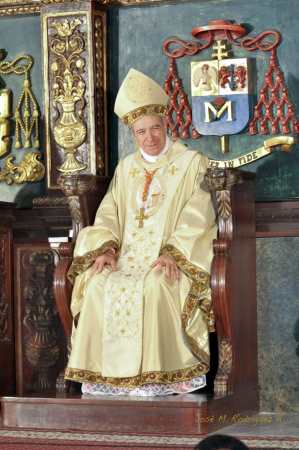
Archbishop of Freiburg Robert ZollitschThe conference, the first of its kind, invited 300 Roman Catholic experts to propose reforms. Zollitsch’s comments echo year-long calls from the Central Committee of German Catholics to permit women to become deacons. On Sunday, Zollitsch said that aim was no longer a ‘taboo.’

Zollitsch said the Catholic Church could only regain credibility and strength by committing to reform. He described an “atmosphere of openness and freedom” at the conference.

Deacons assist priests during church services and can perform baptisms and marriages outside of mass. Their primary role however is to serve the needy in their community and their duties are considered secular rather than pastoral.

Another proposal to emerge from the conference was to extend the rights of remarried divorcees to sit on church bodies such as parish councils. Conference members also discussed the possibility of granting them the right to receive Holy Communion and attend confession.

“It’s important to me that, without undermining the sanctity of marriage, these men and women are taken seriously within the church and feel respected and at home,” said Zollitsch. At present the reforms remain speculative and there is no proposed time-frame for their implementation. The position of divorcees remains highly controversial within the Church.

The conference also touched on the difficulty, particularly in eastern Germany, of recruiting people to work for Catholic institutions such as hospitals and kindergarten. At present the Church can only employ Roman Catholics. However Zollitsch called for work permits to be extended to non-Catholics and to those with “different lifestyles.” This would technically apply to homosexual people too. However Church labour reforms are unlikely to be introduced in the next three years.

While reform might be slow to come, the sentiments expressed at the conference are a signal to many that change is on the way. “I have never experienced a process of strategy development as transparent as this one,” said Thomas Berg, of the Baden-Württemberg Leadership Academy, who attended the conference.

Complete Article HERE!

Kentucky woman ordained as priest in defiance of Catholic church

By Peter Smith

In defiance of Roman Catholic authority and doctrine, the Association of Roman Catholic Women Priests ordained its first Louisville-area priest on Saturday.

Rosemarie Smead weeps openly as almost entire congregation comes to lay their hands on her head in blessing, as she was ordained Roman Catholic priest during Celebration of Ordination in LouisvilleRosemarie Smead of Bedford, Ky., a retired Indiana University Southeast counselor-education professor, was ordained during the two-hour service hosted by a bishop of the movement, Bridget Mary Meehan.

Several other women priests in the movement, in white robes and red stoles, gathered from around the country to participate in a ceremony patterned on traditional Catholic ordination liturgy but suffused with feminist imagery. About 200 people attended the service at St. Andrew United Church of Christ, most of them coming forward to lay hands on Smead in blessing.

The Vatican has stated that as a matter of unchangeable doctrine, the Roman Catholic Church must follow the example of Jesus, who appointed only men as his apostles.

It says anyone who participates in a ceremony purporting to ordain a woman is automatically excommunicated. Louisville Archbishop Joseph Kurtz reiterated that stance in a statement saying the association has no connection to the Roman Catholic Church and that Catholics should not support or participate in Saturday’s event.

Janice Sevre-Duszynska of Lexington, Ky., a priest in the women’s ordination movement, gave opening remarks Saturday, saying there is archaeological and documentary evidence that the early church ordained women — interpretations that have been disputed by supporters of male-only ordination.

Meehan said the decade-old Women Priest movement is an act of justice defying what she called an unjust Vatican law. She said the movement’s bishops were ordained by an unidentified bishop in communion with Rome.

“Sexism in church and society is sinful and should always be challenged,” Meehan said. She said if women were in Catholic leadership, the church’s position against artificial birth control would be lifted.

The liturgy included invocations to numerous female Catholic saints, to God as mother and father and to “Christ-Sophia,” invoking a biblical term for divine wisdom that service leaders said reflects the feminine aspect of God.

After a series of solemn ordination vows, Smead prostrated herself before the altar for several minutes during quiet music and prayer. Participants presented Smead with ceremonial vestments of priestly ministry, and Meehan anointed her hands with oil.

“You’re in for quite a spiritual adventure,” Meehan told Smead.

“It’s just so overwhelming,” Smead said afterward. Smead, who previously lived as a cloistered nun, marched for civil rights and worked for years with troubled youth in Alabama before a quarter-century career at IUS, said the ordination “just raised up 70 years of longing in me to be able to fulfill this.”

Two of Smead’s former IUS students gave testimonials during the ordination, lauding her for providing career and personal guidance, and a niece, nephew and in-law of Smead read Scriptures.

The Rev. Jimmy Watson, pastor of St. Andrew, said the church agreed to host the service after considering a passage in the book of Acts in which the apostle Peter was told by God to bring the gospel to Gentiles.

“I knew there would be some pressure not to do something so illegal,” Watson said. “… We decided that we could not stand in God’s way.”

Complete Article HERE!

Hans Küng on Election of Pope Francis

By Michael Enright

For such a conservative group of middle-aged and elderly men, the Princes of the Church do seem to have a few surprises up the sleeves of their vestments. The 115 cardinals sequestered themselves in the Sistine Chapel on Tuesday, and emerged on Wednesday with tidings of a new Pope – and not one very many people expected.

Jorge Mario Bergoglio, the archbishop of Buenos Aires, was elected Pontiff and rechristened himself Pope Francis, signifying his humility and support for the poor and oppressed. He’s the first Jesuit to be made pope, and the first non-European in twelve hundred years to become heir to St. Peter.

Last week, Michael Enright interviewed the preeminent Catholic theologian, Hans Küng, about the crisis in the Catholic Church and the need for reform and liberalization (click here to read).

At the time, Dr. Küng wasn’t very optimistic about the prospects of the current cohort of cardinals choosing a reform-minded Pope. But the election of Francis has restored hope in many of the faithful, that reform in the Vatican might be possible.

We checking in with Dr. Küng again for his thoughts on Pope Francis. Micheal Enright spoke to Dr. Küng from his office in Tübingen, Germany.

Complete Article and audio clip HERE!

Pope Francis called to restore the Church

Leonardo Boff’s weekly columns are available in Spanish from Servicios Koinonia and in Portuguese on his blog. Some of his older columns are available in English at LeonardoBoff.com.

by Leonardo Boff (English translation by Rebel Girl)

On the social networks, I had proclaimed that the future pope would be named Francis. And I was right. Why Francis? Because Saint Francis’s conversion began when he heard the Crucifix in Saint Damian’s Chapel say to him, “Francis, go and restore my house, which as you see is falling into ruin.” (St. Bonaventure,Legenda Maior II, 1).

Francis took these words literally and rebuilt the Portiuncula Chapel in Assisi which still exists inside a huge cathedral. Then he realized that restoring the “Church that Christ saved through his blood” (ibid) was a spiritual matter. It was then that he started his movement for renewal of the Church that was presided by the most powerful pope in history, Innocent III. He began to live with the lepers and arm in arm with one of them, he went along the way preaching the gospel in the vernacular and not in Latin.

It’s good to know that Francis was never a priest but just a layman, Only at the end of his life, when the popes forbade lay people to preach, did he agree to become a deacon, on the condition that he not receive any kind of remuneration for the post.

Why did Cardinal Jorge Mario Bergoglio choose the name Francis? I think it’s because he realized the Church is in ruins because of demoralization due to the various scandals that have affected the most precious thing it had: morality and credibility.

Francis isn’t a name; it’s a plan for a Church that is poor, simple, gospel-centered, and devoid of all power. It’s a Church that walks the way together with the least and last, that creates the first communities of brothers and sisters who recite the breviary under the trees with the birds. It’s an ecological Church that calls all beings those sweet words “brothers and sisters”. Francis was obedient to the Church and the popes and at the same time he followed his own path with the gospel of poverty in hand. So theologian Joseph Ratzinger wrote: “Francis’ ‘no’ to this imperial type of Church couldn’t be more radical; it’s what we could call a prophetic protest.”(in Zeit Jesu, Herder 1970, 269). Francis doesn’t talk; he simply inaugurates something new.

I think Pope Francis has in mind a church outside the palaces and symbols of power. He showed it when he appeared in public. Normally the Popes and mainly Ratzinger would put over their shoulders the mozzetta, that short capelet embroidered in gold that only emperors could wear. Pope Francis came dressed only in white. Three highly symbolic points stand out in his inaugural address.

First: He said that he wants to “preside with charity”, something that has been called for since the Reformation and by the best theologians of ecumenism. The Pope should not preside as an absolute monarch, clothed in sacred power, as provided for in canon law. According to Jesus, he should preside in love and strengthen the faith of the brothers and sisters.

Second: He gave a central place to the People of God, as Vatican II highlighted but which had been left aside by the two previous popes in favor of the hierarchy. Pope Francis humbly asked the people of God to pray for him and bless him. Only afterwards would he bless the people of God. This means that he’s there to serve and not be served. He asked them to help him build a path together and called for brotherhood for all humankind, where human being don’t recognize each other as brothers and sisters but are tied to economic forces.

Finally, he avoided all spectacle in the figure of Pope. He didn’t extend both arms to greet the people. He remained still, serious and sober, even frightened, I would say. One only saw a white figure who greeted the people affectionately. But he radiated peace and confidence. He showed his mood by speaking without official-sounding rhetoric, like a pastor speaks to the faithful.

It’s worth mentioning that he’s a pope who comes from the Great South, where the poorest of humankind are and where 60% of Catholics live. With his experience as pastor, with a new view of things, from below, he will be able to reform the Curia, decentralize the administration, and give the Church a new and credible face.

Complete Article HERE!

The Pope’s inbox: Top priorities for Benedict’s successor

Pope Benedict XVI’s successor takes the helm at a difficult time for the Catholic Church.

By Michael Hirst

In the West, the Church is struggling to fill pews as congregations dwindle, while the number of priests is also falling.

Meanwhile, the rise of evangelical Churches, especially in Latin America and Africa, is checking the growth of Catholic congregations, which are also threatened in some areas by religious intolerance.

Benedict XVI rejected calls for a debate on the issue of clerical celibacy, and reaffirmed the ban on Communion for divorced Catholics who remarry.

Equality laws being debated in several Western countries are a major issue. Benedict XVI has said the Church’s strict positions on abortion, euthanasia and homosexuality are “not negotiable”, and such outspoken orthodoxy has alienated liberal-minded Catholics.

And the next Pope will also have to shore up confidence in an institution that been rocked for several years by the sexual abuse of minors by priests.

Here are some of the major issues facing the next Pope once he is elected.

Managing the Vatican

The recent leaking of Vatican documents by the Pope’s butler have exposed the Church’s central government – the Curia – as a seriously dysfunctional institution.

It appears to be “riddled with rival factions and there were accusations of corruption in high places”, says veteran Vatican analyst Clifford Longley.

“The reform of the Vatican, which he only began at the margins, has a long way to go yet,” says Mr Longley. “Decentralisation is now imperative. His successor has a huge and unenviable task.”

Systems of oversight need to be put in place to ensure corruption is detected and halted, while Vatican financial transactions need to be made more transparent.

Equality laws


“The one issue which overshadows all others is the growing pressure on Catholics because of equality laws in the West,” says Catholic commentator Austen Ivereigh.

Gay marriage legislation in France and the UK, the closure of Catholic adoption agencies in the UK, the battle in US courts between leading Catholic institutions and the State over sexual equality are all serving to have a chilling effect on the Church in the West, he says.

“Equality laws such as same-sex marriage make Christians and church organisations vulnerable to lawsuits and anti-discrimination claims.”

Ultimately, says Mr Ivereigh, the State could be developing positions through equality legislation that will serve to marginalise Catholics and the presence of the Church in public life.

“There is no bigger file in the Pope’s inbox,” he says.

Sex abuse
USCCB and Survivors of AbuseBenedict XVI has spoken of the Church’s shame for “unspeakable crimes” committed by paedophile priests, as well as offering heartfelt apologies to victims, groups of whom he has met during his trips overseas.

But many critics feel the Vatican was – and still is – far too slow, too reluctant and too secretive when it comes to acknowledging and investigating sexual abuse.

The new Pope will have the task of continuing to ensure perpetrators are held to account, and to ensure the changes introduced by Benedict XVI are implemented – particularly when it comes to bishops signing up to child protection guidelines.

David Clohessy, Executive Director of the Survivors Network of Those Abused by Priests, told the BBC: “The next pontiff must do more to safeguard children.

“He should stop issuing apologies and making gestures, and instead demote bishops who continue to conceal heinous crimes.

“And he should insist that prelates work with secular authorities to craft and pass stronger child sex laws across the globe.”

The role of women


Benedict XVI acknowledged progress on promoting women within the Church – particularly in its administrative bodies – was too slow.

In 2007 he pointed out that while Jesus chose 12 men as apostles, “among the disciples many women were also chosen. They played an active role within the context of Jesus’s mission”.

Despite this, though, he has refused to countenance women priests, delivering a fierce rebuke last year to Catholics who challenged the Church’s teaching.

And while certain women have risen to posts in the Vatican, others considered “difficult” have been removed, says Dr Gemma Simmonds, Director of the UK’s Religious Life Institute.

An investigation into statements made by a group of Catholic nuns in the US on homosexuality and the male-only priesthood caused controversy. Fr Drew Christiansen, a Jesuit priest and visiting scholar at Boston College, says it is one of the key shortcomings of the pontificate.

“The USA owes a huge debt to generous, heroic sisters who have dedicated their lives to offering education, healthcare and pastoral provision only to be subjected to an intrusive, inherently hostile process of investigation for alleged doctrinal errors,” says Dr Simmonds.

“The contrast between their treatment and that of paedophile clergy has caused widespread scandal.”

It is widely acknowledged that a culture shift needs to take place within the Vatican, and the Pope will be expected to promote women into senior management positions in the Curia.

Interfaith tensions

The welfare of persecuted Christians around the world, particularly in troubled areas of the Middle East, Asia and Africa, will be a major issue for the next Pope.
Pope Benedict XVI at the Dome of the Rock in Jerusalem on 12 May, 2009 The exodus of Christians from the Holy Land will be a troubling issue for the next Pope

The ongoing exodus of Christians from the Holy Land will add significance to the Pope’s approach to relations with Jews and Muslims.

Such a bridge-building attempt was not welcomed in some Muslim circles, particularly coming shortly after the Pope quoted from a 14th-century Byzantine emperor who labelled the Prophet Muhammad “evil and inhuman”.

Benedict XVI’s successor will be challenged to find common ground with Islam, which is on the rise in Africa and Asia where Roman Catholicism has a large base.

Benedict XVI irked Jews by forwarding the path of Pope Pius XII to sainthood despite criticisms that the wartime Pope did not do enough to prevent the Holocaust. He also angered some in the Church of England by encouraging those disaffected with Anglicanism to convert to Catholicism.

In general, relations with Anglicans and Jews seem to be on a good footing. But the new Pope will have to tread carefully to build bridges with the Muslim world while not alienating Jews and without being seen to pander to Islamic extremism.

Smaller congregations, fewer priests


There are 1.2 billion Catholics around the world, a large proportion of whom (42%) come from Latin America. Europe, Catholicism’s historic heartland, is now home to just a quarter of Catholics.

However, Benedict XVI seemed reasonably untroubled by this numerical decline, envisioning a smaller, but more faithful, Church.

Key for his successor will be to consolidate this changing position of the Church within society. As it becomes more distant from official institutions, says Austen Ivereigh, the Church will have to ensure that those within the pews – and those who lead them – are well supported.

Similarly, it must continue to ensure it takes advantage of modern technology to spread its message.

The appointment of Fox News’ Rome correspondent Greg Burke as an adviser in 2012 signalled a modern communications strategy at the heart of Vatican decision-making that had previously been lacking. And then the Pope took to Twitter.

His successor will be expected to take a similarly enthusiastic approach to modern technology.

Complete Article HERE!

Cleveland priest excommunicated for role in breakaway worship community

By Brian Roewe

Cleveland Bishop Richard Lennon has issued a decree formally excommunicating Fr. Robert Marrone, the pastor who followed his parishioners from St. Peter Church to the independent worship community that formed in the wake of their parish’s closing.

“It is with sadness I recognize that the Reverend Robert J. Marrone, a priest of the Diocese of Cleveland, has broken communion with the Catholic Church,” Lennon’s decree, issued Monday, reads. “He is found to have withdrawn submission to the pastors of the Church and from communion with the members of the Church subject to them.

“I hereby declare that by doing so freely and with knowledge, the Reverend Robert J. Marrone has incurred ipso facto the automatic penalty (latae sententiae) of excommunication as stated in canon 1364, [paragraph 1] of the Code of Canon Law,” he said.

Fr. Robert Marrone censes the congregation during the Community of St. Peter liturgy Sunday, Dec. 4, 2011, at 7100 Euclid in Cleveland. (Peggy Turbett)

The decree accuses the priest of schism and forbids him from participation in celebrations of the sacraments or in public worship. Marrone can neither receive sacraments nor hold a position in any ecclesiastical office. Canon law allows him 10 days from his excommunication’s publishing to appeal the decree — in this case, until March 14.

Marrone addressed his status in a brief statement to members of the Community of St. Peter, stating the action “reflects the continuous pattern [in the diocese] which has marked the process of clustering, consolidation, closing, suppressions and reopening of parishes. I must, as I have stated repeatedly in the past, follow my conscience in this matter.”

Marrone expressed his gratitude to the community while reaffirming his commitment as their pastor-administrator.

“I will continue to serve the Community of Saint Peter as long as they call me to do so and as long as I am able to fulfill the responsibilities of the work entrusted to me,” he said.

The community scheduled a meeting for registered members only March 11 to discuss their pastor’s current status and future.

At posting time, Marrone had not responded to NCR’s request for comment.

In a statement accompanying his official decree, Lennon said, “The desired effect of excommunication is not to ban someone from the Church permanently. Rather it is a temporary status meant to be medicinal and to encourage the person to reconcile with the Church.”

He added that though excommunicated, Marrone remains a member of the church but has harmed his relationship with it and God through his actions, specifically holding a leadership position with the breakaway St. Peter community.

In March 2009, Lennon announced the closing of St. Peter Parish as part of a wave of closures across the diocese. In all, he shuttered 50-plus parishes and churches, primarily in response to decreasing membership and increasing costs.

Several parishioner groups appealed their cases to the Vatican’s Congregation for the Clergy, and in March 2012, it ruled in favor of 11 parishes, saying Lennon improperly shuttered them and ordering their immediate reopening.

Among those was St. Peter, which, given its unique circumstances, presented a more difficult process than the others. Unwilling to disband as a community upon learning of their church’s closure, a large contingent of St. Peter parishioners chose instead to incorporate themselves in October 2009 as a group outside the diocese’s authority.

A year later in August, they gathered for the first time at their new worship site, a renovated warehouse on Euclid Street. Marrone celebrated the Mass despite his prohibition to publicly celebrate sacraments under the terms of his requested one-year leave from priestly ministry.

Lennon in his statement said he met with Marrone a month before that celebration but said the priest refused to talk. Further attempts to meet also proved futile.

In January 2011, Lennon took a first step toward action against Marrone, giving him a formal canonical warning that he must resign from leadership with the Community of St. Peter. Marrone declined.

In May, Lennon issued a “Declaration of Loss of Canonical Office,” which removed Marrone as pastor of St. Peter Parish and requested he reconcile with the diocese by leaving the Community of St. Peter or face suspension from ministry.

“I will not comply with your decree to leave the community of Saint Peter because I must, before all else, follow what my conscience dictates,” Marrone responded in a letter to Lennon.

A month after St. Peter Parish officially reopened, Lennon in October began the administrative penal process outlined by canon law, with a formal canonical warning sent to Marrone in late October.

Addressing the diocese, Lennon urged parishioners to pray for Marrone and pray that the incident could bring the diocese together.

“I pray that this action may be perceived by the faithful as an initiative to bring unity and peace to the Body of Christ,” he said.

Complete Article HERE!

Vatican spokesman brings flowers as women’s second-class status in church comes under scrutiny

BY NICOLE WINFIELD

The Vatican’s spokesman came to his press briefing Friday bearing flowers for female journalists to mark International Women’s Day. “On behalf of all of us men, congratulations and happy Women’s Day!” said a beaming Rev. Federico Lombardi.

A heartfelt gesture, to be sure, but one that came a day after an awkward acknowledgement: The upcoming election of the pope will be an all-male affair — except for the women who cook for, clean up after and serve the 115 cardinals who will pick the leader of the world’s 1.2 billion Catholics, half of them women.

Lombardi’s admission came when a reporter noted that one of the video clips the Vatican had provided of preparations in the Sistine Chapel featured a woman at a sewing machine, making the skirting for the tables where cardinals will sit. Aside from the seamstress, the reporter inquired, how many women are involved in the conclave process?

Lombardi said the total number wouldn’t be known until all Vatican personnel involved in the conclave take their oath of secrecy. But he noted that several women work at the Vatican’s Santa Marta hotel, where the cardinals will eat and sleep during the conclave, which begins on Tuesday.

For many observers, Lombardi’s comment was a tacit acknowledgment of what many consider women’s second-class status in Catholic Church, despite the fact they take a leading role in staffing Catholic schools, hospitals and other charitable institutions that are the cornerstone of the church’s social outreach.

“It is fine to sew and be a seamstress, but women have much to contribute to the political … health and well-being of the people on the planet,” said Janice Sevre-Duszynska, a member of the Roman Catholic Women Priests movement who says she was ordained a priest in 2008.

She and other members of the women’s ordination movement, as well as other dissident groups calling for greater participation of women in leadership positions in the church, have descended on Rome to try to have their voices heard in the papal election.

Lombardi noted that women’s role in the church was discussed Friday during the pre-conclave meetings that cardinals have attended this week to discuss the problems of the church and who should lead it.

He didn’t provide any details.

Complete Article HERE!

Former Catholics say rigid church forced them to leave

Opposition to female ordination and the prohibition on marriage for priests are among the factors causing an exodus from the Catholic Church.

By: Leslie Scrivener
Joanna Manning, former nun, award-winning religion teacher, advocate for the poor and activist-intellectual, was battle-weary.

For decades she had challenged the Catholic Church, arguing for women’s ordination, the right of priests to marry and accountability in repeated sexual abuse crises.

So Manning, once the public face of the reform movement in Catholic Canada and a persistent burr in the side of the church establishment, decamped a decade ago.

She is now a priest in the Anglican Church.

“I did go through a period of grieving for the loss of the vision I’d grown up with after Vatican II,” says Manning, now 69, referring to the 1962-1965 council to modernize the church. “But the church hierarchy had shut down and retreated . . .”

Critics say the Catholic Church hierarchy is disconnected from many if not most of its followers on issues of reform. Theologian Hans Kung writes that a recent poll in Germany shows 85 per cent of Catholics say priests should be allowed to marry, 79 per cent say divorced persons should have permission to remarry in the church and 75 per cent favour ordaining women.

“There’s a catastrophic shortage of priests, in Europe and in Latin America and Africa,” Kung wrote in the New York Times last week. “Huge numbers have left the church or gone into ‘internal emigration,’ especially in the industrialized countries.”

Around the world there are 49,000 parishes without a resident priest pastor.

The question, says Kung, author of the forthcoming book Can the Church Still Be Saved? , is whether cardinals, gathering to elect a new pope — likely in the next 10 days — will discuss progressive issues, or be “muzzled, as they were at the last conclave, in 2005, to keep them in line.”

In Canada many churches have closed and priests have been brought in from other countries to serve. The Catholic Register has reported that in the Archdiocese of Halifax, elderly priests have been brought out of retirement to serve in parishes.

In the sprawling diocese of London, 42 Catholic churches — including half those in Windsor — closed between 2006 and 2008. About one-third of the remaining parishes are “clustered” or share a priest. Declining attendance, the shortage of priests and the high costs of maintaining old buildings have all contributed to the shuttering, says Connie Paré, the diocese’s director of pastoral planning. “It was a very painful process.”

Speaking from her Bloor West home, Manning recalls of her break with Catholicism that she “had put too much energy into something in which I could see no future.” Her spiky white hair, jeans and purple jacket, worn with a clerical collar, contribute to her youthful appearance. “At my age I could no longer give my life over to resisting.”

She looked elsewhere for a place to practise her faith and found, about 10 years ago, San Lorenzo Anglican church on Dufferin St., which has a Spanish-speaking congregation.

“I’d been in exile and alien in my own church,” says Manning, who received horrific hate mail for her views. “Finally, I’d found a place where I was accepted for who I was without having to check anything at the door, including my brain.”

About five years after she joined the San Lorenzo community, Manning, who is single and has two adult sons and two grandchildren, was unprepared when her fellow parishioners suggested she consider the Anglican priesthood. “It was like I was surprised by the Spirit.”

Women have been ordained as Anglican priests in Canada since 1976.

Manning was ordained in 2011. More than half of those who attended the service were Catholic.

Among them was Ted Schmidt, retired teacher, author and former editor of the Catholic New Times. “This was a woman so far ahead of the institutional leadership she would be shot as the enemy,” says Ted Schmidt, a church progressive. “She’s a prophetic person.”

Manning now works as an assistant curate at two parishes, the inner city All Saints Sherbourne and All Saints Kingsway. She finds herself living with a “deep, abiding joy. A place where I can exercise all my gifts.”

She compares her present state to 10 years ago. “My energies were being drained by struggle. I felt a real outsider. I’d been rejected and was on the fringes of the church. Today my energy is so positive, I feel a flowering . . . at my age to have a second chance to do God’s work in the world.”

The Anglican Church has also attracted Catholic men who wanted to marry and raise families as much as they wanted to be priests. The Rev. Canon Joseph Asselin has been the rector of St. Cuthbert’s Anglican Church in Oakville for the past 13 years.

He was raised Catholic — and was a student of Ted Schmidt — and was so committed that as a young person never once missed Sunday mass over 20 years. His mother continues to attend mass up to four times a week.

Asselin was steeped in Catholic social teaching, he says, and was taught to challenge the culture of consumerism and materialism. His experiences in the church were positive. “I was so happy to have healthy role models and mentors.”
But he could never consider being a priest in the Catholic Church. “This could never happen because I always wanted to be a husband and father. Probably, what I find the greatest joy in is being a father.”

He and his wife, Maureen, an elementary school teacher, have a teenage daughter and son, whose photos adorn his church office.

“The Catholic Church is turning its back on a lot of people who have a genuine calling to be priests, and they are the poorer for it,” says Asselin, 49. “No surprise,” he adds, “women can have the same calling.”
He counts many Catholics in his congregation and has married divorced Catholics who do not want to go through painful, lengthy annulments.

“I am able to relate to families here, with all the joys and challenges of being in a family,” he says.
He adds that the Anglican Church has options for men who feel the calling to live celibate lives as monks.

“When you see priests not leading sexually health lives, it saddens me, because they have been asked to a live a life that is not really for them.”

A radical option for Catholic women who feel called to the priesthood is to be ordained in the Catholic Church.
The price is excommunication.

Monica Kilburn-Smith, a 52-year-old Calgary hospice chaplain and mother of two, is a member of the Roman Catholic Womenpriests group, and was ordained in 2008. “The first priests and bishops in our movement were ordained by male bishops in full communion with Rome, who did this out of their own conviction/conscience that it was wrong for women to be refused this sacrament,” she explains.

Pope John Paul II said that the church has no authority to ordain women, using the argument that the first apostles were all men.

Later, Pope Benedict XVI declared that anyone taking in a woman’s ordination was committing a grave sin.

Kilburn-Smith’s St. Brigid of Kildare Catholic Faith Community is growing, she says, with 200 on the mailing list and up to 60 coming to a monthly service held in a United church. By the fall she hopes to say mass twice monthly.

“When women come to mass for the first time and see a woman in vestments and all that represents, on the surface and at deeper levels, it hits them and makes them cry,” says Kilburn-Smith. “It’s not about me; it’s seeing a woman as a person as a representative of God.”

The movement is not just about getting women into the priesthood, but also about a renewed church for the 21st century.

Why not leave the church and join a denomination that ordains women? “To leave women’s voices out just seems wrong,” Kilburn-Smith says.

“If you see something isn’t right, and you feel called in your own faith, why would you go? The Anglican Church changed because women were ordained. It didn’t come from the hierarchy.”

Complete Article HERE!

WHAT THE POPE CAN PRAY FOR

BY JANE KRAMER

In the twelve days since Benedict XVI announced his retirement, I’ve been wondering whether the Church of Rome might not have been better served—at least from the point of view of progressive Catholics—by the Pope keeping his job and drawing an eventual last breath, in what he would call God’s time, on Peter’s throne. It would have released those Catholics from the strictures of empathy, admiration, and grueling patience his voluntary leaving seems to have placed upon them. (St. Peter, by the way, was married.) The response has been uncharacteristically kind. And how could it not be, at the shock of such eloquent and simple humility coming from the man who, for the past thirty-two years, enforced and eventually led the doctrinal retreat into the Middle Ages begun by his predecessor. There have been endless comparisons between the style of Benedict’s departure and that of John Paul II, in 2005; they are almost comically stereotypic: Pope John Paul II’s ardent, emotional, and pointedly public ecce-homo calvary through disease, senility, and incapacity to death; and Benedict’s rational, considered decision, clearing the way for a like-minded successor who would presumably restore obedience and fealty to a Church whose authority, like his own, was waning. “For the good of the Church,” is how Benedict described his resignation. It may be that, however weakened, Benedict was crafty.

There have been many theories, though few, to my knowledge, say that Joseph Aloisius Ratzinger was pushed into retirement, let alone that those honest, eloquent words about no longer possessing the quality of mind and body that the papacy requires had been scripted for him. And with good reason: knowing Benedict, he probably pushed himself. Today, the average age of the Church’s cardinals, who will convene next week to begin considering candidates for the next pope, is seventy-two, and those who are under eighty—the only ones eligible to actually cast ballots in a papal conclave—were all appointed by John Paul II or, more often than not, by Benedict XVI. So it’s safe to say that the College of Cardinals has been stacked to ensure that their linea gotica continues moving backward. And never mind that the Church has been losing both priests and nuns because of a doctrine of celibacy that began not in the Gospels but in the fourth century (and was largely ignored until much later); because of a doctrine of infallibility that in fact only became canonic in 1870; and because of an institutionalized misogyny that has not only kept women from the priesthood but sends them to Hell if they drop by Planned Parenthood for a morning-after pill, or even if, like those valiant American “nuns on the bus,” they drive off without permission to minister to the poor. The list goes on. A new face, with a new infallibility chakra under his papal hat, may be the Church’s last best hope for what is now called “putting the past behind us”—“the past,” in this case, including decades of rampant, officially closeted pedophilia, involving thousands of priests preying on tens of thousands of children—and continuing its long march backward.

I once met a writer who had been working for years on a book about the Vatican. His idea was that the Catholic Church was the oldest successful corporation in the world, and he predicted that the legacy of John XXIII, whose famous metaphor for the Second Vatican Council was throwing open the windows of the Church of Rome and letting in fresh air, would prove to be, corporately speaking, inconvenient. He was right. Dissident underlings are never convenient, in theology as in business.

When John Paul II was elected in 1978, he was certainly a breath of air, at least in style. He was warm. He wrote poetry. He was “the people’s pope”—a disarming populist and Mary worshipper, which endeared him, if not to Catholic intellectuals, at least to the Catholic masses trying to beat back poverty around the world. He was also a fervent anti-Communist. His support of Solidarity played a huge role in the dismantling of Soviet power that began in deeply Catholic Poland, and people loved him for that. It tended to obscure the fact that, like the Polish Church in which he’d been raised, he was profoundly conservative when it came to dogma. He instructed poor Catholic women (who filled the stadiums of the Third World to hear him) to reproduce, and to keep reproducing, and never mind if the women were struggling against all odds to feed the children they already had. He refused to consider the possibility of married priests or women priests, let alone openly gay priests. What’s more, he arrived at the Holy See with what could be called a professional deformation—understandable in a priest who had spent half his life under Stalinist rule, but delusional all the same. He saw Communists everywhere, and nowhere more than in the communitarian Christian movement called liberation theology, which was the real fresh air of Roman Catholicism and, at the time, doing more to revive Catholic practice in South and Central America than any pope could, or would, short of joining that movement himself.

Enter Joseph Ratzinger, who, three years into John Paul’s papacy, in 1981, took on the role of Bad Cop to Karol Wojtyla’s Good Cop (an arrangement not unheard of in corporations). The official title was Prefect of the Congregation for the Doctrine of the Faith, formerly known as the Inquisition. It was, you could say, the job Ratzinger was born for. He made an enthusiastic stalker of “heretical” practices and opinions, so much so that the people he held in his doctrinal sniper’s sight took to calling him the Grand Inquisitor. His targets ranged from an old Tübingen University friend and mentor, Hans Küng (whom he reportedly had a hand in barring from teaching Catholic theology just before his appointment as Prefect, in 1979), to priests and teachers in progressive orders like the Jesuits. The list is long. Under his watch, America’s liberal Conference of Catholic Bishops quickly became a conservative force, responsible for, among other things, denying communion to Catholic politicians who accept that contraception and abortion rights could be granted under the Constitution of our (still) secular state. He marginalized a group of Brazilian cardinals and bishops who had risked their lives to bear witness to atrocities in the political prisons of their country’s right-wing military junta—most notably the cardinal Aloísio Lorscheider, an appointment of Paul VI (and a strong contender to succeed him) and a lifelong defender of the liberation-theology movement and its priests.

The theologian Leonardo Boff was not only one of those priests but one of the founders of the liberation movement. I knew him in Brazil, in the mid-eighties, where I was writing a piece on a liberation-theology parish priest. Boff had been sentenced to silence for a year—courtesy of Cardinal Ratzinger—for his deviant views. Happily, Boff (who would leave the priesthood six or seven years later, when Ratzinger tried to silence him again) was ignoring the Vatican’s punishment, at least at home. He was, and remains, a remarkable Christian: “as Marxist as Luke” is how he described himself and his dedication to the poor. Twenty years later, Ratzinger was Pope, and one of the words he brought with him from the C.D.F. was “deviant.” Remember his exhortation on “deviant sects,” his term for other faiths, including Christian ones? Remember, for that matter, his Regensburg speech about the inherent illogic (if not evil) of Islam? His friend Rowan Williams, the former Anglican Archbishop of Canterbury, once told me how much he always looked forward to talking to Benedict on his unofficial visits to Rome; they shared an interest in Augustine, and Williams was, as he put it, immensely impressed by the Pope’s quality of mind. That did not prevent Benedict from poaching on Williams’s turf when he opened the Church of Rome to Anglican priests opposed to the ordination of women bishops. It remains unclear whether Benedict counts the Church of England as another “deviant sect” or simply as a lapsed Catholic institution that refused to acknowledge him.

What is “deviant”? Most of us would consider the Holocaust-denying followers of the late Marcel LeFebvre deviant. LeFebvre was a French cardinal so frighteningly racist that he and the four “bishops” he had illegally appointed were excommunicated by John Paul II. But Benedict reversed the excommunication of those bishops—on condition that they kept their views on the Holocaust to themselves. (Their silence was equivocal, given that you could read those views in the books and pamphlets they continued to sell, along with cakes and honey, in their monastery-churches.) It seems that in any reasonable church they would be considered more “deviant,” theologically, than a Leonardo Boff or a Gustavo Gutiérrez, the Peruvian liberation theologian who lived with the poor, practicing theology “from below.” And what about those child-molesting priests who, once caught, were not only protected by their bishops and, for years, ignored by the Vatican but were, instead, discreetly transferred to other parishes, where they could begin molesting again. I wish Ratzinger well in his new life of prayer. But I hope that, in the tranquility of his reflections, he reconsiders the meaning of the word “deviant.”

Complete Article HERE!

Nurse destroys archbishop’s gay marriage stance with a stroke of her pen

A 65-year-old former nurse has told the leader of England’s Catholics to ditch the robes, the Latin and activism against gays and start helping the needy

A 65-year-old former nurse has delivered a withering telling off to the Archbishop of Westminster – England’s most senior Catholic – for his stance on gay marriage.

The woman, who now works with animals and lives in northern England, says she has been married for 30 years but gay marriage doesn’t threaten the status of her relationship whatsoever.

The Most Reverend Vincent Nichols arrives at Westminster Cathedral in central London, ahead of the formal service to install him as the 11th Archbishop of Westminster, on May 21, 2009. AFP PHOTO/Leon Neal (Photo credit should read Leon Neal/AFP/Getty Images)

And she says Archbishop Vincent Nichols and his church have become obsessed with gay sex, ignoring the real problems of society – the economy, schools, hospitals and our children’s future.

She tells him the so-called ‘Princes of the Church’ should ditch the ‘silk, the gold, the Gucci shoes, the ridiculous tall hats’ in favor of a simple pilgrim’s staff and get on with helping real people.

And she says Jesus ‘appears to have happily shared meals with prostitutes, drunkards, lepers, Gentiles and I do not doubt with people of same-sex orientation’.

Nichols has campaigned vigorously against same-sex marriage but she warns him the church’s propaganda calling homosexuality ‘disordered’ and ‘evil’ makes it impossible for the LGBT faithful to feel at home in Catholicism.

She has requested to remain anonymous but asked GSN to share her letter. We understand that she has received a reply from Nichols, but it failed to address the substance of her comments.

You can read her letter here:

Dear Archbishop,

I listened to your letter of Sunday 3 February in which you asked us as a matter of urgency to either send a postcard provided or write to our local MP to request him to vote against the government’s proposed legislation to legalize same-sex marriage. I came out of the church with two thoughts and one resolve. Firstly I thought ‘Lord pity and help any gay person sitting listening to that letter’ not a word a charity or understanding did it contain. Secondly I thought or asked ‘Where in that is the love of Christ for all humankind?’ My resolve was not to contact my MP.

That decision was not made because of the tone of your letter however. I do not find it at all easy or even possible to uphold the church’s teaching on homosexuality. Among gay people of my acquaintance are those who have a deep spiritual life, to have one’s sexual orientation, an orientation that one is born with, described as an ‘objective disorder’ and to hear homosexual acts described as ‘intrinsically evil’ surely makes it almost impossible to feel at home or welcome in the church. It is utterly unrealistic to expect homosexual people to live celibate lives (We all know that many priests find this very difficult and sometimes impossible). The revelations of clerical sex abuse have led many of us to look with a very critical eye on the so-called celibate life and to realize that it has all to often lead to warped and destructive behavior.

To return to same-sex marriage, can it be abhorrent that two people of the same sex would wish to experience that emotional and physical closeness that marriage offers? We believe that God is love and so it must follow that in every loving and committed relationship God must be present – or does this, in your understanding, only apply in heterosexual relationships? Is heterosexuality more valued by God and by the church than homosexuality? You are, I suppose, aware that there are more than a few homosexual men in the priesthood and that nowadays heterosexual men are much less willing to embrace the celibate life. Is the good work done by such men less valuable in the eyes of this church? If so is it further evidence of its dysfunctional state?

I am 65 years of age and have been married for almost 30 years. I would so have appreciated an explanation from you or any of the hierarchy exactly how my long and happy marriage will be threatened by the union of gay couples. When I meet people in my day to day existence they talk about the economic climate (bad), lack of employment (bad), uncertain future for their children (bad), state of schools, hospitals (bad) – never ever has anybody expressed concern about a threat to their marriage by the proposed legalizing of same-sex marriage. You, the church, claim that marriage is the bedrock of society and indeed it is but you also seem to consider it so fragile that allowing a few gay people access to it will endanger it forever. Here the implicit homophobia cannot be ignored.

Sadly you still think your pronouncements will be accepted without question by a meek credulous herd. You have spent far too much time telling us just how sinful we are while drawing veils of respectability over your own grievous wrongdoings.

I sometimes despair of this church, this institution. It seems to me in my reading of the Gospels that Jesus had no problem whatsoever with those who were considered outsiders or exceptions. He appears to have happily shared meals with prostitutes, drunkards, lepers, Gentiles and I do not doubt with people of same-sex orientation since such an orientation has existed since time began. The church seems much happier with its version of order over compassion and love towards the so-called exceptions. It has an appalling history of excluding and torturing those who do not think or subscribe to its definition of ‘right’.

The world is facing disaster on all levels and this church, when not obsessing about matters sexual, spends an inordinate amount of time on pointless activities such as changing the liturgy back to a correct translation of the original Latin – a language not spoken by Jesus but spoken by the oppressors of his time and country. Do you imagine that this obsession with precisely translated texts will win you a single new adherent? To me, you (particularly but not exclusively the hierarchy) appear to be a frightened group of men preoccupied with titles, clothing and other religious externals. You seem, with some wonderful and brave exceptions, to pay only lip service to ecumenism and matters of social justice. I would love to see the so-called ‘Princes of the Church’ (Where did all these triumphant, utterly anti-Gospel titles you award yourselves come from?) get rid of the silk, the gold, the Gucci shoes, the ridiculous tall hats, croziers, fancy soutanes etc etc and substitute bare heads and a simple pilgrim’s staff on all liturgical occasions and that might be taken as a small outward sign of your inner acceptance of fundamental Gospel values.

I seem to have digressed somewhat but to return to where I started, same-sex marriage. I will always be unsure of the validity of any principle or opinion that makes one act in an unkind or intolerant way. Toleration, of course, has its limits, I want you to cry out against injustice and cruelty. Explain to me please exactly how marriage will be ‘changed forever’ by the proposed new laws, specifically tell me how my marriage will be threatened.

I admit that I am not very well versed on biblical texts and I know that there are those who can find a text to confirm any prejudice without having to resort to any sort of reasonable debate but surely if we accept one piece of scripture (Lev 18:22) which declares homosexuality to be an abomination, to judge what is right or wrong, we must accept them all. Following this logic we are therefore forbidden to wear garments made of two different kinds of thread (Lev 19:19), men must never have their hair trimmed especially around the temples (Lev 19:27). According to Lev 25:44 I may possess slaves provided they are purchased from neighboring nations, not sure if this applies to non-members of the EU! As for organizing the stoning of transgressors – well, a logistical nightmare!

Archbishop, we have grasped the principles of evolution, stopped burning witches and holding heresy trials, discounted the flat earth theory. Do you now think we could move the debate about equal human rights for people of same-sex orientation and also the status of women in the church on by a few millennia please?

Complete Article HERE!