Archbishop Philip Tartaglia’s gay MP remark ‘adds to family’s grief’

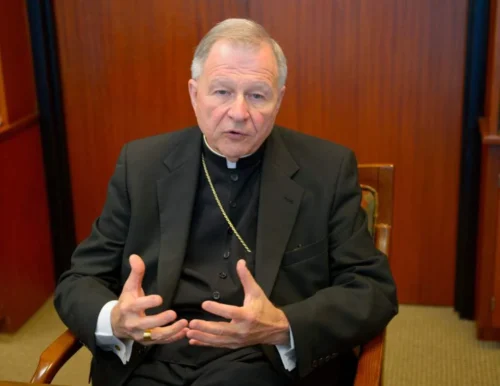
The partner of the late Labour MP David Cairns has said anti-gay remarks by the new Catholic Archbishop of Glasgow have added to his “grief and pain”.

Dermot Kehoe spoke after it emerged Archbishop Philip Tartaglia appeared to link Mr Cairns’ death to his sexuality.

The Roman Catholic clergyman made his remarks at a conference earlier this year on religious freedom and equality at Oxford University.

Archbishop-designate Tartaglia said he had not meant to cause offence.

Mr Cairns, who was Labour MP for Inverclyde and a former Catholic priest, died at the age of 44 in May last year.

He had been admitted to hospital in London a number of weeks before his death suffering from acute pancreatitis.

The controversial remarks by the then Bishop of Paisley were made in April in answer to a question from the university audience.

Without prompting, Archbishop Tartaglia raised the issue of the death of Mr Cairns, saying: “If what I have heard is true about the relationship between physical and mental health of gay men, if it is true, then society has been very quiet about it.

He [Archbishop elect Philip Tartaglia] is sorry for any hurt which has resulted, there was certainly no offence or judgement intended in his words”

Catholic Church spokesman for Archbishop Philip Tartaglia
“Recently in Scotland there was a gay Catholic MP who died at the age of 44 or so and nobody said anything and why his body should just shut down at that age, obviously he could have had a disease which would have killed anyone, but you seem to hear so many stories about this kind of thing.

“But society won’t address it.”

Mr Kehoe said the clergyman’s remarks had been made in complete ignorance.

He told BBC radio Scotland’s Good Morning Scotland programme: “The Archbishop elect brought up David Cairns himself. He wasn’t asked about him, he chose to bring him up and essentially he implied that David’s death was due in some way homosexuality and his being gay.

“This is not only in complete ignorance of the facts in this case.”

Mr Kehoe added that to take a personal tragedy and to make it political “was more than upsetting, it is deeply painful”.

He went on to say: “This has not only upset me and David’s family, but it added to our grief and pain and he [Archbishop elect Tartaglia] hasn’t shown any contrition for doing this.”

A spokesman for Archbishop Tartaglia said: “The Archbishop-elect’s words have been taken out of context.

“They were made in answer to an audience question at a lecture he gave on religious freedom in Oxford 14 weeks ago.

“He had no previous knowledge of the question, which was not related to his speech. In his reply he mentioned a situation he had been closely involved in, namely the funeral arrangements for the late David Cairns.

“The archbishop knew David Cairns, met him regularly at events in Inverclyde, and got on well with him, and was personally involved in his funeral arrangements. He is sorry for any hurt which has resulted, there was certainly no offence or judgement intended in his words.”

But Mr Kehoe rejected the clergyman’s apology.

Speaking to BBC Scotland he said the remarks had not been taken out of context.

Mr Kehoe said that in his view Archbishop Tartaglia was using the situation to “influence the government” to stop its plans for same-sex marriage.

He explained: “He [the archbishop] volunteered this information. It wasn’t something he was asked about specifically.

Dermot Kehoe says Philip Tartaglia should ‘show contrition’ for using David Cairns’ death to make a point about public policy
“It was something he had been cogitating about, and not only that, but he had also used it in an attempt to influence public policy.

“He’s taking a personal tragedy, he’s applying a layer of ignorance of the situation and prejudice on the top, and then trying to influence the government of Scotland with it.”

Gay marriage move
The controversy over the Catholic clergyman’s remarks come on the day the Scottish government announced plans to introduce same-sex marriage north of the border.

A Requiem Mass was held for Mr Cairns at his boyhood parish of St Patrick’s Church in Greenock.

The service was celebrated by Father John Morrison, who said that, as a politician, Mr Cairns “was a man of hope”.

The day before the funeral, former prime minister and high-profile Catholic Tony Blair delivered a reading at a special Mass at Mr Cairns’ former church in Clapham.

Complete Article HERE!

Psychologist: Bishops’ lashing out at sisters is a distraction

COMMENTARY — Kathy Galleher

Since the Vatican’s public release April 18 of the results of the doctrinal assessment of the Leadership Conference of Women Religious, many American Catholics have been confused and angry. These women, who work tirelessly with the poor and marginalized, whom many of us see as embodying Christ’s love, are being accused of doing grave harm to the church. In conversation after conversation, I have heard, “Why so much anger directed at women religious?”, “What is this about?” and “It just seems … abusive.” As I pondered this last observation, I recognized a familiar dynamic.

For nearly eight years I worked as a psychologist at a treatment center for priests and religious. During that time I worked with a number of men who had committed sexual abuse. An essential part of the therapeutic work was for these men to understand the deep pain they had caused, to accept responsibility for it, and to move forward with a commitment not to let it happen again, which included accepting restrictions and consequences. Often the largest obstacle to healing was the first task: accepting and understanding the amount of pain they had caused.

When we harm someone, healing requires that we recognize the extent of the injury we caused. Only when we are able to see this clearly and take responsibility for it can we respond with appropriate guilt. Appropriate guilt focuses us on how to repair the injury (if that is possible) and what actions we must take to prevent it from occurring again. If we cannot recognize the pain and take responsibility for it, we get stuck and assume an aggressively defensive stance, lashing out and blaming others as a way to deflect attention from our actions, actions we find too painful to look at honestly.

In treatment, when a client was stuck in this way, we would see this blaming/lashing-out dynamic, and he would start a fight. The greater the unacknowledged pain, the more furious the fight. Often the fury was directed toward a bishop or superior who was removing him from ministry. “You’re ruining my life,” he would say. “I feel betrayed. You have no idea how much pain you are causing me and you don’t even care.” Although he was the abuser, in his mind in that moment, he was the victim of the bishop or superior. The real victim had vanished from his awareness.

Fights like these were so provocative that the instinctive reaction of those on the receiving end was to respond with their own aggression. So the fight would escalate, take on more heat, and distract from the work at hand. As therapists, we tried to contain these fights and give them as little energy as possible (like depriving a fire of oxygen). Our job was to say, “This is a distraction. Let’s get back to work.” Then we would support the client in leaving the fight behind and returning to his unfinished work: looking deeply at his own pain, taking responsibility for the pain he had caused, and taking action to prevent it from occurring again.

I see strong parallels between this and the church’s dealings with LCWR. The level of anger and blame in the doctrinal assessment document feels like someone is picking a fight, and the intensity of it hints at the enormous amount of still unworked pain at the heart of the church’s sexual abuse crisis. To me, this fight looks like a distraction.

In the past 10 years, the church has taken steps toward responding to the tragedy of sexual abuse in the church at the individual level, including responding to allegations more quickly, involving law enforcement, and developing child protection policies. However, the church has not yet been willing or able to examine its own role as an institution in concealing and enabling decades of abuse. The bishops have not taken collective responsibility for their actions (and inactions) and for the enormous pain they have caused. As much as the abuse itself, it is this failure by the hierarchy to acknowledge and accept their responsibility that has angered and disillusioned so many current and now-former Catholics. Too much pain is still unacknowledged and unworked.

The church hierarchy seems to be stuck and they are blaming and lashing out. They have started a fight with LCWR and the women religious. In the doctrinal assessment, they have accused the women of the church of betraying the core values of the church, of causing scandal and leading the faithful astray, and of not being sufficiently trustworthy to reform themselves. They have ordered the women to be closely supervised. These accusations seem more rightly to belong to the sexual abuse scandal rather than to the actions of LCWR. It was the bishops who, by protecting sexual abusers, betrayed core values of the church and caused scandal to the faithful. It is the institutional church that appears not to be able to reform itself and to be in need of outside supervision.

This fight with LCWR is a distraction from the work the bishops still need to do in order to bring about genuine healing in the church.

In response to the misdirected accusations and the severe punishment directed at LCWR, many Catholics feel outraged and want to fight back. But as we saw above, to do so stokes the fire and continues the distraction. We can all be grateful to the women of LCWR for their powerful model of non-reactivity and reflection in their response to this situation. They have spoken their truth, but have not thrown wood on the fire. Similarly, public statements of support from men religious — notably the Franciscans — are courageous and direct but nonviolent. I hope that all of us will follow their lead — speaking our truth with courage and nonviolence, and, like the sisters, keeping our eyes on the real work we are called to do as a church.

It seems the moment to say clearly to the Vatican and to the bishops, “This fight with LCWR is a distraction. The women are not to blame. The church is not the victim. There is still a great deal of pain to address. Let’s get back to work.” Let us hope that with our prayers and support they will be able to look more deeply. Let us hope they can return to and complete the work that is still theirs to do, and in that way bring about healing and transformation for themselves and for our entire church.

Complete Article HERE!

Bishops, Oaths, and Conscience

Today’s Washington Post reports on a highly troubling story (Arlington Diocese parishioners question need for fidelity oath) about a rising trend in Catholic dioceses to require workers — including volunteers who teach religious education — to affirm some sort of “fidelity oath” in order to continue their work or ministry. The story ends with this:

The Rev. Ronald Nuzzi, who heads the leadership program for Catholic educators at the University of Notre Dame, said many bishops “are in a pickle.” They want Catholic institutions to be staffed by people who not only teach what the church teaches but whose “whole life will bear witness.”

Nuzzi said he keeps a photo on his desk from the 1940s that shows all the German bishops in their garb, doing the Nazi salute.

“I keep it there to remind people who say to do everything the Church says, that their wisdom has limitations, too.”

Anyone who fully understands and values the breadth and depth of Catholic Christianity must be appalled by this trend, especially when such oaths appear to be written in ways that clearly are contrary to Catholic teaching. What is more troubling, however, is the perspective expressed by some — both clergy and laity — who see no problem with such a practice.

Complete Article HERE!

Flaccid ‘Fortnight for Freedom’ fizzles for fathers

COMMENTARY – Fred Clark

The “Fortnight for Freedom” was a flop.

This was supposed to be a game-changer — the U.S. Conference of Catholic Bishops’ big display of political might. But instead it exposed the bishops as inept campaigners and as generals without an army.

I thought they’d be better at this sort of thing. They had some formidable assets to work with. For weeks ahead of time, Fortnight events were publicized and promoted in every diocese and every parish across the country. And they had some serious money to work with thanks to deep-pocketed (anonymous) donors. They even got a big boost of support from their allies in the evangelical religious right.

But still, it flopped. Big time.

This two-week extravaganza was supposed to redefine the political conversation, but instead it went mostly unnoticed and unattended. It was supposed to show massive grassroots support for the bishops’ contention that allowing women to purchase comprehensive health insurance constitutes an intolerable threat to the religious liberty of employers who wish to prohibit that. But instead it showed, definitively, that there is no grassroots support for that strange argument.

The bishops declared themselves the grand marshals of what was to be a glorious parade, but no one showed up to march behind them and only a meager handful turned out to line the route as spectators.

It was pathetic, really. A bunch of nuns on a shoestring-budget bus tour drew more enthusiasm and more support for their polar-opposite message. For all the millions spent and all the weeks of elaborate, top-down fanfare, the Fortnight for Freedom came and went almost without notice.

“Oh, right, the bishops’ big rally, when is that again? Oh, it happened already? Oh.”

Yawn.

All that time and money invested and almost nothing to show for it.

Part of what we learned here, I think, is that if you’ve got a top-down, hierarchical mentality that regards listening to anyone else as beneath you, as an affront to your righteous authority, then you’re probably not well-suited to rallying grassroots support. When that arrogant mentality shapes your outlook, it seems, you’re probably not even capable of recognizing that you’ve utterly lost all grassroots support.

The bishops did their best to put a happy face on their embarrassing fortnight of failure. “Thousands rally in Washington,” one press release said. And that was true — “thousands” plural because two is a plural number. The largest Fortnight event drew about 4,000 — or, in other words, it was a bit smaller than the crowd at a Bowling Green Hot Rods game on Fireworks Night. (Yes, the Rays’ single-A farm team may outdraw the bishops despite a much-smaller PR budget, yet as far as I know the Hot Rods are not making any claims that this gives them the right to dictate national policy to the president.)

By the end of the fortnight, the affiliated Republican effort “Conscience Clause” had also collected 6,000 signatures for a petition in support of the bishops — or nearly half the number of signatures collected so far in the “Save Pan Am” campaign to get ABC to revive that failed show.

The Fortnight for Freedom was a failure. I suppose, though, that it did succeed in at least one way: providing a handle for plenty of insightful commentary on the bishops’ demands for religious privilege and their increasingly partisan political activism. A sampling of some of that commentary below the jump.

Jessica Coblentz: “Fortnight for Freedom: Whose Religious Liberty?

In the reaction against Fortnight for Freedom, some are responding to the bishops on their own terms. If the campaign is about religious liberty, they ask, then whose liberty is at stake? The bishops present the Catholic exercise of religious liberty as the ability to reject the use of contraception, or at least the financing of insurance plans that cover contraceptive services. The irony, to those on the other side, is that a campaign meant to promote religious liberty actually denies the religious freedom of many Catholic women, who rely on their personal religious convictions to determine their stance on contraception and the mandate. Studies show that as many as 98 percent of sexually experienced American Catholic women over the age of 18 have used contraception. A recent PRRI/RNS poll reports that a majority of American Catholics do not see the contraception mandate as a threat to religious freedom, indicating that many hold a broader understanding of religious liberty than the bishops maintain. The debate surrounding the mandate, then, is not only about contraception and religious liberty. It is also about who gets to define religious liberty’s very meaning.

… Critics of the bishops’ current battle can call on this Catholic history of religious liberty and individual freedom. In their view, women’s choices are an issue of religious liberty — not merely a threat to it. Still, who defines religious liberty remains a matter of authority — and a highly gendered one at that. When the USCCB conveys that the rejection of contraception is the only religiously-motivated choice that warrants the protection of religious liberty among Catholics, they assert the message that only church leaders have the authority to determine what counts as religious behavior. This strips other Catholics of the legitimate authority to negotiate their tradition when determining their own religiously-motivated actions. What is more, so long as the all-male Catholic clergy solely possess the authority to identify what does and does not constitute a free, religiously-motivated choice worthy of legal protection, women have no official authority in Catholic religious liberty conversations whatsoever. As it stands, the religious decisions and actions of all Catholics other than clergy — be they for or against contraception and contraceptive coverage — are seemingly insignificant in “Catholic” concerns about religious liberty.

… The bishops, or anyone for that matter, need not theologically condone the contraceptive decisions of Catholic women in order to recognize them as exercises of free, religious choice. Yet the current rhetoric of the USCCB’s “Fortnight for Freedom” campaign does not. … If the bishops continue to exclude so many American Catholics from their representation of religious liberty — notably, the majority of Catholic women — the USCCB fails in its own stated aim to protect the religious liberty of all.

Katherine Stewart: “How Corrupt Catholics and Evangelicals Abuse Religious Freedom

In the writings and speeches of Catholic bishops and evangelical leaders in recent months, “religious freedom” has come to mean something close to its opposite. It now stands for “religious privilege.” It is a coded way for them to state their demand that religious institutions should be allowed special powers that exempt them from the laws of the land.

… This is a war of conquest, designed to expand the power of religious institutions at the expense of the rest of society and the state. It is about carving out an even larger share of the special privileges and exemptions that are already made available only to organized religious institutions.
Such privileges are already substantial. Religions already receive hefty subsidies – by some estimates, as much as $71bn a year – through broad tax exemptions, deductions, and faith-based government programs. A “ministerial exemption” allows them to hire and fire people directly involved in religious activity without regard to anti-discrimination laws.
But they want more. And they are willing to turn the meaning of the word “persecution” on its head to get it.

Sally Rasmussen: “The Bishops on Religious Freedom: ‘We Get More Than You’

The Catholic bishops have been talking a lot recently about the First Amendment. They’ve made the remarkable claim that their tradition is a source of First Amendment freedoms, but their interpretation of such freedom is that it should shield them from prosecution for collaborating in the sexual abuse of children, at the same time that they are doing their best to deny freedom of religion, speech, and assembly to American nuns. Nor do they believe in freedom of conscience for the Catholic Church which is the people of God – a Church that has thoughtfully concluded that contraception is morally acceptable.

Mark Silk: “Religious Freedom, Becket Style

I can’t help suspecting that the bishops’ rage against the contraception mandate is actually displaced anger at losing their de facto power to decide the fate of sexually abusive priests.

The real lesson of the conviction of Msgr. William Lynn in Philadelphia last month and the impending trial of Bishop Robert Finn in Kansas City is that if church authorities don’t behave like secular executives when confronted with a subordinate suspected of abuse, then they too will be criminally prosecuted. Archbishop Becket would have considered that an assault on his religious freedom. No one in America can do so anymore, Fortnight or no Fortnight.

Complete Article HERE!

Woman Says ‘Exorcist’ Priest Abused Her

A Roman Catholic priest “kissed (a woman) on all parts of her body” during a so-called “exorcism” session, and “frequently explained full, passionate kisses as ‘blowing the Holy Spirit into’ her,” the woman claims in court.

Jane Doe sued the Catholic Diocese of Arlington, its Bishop Paul Loverde – who is not the priest accused of the abuse – and Human Life International and the HLI Endowment Inc., of Charlottesville, in Arlington County Court.

Doe claims she was sexually abused repeatedly by her “exorcist,” Thomas J. Euteneur, who was president of Human Life International and the HLI Endowment; Euteneur, however, is not named as an individual defendant.

Doe claims that Euteneur, a Roman Catholic priest, offers “‘spiritual deliverance’ and the performance of the rite of exorcism,” and did it “with the knowledge and consent of the Diocese and the Most Rev. Paul S. Loverde. … On at least one previous occasion, the Diocese and Bishop Loverde gave permission to Euteneur to conduct an exorcism within the Diocese.”

Doe claims that the defendants know that exorcism could be “potentially dangerous to the participants.” She says: “The defendants knew that a basic principle in the administration of an exorcism is that the priest should never act alone, and that he should always be accompanied by a support team who have been duly prepared to assist him.”

Doe says that her relationship with Euteneur began on Feb. 28, 2008, when she signed “a document entitled ‘Agreement for spiritual help.’ Among many other things, the document defines ‘deliverance’ as ‘the application of the spiritual resources of the Church to persons with demonic infestation in order to liberate them from the influence of unclean spirits.’”

Euteneur became her “deliverance minister,” and “The aforementioned documents included a requirement of ‘complete cooperation’ and travel to Euteneur’s offices at HLI,” according to the complaint.

Doe says that Euteneur told her “that her case was ‘severe.’”

For two months he touched her “in appropriate ways” in his offices, then in April 2008 told her “that he had received permission from the Diocese to perform the rite of exorcism,” Doe says.

On April 11, 2008, she says, “Euteneur began to hug the plaintiff while saying, ‘I wish I could go a lot further.’ He carried the plaintiff into a guest residence bedroom at HLI and HLIE, laid her on the bed, embraced her, touched her under her bra, and attempted to touch her under her underclothes, which the plaintiff stopped. Euteneur spent the entire night in bed with the plaintiff.

“During the following weeks, during every meeting, Euteneur became progressively persistent in touching the plaintiff inappropriately. He kissed the corners of her moth; stroked her legs, breasts and thighs; caressed her face; laid his body on top of hers; and frequently explained full, passionate kisses as ‘blowing the Holy Spirit into’ her.”

From April to June that year, on six occasions, Doe says, Euteneur “directed the plaintiff to undress; touched and kissed the plaintiff on all parts of her body; and digitally penetrated the plaintiff’s vagina. In addition, Euteneur directed the plaintiff to touch his penis.”

Doe claims that Euteneur “knew that his sexual violations on the plaintiff were not committed with her consent” and “would cause severe emotional distress to the plaintiff.”

Doe claims that HLI hired her as an independent contractor in September 2008, hired her as full-time employee in March 2010, and that during all this time, until June 2010, Euteneur “sexually abused her during working hours and in various rooms at HLI and HLIE headquarters.”

Doe claims that when she told Euteneur she had kept a journal “that she had kept a private journal which covered her time spent with Euteneur,” he persuaded her to “entrust the journal to him for safekeeping” while she took a vacation in Hawaii with her family.

She claims Euteneur “flew to Hawaii and secretly met with the plaintiff every morning while she was there.”

She claims that before she returned, Euteneur went to her home in Virginia “for the purpose of finding and collecting any and all other journals that the plaintiff might have kept. His attempt was unsuccessful.”

And, she claims, when she returned and asked for her journal back, “Euteneur reported that he had burned the journal ‘because it would scandalize the public and harm HLI.’”

After a final, abusive “deliverance,” Doe says, she concluded that her treatment was “illegal, inappropriate, outrageous, harmful, and completely contrary to the dictates of her understanding of Roman Catholic beliefs and practices.”

She claims she gave another priest in the Diocese a “detailed description of her relationship with Euteneur,” but Euteneur remained at HLI and HLIE for 2 more months, during which he sexually violated her two more times.

Finally, in August 2010, Euteneur resigned as president of HIL and HLIE and “was recalled to the Diocese of Palm Beach, Florida,” according to the complaint.

It continues: “On January 31, 2011, Euteneur published a statement in which he wrote: ‘I must acknowledge, however, that one particularly complex situation clouded my judgment and led me to imprudent decisions with harmful consequences, the worst of which was violating the boundaries of chastity with an adult female who was under my spiritual care.’”

She seeks punitive damages for assault, battery, intentional and negligent infliction of emotional distress, negligent entrustment, medical bills, and loss of enjoyment of life.

Complete Article HERE!

“Bad Spirit” invited to the Vatican

by digby

So the Catholic hierarchy decided it needs some professional PR help, what with all the bad press it’s had what with the pedophilia, nun-hating and other throwback policies and the like. Adele Stan reports that they’ve decided to hire a professional:

This weekend the Vatican announced its hire of Fox News correspondent Greg Burke for the newly created role of communications strategist…

Burke’s authoritarian bona fides hardly end with Fox News. He’s also a member of Opus Dei, the secretive, misogynist, elitist Catholic cult embraced by the late Pope John Paul II. And he’s not just a member, he’s a special member — a “numerary,” a position described by the Religion News Service as “a celibate layman who lives at an Opus Dei center…” The Opus Dei domicile at which Burke resides is in Rome.

Both men and women can bear the title of numeracy, but men enjoy a privileged position in their sex-segregated housing, where they are served by the women. A 1995 article in the Jesuit magazine, America, described the life of the female Opus Dei numerary this way:

According to two former numeraries, women numeraries are required to clean the men’s centers and cook for them. When the women arrive to clean, they explained, the men vacate so as not to come in contact with the women. I asked Bill Schmitt if women had a problem with this. “No. Not at all.” It is a paid work of the “family” of Opus Dei and is seen as an apostolate. The women more often than not hire others to do the cooking and cleaning. “They like doing it. It’s not forced on them. It’s one thing that’s open to them if they want to do it. They don’t have to do it.”

“That’s totally wrong,” said [former numerary] Ann Schweninger when she heard that last statement. “I had no choice. When in Opus Dei you’re asked, you’re being told.” According to Ms. Schweninger, it is “bad spirit” to refuse. Women are told that it is important to have a love for things of the home and domestic duties. “And since that’s part of the spirit of Opus Dei, to refuse to do that when you’re asked is bad spirit. So nobody refuses.”

It’s hard to imagine Greg Burke finding a way to sell that mentality to the media as a good thing — never mind the fact that Opus Dei members are devoted to “mortification of the flesh” by wearing cilices, metal chains with spikey prongs that the wearer fastens tightly to the thigh, prongs to flesh.

This is the really funny part. You’ll recall that I wrote last week about the high level cardinal who said that everyone was believing in Dan Brown conspiracy theories (which were the work of the Devil)?

With an apparent lack of self-awareness, Vatican Secretary of State Cardinal Tarcisio Bertone “accused the media of trying ‘to imitate Dan Brown’ in their coverage of the VatiLeaks scandal,” according to Reuters. In Brown’s conspiracy thriller, The DaVinci Code, Opus Dei is a major player in a Vatican conspiracy. In hiring Burke, it’s almost as if the Vatican was looking to feed the fantastic conspiracies of Brown and his fellow travelers. You could call that an epic PR fail.

I always thought that Dan Brown stuff was nuts. But maybe not …

Complete Article HERE!

Catholic bishop faces Vatican’s wrath after he’s busted cavorting with a scantily-clad beauty on the beach

Argentine Bishop Fernando María Bargallo red-faced after footage emerges

Initially denied he was in video, but later admitted he played starring role
Now under investigation by the Vatican and could be de-frocked

A Catholic bishop busted cavorting on a beach with a scantily-clad beauty has claimed she is just ‘an old friend’ and insisted he is still ‘devoted to God’.
Argentine Fernando María Bargallo, 59, was left red-faced after footage emerged of him swimming and cuddling with the blonde at a secluded luxury Mexican hideaway.
He initially denied it was him in the video, but later admitted he does play a starring role, and is now under investigation by the Vatican.

He could now face being sacked from his post as Bishop for the Roman Catholic Diocese of Merlo-Moreno, a suffragan of the Archdiocese of Buenos Aires.
Bargallo said he recognised the ‘recklessness’ of his behaviour and the ‘ambiguity’ of the film, which he claimed was taken in 2011.

But he has insisted that the woman was a ‘very old friend’ who he has known ‘since I could reason’.
He said: ‘The photographs are, in effect, from an encounter in Mexico where I coincided for various reasons, two years ago, with a friend from my childhood.’

He said there were other people there, who did not appear in the images, and he had a strong relationship with the woman’s family, La Nacion reported.
But he has not responded to questions as to who funded the lavish trip to the Puerto Vallarta resort on Mexico’s Pacific coast.
Bargallo is also head of the Cáritas Latinoamérica organisation which helps the development of impoverished people across the continent.

Complete Article HERE!

Gerald T. Slevin: The Jury Has Spoken! Will the Pope Now Speak?

In Philadelphia today, the jury in the Philadelphia abuse trial found Msgr. William Lynn guilty of child endangerment. Brian Roewe reports on this story at National Catholic Reporter. Jerry Slevin, a Harvard-trained lawyer who has closely followed this trial, has sent the following powerful statement about the verdict:

A Philly jury, that included several Catholics, has found a former top aide to two prominent Philly Catholic Cardinals guilty of endangering children who were sexually assaulted by predatory priests as described here and here.
The Cardinals’ aide, Monsignor Lynn, offered as his main defense that he was only following the Cardinals’ orders pursuant to the Philadelphia Catholic Archdiocese’s massive child abuse cover-up program that continued for decades until as late as last year at least.

The Cardinals had very close ties to the Vatican. One of them, Cardinal Rigali, worked closely with the current pope in Rome for over a decade and was St. Louis mentor for New York’s Cardinal Dolan, head of the American bishops.
The trial revealed in detail a cover-up program that appears to be standard operating procedure in the Catholic Church worldwide.

Will the pope now address this disgrace openly, honestly and effectively? He clearly has failed to do so in the past.

The many ties of the Philly Cardinals to the Vatican are described here.
The challenges the Philly disclosures recently presented for the U.S. bishops are described here.

Several weeks ago U.S. bishops met and had the opportunity to revise their national child protection program to meet these challenges. The bishops, however, failed once again to do so, as U.S. bishops still are not fully accountable for protecting children in their care. The bishops merely continued the policies that a Philly jury has now found to have failed.
The Philly verdict also indicates that the Vatican’s current strategy is doomed to fail as noted here.

It is now quite clear that the Catholic hierarchy is either incapable or unwilling to protect American children, over 100,000 of whom have been sexually abused by predatory priests according to the Vatican’s own experts’ estimates at a recent Vatican conference. That number considerably exceeds the combined U.S. casualties and fatalities from the Iraq and Afghanistan wars. It also represents a number of abused that is equivalent to well over several thousand times all of Jerry Sandusky’s estimated victims.

Will Obama, Romney, Biden, Boehner, Reid, McConnell and Pelosi finally do their duty to protect American children and adopt effective national laws and enforcement policies to protect children from this national scourge?
Ireland is doing it. Why not the U.S. as well?

Complete Article HERE!

Nuns’ leader decries church environment of fear

The leader of the group representing most American nuns challenged the Vatican’s reasons for disciplining her organization, insisting that raising questions about church doctrine should not be seen as rebellion.

Sister Pat Farrell, president of the Leadership Conference of Women Religious, said Monday that Catholics should be able to search for answers about faith without fear.

“I don’t think this is a healthy environment for the church,” Farrell said in a phone interview. “We can use this event to help move things in that direction – where it’s possible to pose questions that will not be seen as defiance or opposition.”

Farrell’s remarks are her first since she met last week in Rome with the Vatican orthodoxy office, the Congregation for the Doctrine of the Faith, which concluded in April that the group had strayed broadly from church teaching. The Vatican has appointed three American bishops to conduct a full-scale overhaul of the organization, sparking protests globally in support of the sisters.

In the Rome meeting, Farrell said she did not ask Vatican officials in to drop their demand for reform. “I think we could clearly see in the tenor of the conversation that that was not an option,” she said. She characterized the meeting as frank and open but difficult, and said she did not leave the talk feeling any more hopeful about what’s ahead.

The Vatican has directed the three American bishops to oversee rewriting the statutes of the Leadership Conference, reviewing its plans and programs including approving speakers, and ensuring the group properly follows Catholic prayer and ritual.

“I don’t yet feel that we’re any further than just the initial conversation,” Farrell said.

The Leadership Conference of Women Religious, based in Silver Spring, Md., represents about 80 percent of the 57,000 U.S. nuns.

After an investigation starting around 2008, the Vatican office concluded that the nuns’ group had failed to emphasize core teaching on abortion, while promoting “certain radical feminist themes” that undermine Catholic teaching on the all-male priesthood, marriage and homosexuality.

The Leadership Conference has called the claims unsubstantiated and the investigation flawed. Farrell said the Leadership Conference “cooperated to the best of our ability” with the doctrinal assessment, but said the group was not shown the final report before it was sent to the Vatican.

Vatican officials and U.S. bishops have stressed that its report targeted the leadership organization, not individual orders of religious women. But in a statement Monday, the board of the Leadership Conference said the Vatican crackdown had been felt by “the vast majority of Catholic sisters” and lay Catholics globally. At a meeting last week of the U.S. Conference of Catholic Bishops in Atlanta, protesters presented church leaders with petitions signed by more than 57,000 people condemning the Vatican inquiry.

Farrell said the nuns’ group would decide its next steps in regional meetings that will culminate in a national assembly in August.

Complete Article HERE!

Perhaps we need some help with PR, say Catholic bishops in U.S.

File Under: Ya don’t say!

There’s no doubt that America’s Roman Catholic bishops have had their share of what might quaintly be called bad press. The priest sex-abuse scandal, a Vatican crackdown on nuns, a head-knocking fight with the president of the United States over contraceptive coverage — none of these would qualify as good news.

On Thursday, the bishops said they’ve had enough. It is time, they said, to beef up their public relations arsenal.

“We need more help and sophistication in our messaging,” said Cardinal Sean O’Malley of Boston, who decried the “latest debacle” of bad PR over the treatment of American nuns (which involves an investigation by the Vatican, not the American bishops).

O’Malley observed ruefully that when John Jay College released a landmark study last year of the causes and handling of the church’s sex-abuse crisis, it “should have been a good moment for the church, and yet it was another black eye.”

His comments followed a report to the U.S. Conference of Catholic Bishops from Bishop John Wester of Salt Lake City, who heads the bishops’ communications committee. The bishops are holding their annual spring meeting in Atlanta this week.

Wester said it was time for the bishops to fully embrace the 21st century array of communications tools, and “take a good, hard look” at how well they communicate their message.

Cardinal Donald Wuerl of Washington, D.C., suggested the not-quite-revolutionary idea of hiring a spokesperson, someone who “can speak for all of us.” Several other bishops hailed the idea, although Cardinal Timothy Dolan of New York, the president of the conference, noted that there was an “ecclesial” problem with the idea, since all bishops have authority to speak for the church and therefore, theoretically, other bishops can’t speak for them.

Be that as it may, the bishops at least have a new way to talk to each other: Wester announced the creation of an exclusive, closed social network open only to American bishops.

He didn’t say what the new network would be called, which seemed to present a ripe opportunity for late-night comedians. Bishop Timothy Doherty of Lafayette, Ind., was the first to attempt to drive through the opening.

“I assume people in the room have already trademarked the phrases i-bishop and e-bishop,” he quipped (perhaps proving why he is a bishop and not a late-night comedian).

Complete Article HERE!