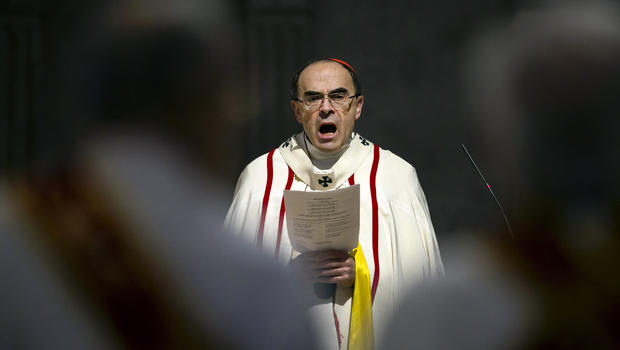
Cardinal’s presence felt at Pa. church-abuse trial

Cardinal Anthony Bevilacqua died just weeks before his longtime aide went on trial in the alleged cover-up of sexual assaults by priests within the Roman Catholic Archdiocese of Philadelphia.

Yet Bevilacqua is very much the ghost inside courtroom 304 at the Philadelphia Criminal Justice Center. Rarely an hour goes by that his name is not invoked.

Witnesses portray him as a regal, sometimes feared authoritarian figure: “the man at the top,” in the words of city detective Joseph Walsh.

After eight weeks of evidence, prosecutors trying to convict Monsignor William Lynn of child endangerment rested Thursday without showing the videotaped deposition Bevilacqua gave two months before his Jan. 31 death. He was 88, and battling cancer and dementia. And he claimed to remember few details of the scores of abuse complaints that came in under his watch, according to a defense motion.

Yet since his death, prosecutors have learned the cardinal ordered two confidantes to destroy a 1994 list Lynn had prepared of 35 problem priests.

The list warned the cardinal they had three diagnosed pedophiles, a dozen confirmed predators and at least 20 more possible abusers in their midst.

Bevilacqua promptly had the list shredded, according to a memo signed by his loyal aides, current Bishop Joseph R. Cistone of Saginaw, Mich., and now-retired Bishop Edward Cullen of Allentown, Pa.

“It was all about the good of Mother Church,” Assistant District Attorney Patrick Blessington argued to the trial judge Thursday. “It’s not only criminal, it’s outrageously criminal.”

Lynn was the point person for abuse complaints in his role as secretary for clergy from 1992 to 2004. He had little training for the job.

“I thought I was dealing with them adequately,” Lynn told a grand jury in 2002, when prosecutors started investigating the archdiocese. “I didn’t get any direction.”

Ten years later, jurors have seen nearly 2,000 documents subpoenaed from secret church archives, an astonishing cache that was long protected by locks, keys and door alarms.

They have also heard from former altar boys, and men and women who worked in rectories growing up, who said they were raped or fondled for years.

Prosecutors call Lynn a key player in developing the archdiocese’s response to the complaints. Typically, that meant taking statements from the accused and accuser, typing up memos, and sometimes sending a priest for counseling before he was transferred to a new parish.

Lynn’s defense lawyers have at times called their client a mere “scrivener” who carried out Bevilacqua’s orders. And even prosecution witnesses agreed the cardinal ultimately decided priest assignments.

Jurors also heard what happened if a pastor refused to take one of the bad apples. Monsignor Michael Picard of Newtown testified that he was called down to meet with Bevilacqua about his “disobedience” in 1996. He spent 14 years “in the penalty box,” denied the title of monsignor.

The evidence paints Lynn, by comparison, as a company man, dutiful and compliant. He alone now faces more than 20 years in prison if convicted.

“I’m not a lawyer. I don’t know whether he broke the law. But he certainly did not do the honorable thing,” said the Rev. Thomas Reese, a senior fellow at the Woodstock Theological Center at Georgetown University. “He should have looked Bevilacqua in the eye and said, `You can’t do this. This is wrong, and I’m not going to be part of it.’”

The cardinal, trained in both canon and civil law, made 10 combative appearances before the grand jury in 2003 and 2004, accompanied by high-priced counsel. Prosecutors blasted Bevilacqua in their 2005 grand jury report, but said they couldn’t charge him because the statute of limitations had run out on the accusations.

A second grand jury last year complained there were still dozens of accused Philadelphia priests in ministry. Armed with new complaints and revised laws, prosecutors charged three priests and a teacher with sexually assaulting two boys in the 1990s. They charged Lynn with two counts each of child endangerment and conspiracy.

“You don’t care about the boys. You care about the business of the church,” Blessington said Thursday about the lead defendant.

Common Pleas Judge M. Teresa Sarmina dropped one of the conspiracy charges when prosecutors rested, finding insufficient evidence Lynn had conspired with the Rev. James Brennan to keep him in ministry. Brennan is also on trial, charged with molesting a teenager in 1996. Defrocked priest Edward Avery pleaded guilty to a 1999 sexual assault, and is serving a 2 1/2- to five-year term.

The defense starts its case Tuesday, with Lynn’s former assistants and several character witnesses expected to testify. It’s not clear whether Lynn will take the stand.

The jury is expected to get the case in about two weeks – presumably, without ever hearing the sealed testimony of “the man at the top.”

Complete Article HERE!

Accused priest told therapist of attempted gang rape at Philadelphia seminary

A Catholic priest admitting a sexual relationship with a teen said he had been the victim of an attempted gang rape by fellow seminarians, according to testimony in a clergy-abuse trial.

Testimony on Monday also mentioned Pope Benedict XVI, who weighed in on the priest’s 2005 censure when he was a Vatican official known as Cardinal Joseph Ratzinger.

Documents show the priest had admitted to the Philadelphia archdiocese in 1992 that he had sex with the high school student for several years. An archdiocesan treatment center concluded the priest was not a pedophile, but was affected by his “traumatic sexual development.” He remained in ministry for another decade.

It’s not clear if the trauma reference was to the alleged seminary assault. The priest told a therapist he had been tied down by several seminarians who tried to rape him and that a friend came to his rescue. But the same friend later twice abused him, the priest told the therapist, according to documents read in court.

The Associated Press is not naming the priest, who graduated from seminary in 1974, because he may be a sexual-assault victim.

The testimony came in the child-endangerment trial of Monsignor William Lynn, the longtime secretary for clergy in Philadelphia. Prosecutors say he helped keep dangerous priest-predators in jobs where they could continue to abuse children.

The priest discussed Monday stayed in active ministry until the national priest-abuse scandal broke in 2002. His ministry was supposed to be strictly supervised so he was not alone around adolescent boys, but he lived alone in a parish rectory in Lower Merion one year, and had little if any supervision after leaving the hospital in 1993, prosecutors allege. He remains a priest today, but lives a private life of “prayer and penance.”

On cross-examination, defense lawyer Jeffrey Lindy noted that Lynn got the priest to admit to the sexual relationship with the teen the same day the complaint came in to Lynn in 1992, and soon had him being evaluated. However, a detective on the stand noted that police, had they gotten such an admission, would have pursued criminal charges.

Neither the priest’s admission — nor the scores of other abuse complaints brought to the archdiocese from 1948 through the 2005 grand jury report — were ever referred to police or prosecutors.

The priest’s alleged victim had disclosed the abuse to another priest during marriage preparation. That priest and the fiancee — by then the accuser’s ex-girlfriend — went to the archdiocese in July 1992. Lynn’s office never tried to interview the accuser.

There was no follow-up testimony Monday on the seminary rape allegation. The Philadelphia archdiocese runs St. Charles Borromeo Seminary, but can’t comment because of a gag order.

Meanwhile, Lynn’s lawyers are preparing for a potential showdown this week with a key trial witness.

A man who said he was raped by two priests and his fifth-grade teacher at a northeast Philadelphia parish is scheduled to testify Wednesday.

The defense wants to challenge his credibility. But if they do, the judge is likely to let jurors hear that one of the priests has pleaded guilty.

Defrocked priest Edward Avery, 69, pleaded guilty days before trial to sexually assaulting the northeast Philadelphia altar boy in 1999. He is now in prison, serving 2 1/2 to five years for sexual assault and conspiracy.

Judge M. Teresa Sarmina is also pondering whether jurors can hear that five other people have come forward since 2010 to say Avery molested them as children. Defense lawyers say those allegations are beyond Lynn’s control, since he left office in 2004.

But Assistant District Attorney Patrick Blessington said Lynn left “a powder keg” in place after the first complaint was filed in 1992.

“Lynn put a powder keg out there whose name was Avery. If that powder keg explodes, a kid gets raped,” Blessington said.

Complete Article HERE!

“VATICAN FALLS” Benefit

Staged Reading of Controversial New Play To Benefit
SNAP (Survivors Network of those Abused by Priests)

“VATICAN FALLS” by Frank J. Avella (author of “CONSENT”) Directed by Laura Caparrotti (Founding Director of Kairos Italy Theater)
May 15, 2012 at 6:45PM at the National Comedy Theatre

New York, NY (April 3, 2012) Impetus Ensemble is proud to present a special presentation of this ambitious new play set against the backdrop of the Catholic sex abuse scandal.

Based on factual material, “VATICAN FALLS” follows the life of one survivor who struggles with understanding how those closest to him could damage him the deepest. The multi-genre, non-linear play probes the conflicting feelings involved in most sexual abuse situations and dares to confront the truth about the ever-growing scandal and the Church’s complicity in it.

“VATICAN FALLS” was set to have its World Premiere in Rome, Italy, last May but was cancelled the night before opening amidst controversy and claims of death threats. This will mark the first U.S. presentation of the play to an audience since the last workshop in 2010.

Recent headline news reports about the Catholic Church putting legal pressure on SNAP to hand over more than two decades of confidential information has put the group at the forefront of a major battle with Vatican attorneys wishing to silence them once and for all. SNAP is holding steadfast in their efforts to protect the privacy of victims, witnesses–even journalists who have come to them for help in the past. All proceeds from this Benefit will go directly to these brave men and women. We hope to raise awareness about the real facts concerning the scandal and about this very important group that has provided a safe haven for survivors since 1988. SNAP recently filed a lawsuit against the Vatican for crimes against humanity.

“VATICAN FALLS” features: Francesco Andolfi, Carlotta Brentan, Drew Bruck, Matthew Crooks, Carlos Dengler, Joshua Dixon, Lucia Grillo, Kalen J. Hall, Liza Harris, Devon Talbott & Rob Ventre. Stage Directions: Cali Gilman. Musical Director/Arranger: Brad Gardner. Songs written by Claudio Procopio & Frank J. Avella.

The National Comedy Theatre is located at 347 West 36th St. (between 8th & 9th Aves), NYC. Tickets range from $20 to $50. Reservations via: VaticanFalls.com or call 973-715-2356.

Frank J. Avella (Author) recently completed Nemesis, The Mad Ones & Consent, a semifinalist for the O’Neill Playwrights Conference. Consent will be workshopped at the Celebration Theatre in West Hollywood, CA this Fall. Frank is currently working on his 17th full-length play and adapting Consent for the screen. Seven of his works have been produced in NYC (Unhinging, 3 Cains, Michael’s #1 Fan, Lexy, About Christine, The Bubble, Greener); one was produced in Cincinnati (Iris). Frank did his Grad work in Cinema Studies & Dramatic Writing at NYU’s Tisch School of the Arts. He is a film journalist for newyorkcool.com and a proud member of the Dramatists Guild.

Laura Caparrotti has a Master Degree in Performing Arts, Cinema and Theatre History from the University “La Sapienza” in Rome. She also studied with Nobel Prize Dario Fo, among others. After ten years of professional theatre in Italy, she relocated to New York, where she continues to direct and/or perform. She is the Founding Artistic Director of the Italian Theater Company in NY Kairos Italy Theater.

Diocese settles civil suit for $3.75 million

The Diocese of Stockton has settled a civil lawsuit and will pay $3.75 million to a plaintiff who accused removed priest Michael Kelly of sexually molesting him.

After obtaining one of the diocese’s largest-ever individual settlements for sexual abuse, the plaintiff named in court papers as John TZ Doe identified himself as Travis Trotter.

Trotter, of Fairfax, was an altar boy at Cathedral of the Annunciation in Stockton under Kelly’s direction more than 20 years ago. He said he recovered memories of the abuse years later and that the emotional fallout has prevented him from working as an airline pilot.

Trotter revealed his name to encourage other abuse victims to come forward and begin the healing process, he said.

“I wasn’t able to be strong as a child,” Trotter, 37, said Friday at University Plaza Waterfront Hotel in Stockton. “I finally took care of that little boy inside me.”

Trotter filed suit, his attorneys said, since the statue of limitations didn’t allow for a criminal trial.

Church officials agreed to pay to avoid further litigation after a jury on April 6 found Kelly liable of sexually assaulting Trotter.

Kelly, who had taken the stand once, departed to his native Ireland – citing health reasons – two days before he was scheduled to testify in the phase of the trial that focused on the diocese’s liability.

The diocese had to consider the jury’s verdict against Kelly and the priest’s departure in deciding whether to settle or continue arguing, said defense attorney Jim Goodman of San Francisco.

“We just felt it was in the best interest of everybody to bring the second phase of the trial to an end,” Bishop Stephen Blaire said, adding the settlement isn’t an admission of negligence on the diocese’s part.

“I don’t think a settlement in any way conveys anything other than an agreement, and I would hope people would not take it that way,” he said.

Jury members found Kelly liable after seven weeks of testimony. Because it was a civil trial, Trotter’s legal team did not have to prove beyond a reasonable doubt abuse had occurred; they had to prove it was more likely than not that the molestation and rape occurred.

“This case has always been (based) on no hard evidence,” said David Edwards, who served as jury foreman.

Edwards of Tracy said the jury looked at complaints by various parents at different parishes where Kelly served.

“For me there just was just too much inappropriate behavior by Father Kelly,” said Edwards, 47. “It was just too hard to dismiss.”

Jurors also considered that some church staff, who became mandatory reporters in 1998 by law, testified that had the complaints taken place at this time, versus 20 years ago, they would have reported the incidents to law enforcement for further investigation.

After the settlement was announced Friday, some of the jury embraced Trotter and his family.

Most headed to a news conference to learn more about Trotter.

At the conference, John Manly, Trotter’s lead attorney, urged law enforcement officials to investigate the diocese’s handling of clergy sexual misconduct.

Blaire said the diocese has clear procedures and policies for investigating allegations, including a review board made up of community members, law professionals and abuse survivors.

“If anybody wants to come in and examine the way we conduct our investigations, I welcome them to do that,” Blaire said.

Blaire said the diocese already has education and training programs for personnel and for youth.

“But I think this will be an opportunity to review all of that. If we need to make some improvements, we can do that.

“We’re always concerned about the impact of these kinds of situations on parishioners. What is most important to me is to reassure them that our No. 1 concern, our No. 1 priority, is the safety and the protection of our young people.”

Now, Blaire said, he must reach out to the people of St. Joachim’s Church in Lockeford, Kelly’s last parish, where he was highly supported.

The priest, who is presumed to be in Ireland, is still under investigation by the Calaveras County Sheriff’s Office for sexual abuse allegations from when he served at St. Andrew’s Catholic Church in San Andreas a decade ago.

Although the investigation was opened when a former altar boy reported being abused, it continues because investigators have identified additional alleged victims and need to conduct additional interviews, said Sgt. Chris Hewitt, a department spokesman.

“When we first learned of the accusations, it was reported to the Calaveras sheriff,” Blaire said. “That was several months ago. … We just have to wait and see what their investigation turns up.”

Manly, of Newport Beach-based Manly & Stewart, also represents the first victim who came forward from Calaveras County.

The diocese oversees parishes in Calaveras, San Joaquin, Stanislaus and Tuolumne counties.

From the $3.75 million payout, $2 million will be paid by insurance, and the rest will come from the diocese’s reserves.

The diocese already has paid millions of dollars in settling past cases of sex abuse by priests.

It includes a $7 million payout to brothers John and James Howard, who said they were molested by now-defrocked Priest Oliver O’Grady while he served at Sacred Heart Church in Turlock. O’Grady was convicted and sentenced to 14 years in prison over the Howards’ abuse and was the focus of the documentary film “Deliver Us From Evil.” Overseen by then-Bishop Roger Mahony, the diocese was criticized for covering up O’Grady’s abuses.

Mahony, recently retired as archbishop of Los Angeles, in 2007 settled with more than 500 victims – for a total of $660 million – and publicly apologized for the abuses by priests.

But Blaire stood by Kelly.

“We defended him because we believed he was innocent,” Blaire said. “The jury made a decision, and I respect that decision.”

Complete Article HERE!

Vatican report attempts mere excuse not explanation

COMMENTARY

RITE & REASON: THE REPORT on the apostolic visitation reflects an exercise in irrelevancy. The visitors listened but did they hear? The report includes the standard apologies, blame for the bishops and religious superiors, and praise for all the church has done in digging into the clerical culture to determine why the horrendous epidemic occurred.

But in reality, they looked for excuses rather than explanations. This “crisis” is not primarily about sexual molestation. It’s about the obsession with power and the corruption and stagnation of the clerical culture.

The visitors were not about to pierce the protective veil that covers the institutional church, a veil that hides the reason the clericalised church is unravelling and the communion between bishops and people is ruptured. The total lack of accountability by the authoritarian model of the church is the root of the crisis.

The Irish people didn’t deserve the insulting claim that the “shortcomings of the past” caused an inadequate understanding of the “terrible phenomenon of the abuse of minors”. The people named the causes head on: the secretive clerical culture, the lopsided theology of sexuality, seminary training disconnected from reality and the “church’s” obsession with control.

These are not the shortcomings of the past. They are the deadly symptoms of the present. A typical Vatican response to a complex problem it can’t understand is imposing structures that change the surface appearance while the core continues to deteriorate. It’s like trying to solve a hardware problem with a software solution.

The outrageous assertion that the bishops and religious superiors gave “much” spiritual and psychological help to victims is followed by a recommendation that they meet with and listen to victims. That this has to be recommended is a pathetic indictment of their lack of pastoral care. If the leadership’s first concern had been the victims and not the church’s image and power, the course of recent Catholic history in Ireland would have been dramatically different.

The visitation of the seminaries avoided the real issue: can priests be prepared to serve in the real world after years of formation in an unreal world? The superficial recommendations try to recapture a seminary culture that inculcated the toxic belief that priests are apart from others because of their exalted “calling”. Survivors know too well this attitude is a major part of the problem.

The second half of the report tells the real story. The agenda is not that of the victims. The true goal is rescuing the Irish clerical institution from its descent into irrelevance by imposing a return to the model of church as monarchy. The “renewed call to communion” is a thinly covered call to docile, unthinking submission.

Catholics in Ireland are walking away not because they need a “deeper formation in the content of the faith” but because they no longer equate faith in God with childish obedience to a clerical establishment that feeds on control.

The younger generation needs the new ecclesial movements as much as a duck hunter needs an accordion. These are nothing more than agents for the return to a model of church dominated by clerical control where intellectual creativity and theological self-determination are anathema.

The abominable legacy of abuse in the Irish church has nothing to do with orthodoxy and fidelity to the pope. It has everything to do with a destructive clerical culture that sacrificed the innocence of children for the distorted image and power of the hierarchy.

The visitors could not delve into the core issue because to do so would have meant recognition of the dark side of the institutional church. The solutions offered – obedience to the hierarchy and lock-step assent to doctrine – are irrelevant and an insult to the victims whose lives were shattered because of this very model of church.

The words and actions of Archbishop Diarmuid Martin – and Taoiseach Enda Kenny’s laser-sharp assessment of the Vatican culture in his speech to the Dáil last July – are proof the real church in Ireland has accurately assessed the situation. The Vatican could have made unprecedented progress in restoring the church’s image by listening and learning.

Complete Article HERE!

Victims of sexual abuse by Catholic priests not allowed to see Pope Benedict XVI

Victims of sexual abuse by Catholic priests accused Mexican Catholic Church officials on Saturday of denying them an audience with Pope Benedict XVI during his visit to Mexico.

Members of the Survivors Network of Those Abused by Priests, or SNAP, said the Mexican Catholic Church has publicly said a meeting wasn’t coordinated because abuse victims never approached them to request one.

However, Jesús Romero, a member of SNAP and a victim of abuse when he was 11 years
“This is not only another lie, it’s another way to protect the pedophile priests that remain active,” he said.

Joaquín Aguilar, another SNAP member who was abused when he was 13, said they had hoped they would be able to meet with the pope, just like abuse victims in other countries — including the United States, Ireland, Australia, Malta and the pope’s home country of Germany — have been able to see Benedict XVI in his other international visits.

“The only thing they have achieved with this silence is make the pope look like an accomplice of all these crimes,” said Aguilar, who is suing Mexican Cardinal Norberto Rivera in a federal court in Los Angeles for covering up several other cases of abuse.

Bernardo Barranco, director of the Center of Religious Studies of Mexico, called the decision not to meet with victims “a mistake” by the Mexican Catholic Church.

Barranco added that by placing the blame on victims groups for allegedly not requesting a meeting with the pope, the Catholic Church showed a “tremendous lack of sensitivity” and an unwillingness to know more about an issue they know exists in Mexico.

“The pope is essentially waiting for a subordinate to ask him (if he wants to meet with victims) to decide if he wants to know” about the problem, he said.

Juan Cruzalta, member of Católicas por el Derecho a Decidir, a group of Catholic women in favor of reproductive rights, said the Mexican Catholic Church has refused for many years to officially address the issue of sexual abuse by priests to avoid scandals.

“Unfortunately, the well-being of minors and obtaining justice for the victims is given less priority,” he said.

Cruzalta said the secrecy and the protection of priests shields offenders from justice and results in church policies having repercussions in civil courts.

“The church worries for the well-being of people, but from the angle of charity, not from the practice of everybody’s rights. Herein lies the great blindness of the clerical hierarchy,” he said.
The accusation against the Mexican Catholic Church came hours before the presentation of a recently released book, “The Will Not to Know,” which collects several leaked Vatican documents on the case of pederast priest Marcial Maciel.

Barranco, who wrote the book’s foreword, said the book showed the deep crisis within the Catholic Church created by the issue of child abuse.

Elsewhere in the state, protesters also responded to the pope’s visit.

According to local media, students on Thursday and Friday morning called for the protection of the secular state — church and state were separated with the constitutional reform of 1857 — and women’s rights activists demanded respect for women’s reproductive rights.

Católicas also wrote an open letter to the pope in which it criticizes the church for not having made a pronouncement against the high level of violence against women and murders in the country and for not officially recognizing the abuse of children by members of the church.

Aguilar said that by covering up the crimes, the church treated the abusers as the wronged ones.
“They are not the victims; we are the victims. Life ended for us, not them,” he said.

Complete Article HERE!

PA trial: Priests struggled with ‘sexual sobriety’

A string of Roman Catholic priests testified Wednesday in a landmark clergy-abuse case, saying they reported fellow priests to the archdiocese after finding them with pornography or in unhealthy relationships with children.

The priests, uncomfortably, are prosecution witnesses in the trial of a longtime supervisor in the Philadelphia archdiocese, Monsignor William Lynn. The former secretary for clergy is charged with endangering children by allegedly helping the church cover up abuse complaints.

The Rev. Joseph Okonski told jurors Wednesday that he found pornographic magazines and videos, and a sexually explicit letter to a seventh-grade boy, in another priest’s bedroom in 1995.

The graphic letter, which purported to be from a classmate, asked if the boy wanted oral sex. The author said he fantasized about seeing the boy getting spanked by his father. The boy was told to write “Yes” on a bulletin board at the parish school if he wanted to engage in sex acts with his “secret lover.”

Okonski said his housemate admitted writing the letter and soon left the parish. But the next trial witness said the priest landed at his rectory, where he worked with altar boys and had no restrictions on his ministry.

Prosecutors argue that predator-priests were, at best, transferred if they got in trouble, then left to seek out new victims.

The witnesses, on cross-examination, said the archbishop had the final say in priest transfers. Lynn could make recommendations, but the late Cardinal Anthony Bevilacqua or his successor, retired Cardinal Justin Rigali, made the decision, they said.

“Inevitably, any movement of priests is done by the archbishop,” Okonski said.

The priests testified that they were put in awkward positions by the behavior of men with whom they lived and worked.

A Levittown pastor said he was tasked with finding out which priest had ordered the X-rated movies that showed up on their cable bill.

Another priest called the Office for Clergy because his North Philadelphia pastor had an all-consuming relationship with a young teen. Father Michael Hennelly said he was concerned, especially after hearing about the pastor’s last such relationship, when a fallout with the boy was said to have ended violently. Hennelly soon asked for a transfer.

“For my well-being, I couldn’t live and work there,” he said.

Hennelly later joined the Office of Clergy staff in 2004, the same year Lynn finished his 12-year stint as its director. He described working with priests trying to achieve what he called “sexual sobriety.”

St. John Vianney, a church-run hospital in Downingtown, had “Sexaholics Anonymous” meetings devoted exclusively to priests. Others attended “Sex and Love Addicts Anonymous,” Hennelly said.

There are about 800 priests in the Philadelphia archdiocese. More than 60 have been accused of molesting children since 1948, although only a few have ever been charged. About 500 Catholic priests in the U.S. have been convicted of sexual-abuse charges, according to the advocacy group BishopAccountability.org.

But no church supervisors were ever charged for mishandling abuse complaints until Lynn.

Prosecutors in Philadelphia issued two explosive grand jury reports on priest sexual abuse in 2005 and 2011. They blasted Rigali and Bevilacqua but concluded they could not make a case against either, in part because of legal time limits.

New accusations led Lynn to be charged last year with felony child endangerment and conspiracy. He faces up to 28 years if convicted. Prosecutors call the archdiocese an unindicted co-conspirator in his case.

Four others were charged in the same indictment with sexually assaulting boys. The Rev. James Brennan is on trial with Lynn. Defrocked priest Edward Avery will serve 2-1/2 to five years after pleading guilty last week to sexual assault and conspiracy. And the Rev. Charles Engelhardt and former Catholic school teacher Bernard Shero are set for trial later this year. They are accused of raping the same boy that Avery assaulted.

All but Avery have pleaded not guilty.

Complete Article HERE!

Lapsed Catholics explain why they leave church

As part of a survey to understand why they have stopped attending Mass, a few hundred Catholics were asked what issues they would raise if they could speak to the bishop for five minutes.

The bishop would have gotten an earful.

Their reasons ranged from the personal (”the pastor who crowned himself king and looks down on all”) to the political (”eliminate the extreme conservative haranguing”) to the doctrinal (”don’t spend so much time on issues like homosexuality and birth control”).

In addition, they said, they didn’t like the church’s handling of the clergy sex abuse scandal and were upset that divorced and remarried Catholics are unwelcome at Mass.

The findings, based on responses to a survey in the Diocese of Trenton, N.J., are included in a report presented March 22 at the “Lapsed Catholics” conference at the Catholic University of America in Washington, D.C.

Conducted by Villanova University’s Center for the Study of Church Management, the survey, called “Empty Pews,” asked Catholics in the Trenton Diocese a series of questions about church doctrine and parish life to better understand why they are staying home.

While the study was restricted to one diocese, chances are the responses could come from just about anywhere in the U.S., where a 2007 report by the Pew Forum on Religion & Public Life found one-third of Americans were raised Catholic but one-third of those had left the church.

Or, as Villanova’s Charles Zech put it, “These are issues that affect the whole church.”

The responses can be divided into two categories, said Zech, who co-authored the study and is director of the Villanova center. In one category are “the things that can’t change but that we can do a better job explaining.” The other category, he said “are some things that aren’t difficult to fix.”

Zech and the Rev. William Byron, professor of business and society at St. Joseph’s University in Philadelphia, conducted the survey of 298 parishioners who have stopped attending Mass.

Almost two-thirds of the respondents were female, and the median age was 53, two facts that Zech finds troubling. “That’s a critical demographic. If we’re losing the 53-year-old women, we risk losing their children and their grandchildren,” he said.

About a quarter of the respondents said they still consider themselves Catholic despite not attending Mass. About half offered negative comments about their parish priests, whom they described as “arrogant,” ‘’distant” and “insensitive.”

“One respondent said, ‘Ask a question and you get a rule, you don’t get a “let’s sit down and talk about it” response,’” Zech said. “They feel no one is willing to explain things to them.”

Respondents also said they were troubled by the church’s views of gays, same-sex marriage, women priests and the handling of the sex abuse crisis.

Criticism of the sex scandal was predictable, Zech said. “That doesn’t surprise anybody. They did not manage that well, and they are still not managing it well,” Zech said. “It hasn’t gone away.”

The respondents also called for better homilies, better music and more accountability of the church staff.

Trenton Bishop David O’Connell, a former president of Catholic University, declined to be interviewed about the survey’s results, saying through a spokeswoman that he “needed to spend time with the findings and develop his own analysis of them.”

Though the project was undertaken to learn more about why church attendance continues to decline in the Trenton Diocese, it’s findings have broader implications, Zech said. “These are issues that affect the whole church,” he said.

Although it was an anonymous survey, about one in eight respondents said they welcomed a call from a church official and provided their names and contact information for that purpose. Many more indicated they were pleased to be asked for their input.

“The fact that they took the time to respond gives us a chance,” Zech said. “If some things change, or we do a better job of representing the church’s position, we might woo some of them back.”

Complete Article HERE!

Memo: Philly parish misled about pastor’s leave

Prosecutors read dozens of confidential church documents aloud in court Tuesday to try to prove the Philadelphia archdiocese routinely buried complaints that priests were molesting children.

Monsignor William Lynn is the first Roman Catholic official in the U.S. charged with endangering children by keeping accused priests in parish work.

The letters and memos read in court Tuesday centered on now-defrocked priest Edward Avery. Avery, known as the Smiling Padre, adopted six Hmong children and moonlighted as a disc jockey at parties and nightclubs throughout his three-decade church career.

According to the documents, a medical student told the archdiocese in 1992 that Avery had molested him after a DJ gig when the priest and the high school freshman were drinking heavily at a West Philadelphia nightclub. It happened again at age 19 when the two shared a motel bed on a ski trip to Vermont with Avery’s brother, he said.

Avery denied the allegations to Lynn, but then said they “could” have happened. A four-day evaluation at a church-owned hospital showed he may be bipolar and have alcohol and psycho-sexual problems. Avery was admitted to St. John Vianney in Downingtown for nearly a year of sex therapy and mental health treatment.

Avery’s parishioners were told that their outgoing, energetic pastor was on a “health leave” but heard no mention of the abuse allegation. Lynn’s lawyer said the documents show that Cardinal Anthony Bevilacqua gave those orders.

St. John Vianney never diagnosed Avery as a pedophile but said he should not be around adolescents or work as a DJ.

Lynn next recommended that Avery go to a Philadelphia parish with a tough pastor, although that parish had a school attached. Bevilacqua instead sent Avery to work as a hospital chaplain, with residency at St. Jerome’s Parish. The northeast Philadelphia parish was home to many of the city’s police and firefighters and had an elementary school.

Avery, 69, admitted last week that he sexually assaulted a fifth-grader there in 1999, forcing the altar boy to strip naked after Mass in the church sacristy. Instead of going on trial with Lynn, Avery pleaded guilty to sexual abuse and conspiracy and will serve 2 1/2 to five years in prison.

The Rev. James Brennan, another co-defendant, is fighting charges that he tried to rape a 14-year-old boy in 1999.

Lynn also chose to go to trial, insisting that he tried to address the long-brewing sexual-abuse problem when he served as secretary for clergy from 1992 to 2004. Bevilacqua and other superiors quashed his efforts, defense lawyer Thomas Bergstrom argued Monday in opening statements.

The jury on Tuesday saw a 1994 list Lynn prepared that named 35 accused priests still on duty in the five-county archdiocese. Avery was on it and deemed “guilty” of the abuse. The list also shows whether the archdiocese could still be sued over each allegation.

Bevilacqua ordered that the list be shredded, although a copy survived, according to Bergstrom. Bevilacqua died of heart disease on Jan. 31, a day after he was ruled competent to testify at Lynn’s trial. He also had prostate cancer and dementia.

In 2002, a decade after the medical student came forward, his mother wrote to the archdiocese after seeing Avery at a party. He was still a priest and still working as a DJ.

“As a pediatric nurse, I must wonder who else was molested,” she wrote. “If he is anywhere near children, you have a problem.”

That year, the church sex abuse scandal erupted in Boston. Dioceses around the country agreed to review complaints in their files. In Philadelphia, those complaints were kept in secret archives in a locked room at the archdiocese. More than 60 priests had been accused since 1948. Many were still working around children.

A review board found the medical student’s complaint against the Smiling Padre credible, according to the documents shown in court. The archdiocese asked the Vatican to defrock Avery in 1993, saying he “has admitted an act of sexual abuse against a minor.” In 1995, the Vatican issued a decree in Latin, ending Avery’s 33-year church career.

The St. Jerome’s victim called the archdiocese in 2009. He said he had been raped by Avery, another priest and his sixth-grade teacher at St. Jerome’s. Defense lawyers question his credibility, given his long history of drug abuse and petty crime.

Avery reports to prison Monday.

Complete Article HERE!

Savannah diocese, bishops sued over priest child abuse case

The Catholic Diocese of Savannah and two of its bishops have been sued in South Carolina over alleged sexual abuse of a minor by former priest Wayland Y. Brown.

The suit, filed Nov. 16 in the Court of Common Pleas in Ridgeland, alleged that Brown abused a Savannah youth whom he met through youth programs at Savannah’s St. James Catholic Church and school in the mid-1970s.

According to the suit, the victim, a “devout Catholic” identified as John Doe, was sexually abused by Brown on various church and school properties as well as in various locations in South Carolina.

The Roman Catholic Diocese of Savannah and bishops Raymond Lessard and Gregory Hartmayer are named as defendants in the suit.

“In approximately 1976-1979, Priest Brown sexually assaulted the minor plaintiff, John Doe, on numerous occasions,” the suit alleged.

The 25-page suit also alleged the church “knew or should have known” Brown was assaulting the victim and the church used “a policy of concealment, secrecy and obfuscation of child abuse by church employees and priests.”

The suit asks for a jury trial to determine damages.

Brown, 67, was ordained in the diocese in July 1977, allegedly over the objections of some diocesan staff, by then-Bishop Raymond Lessard and in 1988 served as associate pastor at St. James Parish in southside Savannah.

Hartmayer was installed as bishop Oct. 18.

Brown was removed from active ministry in July 1988.

Bishop J. Kevin Boland, who served between the two named bishops and is not a defendant in the civil case, started the process to remove Brown from the priesthood in February 2003.

The Vatican dismissed Brown from the priesthood in December 2004. Brown voluntarily agreed to return to Maryland in June 2002 to face prosecution on charges of molesting a Maryland teenager decades earlier.

He pleaded guilty in a Maryland court in November 2002 to charges of child abuse and battery for performing sexual acts on a teenage boy and his younger brother between 1974 and 1977.

He was sentenced to 10 years in prison, but in April 2008 was released after serving five years based on good behavior.

He was required to register as a child sex offenders on the Maryland sex offender registry

Brown has not been charged with sexual abuse in the Savannah area, but at least one man has claimed he was molested by a former St. James priest.

“Father Brown is a convicted sex offender,” said Charleston attorney D. Scott Beard, one of John Doe’s lawyers. “According to our lawsuit, he was placed in a position of authority with young boys even though church officials knew of his inappropriate sexual behavior with minors.”

Beard said Brown “left a trail of child victims in the places where he was assigned by the Catholic Church. If Church officials had not acted recklessly in allowing Father Brown to be around children, they could have prevented John Doe and others like him from being abused.”

Diocese spokeswoman Barbara King said Friday, “We cannot comment on pending legal action.”

Complete Article HERE!