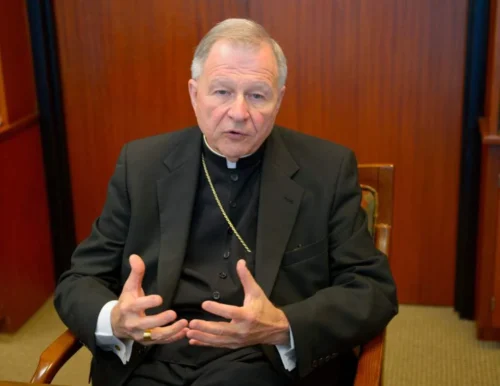
Catholics defy bishops to pray for gay marriage

The folk mass hymns and gospels were familiar, the response “And with your spirit” recited Sundays in church by millions of Catholics, but the 120 faithful gathered outside Seattle’s St. James Cathedral on Sunday afternoon were praying for a cause their bishops are campaigning against.

Mobilized by Catholics for Marriage Equality, they celebrated a “Liturgy of Love,” praying for the recognition of same-sex unions and the passage of Referendum 74, which would legalize marriage between persons of the same gender.

“I would just say the God I have come to know is not one to tell people they are not equal,” said Robert Gavino, a Seattle University student.

John House, a parishoner at Our Lady of Sorrows parish in Snoqualmie, added: “Catholics believe Christ’s primary message is one of love, and Catholic social teaching teaches us that God loves everybody. We are standing up for centuries of Catholic social teaching.”

They are also standing against their bishops.

Seattle Archbishop J. Peter Sartain has issued a pastoral letter denouncing Referendum 74, and put three anti-74 videos on the diocesan website. “R-74 jeopardizes freedom rather than expands it: It endangers our religious liberty and the right of conscience,” Bishop Joseph Tyson of Yakima claimed in a particularly strident letter to the faithful.

We disagree, said those on the steps of St. James Cathedral.

“I find (bishops’ claims) perplexing:. Nothing about marriage equality in the state of Washington is any infringement on liberty. This is about civil marriage and civil law,” said John Morfield, a longtime parishoner at St. Mary’s Catholic Church.

And Barbara Guzzo, organizer of Catholics for Marriage, argued that the bishops have brought “anguish, division and sadness” to the faithful, “particularly those with a gay person in their families, the hurt that this has caused.”

Fr. John Whitney, S.J., pastor of St. Joseph Church, has encouraged discussion and helped a recent meeting to promote reconciliation between those who share the bishops’ passionate opposition and those who back Referendum 74. “Authority never supplants conscience,” he told parishoners in a recent “e-blast.”

But stridently conservative bishops across the country have brought politics to the pulpit — and delivered dictates of what belongs in the consciences of those in the pews.

“A properly formed Catholic conscience will never contradict the Church’s teachings in matters of faith and morality,” Bishop David Kagan of Fargo, N.D., said in a weekend letter. The letter contained no mention of social teachings or poverty or human rights, but among things “never acceptable” was “not recognizing the unique and special role of marriage as a unique union of one man and one woman.”

In Washington, however, more than 60 resigned Catholic priests have endorsed Referendum 74. More than 100 retired and former priests in Minnesota have denounced Archbishop John Nienstedt for his efforts to write a one man-one woman definition of marriage into the state constitution.

State Sen. Ed Murray, D-Seattle, present at St. James on Sunday, is a practicing Catholic and chief sponsor of marriage equality in the Legislature. Murray said he was outside the cathedral as a demonstration of his faith.

“I think any time we show solidarity with those on the margins of our society, it is an expression of our faith,” said Murray. “We (gays) are certainly on the margins . . . at least in the hierarchy’s structure.”

The “Liturgy of Love” took place at the same hour as the weekly Solemn Vespers and Benediction inside St. James Cathedral. Earlier this year, the cathedral refused to serve as a collection center for petitions to force a vote on same-sex marriage.

The liturgy outside was familiar.

It featured singing of the Prayer of St. Francis:

“Make me a channel of your peace. Where there is hatred, let me bring your love; where there is injury, your pardon, Lord; where there is doubt, true faith in you.”

Chad Griffin, president of the Human Rights Campaign — the largest national group campaigning for gay and lesbian rights — spoke at the end of the liturgy. A Georgetown product, he said of his Catholic education: “Nowhere, ever, did it tell me to oppose a right that I might have. Or to support discrimination against my brothers and sisters.”

“The other 49 states are watching,” said Griffin.

Later, in an interview, Griffin noted the long string of defeats for same-sex marriage at the polls. But this year, he predicted, will be different. “Scare tactics, false headlines and lies are not working as they used to,” he said. “It’s close, but I’d rather be where we are than where they are.”

Where gay marriage supporters are is ahead in the polls in three states — Washington, Maryland and Maine — that are voting on marriage equality. In a race where polls are neck and neck, Minnesotans will vote on the constitutional amendment, heavily backed by Catholic bishops, that would write a ban into their state constitution.

Across the North Star state, however, lawn signs have sprouted with the message: “Another Catholic voting No.”

Complete Article HERE!

The Church hates the gays more than it loves its own.

File under the category: The Church hates the gays more than it loves its own. Churches are closing, schools are closing, food banks are underfunded, and shelters for homeless people are shuttered. More and more people are living on the edge of financial collapse…

BUT

Catholic Church Ponied Up More Than $1 Million To Fight Marriage Equality

Forget that vow of poverty: The Roman Catholic Church has shelled out more than $1 million to fight various marriage-equality initiatives, according to a new report from the Human Rights Campaign.

The study shows that the millennia-old institution has donated more than $1.1 million to anti-equality initiatives, including ones fighting gay-marriage measures in Washington, Maryland and Maine—and one supporting a gay-marriage ban in Minnesota, where it has given more than $608,000 to support a constitutional amendment defining marriage as between a man and a woman. (That’s more than half the campaign’s budget.)

Today, the Church is now the top religious donor for anti-equality efforts, with more than $640,000 coming from the Catholic fraternal organization the Knights of Columbus.

Fortunately it looks like gay-rights advocates have been able to raise considerably more funds overall than anti-equality cronies. (HRC has contributed $7.3 million to marriage-equality campaigns in the past 12 months.).

Given that a majority of everyday Catholics actually support gay marriage, HRC president Chad Griffin says “The Church hierarchy owes the laity an explanation as to why they are spending this much money on discrimination, and at what cost to other crucial Church programs.”

In a statement, Jason Adkins of the Minnesota Catholic Conference replied, “Our marriage amendment activities, like our other activities, are aimed at fostering the common good.”
Thanks but no thanks, pal.

Complete Article HERE!

Roman Catholic Priest Comes Out

A Catholic priest is now making the headlines in Italy after having decided to come out on Facebook on International Coming Out Day (11 October).

‘I am gay. Or, better, I am a happily gay priest,’ he stated.

Don Mario Bonfanti, 41, is a priest in Pagnano, near Lecco, in the Italian region of Lombardy. And his openness about his sexuality is something of a revolution.

Openly gay priests, in Italy, are a rarity. The Italian Catholic church is know for not being tolerant of LGBT people.

Bonfanti wrote on Facebook: ‘Truth makes us free, so Jesus said.

‘But, strangely, the Church denies this sentence. Catholic LGBT people must come out. They have to accept the truth.’

Last March, don Bonfanti was banned from another parish in Brianza, Lombardy, for having supported same-sex unions.

The local community defendend their priest, but the bishop did not change his mind and moved don Bonfanti to another church.

Now, a new group, with more than 1,200 followers, has been created on Facebook. ‘Io sto con don Mario’ (I support don Mario), is the name of the group.

Don Mario Bonfanti added: ‘I am happy in this way.’

Complete Article HERE!

Bishop vs. Bishop: Lutheran calls out Catholic over marriage

The retired presiding bishop of the Evangelical Lutheran Church in America, the Rt. Rev. Herbert Chilstrom, has delivered a stinging, public critique of his former Roman Catholic counterpart in Minnesota for aggressively campaigning for an anti-same sex marriage amendment on the November ballot.

“I recognize your authority in formulating positions for your own flock in Minnesota: That is one thing,” Chilstrom said in a letter to Roman Catholic Archbishop John Nienstedt, published in the Minneapolis Star Tribune.

“But for you and others to campaign for an amendment that imposes your stance on all citizens in Minnesota — including other Christians, believers of other faith groups and unbelievers — it is overstepping your bounds.”

Minnesota is one of four states voting on marriage this November. Washington, Maryland and Maine will cast ballots on whether to approve marriage equality. In Minnesota, Nienstedt has put $650,000 in church money into promoting the state constitutional amendment that would ban same-sex marriage.

Nienstedt has gone far beyond church leaders in Washington, where Seattle Archbishop J. Peter Sartain allowed parishes to opt out of signature gathering for Referendum 74.

Nienstedt told St. Paul-Minneapolis archdiocesan clergy that he would permit no “open dissension.” As the Star Tribune reported last week, “He wrote one outspoken priest, the Rev. Mike Tegeder, that if he persisted, ‘I . . . will remove you from your ministerial assignments’.”

Nienstedt is also notorious for responding to a Catholic mother’s plea that her gay son be accepted, “I urge you to reconsider the position that you expressed . . . Your eternal salvation may well depend upon a conversion of heart on this topic.”

Asked by the Star Tribune whether a loyal Catholic could vote No, Nienstedt said: “It would be difficult to comprehend how a person could not believe that marriage is anything but a union between one man and one woman. On this point, Catholic teaching is clear.”

Still, more than 80 former Catholic priests have signed a letter denouncing the amendment, and three retired Catholic priests have urged its defeat. Laity have placed “Another Catholic voting No” signs on their lawns. (Taking a cue from Minnesota, 63 former priests in the Seattle Archdiocese have endorsed marriage equality.)

“By word and action, you leave the impression that there is little room for dissent in your church,” Chilstrom wrote to Nienstedt. He cited the example of a former Catholic bishop in Minnesota, the Rt. Rev. Raymond Lucker, who questioned the church’s prohibition against married priests.

The Lutheran Bishop noted that in his denomination, “we engage in a wide spectrum of clergy and laity in developing statements and guidelines in our thinking about complex social issues.” If member disagree with stands taken in the church’s national assembly, the right of conscience is recognized.

“If there were a call from Roman Catholic members in Minnesota to vote on an issue of significance, would you allow such a vote?” Chilstrom asked Nienstedt. “And if a simple majority voted in favor, would you accept that vote as final? It’s clear that such a vote would not even be permitted in your church.

“There is evidence that many in your church will vote No on this amendment. I stand with them and with all who will vote No.”

Complete Article HERE!

Catholic Church errs in fighting same-sex marriage

There’s a delicious rebellion brewing in Washington state — the “other Washington,” as those of us based in D.C. like to say.

A group of 63 former Roman Catholic priests, with a total of 800 years service, supports Referendum 74, a ballot initiative that would make Washington the seventh state in the nation to legalize marriage between same-sex couples. The announcement of their support is designed to combat a church campaign against the measure that the San Francisco Chronicle describes as “aggressive.”

The church is issuing pastoral statements and releasing videos urging parishioners to vote against marriage equality.

Here’s a sampling:

— Bishop Joseph J. Tyson of the Diocese of Yakima, Wash., told his 41 parishes: “Once marriage is redefined as a genderless contract, it will become legally discriminatory for public and private institutions such as schools to promote the unique meaning of marriage. … This law will challenge our right to educate about the unique value of children being raised by his or her own mother and father in a stable home (sic).”

I understand why the church is undertaking an extensive political campaign against gay marriage. There’s no doubt that gay marriage goes against the very biased doctrinal interpretation of homosexuality often cited in the New Testament.

But if members of the Catholic hierarchy are worried about losing followers to other Christian churches, or want to capture the hearts of the next generation of Catholics, they’ll give up the fight.

It’s clear that young Americans of all faiths have been raised in a cultural environment that views LGBTQ couples as no different than heterosexual couples. The bishops are picking a fight over an issue they are not going to win.

The Chronicle sites a recent Elway Poll that pegged support for Referendum 74 at 57 percent. Gov. Christine Gregoire, a Democrat and an outspoken proponent for it, championed same-sex marriage legislation through the state chambers.

Similar measures are on the ballot in Maryland and Maine.

The church is taking on not just Catholic voters in those states or, one could posit, in the United States — Gallup poll last May on gay marriage showed half of Americans support it.

Ireland’s former president, Mary McAleese, this week told Irish state broadcaster RTE she supports gay marriage. Her views on social issues have drawn the ire of many an archbishop, including the former Archbishop of Boston Bernard Law, who called her “a very poor Catholic president.”

Her response: “I am not a Catholic president, I’m president of Ireland,” where “there were all sorts of people. I’m their president. I happen to be Catholic.”

It seems unwise for the church to take on such powerful politicians and social movements that are gaining mainstream support. The timing is particularly unwise when one takes into account how the church’s handling of the priest pedophilia scandal cost it credibility.

I am in awe of the gay rights movement’s progress on this issue. It seems LGBTQ leaders have been able to turn around public opinion on marriage equality in less than a decade. Too bad their sisters in the abortion-rights movement have not been as successful. Abortion is one topic on which the church, sadly, can keep up a successful crusade. But the church undoubtedly has a dwindling supply of social issues in its arsenal.

Complete Article HERE!

LA priest on leave for advocating gay marriage

Archbishop Jose H. Gomez of Los Angeles has placed Father Joseph Palacios on leave from ministry because of his promotion of same-sex “marriage.”

Tod Tamberg, director of media relations for the Los Angeles archdiocese, confirmed to CNA Sept. 20 that Fr. Palacios was put on inactive leave in June.

Because of the mutually agreed upon leave, he is unable to say Mass or distribute the sacraments, may not wear a Roman collar, and cannot in any way present himself as a priest in public.

Fr. Palacios is a founding member of Catholics for Equality, a group which advocates for same-sex “marriage” and other social benefits for gay, lesbian, bisexual and transgender individuals.

He has identified himself as “a gay man and a celibate gay priest.”

According to the National Catholic Register, he will be on inactive leave as long as he remains politically active. In a Sept. 10 interview with the paper, he said he does not present himself as a priest when promoting same-sex “marriage.”

However, in a Feb. 2011 panel discussion called “Same Sex Marriage in the United States: Where We Are as a Nation,” hosted by the Woodrow Wilson School at Princeton University, he appeared in a priestly collar and was introduced as “Father Joseph Palacios.”

During the event, he said that the Washington, D.C.-based Catholics for Equality are trying to portray support for same-sex “marriage” as a pro-life position, adding that “pro-life means pro-gay.”

Cardinal Donald Wuerl, archbishop of Washington, has publicly stated that the organization is not legitimately Catholic and Archbishop Timothy Broglio of the military archdiocese has made the same judgment.

Fr. Palacios is a priest of the Archdiocese of Los Angeles, but has identified himself as an ex-Jesuit to the Cardinal Newman Society and elsewhere. He was ordained for the archdiocese of Los Angeles in 1987. He then entered the Jesuit novitiate in 1992, but left the Society in October 2004 without having pronounced final vows, according to the California Province of the Society of Jesus.

“Apparently, he was transitioning into the Society of Jesus at that time,” Tamberg said.

“It appears that he did not profess final vows in the Jesuit Community and remained (a) priest of the Archdiocese of Los Angeles,” the archdiocesan spokesman added.

Fr. Palacios is not identifiable as a priest on the Catholic for Equality’s website. He is described only as “Dr.” He holds a Ph.D in sociology from University of California Berkeley and attended St. John’s Seminary in Camarillo, Calif. He was ordained for the archdiocese of Los Angeles in 1987.

Complete Article HERE!

Catholic priest donated $1000 to gay ‘marriage,’ diocese mum

A Catholic priest’s donation to support redefining marriage in Minnesota has been revealed, deepening a rift between a conservative Catholic hierarchy and more liberal subordinates in the blue state over gay ‘marriage.’

The Duluth News Tribune reported Sunday that Rev. Peter Lambert of St. Louis Catholic Church in Floodwood had donated $1,000 to Minnesotans United for Families, the group fighting a constitutional marriage amendment, in March.

The Diocese of Duluth, where Lambert is stationed, has donated $50,000 to support the traditional marriage amendment. Duluth Diocese spokesman Kyle Eller told the Tribune that Lambert didn’t intend the donation to be a public statement.

“It was my understanding that Father Lambert wasn’t aware that the contribution would be made public, and it wasn’t intended to be a public statement,” said Eller, who declined further comment.

The diocese didn’t immediately respond to an email from LifeSiteNews.com requesting comment Tuesday.

The bishops in Minnesota have ranked among the most outspoken Catholic defenders of traditional marriage in the country in recent years. In 2010, the prelates backed a comprehensive six-week campaign to re-catechize their flock on the Church’s moral teaching on marriage and sexuality.

In January, Archbishop John Nienstedt of St. Paul and Minneapolis emphasized to clergy under his purview, which includes the Duluth diocese, the importance of their adherence to Church doctrine on the marriage question.

“The gravity of this struggle, and the radical consequences of inaction propels me to place a solemn charge upon you all,” he said. “On your ordination day, you made a promise to promote and defend all that the Church teaches. I call upon that promise in this effort to defend marriage. There ought not be open dissension on this issue.”

Nienstedt again urged the Catholic faithful this Sunday to support the proposed marriage amendment that will appear on the general election ballot this November.

Supporters of redefining marriage have meanwhile been targeting Catholics with their own message.

An openly homosexual religious priest from St. John’s Abbey in Collegeville, Minn. told a crowd of 200 in June that Catholics are permitted to vote against the amendment as a matter of freedom of conscience.

“I believe this amendment violates an important principle of Catholic teaching, and that as Catholics, we can vote no,” Rev. Bob Pearson said.

Complete Article HERE!

Rev. Stan Sloan has dedicated his life to serving his fellow men

Stan Sloan is not your ordinary Reverend. As a former priest of the Diocese, he has dedicated his life to serving his fellow men, fallen in love, was out during his priesthood, stood up and since departed from the Roman Catholic Church, and even scarier assimilated back into the dating scene after his priesthood. What matters to Sloan is service and perspective – both, which are for and from the people he has helped and continues to help throughout his career.

Currently, as Chicago House and Social Service Agency’s CEO, Sloan has taken his passion for service and his perspective from his days at St. Leonard’s House where he aided former prisoners and homeless people and instilled it back into the community. With exciting, new endeavors with Sweet Miss Givings Bakery, the development of a TransLife Center, as well as events that include Dance for Life, an all-out dance party, at the Park West on September 15 and the charity’s annual speaker series featuring fashion designer Kenneth Cole in November, Sloan has made Chicago House his new Diocese.

TC: (Terrence Chappell) As the longest running CEO of Chicago House and Social Service Agency, it could be argued that you are Chicago House. Who were you before Chicago House?

SS: (The Rev. Stan Sloan) I was a Catholic priest in the Diocese of Tulsa, Oklahoma up until 1995. In 95′ I just decided that I couldn’t do that anymore. I liked what I was doing and I liked the people I was working with, but I couldn’t stand working for the Roman Catholic institution or the hierarchy.

TC: What was the turning point that moved you to transition out of the Roman Catholic Church?

SS: As gay men we under sell this a lot; being gay is so much more about whom you have sex with. I mean even if you’re a celibate gay man, your gay friendships are still important to you. So, if I had a Friday night off, I would go out with my gay friends – not to gay bars because I knew that was crossing the line, but I would go out to dinner with them. Again, I was not breaking any vows. So, the bishop of Tulsa called me in and said that you’re fixing with the gay community. I said yes, but I’m being celibate and that we’re all God’s people. He said it’s one thing to minister to them but it’s another to be friends with them.

TC: Wow. How did that make you feel?

SS: Yea. It’s horrible. It’s okay to minister to them but to not befriend them? You don’t befriend people when you’re actually contributing to the cause let alone their [Roman Catholic Church] stance on birth control. If it sounds like I’m bitter and angry, it’s because I am.

TC: What do you do with all that bitterness and anger?

SS: I exercise like a mad man. I love my work. I’ve got good friends.

TC: However, you didn’t always feel this way. What was it that attracted you to the priesthood?

SS: I always had a natural prayer life growing up as a child. My parents were devout Catholics, and I enjoyed going to daily mass. It was always just a natural fit for me. I actually came out and had a boyfriend before I was a priest.

TC: Oh really? How did that work out?

SS: When I was in seminary I was celibate. So, as I went through the boards to start going into seminary, they asked me if I was gay and I said yes. At the time it was much more permissive than it is now. The church has gone backwards. However, I said if I do this I’ll be celibate.

TC: How did your boyfriend at the time react to you deciding to become a priest?

SS: I told him at the time, Jimmy this is something I have to try and that chances are that I won’t like it and I will be back. We were both kids at the time – we were like 23. He told me if I do this, you do this and when you come back, I won’t be here. So, we broke up, and I went.

TC: But then you quit the Catholic Church.

SS: Yup and never once did I think that I made the wrong decision. It was hard. You grieve it like you grieve a divorce. But, I was lucky that I happen to pick the Episcopal Church as my next step. We just okayed doing gay marriages, so the Episcopal Church is already ahead. I just feel like in the idea world, the Churches or religion in general should lead the rest of the world on social justice issues. However, instead you have ridiculous groups who do just the opposite. I’m very proud to be a part of denomination that is at the forefront of equality, sexual equality, and gender nonconforming issues.

TC: And then you transitioned over to serving and helping homeless people.

SS: Yes. Serving homeless people really puts perspective around your life and whatever is getting you down. You get to see people who have every reason to not have any hope but they do and they are excited about moving forward with their lives. Every day I get to make a difference.

TC: What kind of perspective did that give you at the time?

SS: I was just this naïve, white kid who grew up in Texas in middle-class America. I remember my first day at St. Leonard’s. I was working with all ex-offenders who just got out of prison. I was afraid of these guys. I’ve never been around a population like this. So, I went in and I had to talk to these guys. I started talking to them and I’m thinking to myself I’ve got two master’s degrees and so on. But then I realized that they were way more afraid of me then I was of them. For instance, I’m a part of the world they want to break into – mainstream society.

TC: How did this perspective help you at Chicago House?

SS: Well one of the things Chicago House gets to do on a daily basis is that we get to take our donors and show them the lives of our residents. I invite people all the time to come. It’s great because different people from different factions of our society can meet. We’re not as different as we think we are.

TC: Is there a story of a particular resident or someone that you have helped that stands out?

SS: One of my first days at St. Leonard’s House, I met a guy who I was working one on one with – helping him with his resume and stuff like that. It was like a light bolt when I was working with this guy; this guy’s IQ is off the charts. This guy is way smarter than I am. We stayed in touch and he did a good job while he was at St. Leonard’s House. He wanted to start up his own computer business. I gave him some money to help him get it started. Now, he owns his own computer business and has a home in Lake Forest. Mind you at the time he was just out of prison and would’ve been homeless if he wasn’t staying at St. Leonard’s House.

TC: When you started at Chicago House, you were still a priest in good standing but no longer a part of the Diocese. So, that means you could start dating. How was that?

SS: I didn’t remember from being 23 of how horrible dating was but I learned very quickly it’s a horrible process (laughs). I remember I had this over-the-top romantic idea that I would fall in love with the right one and wouldn’t have to date very much. Of course that’s not true, that’s not how life works.

TC: How was your “first” date?

SS: I signed up with The Smelts for no other reason because I decided that I wanted to date and that I need to find a husband. There was an adorable guy named Seth Hoff, who is still here in town, and I saw him and I thought he was so hot. So, I just found out his name and I just cold called him. I told him I was at swim practice today and that I saw him and asked him out to dinner. He said that I was the guy with no body fat. He said yes and we went on a few dates. I mean I was insane, so it must have been crazy for him. For instance, we would have fun on the date and instead of saying, “Hey, let’s talk soon,” I’d just say, “Can we get another date down?”

It was a very good, funny introduction into the dating world. (Laughs)

TC: What are some exciting, new developments for Chicago House?

SS: I’m excited to announce that Little Miss Muffet will take on Sweet Miss Giving’s product line. They have licensed our brand name and the internship program will operate out of their factory. Little Miss Muffet will give us a dime off every cookie, off every cupcake, and biscotti they will sell. Right now, we are trying to see how we are going to position ourselves with places like Costco and stuff since they are a national baker and they are already in all those places.

Our other big development is our TransLife Center. It will be in a gracious, old mansion where the first floor will be an emergency drop-in center for trans adults who just need to get off the streets for a day. The upstairs rooms will be built as well. There will be nine bedrooms for transgender men and women who are homeless and who need to get their life together. We will be hiring a full-time career counselor who will be transgender himself or herself who will be helping people with employment. We will have a doctor from Children’s Memorial Hospital who will be putting in weekly hours at the TransLife Center connecting people with care, since there is a huge instance of abuse of transgender people by medical professionals. So, as far as I know it will be the most comprehensive service offered to transgender people. We’re very excited about this.

TC: What do you want the LGBT community as a whole to take from Chicago House’s move in the direction of helping and aiding the trans community?

SS: We’ve made good progress as an LGB community and it’s time to start embracing our transgender brothers and sisters.

TC: What are some upcoming events Chicago House has coming up in the future?

SS: We will be having our One Night Stand event at the Park West on September 15. It will be a dance party. We’ve got all sorts of performers. Keith Elliott, who started Dance for Life and who started the burlesque show for TPAN will be a part of the event, so you know it’s going to be brilliant.

November 2 we’ve got Kenneth Cole coming for our speaker series. Kenneth Cole is the national head of the American Foundation of AIDS Research. So, he’s incredibly knowledgeable and will be a fantastic speaker.

TC: What do you want your legacy to be?

SS: That people’s lives are better because you existed.

To find more information about Chicago House visit www.ChicagoHouse.org.

Complete Article HERE!

Catholic Bishop’s Anti-Gay Campaigning May Violate WA Election Law

State workers who track election-law violations are meeting later this morning to discuss the Catholic Church, says Lori Anderson, a spokeswoman for the Washington State Public Disclosure Commission.

At issue is a story I reported yesterday: Yakima bishop Joseph Tyson sent a letter this month instructing all priests in his diocese to begin a fundraising drive inside their parishes that directly funds the anti-gay-marriage PAC Preserve Marriage Washington, which is trying to reject Referendum 74 on the fall ballot. While I lamented that Tyson’s effort seems to comply with federal tax rules, it may not be legal under state law.

Here’s why: The church can’t act as an agent that collects money and sends it to the campaign. In his letter, Bishop Tyson asks the priests to circulate Preserve Marriage Washington’s fundraising envelopes among pews, collect the checks, and mail all the checks to the anti-gay PAC. As he put it, “Please place unopened envelopes into the addressed security envelope, and mail them to Preserve Marriage Washington.”

That sort of activity is informally called “bundling,” Anderson explains, and it would violate a state law that concerns collecting contributions on anther’s behalf. “A person, other than an individual, may not be an intermediary or an agent for a contribution,” says the RCW.

“They can hand out those envelopes,” Anderson says, “but they that can’t collect them and send them in.” Anderson says that election workers will try to “head them off at the pass and see that they are complying.”

Bishop Tyson did not respond to a request for comment.

Complete Article HERE!

Tom Rastrelli: Priests who lie; the dilemma of sexual orientation and the priesthood

People don’t expect their priests and bishops to lie, but as Michelangelo Signorile’s recent post illustrated, clerics do lie. Some even make a virtue of it. I know this from experience, for I was ordained a Catholic priest on a lie.

In spring 2002 I walked with my spiritual director along the blacktop road encircling the seminary. He’d been my confessor and guide for two years, helping me discern God’s presence in all aspects of my life, intimate and mundane. Over our heads, a canopy of newborn leaves rustled in a sunny breeze, a welcome relief from the bitter fog that had engulfed the church and my vocational surety.

For the previous two months an unprecedented number of bishops and priests, starting with Cardinal Law of Boston, had fallen from grace for participation in the sexual abuse of children and the ensuing cover-up. Their duplicity was palpable in my knotted back and abdomen. In a few months I’d be ordained a priest. I didn’t want to do so on a lie.

“I’m coming out of the closet,” I said.

My spiritual director loosened his clerical collar and lit a cigarette. “Where’s this coming from?” he asked. A couple of chattering wrens whooshed past.

I backtracked through six years of seminary formation. At events I had hobnobbed with supposedly holy men, some of whom had been harboring pedophiles. A few had done the deed themselves. By shaking their hands, mine were dirty. I knew the ecclesiology, how the bishops’ authority stemmed from a direct line to Jesus, but they were still criminals. Who were they to declare homosexuals “intrinsically depraved”?

When I’d applied for seminary, the director of seminarians — the priest who’d recruited me — explained that orientation didn’t matter, only celibacy. But on my intake interviews he’d told me to answer “yes” when the archdiocesan psychologist asked if I was attracted to women, and “no” when he asked if I was attracted to men. It was for the greater good, he said. Frightened of being cast out and ashamed of my true nature, I had lied as instructed.

In light of the sexual abuse scandal, lying about my orientation was no longer acceptable. I thought of what a gay friend who’d left seminary had said. His words became my own: “I don’t know if I can separate my private and public selves. Isn’t integration the goal of spiritual direction?”

“Of course it is,” my spiritual director said, more gravelly than usual. He stopped and turned to me. A tree cast a web of shadows over his face. His strawberry nose grew flushed, as he gestured with his hands. “Here’s the thing, Rastrelli. You have to ask yourself: Am I going to be a gay priest, or a priest” — he rolled his fingers and cigarette through the air like a barrel — “who happens to be gay?”

“What’s the difference?” I turned my head to inhale, trying to avoid his secondhand smoke. “Either way I’m gay. It’s a part of me.”

“But are you gay first, and then a priest? Or a priest first, and then gay?” He smiled, satisfied with the distinction.

“Both/and.” I’d hit him with what he’d taught me in class. “Both/and” was the paradoxical answer for every ultimate question in Catholic theology: Scripture or tradition? Faith or works? Is Jesus divine or human? Are we sinful or good? is faith a solo or communal experience?

“Touché,” he said. We walked. He sucked his cigarette. “You’re a smart guy, Rastrelli. Give it some thought.”

I kicked a pebble onto the grass. “I have. I don’t want to lie about my sexuality.”

“It’s not lying if those asking don’t have a right to the information.”

He hadn’t even flinched. I wanted to shake the nicotine from his bones, to scream, “It was that kind of thinking that landed the bishops in the papers!” Still, part of me wanted him to be right. Silence was simpler, easier, and maybe my need to come out was just pride at work. My promise of obedience demanded that I surrender my ego. My vocation was about God, not my orientation. But couldn’t we priests be honest with one another? I had to try.

“Gay Catholics don’t have positive role models,” I said. “I don’t know of a single gay priest that’s healthy. Do you?” I stopped. He kept walking. This was as close as I’d ever come to asking him if he was gay. I suspected he was. He’d lived with another priest for decades. They vacationed and picked out carpeting together. They spoke about their cat as if she were their child. Even if he and his housemate weren’t having sex, they were a couple. I stepped in stride with him. “How am I supposed to be an integrated gay priest when I have no one to look up to? How does celibacy actually work?” I stopped again. “I’m asking you.”

He turned to me. His face became whiter than a funeral pall. “I’m sorry, Rastrelli, but that’s not a conversation I’m comfortable having with a student.”

He resumed his pace. I followed silently.

The breeze picked up. The undulating trees sounded like the ocean breaking on the shore. I choked back the urge to ask, “Are you gay?” I felt like a sinking ship in a fleet that had wandered into a minefield. After laying the mines himself, the fleet commander had ordered radio silence.

I didn’t want to drown alone. I didn’t want to hear him lie. I wanted the truth, but the truth was dangerous. Were I to come out amid sexual-abuse headlines, homophobic Catholics wrongly blaming gay priests for the scandal would demand my dismissal.

My spiritual director was right. Who were they to judge, to put my orientation before my vocation? They had no right to that knowledge. It was safer to be a priest who happened to be gay. Perhaps it was God’s will. The fear accompanying us back to the seminary told me so.

That day, I learned the unspoken rule passed down through generations of priests: the doctrine of justification for lying by clergy. I went on to be ordained a priest. I preached that “the truth will set you free” while living in silence and shame. After a long journey and much pain, I came out. I left the priesthood, finally refusing to live the lies that I’d been taught to venerate.

Complete Article HERE!