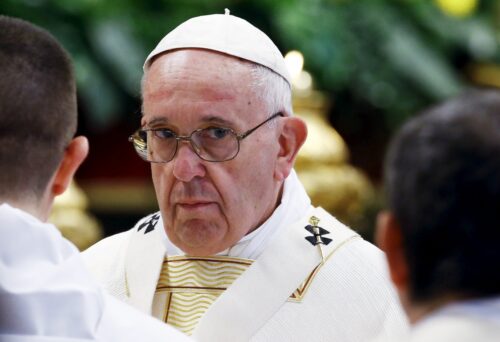
Mahony responds to ban: ‘Not once’ did successor raise questions

File under: It’s gettin’ nasty! The secret internal power struggle is beginning to seep into the public domain. There is no way that Gomez would attack Mahony without the explicit authorization of B-16. The pope is throwing Mahony under the bus. His thinking…better to sacrifice a cardinal and a bishop (Curry) than have this whole thing skink up the Vatican. This is SOOO fascinating. Regular folk, like us, almost never get to see this kind of ecclesiastical fight to the death. The long knives are out!

By: Joshua J. McElwee

Cardinal Roger Mahony, the retired archbishop of Los Angeles who was barred from public ministry by his successor over his handling of sex abuse, has issued a rare public response to the action.

Writing an open letter to Archbishop Jose Gomez, the archdiocese’s current leader, Mahony states that during his leadership the archdiocese became “second to none in protecting children and youth.”

“When you were formally received as our Archbishop on May 26, 2010, you began to become aware of all that had been done here over the years for the protection of children and youth,” Mahony writes to Gomez in the letter, which Mahony has made available on his personal blog.

“You became our official Archbishop on March 1, 2011 and you were personally involved with the Compliance Audit of 2012 — again, in which we were deemed to be in full compliance,” Mahony continues.

“Not once over these past years did you ever raise any questions about our policies, practices, or procedures in dealing with the problem of clergy sexual misconduct involving minors.”

Mahony, who became archbishop of Los Angeles in 1985 and was made a cardinal in 1991, was replaced by Gomez in 2011.

Typically seen as shying away from public criticisms of their peers, Catholic bishops rarely issue public responses to one another’s actions.

In a letter outlining his decision to ask Mahony to stay away from public ministry in LA, Gomez wrote Thursday that Mahony had failed to protect young people from sexually abusive priests.

The Gomez letter accompanied a release of extensive files concerning Los Angeles priests who had abused minors, most involving abuse that had occurred decades ago.

“I find these files to be brutal and painful reading. The behavior described in these files is terribly sad and evil. There is no excuse, no explaining away what happened to these children. The priests involved had the duty to be their spiritual fathers and they failed,” Gomez wrote.

“My predecessor, retired Cardinal Roger Mahony, has expressed his sorrow for his failure to fully protect young people entrusted to his care,” he added. “Effective immediately, I have informed Cardinal Mahony that he will no longer have any administrative or public duties.”

For his part, Mahony states in his letter to Gomez that Mahony’s understanding of sex abuse evolved over the years.

“Nothing in my own background or education equipped me to deal with this grave problem,” states Mahony. “In two years [1962 – 1964] spent in graduate school earning a Master’s Degree in Social Work, no textbook and no lecture ever referred to the sexual abuse of children. While there was some information dealing with child neglect, sexual abuse was never discussed.”

Writing of the era of the documents from the 1980s, Mahony writes that he began implementing “policies and procedures to guide all of us in dealing with allegations of sexual misconduct” in 1986.

He was given advice, Mahony states, “to remove priests from active ministry if there was reasonable suspicion that abuse had occurred, and then refer them to one of the several residential treatment centers across the country for evaluation and recommendation.”
“We were never told that, in fact, following these procedures was not effective, and that perpetrators were incapable of being treated in such a way that they could safely pursue priestly ministry,” Mahony states.

“I have stated time and time again that I made mistakes, especially in the mid-1980s,” Mahony writes.

“Unfortunately, I cannot return now to the 1980s and reverse actions and decisions made then. But when I retired as the active Archbishop, I handed over to you an Archdiocese that was second to none in protecting children and youth.”

Complete Article HERE!

Bishop snared in abuse scandal criticizes Catholic newspaper

Sour grapes, Bishop Finn? Retaliating against the NCR because they had the temerity to suggest that you step side because of your involvement in the clergy sex abuse scandal? Have you no shame?

By Matt Pearce
Bishop Robert W. Finn wishes the independent National Catholic Reporter weren’t so independent.

bishop-finn Finn is the bishop of the Roman Catholic diocese of Kansas City-St. Joseph in Missouri. The National Catholic Reporter is a 48-year-old not-for-profit newspaper based in Kansas City.

Finn was convicted in September of shielding priests from sexual-abuse allegations — prompting editorials from the newspaper calling for his resignation. Now, Finn, who is on probation, has taken to his own diocese’s journalistic bully pulpit to denounce the paper.

“In the last months I have been deluged with emails and other correspondence from Catholics concerned about the editorial stances of the Reporter: officially condemning church teaching on the ordination of women, insistent undermining of church teaching on artificial contraception and sexual morality in general, lionizing dissident theologies while rejecting established magisterial teaching, and a litany of other issues,” Finn wrote this weekend in his diocese’s newspaper, the Catholic Key.

Finn noted that the National Catholic Reporter had long been a thorn in the side of Kansas City bishops; in 1968, one tried to get the publication to remove “Catholic” from its name.

Early in his tenure, Finn said, when he solicited the newspaper to “submit their bona fides as a Catholic media outlet in accord with the expectations of church law, they declined to participate, indicating that they considered themselves an ‘independent newspaper which commented on “things Catholic.”‘ At other times, correspondence has seemed to reach a dead end.”

The National Catholic Reporter has won awards for its investigative reporting and has been covering church sex scandals since 1985, National Catholic Reporter publisher and former editor Tom Fox told the Kansas City Star.

“We are a Catholic publication, but independent of the church structure. That’s one of the keys to our credibility,” Fox told the Star, adding of Finn, “He’s hurting. I know he thinks he’s doing his job.”

According to the original criminal indictment against Finn, sometime in 2010 or 2011 Finn discovered that a priest’s laptop computer contained “hundreds of photographs of children … including a child’s naked vagina, up-skirt images and images focused on the crotch.” Finn, who did not report his knowledge of the priest’s photos for months, became the first bishop convicted in the U.S. in the church’s sprawling child-abuse scandal.

Finn has been apologetic; the National Catholic Reporter’s writers, less so.

“No one is suggesting Finn can’t be forgiven his sins. Indeed, forgiveness is precisely what God always stands ready to offer,” Bill Tammeus wrote in a December column published on the publication’s website.

“But when someone in a position of ecclesial authority has failed in so spectacular a way that even a secular court has found him guilty, he has the obligation to do what he can to avoid further damage to what Finn often calls — in words that should make him quake — Holy Mother Church.”

In other words: Resign.

Finn has not resigned. Instead, he has endured rumblings that he has lost support from the priests inside his diocese, as well as parishioners. Nor has he been released from his duties by Pope Benedict XVI, who holds authority over the church’s bishops.

Finn’s Friday editorial was occasioned by the church’s World Communications Day, in which the pope urged the faithful to reflect on how to find meaningfulness in communication both digital and analog. Finn’s message started with his evocation of St. Francis de Sales, the patron saint of journalism, and closed by narrowing his eyes at the National Catholic Reporter.

“In light of the number of recent expressions of concern, I have a responsibility as the local bishop to instruct the faithful about the problematic nature of this media source which bears the name ‘Catholic,’” Finn wrote in his conclusion. “While I remain open to substantive and respectful discussion with the legitimate representatives of NCR, I find that my ability to influence the National Catholic Reporter toward fidelity to the church seems limited to the supernatural level. For this we pray: St. Francis de Sales, intercede for us.”

Complete Article HERE!

Santa Barbara Bishop Apologizes In Catholic Church Cover Up

File under: When an apology is not an apology. Jesus, these men simply can’t stop the prevarication. They couldn’t take responsibility for their actions if their life depended on it. Shame, shame, shame!

By Liberty Zabala
Dark days fall upon the Catholic Church as files upon files of alleged child sex abuse finally come to light.

Letters between Archdiocese of Los Angeles – Santa Barbara Region Bishop Thomas J. Curry and Cardinal Roger Mahony show they knew about alleged child sex abuse but choose to cover it up.

“You can imagine what the church has to lose,” says Child Sex Abuse Therapist Nancy Gutfreund. “You’re supposed to be an organization that completely protects its people and when there’s damage done nobody wants to admit it.”

curry:mahoneyBut Bishop Curry was forced to, releasing this statement saying:

“I wish to apologize for those instances when I made decisions regarding the treatment and disposition of clergy accused of sexual abuse that in retrospect appear inadequate or mistaken.”

A mistake the Santa Barbara District Attorney’s Office is now investigating.

“We have some very serious allegations of obstruction of justice at the very least by individuals, I think the community has trusted throughout for a number of decades,” says Santa Barbara City Chief Deputy District Attorney Hilary Dozer. “And that’s a disturbing fact.”

And prosecutors face another challenge. Most of the files happened in the 1980’s far beyond the statute of limitations.

“If an individual has actively hidden information from law enforcement, there are some ways and situations where that statute of limitations is tolled,” says Dozer. “Meaning it does not preclude us from going forward.”

Senior Deputy District Attorney Ron Zonnen to lead the investigation against the church.

Last year, prosecutors in Philadelphia were able to convict a monsignor and in Missouri, a judge found a bishop guilty for failing to report child sex abuse.

Complete Article HERE!

Catholicism’s Curse

A must read!

By FRANK BRUNI

But while I have nothing against priests, I have quite a lot against an institution that has done a disservice to 27BRUNI-popupthem and to the parishioners in whose interests they should toil. I refer to the Roman Catholic Church, specifically to its modern incarnation and current leaders, who have tucked priests into a cosseted caste above the flock, wrapped them in mysticism and prioritized their protection and reputations over the needs and sometimes even the anguish of the people in the pews. I have a problem, in other words, with the church’s arrogance, a thread that runs through Wills’s book, to be published next month; through fresh revelations of how assiduously a cardinal in Los Angeles worked to cover up child sexual abuse; and through the church’s attempts to silence dissenters, including an outspoken clergyman in Ireland who was recently back in the news.

Complete Article HERE!

German Catholics vent their dissatisfaction with the Church

A study on Germany’s Catholic community reveals the discontent of faithful with the ecclesiastical institution. But proposals for solutions are lacking

By ALESSANDRO ALVIANI

sad lonely popeThe Pope’s ecclesiastical policies are “backward-looking” and suspected of trying to take the Church back to the pre-Second Vatican Council period. As for the Church’s leaders, they are “cut off from reality, reactionary and obstructionist.”

This is the opinion German faithful have of Benedict XVI and the Catholic Church according to a study by Sinus Institute and consulting agency MDG (which the German Church controls). In-depth interviews were conducted with 100 Catholics from different social backgrounds. According to the study, which picks up on a similar one carried out in 2005, German faithful are convinced that today’s Church finds itself in a “desolate situation” and the most obvious manifestation of this is the sex abuse scandal.

The authors of the study wrote that the scandal seriously damaged the image of the Church, even in the eyes of the most fervent Catholics, whose faith was deeply shaken. The scandal was seen as confirmation of the Church’s “modernization deficit”. The Church lost a great deal of credibility not just as a result of the accusations of paedophilia made against it but also because many believe it dealt with the abuse issue inadequately.

Internal dogma and rules that had been tacitly accepted until about a year ago are now openly criticised by faithful. Criticisms range from complaints about “discrimination against women” and celibacy, to the condemnation of homosexuality, contraception and sex outside wedlock, to the marginalisation of lay people involved in Church life.

Another factor that is creating animosity, is the organisational restructuring that is taking place in Germany, with a number of parishes being merged because of the shortage in parish priests, for example.

The study also shows the Church’s detachment from the weakest sections of society: it would make no difference to the lower social classes if the Church ceased to exist.

Despite their criticisms, however, faithful still look to the Church for “spiritual guidance” and “meaning”. The majority of them do not want to lose their Catholic identity and few consider leaving the Church.

So what do German faithful expect from the Church? They want lay people involved in the Church to play a greater role; they want more women in leadership roles; the possibility for women to be ordained priests; the elimination of celibacy; a different attitude towards sexuality and contraception; the sacraments to be administrated to all Christians, regardless of their denomination or sexual identity; less ostentation and less abuse of power and a greater focus on God’s love and love for one’s neighbour.

Complete Article HERE!

Police: Friar accused of abusing students in 2 states kills himself at Pa. monastery

A Franciscan friar accused of sexually abusing students at Catholic high schools in Ohio and Pennsylvania killed himself at a western Pennsylvania monastery, police said Saturday.

Brother Stephen Baker, 62, was found dead of a self-inflicted knife wound at the St. Bernardine Monastery in Hollidaysburg on Saturday morning, Blair Township Police Chief Roger White said. He declined to say whether a note was found.

Baker was named in legal settlements last week involving 11 men who alleged that he sexually abused them at a Catholic high school in northeast Ohio three decades ago. The undisclosed financial settlements announced Jan. 16 involved his contact with students at John F. Kennedy High School in Warren, Ohio from 1986-90.

The Youngstown diocese previously said it was unaware of the allegations until nearly 20 years after the alleged abuse.

“Let us continue to pray for all victims of abuse, for Brother Baker’s family and the repose of his soul,” Youngstown Bishop George Murry said in a statement Saturday.

After the settlements were announced, the Altoona-Johnstown Diocese in central Pennsylvania said it received complaints in 2011 of possible abuse by Baker at Bishop McCort High School in Johnstown, about 60 miles east of Pittsburgh.

Bishop McCort High School hired an attorney to investigate after several former students alleged they were molested by Baker in the 1990s. Attorney Susan Williams said three former students had talked to her in detail about the alleged abuse.

Baker taught and coached at John F. Kennedy High School in the late 1980’s and early 1990’s and was at Bishop McCort from 1992-2000.

Bishop Mark Bartchak of the Altoona-Johnstown Diocese said in a statement that he was saddened by the news of Baker’s death, but declined further comment citing pending legal action involving the diocese.

A message left for Father Patrick Quinn, the head of Baker’s order, the Third Order Regular Franciscans, was not immediately returned.

Judy Jones, assistant Midwest director of the Survivors Network of those Abused by Priests, said the organization still hopes people who know about other abuse allegations against Baker will continue to come forward.

“We feel sad for Br. Baker’s family but even sadder for the dozens of boys who Baker assaulted,” she said in a statement.

Complete Article HERE!

Church Official in Philadelphia Gets Prison in Abuse Case

By JON HURDLE and ERIK ECKHOLM

Msgr. William J. Lynn, the first Roman Catholic Church official in the United States to be convicted of covering up sexual abuses by priests under his supervision, was sentenced Tuesday to three to six years in prison.

“You knew full well what was right, Monsignor Lynn, but you chose wrong,” Judge M. Teresa Sarmina of Common Pleas Court said as she imposed the sentence, which was just short of the maximum of three and a half to seven years. Monsignor Lynn must serve at least three years before he is eligible for parole.

Monsignor Lynn, 61, was found guilty on June 22 of child endangerment after a three-month trial that revealed efforts over decades by the Philadelphia archdiocese to play down accusations of child sexual abuse and avoid scandal. He was acquitted of conspiracy and a second child endangerment charge.

Monsignor Lynn served as secretary for clergy for the 1.5 million-member archdiocese from 1992 to 2004, recommending priest assignments and investigating abuse complaints. During the trial, prosecutors presented evidence that he had shielded predatory priests, sometimes transferring them to unwary parishes, and lied to the public to avoid bad publicity and lawsuits.

The conviction of a senior official, followed by a prison sentence, has reverberated among Catholic officials around the country, church experts said.

“I think this is going to send a very strong signal to every bishop and everybody who worked for a bishop that if they don’t do the right thing, they may go to jail,” said the Rev. Thomas J. Reese, a senior fellow at the Woodstock Theological Center at Georgetown University. “They can’t just say ‘the bishop made me do it.’ That’s not going to be an excuse that holds up in court.”

In a three-minute statement before sentencing, Monsignor Lynn, dressed in a black clerical shirt and white collar, said: “I have been a priest for 36 years, and I have done the best I can. I have always tried to help people.”

Turning toward relatives of an abuse victim in the courtroom, he said, “I hope someday that you will accept my apology.”

But he did not comment on the broader accusations that he put children at risk by repeatedly protecting “monsters in clerical garb,” as Judge Sarmina described it at the hearing.

The sentence was a victory for the Philadelphia district attorney, R. Seth Williams, who said outside the courtroom, “Many people say that the maximum still would not have been enough.”

Monsignor Lynn’s lawyer, Thomas Bergstrom, called the sentence “unbalanced.” Last week, the defense argued that a long prison sentence would be “merely cruel and unusual.”

Prosecutors argued that the gravity of Monsignor Lynn’s crime — giving known sexual predators continued access to children, causing lifelong anguish and damage to some — was “off the charts.”

Monsignor Lynn’s lawyers said they would appeal the conviction, saying that the child endangerment law at the time did not apply to supervisors and that the judge erred in allowing testimony about accusations that were beyond the statute of limitations.

In a statement Tuesday, the Archdiocese of Philadelphia said that its procedures for protecting children had improved significantly since “the events some 10 years ago that were at the center of this trial.”

It acknowledged “legitimate anger in the broad community toward any incident or enabling of sexual abuse.” But it also described the sentence as overly harsh, saying “fair-minded people will question the severity.”

“We hope that when this punishment is objectively reviewed, it will be adjusted,” it said.

After the sentencing, Ann Casey, a friend of Monsignor Lynn for 36 years, said she believed he was a scapegoat and a victim of his intense faith in the archdiocese’s leaders. “It was his vow of obedience to the church that landed him this morning in jail,” she said.

During the trial, Monsignor Lynn’s lawyers argued that he had followed the instructions of Cardinal Anthony J. Bevilacqua, who was the archbishop of Philadelphia from 1988 to 2003 and who died in January.

Monsignor Lynn’s conviction was for lax oversight of one former priest, Edward V. Avery, who spent six months in a church psychiatric center in 1993 after an abuse episode. Doctors said he should be kept away from children. But Monsignor Lynn sent him to live in a rectory and did not warn parish officials.

In 1999, Mr. Avery engaged in oral sex with a 10-year-old altar boy. He pleaded guilty to the assault just before Monsignor Lynn’s trial and was sentenced to two and a half to five years in prison.

Complete Article HERE!

Lawyer who foretold church scandals writes his story

By Angus MacSwan

Ray Mouton was a successful young lawyer in Lafayette, Louisiana, respected in the community and blessed with a loving family, when he received a call from a vicar in the Roman Catholic diocese for a lunch meeting on a fateful day in 1984.

The diocese asked him to defend an errant priest, accused of abusing dozens of children in a rural community. Mouton reluctantly agreed to take on the task.

What followed over the next few years was the uncovering of an institution riddled with pedophile priests on a national scale and efforts at high levels in the Catholic Church to hide the problem away.

For Mouton, it meant the end of his law career, health problems, and anger, depression and guilt.

After many years of writing from his self-imposed exile in France, he finally tells his story in the novel “In God’s House“. It is a harrowing read laden with sickening detail, but also for Mouton, a work of atonement.

“There’s not a day I don’t think about the children. When I was writing the book, whenever I wanted to quit, I thought about the victims and their families,” he told Reuters.

In person, Mouton, now aged 65, looks like a southern lawyer from central casting, with a head of thick white hair and a sonorous Louisiana drawl.

He chose to tell the story in novel form although the characters, from the lawyer to a senior Vatican official who proves an obstacle to addressing the scandal – are based on real figures.

“The novel is a dramatic experience. My experience was a traumatic one. Every day there were revelations. I didn’t want to believe, the country didn’t want to believe,” he said.

Mouton and his family – Cajuns whose ancestors came to Louisiana as part of the Acadian diaspora – were strongly Catholic. His family had donated land for the cathedral in Lafayette and built schools, churches and a seminary.

When he first agreed to defend the priest, Father Gilbert Gauthe, he believed he was dealing with an isolated case.

“I believed priests were somehow superior. I had never heard of a priest having sex with a child. I could not believe a Catholic priest could do this. I thought he was just one then it all unraveled. In that diocese alone there were a dozen more.”

The church preferred to deal with the problem by paying off victims’ families. But one family wanted to see justice done.

As a lawyer, Mouton believed Gauthe had the right to a fair trial. He soon realized the church was deeply compromised. It had known about Gauthe’s crimes since his days in seminary but had moved him around various parishes, where the abuses continued.

The church was in effect harboring criminals, Mouton said.

“I did start out on the side of the church. I couldn’t imagine they had foreknowledge,” he said.

Mouton joined forces with Father Tom Doyle, a canon lawyer in the Vatican Embassy in Washington, and Father Michael Peterson, a psychiatrist priest who treated sexually deviant clergymen. The two had heard many other cases across Louisiana and the United States – and attempts to bury the problem.Ray Mouton

Believing they had the support of the church hierarchy, they set out on a crusade to bring it into the open and seek justice for the victims.

They spent a year working on a document detailing the scale of the abuse, the steps the church should take to address it and the consequences if it did not. It stated that there was a national crisis involving dozens, if not hundreds, of priests.

“It told them what the deal was – you’ll lose 1,000 priests and a billion dollars.”

They hoped to present the document to the United States Conference of Catholic Bishops for debate. But after a meeting in a Chicago hotel in 1985 with a cardinal, they were told to kill it.

“They put the reputation of the church above the value of the little children. They did all they could to avoid scandal.”

FALL FROM GRACE

“In God’s House” details a powerful apparatus at work involving local politicians, expensive lawyers, insurance companies and bishops. It also reached into the Vatican, which Mouton says considered the institution above the law.

It also shows the devastation of the victims and their families – shame, anger and frustration as well as physical damage. Many were told that to seek redress would be disloyal to the church, adding further conflict to their emotions.

Mouton himself suffered verbal abuse and even death threats in the community for defending Gauthe. He was accused of trying to extort the church for exorbitant fees.

He put up an insanity plea for Gauthe but the priest himself insisted he was sane. He was sentenced to 20 years.

However, a senior jurist in Louisiana involved himself personally in Gauthe’s case. Instead of going to a prison that was a treatment facility for pedophiles, the priest was sent to a prison where juveniles were held. He was released after serving only half of his sentence.

Gauthe was picked up in Texas soon after his release for molesting a 3-year-old boy, but put on probation rather than being sent back to prison.

Mouton’s marriage broke up and he became an alcoholic.

“It was a cataclysmic event. It broke me in half. I did fall from grace,” he said.

It took many years but subsequent events have vindicated Mouton as widespread sexual abuse by priests came to light across the United States and the world, from Ireland to Australia.

The church and its insurance companies have paid out more than $2 billion dollars in the United States, bishops have been disgraced, and its reputation has suffered to the point that the faithful have deserted in droves.

Mouton now lives in southern France close to the Pyrenees with his second wife Melony and travels frequently to Spain, Mexico and other countries.

He is still bitter about the cover-ups and that many of those responsible have never been brought to justice. Nor has the problem been eradicated, he believes.

“I don’t think we’ve reached critical mass on it yet. The question is what can the church do? The church needs to release all the documents and demand the resignations of those involved.”

The novel is dedicated to Scott Anthony Gastal, the first child to testify in court against a bishop, and to the victims and their families, who, he says, “were abandoned not by their God, but by their Church”.

“I was haunted by my experience. I felt I had to do something,” he said.

Complete Article HERE!

UnHoly Communion

Some months ago a fellow contacted out of the blue and identified himself as Hank Estrada. Apparently he found me through the Gay Catholic Priests Facebook page. Hank went on to introduce himself and tell me about his latest book, UnHoly Communion-Lessons Learned from Life among Pedophiles, Predators, and Priests. This immediately piqued my interest. His book was published just weeks before my book, Secrecy, Sophistry and Gay Sex In The Catholic Church: The Systematic Destruction of an Oblate Priest in the summer of 2011. After a short conversation on Skype we decided to exchange books and read each other’s story. Hank was way better than me in getting this job done. In record time he plowed through my rather ponderous book and we spoke again on Skype in the earl fall.

Hank complimented me on my work and we spoke for nearly an hour about the many church related experiences we had in common. You see, Hank was a Claretian seminarian in Los Angeles, California around the same time I was Ordained and Oblate priest in Oakland California.

UnHoly CommunionI told Hank that I had yet to get to his book. I apologized for being so slow and promised that I’d get to it as soon as possible. Well it took me way longer than I thought. It’s astonishing how life seems to get in the way of of my best intentions. At any rate, I finished Hank’s book yesterday, Christmas Day. Curiously enough, Hank had some time to spend yesterday afternoon so we met on Skype once again to discuss his book.

UnHoly Communion-Lessons Learned from Life among Pedophiles, Predators, and Priests is primarily a story of the indomitable human spirit. Hank’s story is harrowing — years of childhood incest with his pedophile uncle while his alcoholic family lived in denial.  His escape to what he believed to be a safe haven, the Church, only to be sexually abused by a trusted superior.   And how the leadership of his religious community added insult to injury by ignoring his story and shamefully protecting the sexual predator in their midst permitting him  to move from one victim to another.

Despite all of the abuse, deception and betrayal, Hank triumphs. He is now a nationally recognized spokesman and tireless advocate for male victims and adult survivors of sexual assaults. In 1986, he founded the first national nonprofit organization to support non-offending adult male survivors. His book, despite the difficult subject matter and candid recollections of his ordeal, is really a testament to all of us who have been through similar experiences. It is a message, presented in a very accessible, matter of fact style, of hope, support, and encouragement.

I was particularly touched by his perception, as a seminarian, of the Catholic priesthood that he aspired to join. He perfectly captures the moral and ethical minefield that each priest and religious faces. And how easily it is for any one of us to succumb to the dark side. I quote…

While living in a community of Catholic priests and brothers, I quickly learned about the many personal benefits a religious clergyman receives throughout his priesthood, among them prestige, privilege, protection and often unchallenged influential power over parishioners. Could these questionable benefits lead to arrogance, self-righteousness, and a false sense of invincibility on the part of the priest? What about the sense of accountability, respect, adherence to faith, protection of the innocent and being true examples of Christ’s presence in the world? I witnessed as these men who wore a traditional black suit with white “Roman” collar, undeniably the most recognizable symbol of the Catholic priesthood, were frequently sought out, pampered, given unlimited trust and attention, and had people constantly offering to do things for them. Internally, I questioned some priests I saw take the spiritual “gift” of priesthood and turn it into something they bartered with, a way to control parishioners, as saying “If you treat me special, I will pray and give you blessing from our Lord.”

Hank’s book, UnHoly Communion-Lessons Learned from Life among Pedophiles, Predators, and Priests is a must read for anyone interested in knowing the truth about life in the Catholic Church. His thoughtful and reflective presentation is not about grinding an ax, although he has every right to do so. It’s all about being honest, primarily with himself, then with his family, his religious community, and us. Because it is precisely this honesty that will help him, them and us from shirking our responsibility to be more vigilant in terms of protecting the most vulnerable among us.

Thank you, Hank, for your witness. And thank you for calling us to uncover our eyes and see things, not as we would like them to be, but as they really are.