U.S. Episcopalians set to be first to bless gay marriage

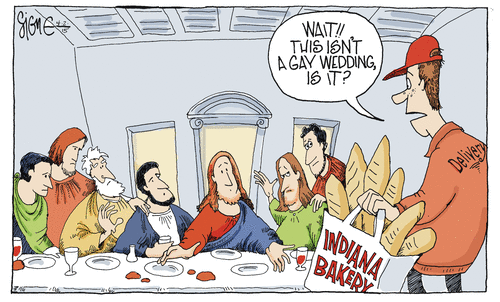
On Monday bishops of the Episcopal Church in the United States – the 14th largest denomination in the country, with almost 2 million members – “overwhelmingly” approved a rite for blessing gay marriages, making it the first big U.S. church to say “yes” to gay marriage.

Speaking to Reuters, Ruth Meyers, a chair of the Episcopalians’ Subcommittee on Prayer Book, Liturgy and Church Music, said the Episcopal Church’s Chamber of Bishops agreed to the proposed blessing at a meeting in Indianapolis and its House of Deputies should formally approve it later this week.

“The decision would go into effect in December and make the Episcopal Church, an independent U.S.-based institution affiliated with global Anglicanism, the biggest U.S. church to allow a liturgy for same-sex marriages,” Reuters said.

Up until now, it had been the United Church of Christ, a mainstream Protestant denomination counting approximately 1 million members, which had done more than any other U.S. church to support same sex marriage voting in favour of it in 2005.

The new Episcopal same-sex liturgy is called “the Witnessing and Blessing of a Lifelong Covenant,” and would become the standard rite for same-sex marriage, Reuters reported.

In the past, it was bishops who showed the strongest opposition to such measures but the result of Monday’s vote showed a different attitude altogether, with 111 voting in favour and 41 against. Abstentions totalled 3.

The convention also approved inclusion of transgender people among those who should not be discriminated against, either for ordination or as lay leaders.

“Today the Episcopal Church affirmed the human dignity of a deeply stigmatized population that is far too often victim to discrimination, bullying and abuse,” the Reverend Lowell Grisham, a leader of the Chicago Consultation, a group that supports equality, said in a statement quoted by Reuters.

The Episcopal Church allowed gay priests 16 years ago and approved its first openly gay bishop 9 years ago.

Today, gay marriage is legal in six states and the District of Columbia and as Reuters reported, the legislatures of three states – New Jersey, Maryland and Washington State – approved gay marriage this year, although New Jersey Governor Chris Christie vetoed it. Governors in the other two states signed the legislation but there are attempts being made to block it through a referendum. Monday’s decision has nevertheless marked yet another victory for gay-rights advocates in the U.S., after President Barack Obama endorsed gay marriage in May.

Complete Article HERE!

Episcopal Church Approves Ordaining Transgender People

The Episcopal Church on Monday overwhelmingly voted to allow the ordination of transgender people.

At its triennial General Convention in Indianapolis, the church House of Deputies approved a change to the “nondiscrimination canons” to include “gender identity and expression.” The move makes it illegal to bar from the priesthood people who were born into one gender and live as another or who do not identify themselves as male or female.

The church, which has 1.9 million members in the U.S., currently has rules against discrimination based on race, ethnicity, national origin, sex, marital status, sexual orientation, disability and age for Episcopalians who want to become priests.

There are transgender priests in some Episcopal dioceses and transgender people have been discouraged from becoming priests in some areas. Transgender advocates have campaigned for an official denominational policy.

The vote by the House of Deputies — which includes lay people and clergy — followed Saturday’s approval of the non-discrimination clause by the church House of Bishops. Both groups have to approve new legislation.

“We are filled with joy for this clear affirmation that the Episcopal Church welcomes and values the ministerial gifts of transgender people, lay and ordained. We are also delighted by the strong support and broad understanding of trans issues shown by deputies representing a wide range of regions and generations in this church. As the church steps boldly into new frontiers in various facets of its light, we are proud to be part of this spirit-filled movement,” members of TransEpiscopal, a organization of transgender Episcopalians, said in a statement.

The House of Deputies passed similar legislation at the previous General Convention in Anaheim, Calif., in 2009. When presented with the legislation that year, however, the House of Bishops voted instead to bar discrimination against “all” people instead of specific groups.

The church on Monday also voted to make it illegal to discriminate against transgender people in non-clergy positions in the church.

“It is not just a good day for transgender Episcopalians and their friends, families and allies. It is a good day for all of us who are part of a church willing to the risk to continue to draw the circle wider as we work to live out our call to make God’s inclusive love known to the whole human family,” the Rev. Susan Russell, a deputy from the Diocese of Los Angeles and an activist who supported the legislation, said in a statement.

The House of Bishops on Monday also approved a provisional standard liturgy for priests to use in the blessing of same-sex relationships. Bishops approved the liturgy 111 to 41 with three abstentions. The House of Deputies is expected to vote on the matter before the church’s meeting ends on Thursday.

If the same-sex liturgy is approved, it would be used during a trial that would begin in December and be revisited at the church’s next national meeting in three years. Some Episcopal bishops currently allow same-sex blessings in their dioceses, but many have said they will not allow them unless the church has an official liturgy. If approved, the new liturgy would not be mandatory. Bishops who do not approve of same-sex relationships could bar its use in their dioceses. The liturgy does not represent a religious marriage, though some clergy in states that allow civil marriage do secular marriages in their churches.

The Episcopal Church is the U.S.-based wing of the Anglican Communion, an 85 million-member global denomination. In addition to its U.S.-based members, it has 173,000 members in other countries and territories, including the British Virgin Islands, Colombia, the Dominican Republic, Ecuador, Haiti, Honduras, Taiwan and Venezuela.

Liberal trends in the church regarding the ordination of gay priests and bishops have increasingly strained its relations with its more conservative counterparts in the United Kingdom and Africa. The election in 2003 of its first gay bishop, the Rt. Rev. Gene Robinson of New Hampshire, caused several dioceses to defect and align themselves with more conservative Anglican churches in Africa.

The vote on transgender clergy and the possible passing of same-sex liturgical blessings could further strain relations between Episcopalians and the Anglican Communion.

Complete Article HERE!

Argentine Bishop Bargallo quits over ‘amorous ties’ row

The Pope has accepted the resignation of an Argentine bishop after the publication of pictures showing him embracing a woman on a Mexican beach.

Bishop Fernando Bargallo, 57, was photographed in the sea, hugging a woman in a bikini.

He initially said she was a childhood friend, but later admitted to having had “amorous ties” with her.

Bishop Bargallo was in charge of the diocese of Merlo-Moreno, in the province of Buenos Aires.

The scandal broke last week, when an Argentine television station broadcast pictures of Monsignor Bargallo on holiday at a beach resort in Mexico in the company of a woman.

‘Childhood friend’

In one of the pictures, he is seen half-submerged in the water, embracing a woman in a bikini.

Shortly after the pictures were published, Monsignor Bargallo gave a public statement saying that the woman was a childhood friend, whom he had known all of his life.

He said the situation in which he had been photographed was “imprudent, as it could lead people to jump to the wrong conclusion”.

He asked his flock to forgive him for “the ambiguity of the pictures” and urged them to view the photos “in the context of a long friendship”.

But later that same week, Monsignor Bargallo convened the priests of his diocese and told them he had had “amorous ties” with the woman and would resign.

The Vatican said he would be replaced by Monsignor Alcides Jorge Pedro Casaretto.

Complete Article HERE!

Woman Says ‘Exorcist’ Priest Abused Her

A Roman Catholic priest “kissed (a woman) on all parts of her body” during a so-called “exorcism” session, and “frequently explained full, passionate kisses as ‘blowing the Holy Spirit into’ her,” the woman claims in court.

Jane Doe sued the Catholic Diocese of Arlington, its Bishop Paul Loverde – who is not the priest accused of the abuse – and Human Life International and the HLI Endowment Inc., of Charlottesville, in Arlington County Court.

Doe claims she was sexually abused repeatedly by her “exorcist,” Thomas J. Euteneur, who was president of Human Life International and the HLI Endowment; Euteneur, however, is not named as an individual defendant.

Doe claims that Euteneur, a Roman Catholic priest, offers “‘spiritual deliverance’ and the performance of the rite of exorcism,” and did it “with the knowledge and consent of the Diocese and the Most Rev. Paul S. Loverde. … On at least one previous occasion, the Diocese and Bishop Loverde gave permission to Euteneur to conduct an exorcism within the Diocese.”

Doe claims that the defendants know that exorcism could be “potentially dangerous to the participants.” She says: “The defendants knew that a basic principle in the administration of an exorcism is that the priest should never act alone, and that he should always be accompanied by a support team who have been duly prepared to assist him.”

Doe says that her relationship with Euteneur began on Feb. 28, 2008, when she signed “a document entitled ‘Agreement for spiritual help.’ Among many other things, the document defines ‘deliverance’ as ‘the application of the spiritual resources of the Church to persons with demonic infestation in order to liberate them from the influence of unclean spirits.’”

Euteneur became her “deliverance minister,” and “The aforementioned documents included a requirement of ‘complete cooperation’ and travel to Euteneur’s offices at HLI,” according to the complaint.

Doe says that Euteneur told her “that her case was ‘severe.’”

For two months he touched her “in appropriate ways” in his offices, then in April 2008 told her “that he had received permission from the Diocese to perform the rite of exorcism,” Doe says.

On April 11, 2008, she says, “Euteneur began to hug the plaintiff while saying, ‘I wish I could go a lot further.’ He carried the plaintiff into a guest residence bedroom at HLI and HLIE, laid her on the bed, embraced her, touched her under her bra, and attempted to touch her under her underclothes, which the plaintiff stopped. Euteneur spent the entire night in bed with the plaintiff.

“During the following weeks, during every meeting, Euteneur became progressively persistent in touching the plaintiff inappropriately. He kissed the corners of her moth; stroked her legs, breasts and thighs; caressed her face; laid his body on top of hers; and frequently explained full, passionate kisses as ‘blowing the Holy Spirit into’ her.”

From April to June that year, on six occasions, Doe says, Euteneur “directed the plaintiff to undress; touched and kissed the plaintiff on all parts of her body; and digitally penetrated the plaintiff’s vagina. In addition, Euteneur directed the plaintiff to touch his penis.”

Doe claims that Euteneur “knew that his sexual violations on the plaintiff were not committed with her consent” and “would cause severe emotional distress to the plaintiff.”

Doe claims that HLI hired her as an independent contractor in September 2008, hired her as full-time employee in March 2010, and that during all this time, until June 2010, Euteneur “sexually abused her during working hours and in various rooms at HLI and HLIE headquarters.”

Doe claims that when she told Euteneur she had kept a journal “that she had kept a private journal which covered her time spent with Euteneur,” he persuaded her to “entrust the journal to him for safekeeping” while she took a vacation in Hawaii with her family.

She claims Euteneur “flew to Hawaii and secretly met with the plaintiff every morning while she was there.”

She claims that before she returned, Euteneur went to her home in Virginia “for the purpose of finding and collecting any and all other journals that the plaintiff might have kept. His attempt was unsuccessful.”

And, she claims, when she returned and asked for her journal back, “Euteneur reported that he had burned the journal ‘because it would scandalize the public and harm HLI.’”

After a final, abusive “deliverance,” Doe says, she concluded that her treatment was “illegal, inappropriate, outrageous, harmful, and completely contrary to the dictates of her understanding of Roman Catholic beliefs and practices.”

She claims she gave another priest in the Diocese a “detailed description of her relationship with Euteneur,” but Euteneur remained at HLI and HLIE for 2 more months, during which he sexually violated her two more times.

Finally, in August 2010, Euteneur resigned as president of HIL and HLIE and “was recalled to the Diocese of Palm Beach, Florida,” according to the complaint.

It continues: “On January 31, 2011, Euteneur published a statement in which he wrote: ‘I must acknowledge, however, that one particularly complex situation clouded my judgment and led me to imprudent decisions with harmful consequences, the worst of which was violating the boundaries of chastity with an adult female who was under my spiritual care.’”

She seeks punitive damages for assault, battery, intentional and negligent infliction of emotional distress, negligent entrustment, medical bills, and loss of enjoyment of life.

Complete Article HERE!

Catholic bishop faces Vatican’s wrath after he’s busted cavorting with a scantily-clad beauty on the beach

Argentine Bishop Fernando María Bargallo red-faced after footage emerges

Initially denied he was in video, but later admitted he played starring role
Now under investigation by the Vatican and could be de-frocked

A Catholic bishop busted cavorting on a beach with a scantily-clad beauty has claimed she is just ‘an old friend’ and insisted he is still ‘devoted to God’.
Argentine Fernando María Bargallo, 59, was left red-faced after footage emerged of him swimming and cuddling with the blonde at a secluded luxury Mexican hideaway.
He initially denied it was him in the video, but later admitted he does play a starring role, and is now under investigation by the Vatican.

He could now face being sacked from his post as Bishop for the Roman Catholic Diocese of Merlo-Moreno, a suffragan of the Archdiocese of Buenos Aires.
Bargallo said he recognised the ‘recklessness’ of his behaviour and the ‘ambiguity’ of the film, which he claimed was taken in 2011.

But he has insisted that the woman was a ‘very old friend’ who he has known ‘since I could reason’.
He said: ‘The photographs are, in effect, from an encounter in Mexico where I coincided for various reasons, two years ago, with a friend from my childhood.’

He said there were other people there, who did not appear in the images, and he had a strong relationship with the woman’s family, La Nacion reported.
But he has not responded to questions as to who funded the lavish trip to the Puerto Vallarta resort on Mexico’s Pacific coast.
Bargallo is also head of the Cáritas Latinoamérica organisation which helps the development of impoverished people across the continent.

Complete Article HERE!

Exit, Don’t Enable the Roman Catholic Church

By Wayne Besen

If there is one thing that irks me, it is having the Roman Catholic Church preach to me about sexual morality. It is a religious sect led by a virulently homophobic Pope that goes out of its way to trash my family. Yet, my family hasn’t spent a cent defending itself against nonexistent charges of child rape, while the Vatican has spent $2.5 billion on legal fees, prevention programs, and settlements relating to the sexual abuse of minors.

Exactly why should I listen to what these “holy” men have to say? I’ve been out of the closet for twenty-four years, during which time I worked in the center of the LGBT movement, but can’t think of a single friend or colleague arrested for child molestation. None of the people I associate with have shielded, shuffled, or offered severance packages to pedophiles to protect the institutions that they work for. But such obscene behavior is precisely what the Vatican did, all the while turning my loved ones into scapegoats to obscure their criminality.

The latest preoccupation of the Catholic Church, as well as their brethren in the ultra-Orthodox Jewish Community, is fiercely lobbying state legislatures to not change the statute of limitations for child sexual abuse cases.

“Even when you have the institution admitting they knew about the abuse, the perpetrator admitting that he did it, and corroborating evidence, if the statute of limitations has expired, there won’t be any justice,” Marci Hamilton, a professor at the Benjamin N. Cordozo School of Law at Yeshiva University, explained to the New York Times.

It seems the hierarchy is only interested in saving its own skin, instead of paying a price for those whose skin it violated. For a church built on a human sacrifice, there is scant evidence of noble virtues as the church lies and litigates against its victims.

Which brings us to a burning question: Why do liberal Catholics continue to support an intolerant, homophobic, misogynistic institution capable of covering up heinous crimes against children?

I’m not the only one asking this pertinent question. On June 1, the Freedom From Religion Foundation placed a full-page ad in USA Today headlined, “It’s Time to Quit The Catholic Church.”

According to the ad: “If you think you can change the church from within – get it to lighten up on birth control, gay rights, marriage equality, embryonic stem-cell research – you’re deluding yourself. By remaining a ‘good Catholic,’ you are doing ‘bad’ to women’s rights. You are an enabler. And it’s got to stop.”

New York Times columnist Bill Keller also urged moderate Catholics to find a new church: “Much as I wish I could encourage the discontented, the Catholics of open minds and open hearts, to stay put and fight the good fight, this is a lost cause…Summon your fortitude, and just go. If you are not getting the spiritual sustenance you need, if you are uneasy being part of an institution out of step with your conscience — then go.”

It does seem as if diehard liberal and moderate Catholics are not fighting so much as being beaten to a pulp by ideologues. If this were a boxing match, it would have been stopped many rounds ago. Indeed, attacks from the right have become so extreme that the Church is even going after American nuns. If nuns aren’t Catholic enough for these fanatics, liberal Catholics sure aren’t going to be embraced any time soon.

This whole debate reminds me of when gay people from conservative backgrounds complain to me that they can’t come out because of the environment in which they were raised. One says, “I grew up in a traditional Chinese household, so I can’t tell my parents.” While another person says, “I grew up in a Pentecostal family, so I can’t tell anyone.” And yet another proclaims, “You wouldn’t understand, it’s not that easy coming out because my parents are from a rural area.”

Everybody has an excuse or explanation, and, no, it’s never easy to come out – but at the same time, it really is a simple process. Saying “I’m gay” works like a charm every time and frees a person to be their authentic self.

Similarly, it may be incredibly difficult to leave the Catholic Church. But, it is also as easy as going to a computer search engine and typing “church” or speaking into your iPhone, “Siri, find me a church.” Within moments dozens of alternatives will pop up – many of which are more concerned with spirituality than the statute of limitations.

Are you tired of being treated like an abused dog by the Catholic Church? Then drop the dogma and quit. After all, they quit you, your family, and your moderate belief system a long time ago. Exit, don’t enable.

Complete Article HERE!

QUOTE OF THE DAY

“Too many of my sisters and brothers in the gay community don’t seem to understand the power of religion,” White lamented. “They have been rejected by religion. They hate the idea of religion. Therefore, they’re not going to deal with religion, which is fatal, because religion is the heart of homophobia. Without religion there would be no homophobia. What other source of homophobia is there but six verses in the Bible? When Bible literalists preach that LGBT people are going to hell they become Christian terrorists. They use fear as their weapon, like all terrorists. They are seeking to deny our religious and civil rights. They threaten to turn our democracy into a fundamentalist theocracy. And if we don’t reverse the trend, there is the very real possibility that in the end we will all be governed according to their perverted version of biblical law.”

Gay activist and Christian pastor Mel White quoted in a post by Chris Hedges over at TruthDig titled, The War on Gays.

Sexism and the Roman Catholic Church

By — Roy Bourgeois

I have been a Catholic priest for years and like most people I know, my experiences in life have changed me.

Growing up in a small town in Louisiana, as Catholics, my family did not question our segregated schools or ask why the black members of our church had to sit in the last five pews during Mass. Nor did we, needless to say, question why women could not be priests.

Joining the military was my ticket out of Louisiana. I volunteered for duty in Vietnam, which became that turning point in my life. In the midst of all the violence and death, my faith became more important and I felt God was calling me to be a priest. After four years in the military, I entered the Maryknoll Order.

In my ministry in the United States, I have met many devout Catholic women who are called by God to be priests. They are rejected because the Church teaches only baptized males can be ordained. This makes no sense to me.

Don’t we profess that God created men and women of equal worth and dignity? The Holy Scriptures state clearly in Galatians 3:28 that “There is neither male nor female. In Christ Jesus you are one.” All Catholic priests say that the call to be a priest is a gift and comes from God. How can we, as men, say that our call from God is authentic, but your call, as women, is not?

After much reflection, study and prayer, I have come to believe that the exclusion of women from the priesthood is a grave injustice against women and against our loving God, who calls both men and women to be priests. I also believe that if we are to have a healthy and vibrant Church, we need the wisdom, experiences and voices of women in the priesthood.

The Vatican refers to the ordination of women as “a grave scandal” in our Church. When Catholics hear the word “scandal” they think about the thousands of priests who sexually abused children, and the many bishops who covered up their horrific crimes.

Pope Benedict XVI is telling priests like me to be obedient to our Church leaders and not to question or discuss our Church teachings.

This presents a problem because the Church teaches us about the primacy of conscience. Our conscience is sacred because it gives us a sense of right and wrong and urges us to do what is right, what is just. When we betray our conscience, we separate ourselves from God.

Often, I think how we, as Catholics, were silent when our schools were segregated; not questioning why black members of our Church had to sit in the back pews. As a priest, I have learned that when there is injustice, our silence is the voice of complicity. Sexism, like racism, is a sin.

And no matter how hard we may try to justify discrimination against others, in the end, it is not the way of God.

Complete Article HERE!

Vatican’s term ‘radical feminist’ says more about cardinals than nuns they rebuke

COMMENTARY

It surprises me a little that the men who run things at the Vatican did not use their most favorite recent pejorative – “feminist” — when they rapped the knuckles of Margaret Farley, a nun who has long been a professor at Yale, for having written a book about sex and love that condones masturbation (and as of Thursday morning was in Amazon’s top 20). In a million other ways, it doesn’t uphold their view of Christian sexual morality.

Because unlike the other nuns the Vatican has been reprimanding recently, Sister Farley is, in fact, a feminist. An ethicist who has worked on the problem of HIV/AIDS, Farley was commended in 2005 by her Yale colleagues for her contributions to feminist theory.

A nun looks on as Pope Benedict XVI leads a ceremony commemorating Christ’s gesture of humility toward his apostles on the night before he died at the Basilica of St. John Lateran in Rome April 5, 2012. Pope Benedict recently re-stated the Roman Catholic Church’s ban on women priests and warned that he would not tolerate disobedience by clerics on fundamental teachings.

Members of the Vatican hierarchy are using the word “feminist” and even “radical feminist” the way third-graders use the word “cooties.” In April, the Vatican accused the Leadership Conference of Women Religious, which represents 57,000 nuns nationwide, of allowing “radical feminist” ideas to flow, unchecked, in their communities. In 2008, after he launched an investigation against American nuns (the results of which have not yet been released), Cardinal Franc Rode told a radio interviewer that the nuns are suspected of “certain irregularities,” a “secular mentality,” and “perhaps also a certain feminist spirit.”

The authors of these rebukes never define “feminism” or “radicalism.” In their hands, these words, which can carry legitimate intellectual meanings, appear to signify something like: “Yucky women who fail to heed our instructions and, anyway, don’t meet our standards of womanhood.” In other words, the sisters aren’t behaving as girls should.

Their casual use of these terms convinces me that the cardinals, in their vast experience, have never actually met a radical feminist theologian. Such creatures do exist, although American religious orders are hardly their breeding ground. What the Vatican hierarchy sees as a “radical feminist” is a woman who dares to believe that she’s equal to a man.

“Even large sectors of the church itself have legitimate concern and want to continue to talk about the place of women in the church, and rightful equality between men and women,” Sister Pat Farrell, a member of the LCWR, told the New York Times last week. “So if that is called radical feminism, then a lot of men and women in the church, far beyond us, are guilty of that.”

Lisa Isherwood is a real-life radical feminist theologian. She is editor of the journal Feminist Theology and a professor at Winchester University in England. She believes that the men at the Vatican are using the term “radical feminist” as a right-wing scare tactic, for it evokes other enemies far more dangerous than nuns. Their thinking goes like this, she says: “We hear the word radical Islam, and everyone panics, so let’s chuck that at them.”

The mother of radical feminist theology was the late Mary Daly, who started life as a committed Roman Catholic and spent most of her career teaching at Boston College, a Catholic institution.

She was driven to critique her beloved church after she sat in on sessions of the Second Vatican Council in Rome and felt that women had no meaningful part in the proceedings.She was, she wrote later, appalled by “the contrast between the arrogant bearing and colorful attire of the ‘princes of the church,’ ” she wrote later, “and the humble, self-deprecating manner and somber clothing of the very few women. … Watching the veiled nuns shuffle to the altar rail to receive Holy Communion from the hands of a priest was like observing a string of lowly ants at some bizarre picnic.”

In her breakthrough 1974 book, “Beyond God the Father,” Daly wrote, “If God is male, then the male is God. The divine patriarch castrates women as long a he is allowed to live on in the human imagination.” Now that’s a radical feminist for you. Daly’s work gave voice to generations of feminist scholars.

Isherwood, for one, wears the labels “feminist” and “radical” with pride. She is a Catholic — “in as far as anyone’s trying to hang in there” – she says.

She deeply loves her church and believes that at its core, Roman Catholicism has a radical feminist message. “The church should be radical. It should be saying, ‘More inclusion, more equality.’ An abundance of life is a fundamental Catholic value. The idea of ordination of women and so on is just one very small, very significant point. Radical feminism would want the church to be more proactive in terms of working for a life of abundance for the marginalized.”

Now that’s a threatening idea.

Complete Article HERE!