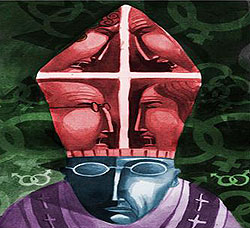
Catholicism’s Curse

A must read!

By FRANK BRUNI

But while I have nothing against priests, I have quite a lot against an institution that has done a disservice to 27BRUNI-popupthem and to the parishioners in whose interests they should toil. I refer to the Roman Catholic Church, specifically to its modern incarnation and current leaders, who have tucked priests into a cosseted caste above the flock, wrapped them in mysticism and prioritized their protection and reputations over the needs and sometimes even the anguish of the people in the pews. I have a problem, in other words, with the church’s arrogance, a thread that runs through Wills’s book, to be published next month; through fresh revelations of how assiduously a cardinal in Los Angeles worked to cover up child sexual abuse; and through the church’s attempts to silence dissenters, including an outspoken clergyman in Ireland who was recently back in the news.

Complete Article HERE!

German Catholics vent their dissatisfaction with the Church

A study on Germany’s Catholic community reveals the discontent of faithful with the ecclesiastical institution. But proposals for solutions are lacking

By ALESSANDRO ALVIANI

sad lonely popeThe Pope’s ecclesiastical policies are “backward-looking” and suspected of trying to take the Church back to the pre-Second Vatican Council period. As for the Church’s leaders, they are “cut off from reality, reactionary and obstructionist.”

This is the opinion German faithful have of Benedict XVI and the Catholic Church according to a study by Sinus Institute and consulting agency MDG (which the German Church controls). In-depth interviews were conducted with 100 Catholics from different social backgrounds. According to the study, which picks up on a similar one carried out in 2005, German faithful are convinced that today’s Church finds itself in a “desolate situation” and the most obvious manifestation of this is the sex abuse scandal.

The authors of the study wrote that the scandal seriously damaged the image of the Church, even in the eyes of the most fervent Catholics, whose faith was deeply shaken. The scandal was seen as confirmation of the Church’s “modernization deficit”. The Church lost a great deal of credibility not just as a result of the accusations of paedophilia made against it but also because many believe it dealt with the abuse issue inadequately.

Internal dogma and rules that had been tacitly accepted until about a year ago are now openly criticised by faithful. Criticisms range from complaints about “discrimination against women” and celibacy, to the condemnation of homosexuality, contraception and sex outside wedlock, to the marginalisation of lay people involved in Church life.

Another factor that is creating animosity, is the organisational restructuring that is taking place in Germany, with a number of parishes being merged because of the shortage in parish priests, for example.

The study also shows the Church’s detachment from the weakest sections of society: it would make no difference to the lower social classes if the Church ceased to exist.

Despite their criticisms, however, faithful still look to the Church for “spiritual guidance” and “meaning”. The majority of them do not want to lose their Catholic identity and few consider leaving the Church.

So what do German faithful expect from the Church? They want lay people involved in the Church to play a greater role; they want more women in leadership roles; the possibility for women to be ordained priests; the elimination of celibacy; a different attitude towards sexuality and contraception; the sacraments to be administrated to all Christians, regardless of their denomination or sexual identity; less ostentation and less abuse of power and a greater focus on God’s love and love for one’s neighbour.

Complete Article HERE!

Lawyer who foretold church scandals writes his story

By Angus MacSwan

Ray Mouton was a successful young lawyer in Lafayette, Louisiana, respected in the community and blessed with a loving family, when he received a call from a vicar in the Roman Catholic diocese for a lunch meeting on a fateful day in 1984.

The diocese asked him to defend an errant priest, accused of abusing dozens of children in a rural community. Mouton reluctantly agreed to take on the task.

What followed over the next few years was the uncovering of an institution riddled with pedophile priests on a national scale and efforts at high levels in the Catholic Church to hide the problem away.

For Mouton, it meant the end of his law career, health problems, and anger, depression and guilt.

After many years of writing from his self-imposed exile in France, he finally tells his story in the novel “In God’s House“. It is a harrowing read laden with sickening detail, but also for Mouton, a work of atonement.

“There’s not a day I don’t think about the children. When I was writing the book, whenever I wanted to quit, I thought about the victims and their families,” he told Reuters.

In person, Mouton, now aged 65, looks like a southern lawyer from central casting, with a head of thick white hair and a sonorous Louisiana drawl.

He chose to tell the story in novel form although the characters, from the lawyer to a senior Vatican official who proves an obstacle to addressing the scandal – are based on real figures.

“The novel is a dramatic experience. My experience was a traumatic one. Every day there were revelations. I didn’t want to believe, the country didn’t want to believe,” he said.

Mouton and his family – Cajuns whose ancestors came to Louisiana as part of the Acadian diaspora – were strongly Catholic. His family had donated land for the cathedral in Lafayette and built schools, churches and a seminary.

When he first agreed to defend the priest, Father Gilbert Gauthe, he believed he was dealing with an isolated case.

“I believed priests were somehow superior. I had never heard of a priest having sex with a child. I could not believe a Catholic priest could do this. I thought he was just one then it all unraveled. In that diocese alone there were a dozen more.”

The church preferred to deal with the problem by paying off victims’ families. But one family wanted to see justice done.

As a lawyer, Mouton believed Gauthe had the right to a fair trial. He soon realized the church was deeply compromised. It had known about Gauthe’s crimes since his days in seminary but had moved him around various parishes, where the abuses continued.

The church was in effect harboring criminals, Mouton said.

“I did start out on the side of the church. I couldn’t imagine they had foreknowledge,” he said.

Mouton joined forces with Father Tom Doyle, a canon lawyer in the Vatican Embassy in Washington, and Father Michael Peterson, a psychiatrist priest who treated sexually deviant clergymen. The two had heard many other cases across Louisiana and the United States – and attempts to bury the problem.Ray Mouton

Believing they had the support of the church hierarchy, they set out on a crusade to bring it into the open and seek justice for the victims.

They spent a year working on a document detailing the scale of the abuse, the steps the church should take to address it and the consequences if it did not. It stated that there was a national crisis involving dozens, if not hundreds, of priests.

“It told them what the deal was – you’ll lose 1,000 priests and a billion dollars.”

They hoped to present the document to the United States Conference of Catholic Bishops for debate. But after a meeting in a Chicago hotel in 1985 with a cardinal, they were told to kill it.

“They put the reputation of the church above the value of the little children. They did all they could to avoid scandal.”

FALL FROM GRACE

“In God’s House” details a powerful apparatus at work involving local politicians, expensive lawyers, insurance companies and bishops. It also reached into the Vatican, which Mouton says considered the institution above the law.

It also shows the devastation of the victims and their families – shame, anger and frustration as well as physical damage. Many were told that to seek redress would be disloyal to the church, adding further conflict to their emotions.

Mouton himself suffered verbal abuse and even death threats in the community for defending Gauthe. He was accused of trying to extort the church for exorbitant fees.

He put up an insanity plea for Gauthe but the priest himself insisted he was sane. He was sentenced to 20 years.

However, a senior jurist in Louisiana involved himself personally in Gauthe’s case. Instead of going to a prison that was a treatment facility for pedophiles, the priest was sent to a prison where juveniles were held. He was released after serving only half of his sentence.

Gauthe was picked up in Texas soon after his release for molesting a 3-year-old boy, but put on probation rather than being sent back to prison.

Mouton’s marriage broke up and he became an alcoholic.

“It was a cataclysmic event. It broke me in half. I did fall from grace,” he said.

It took many years but subsequent events have vindicated Mouton as widespread sexual abuse by priests came to light across the United States and the world, from Ireland to Australia.

The church and its insurance companies have paid out more than $2 billion dollars in the United States, bishops have been disgraced, and its reputation has suffered to the point that the faithful have deserted in droves.

Mouton now lives in southern France close to the Pyrenees with his second wife Melony and travels frequently to Spain, Mexico and other countries.

He is still bitter about the cover-ups and that many of those responsible have never been brought to justice. Nor has the problem been eradicated, he believes.

“I don’t think we’ve reached critical mass on it yet. The question is what can the church do? The church needs to release all the documents and demand the resignations of those involved.”

The novel is dedicated to Scott Anthony Gastal, the first child to testify in court against a bishop, and to the victims and their families, who, he says, “were abandoned not by their God, but by their Church”.

“I was haunted by my experience. I felt I had to do something,” he said.

Complete Article HERE!

Swiss abbot makes fiery appeal for church reform

By Christa Pongratz-Lippitt

A fiery appeal for church reform by an influential Swiss abbot has attracted widespread attention throughout Europe, and has, moreover, been welcomed by the future president of the Swiss bishops’ conference.

Abbot Martin WerlenFifty-year-old Abbot Martin Werlen, leader of the Abbey of Einsiedeln and himself a member of the Swiss bishops’ conference, first voiced his appeal in a sermon on the 50th anniversary of the beginning of the Second Vatican Council in October. The sermon was later published in a 39-page brochure that sold out within three days and is now in its third edition.

Titled “Discovering the Embers Under the Ashes,” it echoes remarks by Cardinal Carlo Maria Martini in his last interview before his death Aug. 31. Referring to the state of the church today, Martini spoke of his sense of powerlessness and how Catholicism’s “embers” were “hidden under the ashes.”

Werlen said he is alarmed by the present state of the church. “The situation of the church is dramatic, not only in the German-speaking countries,” he said. “It is dramatic not only because of the rapidly decreasing number of priests and religious or because of plummeting church attendance. The real problem is not a problem of numbers. What is missing is the fire! We must face the situation and find out what is behind it.”

He said there is leeway for reform and discussed possible reforms at length.

For example, he said, the church could learn from the way the Orthodox church deals with remarried divorced people, who are not barred from Communion. The Catholic church has never condemned the Orthodox approach, Werlen emphasized.

Local churches should also have more say in episcopal nominations, he said, recalling that religious orders have always elected their superiors democratically over the centuries.

On priestly celibacy, he quoted the Code of Canons of the Eastern Churches, promulgated by Pope John Paul II in 1990. The code says that clerical celibacy “is to be greatly esteemed everywhere,” but adds that “likewise, the hallowed practice of married clerics in the primitive Church and in the tradition of the Eastern Churches throughout the ages is to be held in honor.”

There is also a lot of leeway as far as cardinals are concerned, Werlen pointed out. Women and men from all over the world, both young and old, could be elected to the cardinalate for a period of five years and could meet with the pope every three months in Rome. “Such meetings could bring a new dynamism into church leadership,” Werlen suggested.

The church could also “rediscover” synodal processes. “If bishops’ synods are so influentially prepared and accompanied by the Roman Curia that nothing new can emerge, is that a witness of faith?” he asked. As at Vatican II, “bishops should realize their responsibilities and with the help of theologians, and together with the pope, face changes in full faith — and let paper remain paper!”

Werlen wrote that he deplores the lack of courage, vision and creativity in today’s church, which he says is crawling along “with the hand brake on.”

“The problems are known. Pope Benedict on occasion refers to them. But nothing concrete is done to solve them,” Werlen said.

Sweeping problems under the table or forbidding discussion of certain issues undermines the church’s credibility, he warned.

“Not taking a situation or a person seriously is an act of disobedience. When those in authority in the church do not fulfill their duty and are therefore disobedient, initiatives are started as emergency measures … which can lead to schisms or to people leaving the church. The disobedience deplored by church officials is often the consequence of those very church officials’ own disobedience. I can understand why so many initiatives were started in recent years.”

But polarization between conservatives and progressives in the church, which he said has now reached a “frightening” level, has a deadening effect, he cautioned.

“I myself together with the Einsiedeln community would like to take another path, namely that of seeking the embers in the ashes,” he said. He pointed out that Einsiedeln is in dialogue with both the Lefebvrist Society of St. Pius X and the progressive Catholic theologian Fr. Hans Küng.

Within a week after the brochure was first published, Werlen received more than a 1,000 emails and 100 letters, many from prominent Catholics. He said he was “quite overwhelmed” by this and added, “The embers are there. One can feel people of different generations heaving a deep sigh of relief.”

After reading the brochure, Bishop Markus Büchel of Sankt Gallen, newly elected president of the Swiss bishops’ conference, released the following statement: “Abbot Werlen has taken up urgent questions the faithful are asking; he has outlined the problems very clearly and has put forward possible solutions. This is an impetus for very necessary discussions in the church that are also a great concern of mine. That is why I am most thankful to him.”

Büchel has been elected to succeed Bishop Norbert Brunner of Sion as conference president for three years starting Jan. 1.

Werlen became abbot of Einsiedeln in 2001. The abbey is a famous pilgrimage shrine in the oldest part of Switzerland, its heartland. Between 150,000 and 200,000 pilgrims annually visit the shrine, which at times rivaled Santiago de Compostela in Spain.

Complete Article HERE!

Pope Benedict pardons former butler Paolo Gabriele

What A Guy! The truth of the matter is this is all about Vatican corruption. It has virtually nothing to do with charitable forgiveness. But it makes for a fabulous photo op, huh?

Pope Benedict XVI has pardoned his former butler, Paolo Gabriele, who is serving an 18-month jail sentence for stealing confidential papers.

The Pope visited Gabriele in prison to personally inform him of the decision, the Vatican said in a statement.

In October the former butler was found guilty of stealing and copying the Pope’s documents and leaking them to an Italian journalist.

Gabriele said he acted out of love for the Church.

“This morning the Holy Father Benedict XVI visited Paolo Gabriele in prison in order to confirm his forgiveness and to inform him personally of his acceptance of Mr Gabriele’s request for pardon,” the Vatican statement said.

Following Gabriele’s conviction by a Vatican court, officials said he was likely to be pardoned by the pontiff.

In November the court convicted a computer expert, Claudio Sciarpelletti, of helping leak the papal documents.

Sciarpelletti was given a suspended sentence of two months.

Gabriele’s trial heard that he had taken advantage of his access to the pontiff to photocopy thousands of confidential documents.

He later passed some to journalist Gianluigi Nuzzi, who this year released a best-selling book detailing scandals and infighting within the Vatican.

Gabriele confessed to taking the papers, but said he believed the Pope was being manipulated and hoped to reveal alleged corruption at the Holy See.

Complete Article HERE!

Pope attacks gay marriage…AGAIN!

File under “Doubling Down — In The Vain Hope That The Tide of History Will Turn Back The Clock.”

Benedict promoted traditional marriage in his annual ‘State of the Church’ speech at the Vatican and added posts lauding truth, faith and family to his popular personal Twitter account this week.

Benedict ClausSpeaking to the Curia, the bureaucrats who run the global church of 1.2 billion Catholics, the pope said opposition to gay marriage is a way of defending humanity: “Whoever defends God is defending man.”

Benedict also quoted the chief rabbi of France, Gilles Bernheim, who has written that promoting a right to same-sex marriage is an “attack” on the traditional family made up of a father, mother and children.

The address echoed his recently released annual peace message, which said gay marriage, abortion and euthanasia are threats to world peace.

These are the threats to world peace, huh? Not war! Not poverty! Not a lack of access to education! Not sectarianism! Not nuclear arms! Not the changing climate! Jesus! No wonder fewer and fewer people take the man and the institution he represents seriously any more.

Complete Article HERE!

Vatican disciplines Austrian dissident priest

File under … “Oh Snap!”
Apparently someone’s got his white cassock in a twist. The pettiness of these “holy” men is absolutely astounding.

By Philip Pullella

The Vatican has cracked down on a prominent Austrian Roman Catholic priest who has been leading a disobedience campaign to openly challenge Roman Catholic teachings on celibacy and women priests.

The Vatican said on Thursday it had stripped Father Helmut Schueller of the right to use title monsignor and said he also was no longer a “Chaplain of His Holiness”. Schueller remains a priest.

Schueller, a former deputy to Vienna’s archbishop, Cardinal Christoph Schoenborn, had been given the honorary title in his capacity as head of the Austrian branch of the Catholic charity group Caritas.

Schueller is head of the group “Call to Disobedience”, which has broad public backing in opinion polls and says it represents about 10 percent of the Austrian clergy.

Nearly 150,000 Austrians left the Church in 2011-2012, many in reaction to sexual abuse scandals.

The group wants Church rules changed so that priests can marry and women can become priests. It has said it will break Church rules by giving communion to Protestants and divorced Catholics who remarry.

Schueller told Austrian media that the Vatican decision had not shaken his principles.

Reformist Austrian Catholics have for decades challenged the conservative policies of Benedict and his predecessor John Paul, creating protest movements and advocating changes the Vatican refuses to make.

Schueller has met like-minded clergy in Austria and abroad since launching the “Call to Disobedience” group. Catholic reform groups in Germany, Ireland and the United States have made similar demands from the Church.

The Catholic Church does not allow priests to marry and teaches that it has no authority to allow women to become priests because Jesus willingly chose only men as his apostles when he instituted the priesthood at the Last Supper.

Proponents of a female priesthood say Jesus was only adhering to the social norms of his times.

Last week, the Vatican disciplined another priest who advocated women’s ordination.

Father Ray Bourgeois, an American of the Maryknoll religious order, was kicked out of the priesthood and the order by the Vatican’s doctrinal department, the Congregation for the Doctrine of the Faith.

Last year, Bourgeois, who had been a priest for 40 years, was among a group of Roman Catholic activists detained by Italian police after they tried to deliver a petition to the Vatican in favor of a female priesthood.

Benedict, who for decades before his 2005 election as pope was the Vatican’s chief doctrinal enforcer, directly denounced disobedient priests last April, saying it was not the right path to renewal in the Church.

Complete Article HERE!

50 Reasons to Boycott the Catholic Church

The Church uses its resources to oppose social progress and positive change all over the world.

By Adam Lee

Last month in Ireland, Savita Halappanavar died, and she shouldn’t have. Savita was a 31-year-old married woman, four months pregnant, who went to the hospital with a miscarriage in progress that developed into a blood infection. She could easily have been saved if the already doomed fetus was aborted. Instead, her doctors did nothing, explaining that “this is a Catholic country,” and left her to suffer in agony for days, only intervening once it was too late.

Savita’s death is just the latest in a long line of tragedies directly attributable to the doctrines and beliefs of the Roman Catholic church. I acknowledge that there are many good, progressive Catholics, but the problem is that the church isn’t a democracy, and those progressives have no voice or vote in its governance. The church is a petrified oligarchy, a dictatorship like the medieval monarchies it once existed alongside, and it’s run by a small circle of conservative, rigidly ideological old men who make all the decisions and choose their own successors.

This means that, whatever individual Catholics may do, the resources of the church as an institution are bent toward opposing social progress and positive change all over the world. Every dollar you put into the church collection plate, every Sunday service you attend, every hour of time and effort you put into volunteering or working for church organizations, is inevitably a show of support for the institutional church and its abhorrent mission. When you have no voice, there’s only one thing left to do: boycott. Stop supporting the church with your money and your time. For lifelong Catholics, it’s a drastic step, but it’s more than justified by the wealth of reasons showing that the church as an institution is beyond reform, and the only meaningful response is to part ways with it. Here are just a few of those reasons:

1. Throughout the world, Catholic bishops have engaged in a systematic, organized effort going back decades to cover up for priests who molest children, pressuring the victims to sign confidentiality agreements and quietly assigning the predators to new parishes where they could go on molesting. Tens of thousands of children have been raped and tortured as a result of this conspiracy of silence.

2. Strike one: “What did the pope know and when did he know it?” The current pope, when he was Cardinal Joseph Ratzinger, was personally implicated in a case from the 1970s in which at least three sets of parents reported that a priest in his diocese had sexually abused their children. In response, Ratzinger assigned the priest to therapy, without notifying law enforcement, and washed his hands of the matter. That priest was back on duty in just a few short days and went on to molest more children.

3. Strike two: In 1981, again when the current pope was Cardinal Ratzinger, he got a letter from the diocese of Oakland asking him to defrock a priest who had acknowledged molesting two children. Ratzinger ignored this letter, and several followup letters, for four years. Finally, in 1985, he wrote back saying that more time was needed, and that they had to proceed very slowly to safeguard “the good of the Universal Church” in light of “the young age of the petitioner” — by which he meant not the victimized children, but the pedophile priest. (By contrast, when a rogue archbishop ordained married men as priests, he was laicized six days later.)

4. Strike three: In 2001, Cardinal Ratzinger wrote a letter, De Delictis Gravioribus, to all Catholic bishops advising them how to handle accusations of sex crimes by priests. There was no recommendation to contact the police, but rather an instruction for them to report such cases only to the Vatican and tell no one else: “Cases of this kind are subject to the pontifical secret.

5. Some church officials, like the American friar Benedict Groeschel, have blamed the epidemic of child molestation on sexually wanton boys who tempt priests into assaulting them.

6. They threaten to cut off funding for immigrants’ rights advocates because they sometimes work with gay-rights advocates. Preventing immigrants from getting legal and medical aid is less important than ensuring the church isn’t contaminated by even indirect contact with anyone who helps gay people.

7. In a sign of how ridiculously disproportionate and unhinged the church’s martyrdom complex is, the current pope has compared expanding the rights of women and gay people to the murderous anticlerical violence of the 1930s Spanish civil war.

8. They’ve used their official UN observer status to team up with Islamic theocracies like Iran and Libya to oppose calls for family-planning services to be made available in the world’s poorest nations.

9. They’ve gone to desperately poor, AIDS-ravaged regions of Africa to spread the life-destroying lie that condoms don’t prevent transmission of HIV.

10. In the mid-20th century, they appointed a special papal commission to study whether Catholicism should permit the use of birth control. When the commission almost unanimously recommended that they should, they ignored that recommendation and doubled down on their absolute ban on contraception.

11. They excommunicated the doctors who performed an abortion on a pregnant 9-year-old who’d been raped by her stepfather.

12. They did not excommunicate the stepfather.

13. Savita Halappanavar wasn’t the first: Catholic-run hospitals are willing to let women die rather than get lifesaving abortions, even when a miscarriage is already in progress and no possible procedure could save the fetus.

14. They refused to provide contraception or abortion to women who were abducted and forced to work as prostitutes, and then filed a lawsuit complaining it was violating their religious freedom when the government took away their contract.

15. In Poland, they ordered politicians to vote for a law banning IVF and threatened to excommunicate any who didn’t comply.

16. They were a major source of the pressure on the Komen Foundation that led to its disastrous decision to cut ties with Planned Parenthood.

17. They’ve announced an inquisition into the Girl Scouts to get to the bottom of its association with morally suspect groups like Doctors Without Borders and Oxfam.

18. They’ve been one of the major forces attacking Obamacare, filing lawsuits arguing that non-church Catholic employers should be able to decide whether or not employee health insurance plans will cover contraception. This is effectively an argument that a woman’s employer should be allowed to force her to pay more for medical coverage, or even place it out of her reach altogether, based on his religious beliefs.

19. In Australia, they allegedly derailed a police investigation of an accused pedophile, putting pressure on higher-ups to get an investigating officer removed from the case.

20. They demanded that Sunday school teachers sign a loyalty oath agreeing to submit “will and intellect” to the proclamations of church leaders.

21. Some top church officials, including the current pope, have advocateddenying communion to politicians who support progressive and pro-choice political ideas. Notably, although the church also opposes preemptive war and the death penalty, no conservative politician has ever been denied communion on this basis.

22. They’ve cracked down on American nuns for doing too much to help the poor and not enough to oppose gay marriage, condemning them for displaying a seditious “feminist spirit.”

23. In Germany, where parishioners pay an officially assessed tax rate to the church, they’ve tried to blackmail people who don’t want to pay the church tax, threatening to fire them from jobs in church institutions. In some cases, if the person opts out but later loses the paperwork, they demand on-the-spot repayment of decades of back taxes.

24. In America, bishops have compared Democratic officeholders, including President Obama, to Hitler and Stalin and have said that it jeopardizes a person’s eternal salvation if they don’t vote as the bishops instruct them to.

25. They fight against equal marriage rights for same-sex couples. It’s not enough for the Catholic church hierarchy that they refuse to perform church weddings for gay and lesbian couples; they want to write that prohibition into the civil law and deny marriage equality to everyone who doesn’t fit their religious criteria, and have invested vast amounts of money and effort into doing so. In the 2012 election cycle alone, the church spent almost $2 million in an unsuccessful fight to defeat marriage-equality initiatives in four states.

26. They’ve compared gay sex to pedophilia and incest and called for it to be forbidden by law, saying that “states can and must regulate behaviors, including various sexual behaviors.”

27. They’ve shut down adoption clinics rather than consider gay people as prospective parents. The church’s official position, apparently, is that it’s better for children to remain orphans or in foster care than to be placed in a loving, committed same-sex household.

28. They barred an anti-LGBT bullying group, anti-teen-suicide foundation from a Catholic school ceremony, explaining that the group’s mission is “contrary to the teachings of the Catholic church.”

29. They told a teenager he wouldn’t be allowed to go through confirmationbecause he posted a pro-gay-rights status message on Facebook, and theyexpelled a preschooler from a private Catholic school because his parents were lesbians.

30. They have a history of dumping known pedophile priests in isolated, poor, rural communities, where they apparently assumed that local people wouldn’t dare to complain or that no one would listen if they did.

31. They’ve given huge payouts — as much as $20,000 in some cases — to pedophile priests, to buy their silence and quietly ease them out of the priesthood, after specifically denying in public that they were doing this.

32. When the Connecticut legislature proposed extending statute-of-limitations laws to allow older child-abuse cases to be tried, the bishops ordered a letter to be read during Mass instructing parishioners to contact their representatives and lobby against it.

33. To fight back against and intimidate abuse-survivor groups like SNAP, the church’s lawyers have filed absurdly broad subpoenas demanding the disclosure of decades’ worth of documents.

34. In the Netherlands, some boys were apparently castrated in church-run hospitals after complaining to the police about sexual abuse by priests.

35. When a Catholic official from Philadelphia, William Lynn, was charged with knowingly returning predator priests to duty, his defense was to blame those decisions on his superior, Cardinal Anthony Bevilacqua, thus acknowledging that the corruption reaches to the highest levels of the church.

36. When confronted with hundreds of complaints about child-raping priests spanning decades, a Dutch cardinal used the same “we knew nothing” excuse once given by Nazi soldiers. Several months later, it was reported that this same cardinal had personally arranged to move a pedophile priest to a different parish to shield him from accusations.

37. In one case, Mother Teresa successfully persuaded the church to return a suspected pedophile priest to duty because he was a friend of hers. Eight additional complaints of child abuse were later lodged against him.

38. In yet another case, they appointed a priest with a history of child molestation to a board that advises the church on what to do when they get reports of priests molesting children.

39. And after all this, they’ve had the audacity to plead for money and ask parishioners to pick up the tab for legal costs and settlements.

40. They abducted tens of thousands of babies from unwed mothers who gave birth in Catholic-run hospitals all over the world throughout the 20th century, forcing drugged or helpless women to give their newborn children up for adoption against their will.

41. They tried to have the Indian skeptic Sanal Edamuruku charged with blasphemy and imprisoned for debunking a claim of a miraculous weeping statue.

42. They publicly supported the Russian Orthodox church’s decision to have the punk band Pussy Riot charged and imprisoned for blasphemy.

43. Their finances are a disorganized mess, lacking strong accounting controls and clear internal separations, which means parishioners who give to the church can have no assurance of what the money will be used for. According to an investigation by the Economist, funds meant for hospitals, cemeteries and priests’ pensions have been raided to pay legal fees and settlements in several diocesan bankruptcies.

44. They’ve said in public that the sexist prohibition on women priests is an infallible part of Catholic dogma, and hence can never be changed.

45. They’ve silenced priests who call for the ordination of women and other desperately needed reforms, exhorting them to instead show “the radicalism of obedience.”

46. They’ve excommunicated at least one priest for advocating the ordination of women.

47. They lifted the excommunication of an anti-Semitic, Holocaust-denying bishop who also thinks women shouldn’t attend college or wear pants.

48. When it comes to the question of who’s financially responsible for compensating the victims of sex abuse, they argue that priests aren’t employees and therefore the church bears no responsibility for anything they do.

49. They canonized Mother Teresa for doing little more than offering a squalid place for people to die. Outside observers who visited her “Home for the Dying” reported that medical care was substandard and dangerous, limited to aspirin and unsterilized needles rinsed in tap water, administered by untrained volunteers. The millions of dollars collected by Mother Teresa and her order, enough to build many advanced clinics and hospitals, remain unaccounted for.

50. They announced that voluntary end-of-life measures, such as terminal patients’ directives for when they wish to have a feeding tube removed, won’t be respected at Catholic hospitals.

Complete Article HERE!

For Gay Catholics, an Alternative to the Collection Plate

By donating gift cards to local priests, churchgoers can support their parishes without accidentally funding political causes.

Salvatore Cordileone is the archbishop of San Francisco. Although — or, perhaps, because — he lives in the American city most identified with same-sex relationships, he is also the chairman of the U.S. Conference of Catholic Bishops’ Subcommittee for the Promotion and Defense of Marriage. During a press conference last Tuesday, a reporter asked Cordileone to comment on the string of successes for same-sex marriage during this month’s elections. The archbishop responded, “This is not a time to give up, but rather a time to redouble our efforts.”

The Catholic bishops may be holding firm, but their flock is drifting away from them. According to a recent poll by Pew Forum on Religion and Public Life, the number of religiously unaffiliated Americans has risen over the last five years. The poll’s authors attributed this decline in part to public cynicism about religious leaders who tap revenue streams from their congregations to advance their own political goals.

For gay Catholics our straight Catholic allies, this question became especially relevant during the recent elections. We saw the highly-coordinated efforts by some bishops to stanch the growing marriage equality movement – and the Catholic church resources that helped fuel their effort – and wondered, “Is it really possible to support marriage equality while still being a church-going Catholic who tithes?”

Take Minnesota, one of the four states where voters faced referenda on gay and lesbian couples. Using resources from churchgoers, the Minnesota Catholic Conference was able to give $600,000 to “Minnesota for Marriage,” an anti-marriage equality group. In Washington state, some Catholic bishops were so aggressive in their fundraising that the Public Disclosure Commission, the state’s campaign finance agency, had to warn the Washington Catholic Conference that they were not permitted to collect donations at Mass. (To comply with the law, volunteers were required to collect donations in separate envelopes.) In Baltimore, Archbishop William Lori headlined a pre-election fundraiser for Maryland’s anti-marriage equality group.

According to the Human Rights Campaign’s report Catholic Church: Top Funder of Discrimination, the Church and affiliated organizations – the Knights of Columbus and the National Organization for Marriage – were responsible for a whopping 60 percent of all funding for anti-marriage equality campaigns in the four states where the issue appeared on the 2012 ballot.

Yet according to a 2011 Public Religion Research Institute poll, nearly three-quarters of the American Catholic laity support state recognition of same-sex marriage or civil unions. According to that same poll, when same-sex marriage is explicitly defined as civil marriage – having no involvement with the church – support for it jumps from 43 percent to 71 percent.

Still, the reality is this: Every time Catholics tithe at a local parish, they are not only helping to keep the lights on for Mass and to make sure the priest has enough food in his stomach, they are contributing to diocesan coffers, which are often tapped for anti-equality ballot initiatives. So far, the IRS has not seemed especially interested in investigating allegations that the Catholic Church has violated its tax-exempt status by conducting political activity. And as Melissa Rogers, a legal scholar at Wake Forest Divinity School, told the Religion News Service, “When there’s an impression that the IRS is not enforcing the restriction – that seems to embolden some to cross the line.”

Given such circumstances, what are gay Catholics and our straight Catholic allies to do? Should we leave the Catholic church, as increasing numbers of Americans are doing? Or should we stay in the church and keep our hands at our sides, offering nothing more than a poker face when the collection basket comes around?

Fortunately, there is an alternative. Gift cards for priests — to local grocery stores, pharmacies, and gas stations — are a clear way to support the real work of the Catholic Church without undermining our own rights or those of our friends. We can ask our priests each week what their upcoming material needs will be and then following through with the appropriate gift cards — to local grocery stores, pharmacies, and gas stations. Catholic finance councils could even make arrangements with utility companies, allowing parishioners to make direct online donations toward a parish’s monthly utility bills. That would allow Catholics to help keep the lights on for Mass without unwittingly putting money in the hands of bishops like John Myers of Newark, who has publicly intimated that Catholics who support marriage equality are unworthy to receive communion.

Indeed, gift cards, which cannot be redeemed for cash, allow us to reaffirm our commitment to the clergy. Over the past several years, Catholic priests have had their image sullied in the public square, largely because of misguided bishops who chose to protect the church’s reputation instead of removing child abusers from the ranks. The entire profession suffered as a result. (A 40-something priest in the archdiocese of Washington once told me that at the height of the scandal, mothers at the supermarket would see him wearing his Roman collar and nervously pull their small children close to them.) Those of us who respect and admire our local clergy know that the vast majority of priests, far from being pedophiles, are good leaders who truly want the best for their congregations. Gift cards give us a way to empower them, making sure our funds go toward their immediate needs.

This non-cash tithing could result in an economic revival for Catholic parishes all over the country. It need not preclude cash gifts for specific Catholic charities and causes, like the St. Vincent de Paul Society or foreign missions. It would simply keep the anti-marriage equality movement from using faithful congregants as a major source of revenue. In this way, mainstream Catholics -the majority of whom support marriage equality for same-sex couples – can send an unmistakable message to Catholic bishops: We support our congregations and the clergy who serve them, but we also believe that love, happiness, and equal rights for everyone are part of God’s plan.

Complete Article HERE!