Pope resignation: Full text

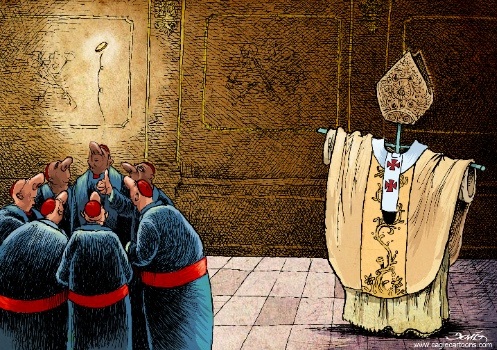
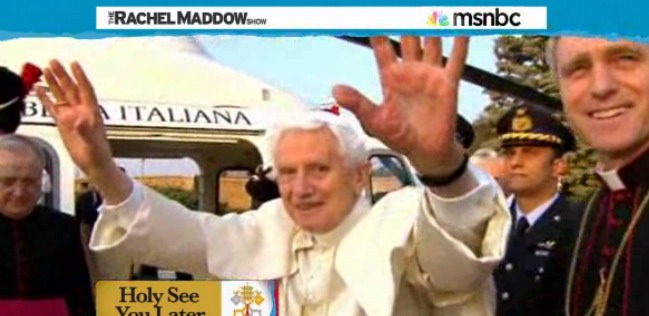
Pope Benedict XVI has announced his resignation. Here is the full text of his statement from the Vatican translated from the Latin:

Dear Brothers,

I have convoked you to this Consistory, not only for the three canonisations, but also to communicate to you a decision of great importance for the life of the Church.

After having repeatedly examined my conscience before God, I have come to the certainty that my strengths, due to an advanced age, are no longer suited to an adequate exercise of the Petrine ministry.

I am well aware that this ministry, due to its essential spiritual nature, must be carried out not only with words and deeds, but no less with prayer and suffering.

However, in today’s world, subject to so many rapid changes and shaken by questions of deep relevance for the life of faith, in order to steer the boat of Saint Peter and proclaim the Gospel, both strength of mind and body are necessary, strength which in the last few months, has deteriorated in me to the extent that I have had to recognise my incapacity to adequately fulfil the ministry entrusted to me.

For this reason, and well aware of the seriousness of this act, with full freedom I declare that I renounce the ministry of Bishop of Rome, Successor of Saint Peter, entrusted to me by the Cardinals on 19 April 2005, in such a way, that as from 28 February 2013, at 20:00 hours, the See of Rome, the See of Saint Peter, will be vacant and a Conclave to elect the new Supreme Pontiff will have to be convoked by those whose competence it is.

Dear Brothers, I thank you most sincerely for all the love and work with which you have supported me in my ministry and I ask pardon for all my defects.

And now, let us entrust the Holy Church to the care of Our Supreme Pastor, Our Lord Jesus Christ, and implore his holy Mother Mary, so that she may assist the Cardinal Fathers with her maternal solicitude, in electing a new Supreme Pontiff.

With regard to myself, I wish to also devotedly serve the Holy Church of God in the future through a life dedicated to prayer.

Experts: Top 5 picks for the next pope

Three expert Vatican watchers list some of their leading papabile – Italian for cardinals who might be elected as the next pope. In alphabetical order:

Cardinal Angelo Bagnasco, Archbishop of Genoa, made headlines last year for a ripping attack on then-Prime Minister Silvio Berlusconi and other Italian leaders as unethical role models.

He’s “fairly savvy about both secular politics and the media,” writes National Catholic Reporter Vatican specialist John Allen.

Church historian Matthew Bunson, calls Bagnasco, 69, former professor of metaphysics and contemporary atheism “an intellectual heavyweight” who speaks multiple languages, and takes strong stands on doctrine.

But the biggest boost may come from Bagnasco’s role as two-time president of the Italian bishops conference. Italians hold about a fourth of the seats in the College of Cardinals that will choose the next pope.

Cardinal Marc Ouellet, the Canadian-born former Archbishop of Quebec, now heads the powerful Congregation of Bishops, a “great spot for great spot for making friends and influencing people,” by choosing the global leadership of the Church, says Allen. He describes Ouellet, 68, as a veteran in dealing with the secularized West, someone smart and intellectual with “a cosmopolitan resume,” says Allen.

Ouellet is close to the late pope in theological thinking and someone who could bring a strong hand to the curia (the Vatican bureaucracy).

“The electors could get a traditional pick still say, ‘Hey, we’re innovators. We went to North America!’ He’s the eye-popping choice.” says David Gibson, author of several books on the Catholic Church including a biography of Pope Benedict XVI.

Cardinal Gianfranco Ravasi, elevated to cardinal in 2010 and head of the Pontifical Council for Culture, is so smart, says Allen, “if you were picking a quiz bowl team in the College of Cardinals, most people would start with Ravasi.”

Allen calls him “a master communicator who could take the world by storm. He can ignite rich, solid commitment to Catholic orthodoxy without ever coming off as a scold.”

The Italian-born Biblical scholar has the advantage of being based in Rome. Cardinals in the curia, the church’s governing bureaucracy, get to meet many of the electors that cardinals in far-flung posts scarcely know.

Still, Allen sees hurdles for Ravasi, who, at age 69 has never been a diocesan bishop. “Some would wonder if there were substance beneath the charm. He spends a lot more time talking to the outside world than within the church. Some see him as trying too hard. That’s off-putting.”

Cardinal Leonardo Sandri, 70, the head of the Vatican’s office for the Eastern Catholics and a longtime Vatican diplomat, would be the first pope from South America, the center of global Catholicism today, if he were chosen.

“He’s prayerful, well-liked around the world and very much aware, because of his diplomatic experience, of the global dimensions of the Church,” says church historian Matthew Bunson.

He may be best known in his role as No. 2 in the Vatican Secretary of State’s office. Sandri was the person who read the public announcement that Pope John Paul II had died in April 2005.

However, Sandri’s age, his lifelong background in the church bureaucracy, and his reserved demeanor may work against him, says Bunson.

Cardinal Angelo Scola, Archbishop of Milan, leads Bunson’s list as “an Italian with the intellectual chops for the job” who would bring Benedict’s enthusiasm for “recapturing Catholic excitement in Europe.”

Benedict moved him from another high profile post, Venice, in July, 2011, thereby giving this Vatican insider a perch at Europe’s largest diocese. Milan and Venice together have produced five popes in the last 100 years.

A top scholar on Islam and Christian-Muslim dialog, Scola, 70, is “well positioned for dealing with the challenges of secularism and materialism in the West,” says Bunson.

Scola once said: “Our job now has to be to help people to remember God. People suffer from a kind of amnesia about God and we have to remind them to reawaken God in their hearts and in their minds.”

Complete Article HERE!

Gomez, Mahony and the ‘Sodano Rule’

By John L. Allen Jr.

This column probably ought to carry a warning label: “The following piece of writing contains an apples-and-oranges comparison that may be hazardous to your intellectual health.” I’m going to compare two fights among senior churchmen, but the purpose is not to suggest they’re identical. Rather, it’s to understand what makes them different.


The first term of comparison is the tension between Archbishop Jose Gomez of Los Angeles and his predecessor, Cardinal Roger Mahony. On Jan. 31, Gomez announced that Mahony would “no longer have any administrative or public duties” because of failures to protect children from abuse, documented in files released by the archdiocese. That triggered an open letter to Gomez from Mahony acknowledging mistakes, but insisting he went on to make Los Angeles “second to none” in keeping children safe.

Mahony remains a priest and bishop in good standing, and he really hasn’t had any administrative role since stepping down in March 2011. The practical effect of the action thus is limited, but symbolically it amounts to what Jesuit Fr. Tom Reese has called a “public shaming.”

So far, the Vatican hasn’t said much other than it’s paying attention and clarifying that the action applies only to Los Angeles.

Behind door No. 2 lies the highly public spat in 2010 between Cardinal Christoph Schönborn of Vienna, Austria, and Italian Cardinal Angelo Sodano, a former Secretary of State and still the dean of the College of Cardinals.

For those whose memories may have dimmed, a series of clerical abuse scandals exploded across Europe in early 2010, which among other things cast a critical spotlight on Benedict XVI’s personal record. Sodano created a media sensation in April 2010 by calling that criticism “petty gossip” during the Vatican’s Easter Mass.

In a session with Austrian journalists not long afterward, Schönborn not only said Sodano had “deeply wronged” abuse victims, but he also charged that Sodano had blocked an investigation of Schönborn’s disgraced predecessor, Cardinal Hans Hermann Gröer, who had been accused of molesting seminarians and monks and who resigned in 1995. Schönborn reportedly said that then-Cardinal Joseph Ratzinger, now Pope Benedict XVI, wanted to take action, but he lost an internal Vatican argument to Sodano.

Schönborn apparently thought that session was off the record, but the content leaked out anyway.

In that case, the Vatican hardly restricted itself to a dry “no comment.” Instead, Schönborn was summoned for a one-on-one with Benedict, and afterward, both Sodano and Cardinal Tarcisio Bertone, the current Secretary of State, joined the conversation. When it was over, the Vatican issued a statement widely seen as a rebuke to Schönborn — among other things, pointedly reminding him that it’s not up to him to pass judgment on a fellow cardinal.

“It should be remembered that in the church, when there are accusations against a cardinal, competence rests solely with the pope,” it said.

One might call this the “Sodano Rule”: When it comes to cardinals, keep your hands off and leave it to the boss.

Hence the obvious question: Why doesn’t the Sodano Rule apply to Gomez? So far, no one has summoned him for a knuckle-rapping session, and the Vatican declined a chance to reiterate that cardinals are accountable only to the pope. The working assumption is that Gomez informed Rome of his plans, and apparently no one asked him to back down.

I can think of six factors that might help account for the contrast.

First, Schönborn had no authority over Sodano, who doesn’t live in Vienna. Mahony, however, resides in Los Angeles, having moved back to his childhood parish of St. Charles Borromeo in North Hollywood. Moreover, Mahony had no intention of keeping a low profile. He wanted to help lead the charge in Los Angeles and nationally on immigration reform.

Canonically speaking, Gomez has the right to determine who can play public roles on behalf of the church in his own jurisdiction, even if no one probably envisioned that codicil being wielded against a prince of the church.

Second, the 68-year-old Schönborn studied under Benedict XVI when the future pope was a theology professor and is widely perceived as a papal protégé. He made his comments about Sodano in the context of defending the pope’s record. Thus the initial suspicion in many quarters was that Schönborn was speaking for the pope, that his attack on Sodano represented Benedict’s thinking, expressed through one of his closest friends and allies.

Gomez does not have the same close relationship with Benedict XVI, so there’s not the same tendency to assume he’s acting as a mouthpiece for the papal apartment. As a result, the Vatican likely doesn’t feel the same pressure to get involved.

Third, and with no disrespect to Mahony, Sodano is simply a bigger target.

Sodano was the second-most-powerful official in the church under Pope John Paul II, and he remains dean of the College of Cardinals, which means he would preside over the college when Benedict dies. Although Sodano’s reputation has taken a beating, especially over his long-running defense of the late Mexican Fr. Marcial Maciel Degollado, founder of the Legionaries of Christ, he still has a lot of Vatican friends.

Mahony, by way of contrast, is seen as a relatively liberal prelate somewhat out of sync with the ethos under John Paul II and Benedict XVI. Although he’s an active member of three Vatican departments — the Congregation for Eastern Churches, the Council for Social Communications, and the Prefecture for the Economic Affairs — he doesn’t have anything like Sodano’s base of support to push back.

Fourth, precisely because Sodano was a key aide to John Paul II, criticism of his record functions as a proxy for calling John Paul’s legacy into question. In 2010, the Vatican was preparing to beatify John Paul II, just as they’re now getting ready for his canonization. In that context, anything that smacks of tarnishing the late pope’s memory is dicey stuff, especially if the critique is perceived as coming from the sitting pope through one of his friends.

Mahony was never part of John Paul’s inner circle, so criticism of him doesn’t carry quite the same sting.

Fifth, perhaps the Vatican learned something from the way it handled things two years ago. Whatever the intent, the fact that Schönborn was hauled on the carpet came off as punishment for being outspoken about the sex abuse crisis and was taken by critics as another chapter in denial. If the Vatican were to wade in now in support of Mahony, even if the principle involved was a cardinal’s unique relationship with the pope rather than his record on abuse cases, it would probably leave a similar bad aftertaste.

Of course, the Vatican has a mixed record in terms of learning the right lessons from previous PR disasters, but maybe this is one instance in which they’ve concluded that discretion is the better part of valor.

Sixth, and most basically, the culture of the church is evolving in the direction of greater accountability. Yes, it’s happening under external pressure, and yes, it’s taking an awfully long time. Nonetheless, the wheels are slowly grinding in the direction of the idea that when someone drops the ball, there need to be consequences.

This week marks the one-year anniversary of an international summit on the sex abuse crisis at Rome’s Gregorian University co-sponsored by several Vatican departments. At that session, then-Msgr. Charles Scicluna of the Congregation for the Doctrine of the Faith said it’s “simply not acceptable” for bishops to fail to act when reports of abuse surface, and that “we need to use the tools that canonical law and tradition give us for the accountability of bishops.” Sciculna since has been made a bishop in Malta and a member of the doctrinal congregation, and one could view the situation in Los Angeles as a trial run for Scicluna’s position.

How all this will play out isn’t clear. Vatican culture abhors public tiffs between senior prelates, fearing that it projects disunity. If the tensions between Gomez and Mahony metastasize, Rome may feel compelled to step in.

For now, however, it would seem the Sodano Rule comes with an asterisk: Only the pope can judge a cardinal — unless there are good reasons to let somebody else do it.

Complete Article HERE!

LA Cardinal Mahony ‘stripped of duties’ over sex abuse

A retired Los Angeles cardinal accused of mismanaging a child sex abuse crisis has been stripped of all administrative and public duties by his successor.

Retired Cardinal Roger Mahony, 76, has apologised for his “failure”, Archbishop Jose Gomez said on Thursday.


The Los Angeles archdiocese, the largest in the US, has released thousands of pages of files on priests accused of child molestation.

Cardinal Mahony retired in 2011, having run the archdiocese for 25 years.

In 2007 Los Angeles paid $660m (£415m) to alleged victims of abuse, the largest sex abuse payout on record.

Cardinal Mahony has publicly apologised for mistakes he made handling the clerical sex abuse issue.
‘They failed’

“I find these files to be brutal and painful reading,” Archbishop Gomez said in a statement. “The behaviour described in these files is terribly sad and evil.

“There is no excuse, no explaining away what happened to these children. The priests involved had the duty to be their spiritual fathers and they failed.”

He added that Bishop Thomas Curry, former vicar of the clergy who handled the cases of accused priests, had stepped down from his post as bishop of Santa Barbara.

The 12,000 pages of documents were released after Church records on 14 priests were unsealed as part of a civil case.

They showed both Bishop Curry and Cardinal Mahony had helped to shield accused priests from investigation in the 1980s.

A Church expert said the “very unusual” punishment showed how seriously the US Catholic hierarchy was taking the case.

“To tell a cardinal he can’t do confirmations, can’t do things in public, that’s extraordinary,” Jesuit scholar the Reverend Thomas Reese, a Georgetown University fellow, told the Los Angeles Times.

But a victims’ support group said Cardinal Mahony’s reprimand was too little, too late.

“When [Cardinal Mahony] had real power, and abused it horribly, he should have been demoted or disciplined by the Church hierarchy, in Rome and in the US,” said David Clohessy, director of the Survivors Network of Those Abused by Priests.

“But not a single Catholic cleric anywhere had the courage to even denounce him. Shame on them.”

The Catholic Church in the US has been embroiled in a series of child sex scandals over the past two decades.

A Church-commissioned report said more than 4,000 US priests had faced sexual abuse allegations since the early 1950s, in cases involving more than 10,000 children – mostly boys.

Complete Article HERE!

Mahony responds to ban: ‘Not once’ did successor raise questions

File under: It’s gettin’ nasty! The secret internal power struggle is beginning to seep into the public domain. There is no way that Gomez would attack Mahony without the explicit authorization of B-16. The pope is throwing Mahony under the bus. His thinking…better to sacrifice a cardinal and a bishop (Curry) than have this whole thing skink up the Vatican. This is SOOO fascinating. Regular folk, like us, almost never get to see this kind of ecclesiastical fight to the death. The long knives are out!

By: Joshua J. McElwee

Cardinal Roger Mahony, the retired archbishop of Los Angeles who was barred from public ministry by his successor over his handling of sex abuse, has issued a rare public response to the action.

Writing an open letter to Archbishop Jose Gomez, the archdiocese’s current leader, Mahony states that during his leadership the archdiocese became “second to none in protecting children and youth.”

“When you were formally received as our Archbishop on May 26, 2010, you began to become aware of all that had been done here over the years for the protection of children and youth,” Mahony writes to Gomez in the letter, which Mahony has made available on his personal blog.

“You became our official Archbishop on March 1, 2011 and you were personally involved with the Compliance Audit of 2012 — again, in which we were deemed to be in full compliance,” Mahony continues.

“Not once over these past years did you ever raise any questions about our policies, practices, or procedures in dealing with the problem of clergy sexual misconduct involving minors.”

Mahony, who became archbishop of Los Angeles in 1985 and was made a cardinal in 1991, was replaced by Gomez in 2011.

Typically seen as shying away from public criticisms of their peers, Catholic bishops rarely issue public responses to one another’s actions.

In a letter outlining his decision to ask Mahony to stay away from public ministry in LA, Gomez wrote Thursday that Mahony had failed to protect young people from sexually abusive priests.

The Gomez letter accompanied a release of extensive files concerning Los Angeles priests who had abused minors, most involving abuse that had occurred decades ago.

“I find these files to be brutal and painful reading. The behavior described in these files is terribly sad and evil. There is no excuse, no explaining away what happened to these children. The priests involved had the duty to be their spiritual fathers and they failed,” Gomez wrote.

“My predecessor, retired Cardinal Roger Mahony, has expressed his sorrow for his failure to fully protect young people entrusted to his care,” he added. “Effective immediately, I have informed Cardinal Mahony that he will no longer have any administrative or public duties.”

For his part, Mahony states in his letter to Gomez that Mahony’s understanding of sex abuse evolved over the years.

“Nothing in my own background or education equipped me to deal with this grave problem,” states Mahony. “In two years [1962 – 1964] spent in graduate school earning a Master’s Degree in Social Work, no textbook and no lecture ever referred to the sexual abuse of children. While there was some information dealing with child neglect, sexual abuse was never discussed.”

Writing of the era of the documents from the 1980s, Mahony writes that he began implementing “policies and procedures to guide all of us in dealing with allegations of sexual misconduct” in 1986.

He was given advice, Mahony states, “to remove priests from active ministry if there was reasonable suspicion that abuse had occurred, and then refer them to one of the several residential treatment centers across the country for evaluation and recommendation.”
“We were never told that, in fact, following these procedures was not effective, and that perpetrators were incapable of being treated in such a way that they could safely pursue priestly ministry,” Mahony states.

“I have stated time and time again that I made mistakes, especially in the mid-1980s,” Mahony writes.

“Unfortunately, I cannot return now to the 1980s and reverse actions and decisions made then. But when I retired as the active Archbishop, I handed over to you an Archdiocese that was second to none in protecting children and youth.”

Complete Article HERE!

What’s the message on the runway for Baroque fashions?

By Thomas F. O’Meara

When I was a boy, more than 50 years ago, ecclesiastical clothes were impressive. They were unusual and colorful, antique and sacral; they were distinctively Roman Catholic. The colored watered silk, the jeweled gloves, the red slippers (buskins) pointed to an individual caught up in a church office. This transcendent figure, a representative of the divine, appeared among the ordinary suits and dresses of working-class Catholics at rare moments. Nonetheless, even as a teenager singing in a college choir at the archbishop’s liturgies, I had already noticed that sometimes rituals focused more on the clothes than on religious words and sacrament. Removing gloves and putting on glasses, keeping a skullcap in place or adjusting a pallium could appear more important than the elevation of the chalice.

SampleTime passes, and today ecclesiastical clothes are less intelligible and point less clearly to something beyond their colors and gilt. They raise questions of gender and class, of culture and sacramentality.

There are three kinds of clothes male Catholics wear for public ecclesiastical and liturgical events. There are vestments for the liturgy of the Eucharist and other sacraments and for devotions. Among them are chasuble and stole, alb and cincture, miter and cope. Second, there are the habits of religious orders and congregations. Third, there are special garments for those in the episcopal order and for those in levels below (monsignors) or above (cardinals). Vestments at the Eucharist and other liturgies appear at their best when they are simple, aesthetically pleasing and inspiring to the people viewing them. Members of religious orders, particularly monks and friars, tend to wear their habits at liturgy and at other times inside their religious houses.

Here is a ninth-century description of the liturgical clothes used by the bishop of Rome, clothes related in their style to garments worn by Romans two centuries earlier. Walahfrid Strabo, who died in 849, wrote: “Priestly vestments have become progressively what they are today: ornaments. In earlier times priests celebrated Mass dressed like everyone else.”

Often special church garments do not come from the patristic or medieval period (which did not encourage distinctive clothes). They come from the Baroque period from 1580 to 1720, when liturgy as theater arranged rituals to channel graces. After 1620, in the world of Pope Urban VIII, ecclesiastical garments began to assume the importance they have today in spotlighting ecclesiastical officeholders. Who may wear what, in which color, and at which church services? The years from 1830 to 1960 witnessed additional, quite artificial elaborations of church attire. Today vestments that reflect the simplicity of the patristic or early medieval style also appear contemporary, while those that appear antiquarian and flamboyant are the product of the Baroque.

Critics of religious clothes

Jesus is a critic of religion. He warns against human display and the use of religious objects to disdain others. He condemns using religion to further being noticed or set apart from most people. “The scribes and the Pharisees … do all their deeds to be seen by people; they make their phylacteries broad and their fringes long, and they love the place of honor at feasts and the best seats in the synagogues … The greatest among you must be your slave” (Matthew 23:5-6, 12).

Few dimensions of human life aroused Jesus’ anger, but religious leaders seeking attention and power through clothes were called “whitewashed tombs that look handsome on the outside but inside are full of the bones of the dead” (Matthew 23:27).

In the years just before the Second Vatican Council (1962-65), Dominican Fr. Yves Congar wrote a critique of the church’s display of power and privilege. He had researched the origins of church vestments and insignia in the Roman Empire and in feudalism, concluding that those clothes no longer have any clear meaning for people. He concluded that vestments can have value, although their religious presence must resonate with the people they address.

One contemporary critique of ecclesiastical clothes was Federico Fellini’s 1972 movie “Roma.” Ecclesiastical fashions are exhibited on a runway where models display chasubles and miters for an audience of nuns and clerics and a presiding cardinal, a pale, sexless creature with crimson robes and ill-suited sunglasses who falls asleep. The style show ends with new designs using electric lights on chasubles.

Vatican II spoke of “a noble simplicity” for ecclesiastical clothes. In the years just after Vatican II, Pope Paul VI sold papal tiaras and issued instructions to set aside unusual clothes like flamboyant cloaks, colored stockings, special buckles and sashes with tassels.

Clothes today

Among a few small groups in the church, religious clothes are returning. They may be returning not as religious signs but as distractions from faith and ministry. Sashes and birettas, chains and large crosses, amices and maniples, special gloves and shoes have reappeared. Restorationist and reactionary groups tend to have striking clothes just as dictatorships have uniforms.

These groups show a preference for special kinds of clerical collars, tall miters, elaborate trains, a metal cross hung around the neck. Programs on EWTN are the runway for Baroque fashions, some authentic, some from the 19th century, most imitations. Great attention is given to gold vestments and gold vessels, odd new habits and distortions of past religious objects. Monastic habits with tunic and hood were originally the ordinary clothes of laborers. As centuries passed, they became unusual when ordinary clothes changed. Still, the habits of the medieval monks and friars were simple, and no sashes and capes or medals are added. The habits of many congregations of men founded after 1830 were colorful and attention-getting, elaborating on the medieval or Baroque but without any connection to the modern world.

At graduations at Catholic universities, students, faculty and administrators wear their academic robes, while parents and families wear suits and dresses. A bishop in a silk cape with ribbons and a skullcap looks out of place. Once, at a fundraising event in a large hotel, a bishop wore what he called his “full dress uniform, which attracts lots of compliments on my wardrobe.” The main speaker of the night remarked: “If I were dying and someone with a red bow and gown drew near, I would be scared stiff.”

The media pays attention to the current pope’s red-pink shoes, fur-lined hat of the eighth century, elaborately embroidered stole from the 18th century. Recent images on television of bishops and popes in white and red cassocks, Renaissance hats and jeweled gloves no longer seem religious and sacramental but antiquarian and self-centered. The pope, during a visit to the White House garden in white cassock and no visible pants, looked out of place; distinctive and different, yes, but not spiritual. American Catholics are, for the first time, reacting to televised gatherings of bishops and cardinals where there is concern over wearing properly colored skirts and sashes.

Clothes and ministry

New religious groups in the United States, along with some young members of older orders seem eager to wear a religious habit in public, not just on the grounds around a school but at airports or on the subway. What does a monastic habit or a cassock in public say to Americans at the beginning of the 21st century? It is not at all evident that the general public knows who this strangely dressed person is or even connects the clothes to religion. The symbolism is not clear and a message is not evident. The person does stand out, but as a kind of public oddity. Eccentric clothes instill separation. While some argue that odd clothes attract people, the fact is that more often than not they repel. Normal people are not attracted by the antique or bizarre costume, and ordinary Christians are not drawn to those whose special costume implies that others are inferior. Sometimes wearing clothes seems to be a substitute for real ministry.

It is not clear how men wearing dresses and capes proclaim God’s transcendence or the Gospel’s love. A man’s identity is something complex; the search for it lasts a lifetime. A celibate cleric gives up things that form male identity, like being a husband and a father. One cannot overlook possible links between unusual clothes and celibacy. Does the celibate male have a neutral or third sexuality that can put on unusual clothes? Are special clothes a protection of celibacy? Or are they a neutralization of maleness? Why would a man want to wear a long dress or a cape in public? Are spiritual reasons the true motivation?

Cultural meaning

Clothes are useful as they keep us warm or cool and cover our nakedness. They can make men and women attractive to others. Human beings and societies have come up with a variety of clothes to which they give particular meanings, using a few clothes as symbols — the toga, the high hat, the veil, the robe. What do ecclesiastical clothes say today? This question touches not only the wearer’s identity but the community’s faith. There is no absolute answer, no answer apart from people in their time and culture. Tradition and history are not an answer, for there is always a time when this ecclesiastical garment was unknown and there will be a time when it will be seen only in a museum.

Time brings and then buries styles. A medieval person probably understood episcopal regalia fairly well because aspects of his or her life depended upon its rare appearance, and it was seen in a milieu of many insignia. The elaborate arrangement of artificial clothes in the Catholic church is from the past four centuries. Today, unusual clothes appear on television as something connected to entertainment. What thoughts are conjured up when a cardinal or archbishop appears at a baseball game in a cape and gown? What does the cape and sash say personally and socially? Does it recall the New Testament or the liturgy of the Christian community?

There are no intrinsically religious clothes. Religious clothes are meant to point to some truth of faith or suggest a sacramental presence. The public person of each minister in the church should relate to the humble Jesus and to sacramentality in this church’s life. In the Christian community all clothing — this includes liturgical clothing — expresses the church’s life animated by the Spirit. Capes and cloaks in a Baroque style are neither prophetic nor countercultural. If regal or antiquarian distinction was once a value for church leaders, if pretension to being ecclesiastically or even metaphysically better was presumed, since Vatican II more and more people ignore such displays. Time never stands still. What seemed powerful in the past is today merely curious. Many Catholics are reaching a point where antiquated clothes are not inspiring and sacramental but exist outside human life.

Both the church’s expression of the reign of God and the culture to which it speaks are historical. Change touches everything. At any time, something new is being born and something static and alien is dying. History flows through the relationships between faith and grace and people, and those are always being determined anew in the concrete. The Holy Spirit strives, against sin, unreality and selfishness, to animate the church. In the last analysis, clothes are just clothes.

Henry David Thoreau said it well: “Beware of all enterprises that require new clothes.” Perhaps some lesson remains in the words of Psalm 132: “I will vest the priests in holiness, and the faithful will shout for joy.”

Complete Article HERE!

Priest Is Planning to Defy the Vatican’s Orders to Stay Quiet

By DOUGLAS DALBY

A well-known Irish Catholic priest plans to defy Vatican authorities on Sunday by breaking his silence about what he says is a campaign against him by the church over his advocacy of more open discussion on church teachings.

Father Tony FlanneryThe Rev. Tony Flannery, 66, who was suspended by the Vatican last year, said he was told by the Vatican that he would be allowed to return to ministry only if he agreed to write, sign and publish a statement agreeing, among other things, that women should never be ordained as priests and that he would adhere to church orthodoxy on matters like contraception and homosexuality.

“How can I put my name to such a document when it goes against everything I believe in,” he said in an interview on Wednesday. “If I signed this, it would be a betrayal not only of myself but of my fellow priests and lay Catholics who want change. I refuse to be terrified into submission.”

Father Flannery, a regular contributor to religious publications, said he planned to make his case public at a news conference here on Sunday.

The Vatican’s doctrinal office, the Congregation for the Doctrine of the Faith, wrote to Father Flannery’s religious superior, the Rev. Michael Brehl, last year instructing him to remove Father Flannery from his ministry in County Galway, to ensure he did not publish any more articles in religious or other publications, and to tell him not to give interviews to the news media.

In the letter, the Vatican objected in particular to an article published in 2010 in Reality, an Irish religious magazine. In the article, Father Flannery, a Redemptorist priest, wrote that he no longer believed that “the priesthood as we currently have it in the church originated with Jesus” or that he designated “a special group of his followers as priests.”

Instead, he wrote, “It is more likely that some time after Jesus, a select and privileged group within the community who had abrogated power and authority to themselves, interpreted the occasion of the Last Supper in a manner that suited their own agenda.”

Father Flannery said the Vatican wanted him specifically to recant the statement, and affirm that Christ instituted the church with a permanent hierarchical structure and that bishops are divinely established successors to the apostles.

He believes the church’s treatment of him, which he described as a “Spanish Inquisition-style campaign,” is symptomatic of a definite conservative shift under Pope Benedict XVI.

“I have been writing thought-provoking articles and books for decades without hindrance,” he said. “This campaign is being orchestrated by a secretive body that refuses to meet me. Surely I should at least be allowed to explain my views to my accusers.”

His superior was also told to order Father Flannery to withdraw from his leadership role in the Association of Catholic Priests, a group formed in 2009 to articulate the views of rank-and-file members of the clergy.

In reply to an association statement expressing solidarity with Father Flannery, the Congregation for the Doctrine of the Faith denied it was acting in a secretive manner, pointed out that Father Flannery’s views could be construed as “heresy” under church law, and threatened “canonical penalties,” including excommunication, if he did not change his views.

This month, the Congregation for the Doctrine of the Faith wrote to an American priest, Roy Bourgeois, notifying him of his laicization, following his excommunication in 2008 over his support for the ordination of women.

Complete Article HERE!

The Pope’s dangerous sex appeal

By Ian Buruma

Human sexual behaviour can be perilous, as the ghastly rape of a 23-year-old woman by six men on a Delhi bus in December once again showed. After going to the cinema, she and her boyfriend were beaten, before she was brutally assaulted and attacked with an iron rod for more than an hour. Thirteen days later, she died from her wounds.

It is often claimed that rape is not really about sex, but about power. True enough. But it is not unrelated to sex. The sexual act is used as a form of torture, or even, in some cases, as a deadly weapon.

But that was not what Pope Benedict XVI had in mind when he spoke in his pre-Christmas speech to the Roman Curia.

It was a deeply confused speech. His disquisition on the dangers posed by same-sex marriage followed a passage deploring the modern tendency to avoid lifelong commitments in human relationships, as if that were not precisely what gay marriage is about. Of course, in the pope’s view, commitment in gay relationships is part of the problem: more and more people, especially in the Western world, now claim the freedom to choose their own sexual identities instead of sticking to the “natural” roles “ordained by God.”

The pope’s words suggest that homosexuality is a kind of lifestyle choice, a form of modern decadence – a secular, even blasphemous act against God and nature – rather than a fact of birth. Fear of sexual behavior is one of the main reasons why most religions establish strict rules concerning sexual relationships. Marriage is a way to contain our dangerous desires. Restricting sexual conduct to procreation is supposed to make the world safer and more peaceful.

Benedict is not so extreme. Nor does he advocate violence against homosexuals. On the contrary, he sees himself as a deeply civilised man of peace. But I would argue that his speech actually encourages the kind of sexual aggression that can result in the savagery that took place in Delhi recently.

The six rapists who killed the young woman were not modern decadents who chose to defy God and nature by claiming new secular freedoms, let alone heterodox sexual identities. From what we can surmise from this case – and many others like it – they are the semi-urbanised products of a highly conventional rural society where the roles of men, and especially women, are tightly regulated. Their victim, a well-educated physiotherapy intern, seems to have been a great deal more modern than her attackers. The men were not uneducated, but they were unable to cope with the freedoms of contemporary women.

For that reason, the six rapists saw her as a “loose” woman, a city slut, fair game. After all, she was out late with her boyfriend. That is precisely how the men taunted the young couple: What was an unmarried young woman doing out in the Delhi streets with a young man? She deserved what was coming to her.

Violent hatred of homosexuals comes from a similar source. Just as women outside the family home – women who stake a claim to public space, working and living among men – are seen as dangerous temptresses, men who love men are often regarded as predators, ready to pounce on society’s children. What many people fear is not just uncontrolled sexual behavior, but sex itself.

But the more sex is repressed and people are made to fear it the greater the chance of sexual violence, because anyone who might possibly stir our sexual desires, man or woman, becomes a potential target of our rage.

This might help to explain what happened in Delhi, but it does not in any way excuse it.

One wishes that the pope had said something about that, and had offered some words of encouragement to the men and women in India who have had enough of sexual violence coming not from modern libertines, but from deeply repressed men. But that is too much to expect from a man who appears to understand little about sexual life. That is why, instead of talking about rapists, he targeted peaceful homosexual men and women who wish to show their commitment to their lovers by marrying them.

Complete Article HERE!

4 women go topless in St. Peter’s Square to protest Vatican opposition to gay marriage

VATICAN CITY — Four women have gone topless in St. Peter’s Square to protest the Vatican’s opposition to gay marriage.

Police quickly took the women away Sunday, and the pope appeared not to have been disturbed as he delivered his traditional prayer from his studio window overlooking the piazza.

On their bare backs, the women had painted slogans “In Gay We Trust,” and “Shut Up.” One of them, Inna Shevchenko, said: “Today we are here to protest against homophobia.”

The small demonstration coincided with a march in Paris that is expected to draw hundreds of thousands of people to protest the French president’s plan to legalize gay marriage and let gay couples adopt children.

French Catholic bishops and other religious leaders have strongly opposed the proposal, and the Vatican has backed them.

Complete Article HERE!

Bourgeois receives official Vatican letter dismissing him from priesthood

By Joshua J. McElwee

Roy Bourgeois, the longtime peace activist and Catholic priest dismissed by the Vatican because of his support for women’s ordination, has received the official letter notifying him of the move three months after it was made.
The letter, which comes from the Vatican’s Congregation for the Doctrine of the Faith, is signed by the congregation’s prefect on behalf of Pope Benedict XVI and states that the pope’s decision in the matter is “a supreme decision, not open to any appeal, without right to any recourse.”

Translation of papal letter to Roy Bourgeois

Written in Latin, the letter dismisses Bourgeois from the priesthood and restricts him from all priestly ministries. It asks Bourgeois to return a signed copy “as a proof of reception and at the same time of acceptance of the same dismissal and dispensation.”

The letter, dated Oct. 4, was made available Wednesday by Bourgeois, who said he received it last week from the Maryknoll Fathers and Brothers, the U.S. missionary society he served as a priest for 40 years. Bourgeois said he did not plan to return a signed copy.

The congregation’s letter does not make reference to specific charges against Bourgeois or mention his support for women’s ordination, saying, “for the good of the Church, the dismissal from the said Society must be confirmed, and moreover, also the dismissal from the clerical state must be inflicted.”

“There’s no mention of what I did,” Bourgeois said. “There’s no mention … of women’s ordination. What crime did I commit that brought about this serious sentence? There’s no mention of that. What did I do? What am I being charged with?”

Bourgeois said he found the request to sign the letter “somewhat laughable” at first because he could not fully understand its contents until he obtained an English translation of the Latin from a translation service.

His signature, Bourgeois said, would indicate he accepts the letter’s contents.

“I do not accept it,” he said. “I think it’s a grave injustice. I think it’s mean-spirited. I think it contradicts whatever Jesus had talked about and taught us.”

Maryknoll announced the move against Bourgeois in a press release Nov. 19, but neither the society nor the Vatican congregation responded to previous requests to make public the official letter announcing the move.

Bourgeois said his copy of the letter arrived via registered mail last week along with a short note from Fr. Edward Dougherty, the society’s superior general.

The Vatican’s dismissal, Dougherty wrote to Bourgeois in that note, “is irrevocable and not subject to appeal.”

Mike Virgintino, the communications manager for the Maryknoll Fathers and Brothers, wrote in an email Thursday that Maryknoll officials attempted to schedule a meeting with Bourgeois in December to personally deliver the letter but the meeting had to be postponed following the death of Bourgeois’ father in November.

The Vatican’s letter states Bourgeois may not exercise any priestly ministries, including giving homilies or having a “directive role in a pastoral environment.” He also cannot hold an office or teach at any seminary or theological school.

The letter also asks Maryknoll to “exhort [Bourgeois] assiduously so that, once [his] proud behavior has been purified, he will participate in the life of the People of God in conformity to his new condition, will give edification and in this way will show himself a worthy son of the church.”

The letter is signed by Archbishop Gerhard Müller, the doctrinal congregation’s prefect, and Archbishop Luis Ladaria Ferrer, its secretary.

Oblate Fr. Francis Morrisey, a canon lawyer at Ottawa’s Roman Catholic University of Saint Paul, said the official document seems clear that Bourgeois has no recourse in the matter, as his removal was a decision of the pope himself.

William Quigley, an American lawyer who had the original version of the Vatican letter professionally translated into English for Bourgeois, called the letter “very, very unfair” because it does not mention any charges against Bourgeois.

“It’s like they gave him a punishment, but they’ve never given him a charge,” said Quigley, the director of the Gillis Long Poverty Law Center at Loyola University New Orleans and a former legal director for the Center for Constitutional Rights.

“Under the most basic human rights law … everybody has a right to know what the charge is and to have a hearing before a fair tribunal,” Quigley said. “This is bewildering.”

Bourgeois said Wednesday he would continue to speak in favor of women’s ordination and did not think the Vatican’s letter would stop others from also expressing support.

Comparing women’s ordination to the abolition of slavery and women’s suffrage, Bourgeois said “this movement of gender equality … is rooted in God, equality and justice. It’s not stoppable.”

“This letter is not going to stop anything,” Bourgeois said. “I think it’s simply going to bring more people into the movement.”

Bourgeois first attracted episcopal attention after he participated in the ordination of Roman Catholic Womanpriest Janice Sevre-Duszynska in August 2008. Shortly after, the Vatican congregation notified him he had incurred a latae sententiae, or automatic, excommunication for his participation.

Maryknoll asked Bourgeois to publicly recant his support of women’s ordination, telling the priest in a March 2011 letter he faced laicization and removal from the order if he did not comply.

In a series of letters and interviews since then, Bourgeois said he could not comply with the request for reasons of conscience.

Complete Article HERE!