New Zealand legalises same-sex marriage

New Zealand’s parliament has legalised same-sex marriage, the first country in the Asia-Pacific region to do so.

Lawmakers approved the bill, amending the 1955 marriage act, despite opposition from Christian lobby groups.
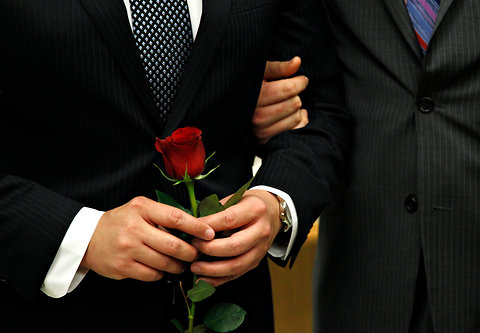
The bill was passed with a wide majority, with 77 votes in favour and 44 against.
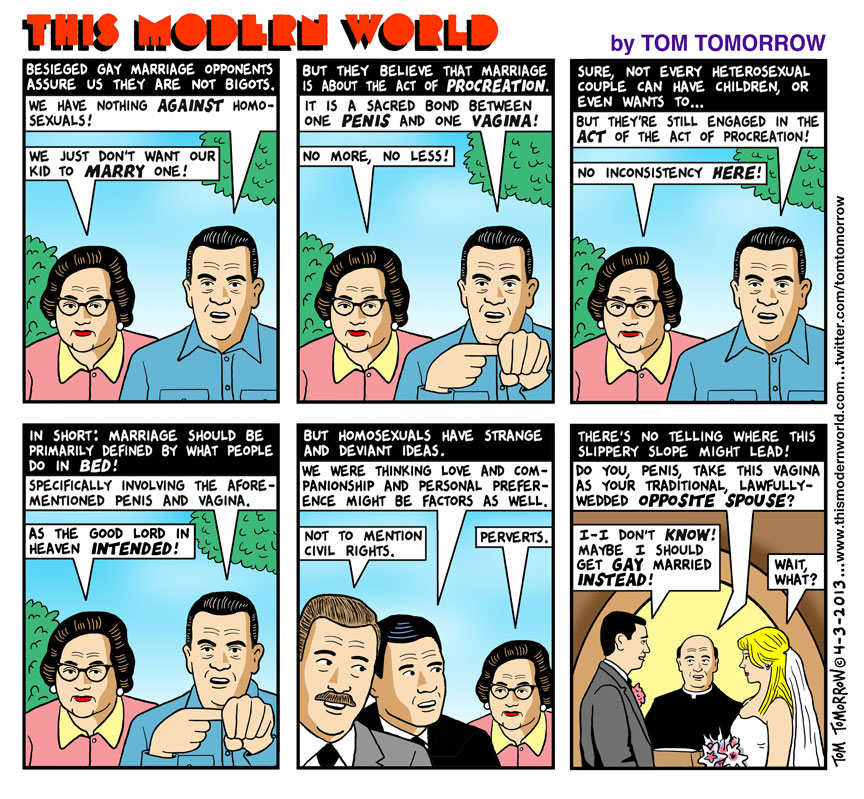
Hundreds of jubilant gay-rights advocates celebrated outside parliament after the bill was passed, calling it a milestone for equality.

People watching from the public gallery and some lawmakers immediately broke into song, singing the New Zealand love song “Pokarekare Ana”, AP news agency reported.

Some opinion polls have suggested that about two-thirds of New Zealanders support the reform, although others polls suggest the public are more divided.

Parliamentarians were allowed a conscience vote, and, crucially, the reform had the backing of both the Prime Minister John Key and leader of the opposition David Shearer, the BBC’s Phil Mercer in Sydney reports.

Celebrations have been held in pubs and clubs in the capital Wellington, our correspondent adds.

Same-sex civil unions have been legal in New Zealand since 2005.
‘Human rights’

“In our society, the meaning of marriage is universal – it’s a declaration of love and commitment to a special person,” Labour MP Louisa Wall, who introduced the legislation, said.

Historically and culturally, marriage is about man and a woman”

Bob McCoskrie Family First

“Nothing could make me more proud to be a New Zealander than passing this bill,” she added.

Tania Bermudez and Sonja Fray, a same-sex couple, said the bill was about human rights.

“It means that we can actually call each other wife,” Ms Fray said.

However, Conservative Party leader Colin Craig said there were many people who disagreed with the bill.

“We’re seeing the politicians make a decision tonight that the people of this country wouldn’t make,” he said.

Bob McCoskrie, founder of the lobby group Family First, said the bill undermined the traditional concept of marriage.

“Historically and culturally, marriage is about man and a woman, and it shouldn’t be touched,” he said.
Celebrations begin at the Caluzzi Bar and Cabaret venue after New Zealand MP’s gathered today to vote on the gay marriage bill at Parliament House on 17 April 2013 People gathered in bars and pubs to watch the vote and celebrate the results

New Zealand becomes the 13th country to legalise same-sex marriage.

Other countries include the Netherlands, Belgium, Spain, Canada, South Africa, Argentina and Uruguay.

French and British lawmakers have also voted in favour of legislation allowing gay marriage, although the bills have not yet been passed into law.

No other country in the Asia-Pacific region allows gay marriage.

Australian members of parliament overwhelmingly voted against a bill that would have legalised same-sex marriages in September. However, some states allow civil unions for same-sex couples.

China does not allow gay marriage. However, transsexuals who have undergone surgery are able to marry someone of the opposite sex, provided their new gender is verified by the local public security authorities.

Complete Article HERE!

Pope Francis and the American Sisters

By MARY E. HUNT

The jury is still out on Pope Francis in a pontificate that may well be shaped by women. A month after Cardinal Jorge Mario Bergoglio was named Bishop of Rome, his Prefect of the Congregation for the Doctrine of the Faith, Most Rev. Gerhard Ludwig Mueller, met with the presidents of the Leadership Conference of Women Religious, an umbrella group of American nuns that had come under doctrinal scrutiny and been found wanting.

VATICAN-NUNS/Archbishop Mueller claimed that he had “recently discussed the Doctrinal Assessment with Pope Francis, who reaffirmed the findings of the Assessment and the program of reform for this Conference of Major Superiors.” On the face of it, this means that Archbishop J. Peter Sartain, Bishop Leonard P. Blair, and Bishop Thomas John Paprocki, who were named to enforce the terms the Congregation’s findings against the LCWR, are given carte blanche to do so. There may be more to this than meets the eye.

LCWR’s statement on the meeting includes just the facts and a dignified conclusion: “The conversation was open and frank. We pray that these conversations may bear fruit for the good of the Church.” Pundits are left to parse the rest.

It is early in a pontificate to make definitive judgments. Jesuits, I am informed, usually wait 100 days before making major decisions in their new positions. Perhaps Francis is observing the custom, hence some warrant for the bated-breath approach of some progressive pundits. As an inveterate pope watcher and advocate for justice for women, let me offer a few insights to guide future evaluation.

First, the early impressions of Francis are positive on several fronts. His much vaunted simple lifestyle, his decision to live in community, wear black shoes, pay the hotel bill he owed, ride the cardinals’ bus, worry about the well-being of the Swiss Guards, and forsake the white ermine-collared mozzetta (part of the papal wardrobe) all stand in deep contrast to the customs of his immediate predecessor popes. Although a reasonable person might conclude that the bar is hopelessly low in this regard.

In recent years, we were treated to cardinals wearing long trains (cappa magna). We endured stories of a sumptuous 80th birthday party for disgraced Boston Cardinal Bernard Law at one of Rome’s four-star restaurants. We know that Benedict and his colleagues were harsh on nuns whose lifestyles they would do well to emulate.

I expect a good deal more from Francis than the friendly but still largely cosmetic changes he has instituted. Gradualists will disagree with me, but I think it is time for Catholics to grow up and realize that royalty does not become us. The church is a service organization whose primary stakeholders are people who are poor. Their needs, and not the whims of pampered prelates, are the priority. Nothing less is acceptable. Raise the bar for heaven’s sake.

Second, on things that enthusiasts say are different in the months since the new pope took office: they are not all that different. Take, for example, the washing of two women’s feet at the Holy Thursday celebration. Granted, one of them was Muslim, and granted, the current pope may not be one for grand gestures (in which case they all would have been women in retribution), but is the liturgical act of washing two women out of 12 in 2000 years really the sign of the ‘feministization’ of the Roman Catholic Church? Not by my lights.

Rather than washing feet, I suggest looking Catholic women in the eye and saying, “You are my sister, equal in every way to me,” and then changing structures accordingly. To atone for centuries of discrimination against women will take more than four clean female feet. I despair of those who say, “It is a start,” to which I respond, “Obviously, but how pitifully inadequate.”

Naming a committee of nine Cardinals to advise Pope Francis on reforming the Curia and administering an unwieldy bureaucracy is also touted as a big change. However, this sort of kitchen cabinet looks to me like a kind of steering committee of the cardinals, hardly a revolutionary idea. Note the lack of lay people, women, and, God-forbid, young people on the list. I am hard pressed to think that certain cardinals did not have a pope’s ear before this. The Vatican’s spokesman emphasized the advisory nature of the group, further assuring that nothing has really changed. I am getting ready to rest my case though I long to be proven wrong.

Third, the meeting with the LCWR presidents needs to be read critically in light of the theo-politics of the moment. I can imagine that the Archbishop Mueller’s of this world are scrambling to figure out where to go next. This is a crowd accustomed to taking orders from the top, and when they cannot be sure just what the top wants they must be very nervous.

Nonetheless, I take the man at his word that he had some communication with the pope, which gave him the impression that it was fine to go full steam ahead with the hostile take-over of LCWR. What we do not know is the nature of the conversation. Maybe it was part of a long, soul-searching discussion into the wee hours of the morning by men who agonized over how to apologize sufficiently to the women for taking their time and impugning the reputations. More likely, it was a short, pedestrian mention by an overeager cleric who simply had to tell Su Santidad that he was planning to meet with the women. I can imagine that the Pope, distracted by concerns of poverty, ecocide, and war said “have a good meeting” which the Archbishop interpreted as license to continue with the oppression of women religious. Time will tell which it was, or something in between. For now, the bureaucracy grinds on with the women’s organization still under a cloud.

More telling, perhaps, will be the action or lack of it against women religious more broadly. The doctrinal investigation of LCWR was insult, but injury came in the form of an Apostolic Visitation (something akin to a convening a grand jury with the presumption that something is wrong) of virtually all of the communities whose leaders belong to LCWR.

A ray of hope is seen in the recent appointment of José Rodríguez Carballo, the leader of Franciscan men worldwide as the secretary of the Congregation for Institutes of Consecrated Life and Societies of Apostolic Life (memo to curial reformers: shorten the names of these outfits). That is the group that undertook the snooping into the lives and institutions of women religious. Archbishop Carballo, a member of a religious congregation himself, is expected to be a pastoral sort. But let optimists not pass over the fact that he serves under the Prefect Cardinal João Braz de Aviz who succeeded Cardinal Franc Rodé who started the whole operation.

If the Vatican under Pope Francis is smart, they will conveniently forget that this unfortunate chapter of church history ever took place. If they are wise, they will thank Mother Mary Clare Mallia, A.S.C.J., and her collaborators who did their bidding and move on, and apologize to the women’s communities for intruding on their space and time. Then I will say there is hope for this papacy. But if LCWR is left to twist in the wind, if the rest of the active communities that were subject to the indignity of a visitation are left hanging, can we say this pope is different from any other pope?

I urge that if women are not welcomed into all forms of ministry, decision making, and administration of the Roman Catholic Church in the very near future—I mean a year, max two, not a lifetime—then the jury find this pope as guilty as the rest in the ‘disappearance’ of half of the Catholic community. Maybe we will be surprised, and I will be the first one to rejoice that my skepticism was unwarranted.

Meanwhile, as one who is not accustomed to drinking the Kool-Aid, I suggest that the nuns lawyer up and all Catholic women go on with our ministries as we have been doing for decades, as if nothing has happened.

Complete Article HERE!

Constitutional convention backs extension of marriage rights to same-sex couples

By Ruadhan Mac Cormaic

The constitutional convention has voted overwhelmingly in favour of extending marriage rights to same-sex couples.

Some 79 per cent of members voted to recommend that the constitution be amended to allow for same-sex marriage, with 19 per cent against and the remainder having no opinion.

Supporters of the proposal, some of whom cheered and wept as the result was announced this afternoon, hailed it as a landmark on the road towards equality for gay couples and urged the Government to act swiftly by calling a referendum. The convention’s recommendation will now be sent to the Government, which has pledged to hold a debate in the Oireachtas and set out its response within four months.

Tánaiste Eamon Gilmore welcomed the result, saying he had always believed “that our laws reflect the past, not the future” on this issue. “It’s not the role of the State to pass judgement on who a person falls in love with, or who they want to spend their life with,” he said.

Asked what form the constitutional change should take, the convention – comprising one third politicians and two thirds ordinary citizens – 78 per cent of members voted for a directive amendment (“the State shall enact laws providing for same-sex marriage”) while 17 per cent opted for a permissive amendment (“the State may enact laws providing for same-sex marriage”).

The members also voted in favour of recommending that the State pass laws “incorporating changed arrangements in regard to the parentage, guardianship and the upbringing of children”.

Minister for Justice Alan Shatter said he welcomed the support expressed for “the reform and modernisation” of laws in relation to parentage, guardianship and upbringing of children.

“Essential work has been undertaken on the preparation of a new Family Relationships and Children’s Bill to address these issues in relation to children and details of the bill will be published in the coming months,” he said.

The same-sex marriage discussion had attracted considerable public interest, with more than 1,000 submission having been lodged with the convention. Today’s vote followed a weekend of discussion on the topic at the Grand Hotel in Malahide, north Dublin, where members heard from legal experts as well as supporters and opponents of the proposal.
In a joint statement this afternoon, advocacy groups Marriage Equality, the Gay and Lesbian Equality Network (GLEN) and the Irish Council for Civil Liberties welcomed the outcome as “an historic step”.

“It is a major milestone on the remarkable journey to full constitutional protection for lesbian and gay people and families in Ireland,” said GLEN director Brian Sheehan. “It builds on the extraordinary progress we have achieved over the last 20 years, and clearly demonstrates that Ireland is ready to take the next step to complete that remarkable journey.”

The Irish Catholic Bishops Conference was one of three groups that gave presentations arguing against same-sex marriage.

Commenting on the outcome today, a spokesman for the Catholic Communications Office said: “While the result of the constitutional convention is disappointing, only the people of Ireland can amend the constitution. The Catholic church will continue to promote and seek protection for the uniqueness of marriage between a woman and a man, the nature of which best serves children and our society.”

Convention chairman Tom Arnold thanked the participants and said proceedings were conducted in a fair and transparent manner. “This weekend’s discussions have been both passionate and thoughtful, both heartfelt and rigorous,” he said.
Independent Senator Ronan Mullen said the debate on same-sex marriage had been a “flawed process”. He said documentation commissioned from various experts ahead of the meeting was “not inclusive of all the relevant issues and failed to be completely impartial”.

Senator Mullen also said “some citizen members of the convention felt that they had been pressured by politician members at the tables to support a particular line”.

Same-sex marriage is permitted in 11 countries, and Bills are being debated in a number of others, including France, Britain and Uruguay.

The next meeting of the Constitutional Convention will consider the Dáil electoral system and the way in which politicians are elected.

Complete Article HERE!

Sculpture of Jesus the Homeless rejected by two prominent churches

Ontario sculptor struggled to find a home for his haunting sculpture of Jesus sleeping on a bench.

Jesus has been depicted in art as triumphant, gentle or suffering. Now, in a controversial new sculpture in downtown Toronto, he is shown as homeless — an outcast sleeping on a bench.

It takes a moment to see that the slight figure shrouded by a blanket, hauntingly similar to the real homeless who lie on grates and in doorways, is Jesus. It’s the gaping wounds in the feet that reveal the subject, whose face is draped and barely visible, as Jesus the Homeless.

Despite message of the sculpture — Jesus identifying with the poorest among us — it was rejected by two prominent Catholic churches, St. Michael’s Cathedral in Toronto and St. Patrick’s Cathedral in New York.

“Homeless Jesus had no home,” says the artist, Timothy Schmalz, who specializes in religious sculpture. “How ironic.”

Rectors of both cathedrals were enthusiastic about the bronze piece and showed Schmalz possible locations, but higher-ups in the New York and Toronto archdiocese turned it down, he says.

“It was very upsetting because the rectors liked it, but when it got to the administration, people thought it might be too controversial or vague,” he says. He was told “it was not an appropriate image.”

The Toronto archdiocese tried to help him find an alternative location, including St. Augustine’s Seminary in Scarborough. But Schmalz, who describes his work as a visual prayer, wanted to reach a wider, secular audience. “I wanted not only the converted to see it, but also the marginalized. I almost gave up trying to find a place.”

Now the sculpture stands near Wellesley St. W., outside Regis College at the University of Toronto. It’s a Jesuit school of theology, where priests and lay people are trained, with an emphasis on social justice.

Bill Steinburg, communications manager for the Toronto archdiocese, says the decision not to accept the sculpture at St. Michael’s may have had to do with renovations at the cathedral and “partly to do with someone’s view of the art.”

To some who have seen it, it speaks the message of the Gospels. When theologian Thomas Reynolds came upon it he felt “the shock of recognition.” He quoted the biblical passage: “ … the Son of Man has nowhere to lay his head.”

“I’m so used to seeing images of Jesus that are palatable,” says Reynolds.

But recent depictions of Jesus in political and social contexts have spurred controversy.

At Emmanuel College, the educational arm of the United Church where Reynolds teaches, there is a graceful sculpture showing Jesus’ suffering in a crucified woman. Schmaltz says he intended that his Jesus the Homeless can be interpreted as either male or female.

At Regis College, there is a small crucifix of Jesus as a landmine victim, missing a leg; another at the college shows Jesus as an Aztec.

A sculpture in a church in Uckfield, England, shows a euphoric Jesus wearing jeans and a collared shirt.

In 2011, British sculptor David Mach, created an agonized, shouting Jesus out of 3,000 straightened coat hangers that emerge like barbs from the body.

Jesus the Homeless is provocative, says Reynolds, because it ‘punctures the illusion of normalcy.

“In certain ways, Christian communities have been privileged and considered themselves the norm in society and that has made Christians comfortable in our complacency.”

Schmalz, 43, roots the sculpture in his experiences in Toronto, where he trained at the former Ontario College of Art. “I was totally used to stepping over people. You’re not aware they are human beings. They become obstacles in the urban environment and you lose a spiritual connection to them. They become inert, an inconvenience.”

He now lives with his wife and family in St. Jacobs, Ont. When he returns to Toronto, he sees the city differently.

“A lot of people who don’t live in Toronto or a big urban place are shocked to see human forms under blanket on too many street corners.”

The Regis sculpture shows Jesus as a wanderer who depended on the hospitality of others, says Reynolds. “The counternarrative in Christianity is Jesus the outsider.”

Not all embrace this interpretation, as Bryan Stallings and his wife Amy discovered. They run a mission in Branson, Mo., called Jesus Was Homeless, where they serve about 1,000 people a week, many of whom live in the woods and extended-stay motels. They’ve been criticized for the mission’s name.

“People who have issue with it are usually the staunch religious people,” says Stallings, “especially those who follow prosperity teaching and doctrine that says if you are homeless or poor you don’t have enough faith.”

Critics tell him that Jesus wasn’t homeless. “Then we reference Scripture and it sparks tons of conversation.”

The Toronto sculpture, funded by Kitchener real estate developer Peter Benninger, is situated near the front entrance to Regis College. “It’s one of the most inviting and authentic representations of Jesus,” says Rev. Gordon Rixon, dean of the college. “There’s the suggestion there is the king and he is answering our culture with his poverty, vulnerability and weakness.”

Though the slender figure occupies most of the two-metre bench, Schmalz purposely left space at the end for someone to sit close to the slumbering figure, “as uncomfortably as possible.”

Complete Article HERE!

The Vatican Is Into Lesbian And BDSM Porn, According To Download History

File under: Who Knew?

by Jonathan Higbee

Surprisingly, Bel Ami films were not included on a list of torrent downloads occurring within The Vatican. Instead, lesbian porn starring Tiffany Starr and Sheena Shaw, and a few BDSM titles worked their way over the IP pipeline to the computers of those inside the Holy See.

TorrentFreak decided to check out the download habits of those within the Vatican after receiving word of an Irish monastery that hosts weekly screenings of pirated Hollywood flicks.

But instead of big-screen blockbusters, TorrentFreak found that folks within the Vatican have a more sordid taste in movies.

From TorrentFreak:

In the interests of science we researched each of the titles (including the curiously named RS77_Episode 01) and discovered that downloaders in the Vatican have one or two unusual ‘niche’ interests. We won’t link to our discoveries here, but feel free to do your own ‘research’ using the titles shown above. There isn’t a commandment that covers these films directly, but some might argue there should be.

TorrentFreak couldn’t find a priest prepared to make a comment and apparently the Pope is “busy” today. On a Sunday?

Are you surprised by what TorrentFreak found in this brief window of download time at the Vatican?

Complete Article HERE!

Two Catholic Leaders Advise Denying Communion to Marriage Equality Supporters

Detroit Catholic leaders, one a legal adviser to the Vatican, suggest those who support gay marriage be denied Communion. Compare this to news that the Vatican collaborated with another murderous dictator.

By Niraj Warikoo

A Detroit professor and legal adviser to the Vatican says Catholics who promote gay marriage should not try to receive holy Communion, a key part of Catholic identity.

And the archbishop of Detroit, Allen Vigneron, said Sunday that Catholics who receive Communion while advocating gay marriage would “logically bring shame for a double-dealing that is not unlike perjury.”

The comments of Vigneron and Edward Peters, who teaches Catholic canon law at Sacred Heart Major Seminary in Detroit, are part of a polarizing discussion about gay marriage that echoes debate over whether politicians who advocate abortion rights should receive Communion.

In a post on his blog last week, Peters said that Catholic teachings make it clear that marriage is between one man and one woman. And so, “Catholics who promote ‘same-sex marriage’ act contrary to” Catholic law “and should not approach for holy Communion,” he wrote. “They also risk having holy Communion withheld from them … being rebuked and/or being sanctioned.”

Peters didn’t specify a Catholic politician or public figure in his post. But he told the Free Press that a person’s “public efforts to change society’s definition of marriage … amount to committing objectively wrong actions.”

Peters, an attorney and the Edmund Cardinal Szoka chairman at Sacred Heart, was appointed by Pope Benedict XVI in 2010 to be a referendary of the Apostolic Sinatura, which means he helps advise the top judicial authority in the Catholic Church. Peters’ blog, “In Light of the Law,” is popular among Catholic experts, but not everyone agrees with his traditional views.

“Most American bishops do not favor denying either politicians or voters Communion because of their positions on controversial issues,” said Thomas Reese, a Catholic priest and senior fellow at the Woodstock Theological Center at Georgetown University. Reese said that Peters’ views are “in a minority among American canon lawyers.”

But, Reese added, “about 30 or so bishops have said that pro-choice or pro-gay-marriage Catholics should not present themselves for Communion.”

Peters has said before that liberal Catholic Democrats, such as U.S. Rep. Nancy Pelosi of California and New York Gov. Andrew Cuomo, should be denied Communion because of their statements and positions.

In 2011, Peters said that Cuomo should not receive Communion because he is an outspoken proponent of gay marriage. Last month, Peters said, “Pelosi suffers from one of the most malformed consciences in the annals of American Catholic politics or … she is simply hell-bent on using her Catholic identity to attack Catholic values at pretty much every opportunity.”

In 2002, Catholic Jennifer Granholm’s support of abortion rights became an issue in the gubernatorial race a month before the election, when Detroit Cardinal Adam Maida released a letter saying Catholic politicians had a “special moral obligation” to oppose abortion.

Last month, Vigneron said at a news conference that maintaining views that oppose abortion and support traditional marriage are important for Catholics.

“Were we to abandon them, we would be like physicians who didn’t tell their patients that certain forms of behavior are not really in their best interest,” said Vigneron, who oversees 1.3 million Catholics in southeastern Michigan.

On Sunday, Vigneron said about supporting gay marriage and receiving Communion: “For a Catholic to receive holy Communion and still deny the revelation Christ entrusted to the church is to try to say two contradictory things at once: ‘I believe the church offers the saving truth of Jesus, and I reject what the church teaches.’ In effect, they would contradict themselves. This sort of behavior would result in publicly renouncing one’s integrity and logically bring shame for a double-dealing that is not unlike perjury.”

Vigneron said the church wants to help Catholics “avoid this personal disaster.”

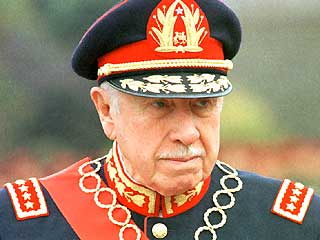
Vatican said Pinochet killings were ‘propaganda’

The Vatican once dismissed reports of massacres by Chilean dictator Augusto Pinochet as “Communist propaganda”, according to US diplomatic and intelligence documents from the 1970s leaked on Monday.

One cable dated October 18, 1973 sent to Washington by the US embassy to the Holy See relayed a conversation with the Vatican’s then deputy Secretary of State, Giovanni Benelli, the leak by whistleblowing website WikiLeaks showed.

Benelli expressed “his and the pope’s grave concern over successful international leftist campaign to misconstrue completely realities of Chilean situation,” read the cable to then US Secretary of State Henry Kissinger.

“Benelli labelled exaggerated coverage of events as possibly greatest success of Communist propaganda,” it said, adding that the Italian monsignor said this showed “how Communists can influence free world media in future”.

“As is unfortunately natural following coup d’etat, Benelli observed, there has admittedly been bloodshed during mopping up procedures in Chile,” it said.

But Benelli went on to say that Chilean bishops had assured him “that stories alleging brutal reprisals in international media are unfounded.”

The conversation took place five weeks after army general Pinochet took power in a coup that overthrew the socialist regime of Salvador Allende, as thousands of perceived leftist sympathisers were being imprisoned and killed.

The cables also showed the Vatican later realised the full extent of the abuses being carried out but refused to criticise Pinochet’s regime openly and continued with normal diplomatic relations.

Complete Article HERE!

Zambia gay rights activist Paul Kasonkomona arrested

A prominent gay rights activist has been arrested in Zambia after appearing on a live television calling for same-sex relations to be decriminalised.

Paul Kasonkomona had been charged with “inciting the public to take part in indecent activities”, police chief Solomon Jere told AFP news agency.

He was detained as he stepped out of the studios of privately owned Muvi TV in the capital, it reports.

Homosexual acts are illegal in deeply conservative Zambia.

Correspondents say many people believe that it is contrary to their religious beliefs.
Petition

Sources at the television station in Lusaka told AFP that police tried to stop the interview and take Mr Kasonkomona off air but the management refused.

South Africa-based campaign group Ndifuna Ukwazi demanded Mr Kasonkomona’s release, in an online petition addressed to Zambia’s President Michael Sata.

“We further urge your government to immediately start a process to decriminalise consensual sex between adults in private irrespective of sexual orientation and gender identity,” the group said.

“This means repealing the laws introduced by the British colonial administration and codified in the Zambian penal code.”

All consensual adult same-sex acts are criminalised in Zambia, Ndifuna Ukwazi said.

Offences such as sodomy, or sex between women, carry a minimum sentence of 15 years or a maximum of life, it added.

“Indecent same-sex practices” – probably a reference to holding hands, kissing and masturbation between adults or alone – carries a minimum sentence of seven years or a maximum of 14 years, the group said.

Last week, a group of gay couples attempted to register their marriages but were stopped and the government ordered the arrest of anyone practising homosexuality, AFP reports.

The European Union last month offered financial support for organisations that wanted to promote the rights of gay people in Zambia, it said.

In 2011, both the UK and US warned they would use foreign aid to push for homosexuality to be decriminalised in Africa.

South Africa is one of the few African countries where it is legal.

Complete Article HERE!