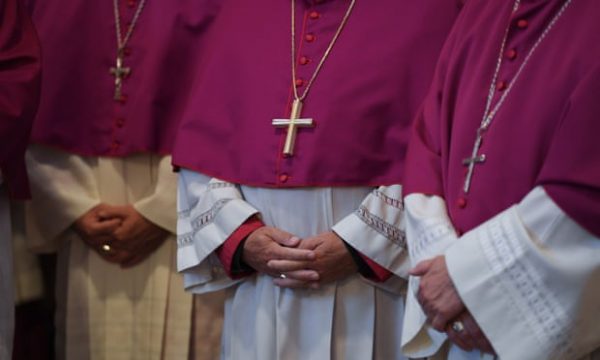
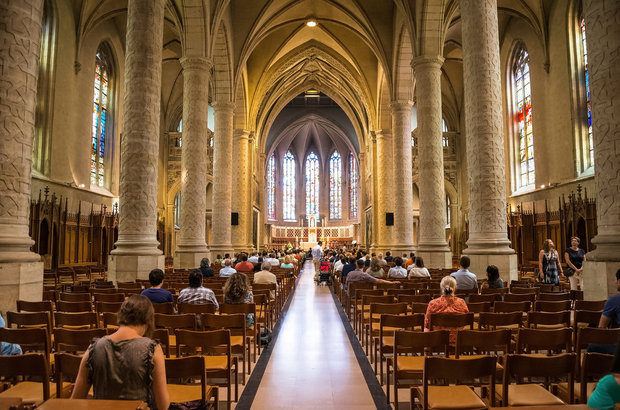
Vatican condemns radio station over anti-gay comments on quake

File under: Me thinks she doth protest too much.
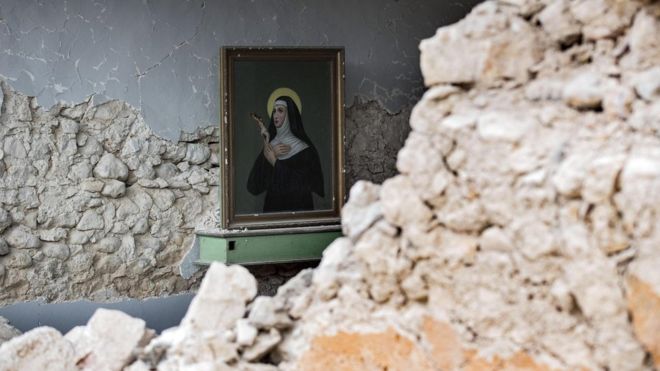
The Vatican has condemned a right-wing Catholic radio station after a broadcast said the recent earthquakes in Italy were “God’s punishment” for gay civil unions.

The remarks, made on the station Radio Maria, were “offensive and scandalous”, the Vatican said.

A Dominican friar said the quakes, including one in August that killed nearly 300, were caused by sins of man.

He said these included the approval of same-sex civil unions last May.

But the Vatican rejected the remarks as pagan, and said they had nothing to do with Catholic theology.


“They are offensive statements for believers and scandalous for those who do not believe”, said Monsignor Angelo Becciu, deputy secretary of state, who is close to Pope Francis.

Monsignor Becciu said Radio Maria, which has come under criticism in the past for comments seen as anti-Semitic, had to “moderate the tone of its language” and conform to the Church’s message of mercy.

But the friar at the centre of the scandal stood by his description of the quakes as divine intervention.

“Just read the catechism,” Father John Cavalcoli said, referring to Roman Catholic religious instruction.

Radio Maria has published a statement (in Italian) on its website, saying the offensive comments did not reflect the views of the station.

Complete Article HERE!

San Diego priest charged with sexual assault of Minnesota woman during private mass

San Diego priest charged with sexual assault of Minnesota woman during  private mass | FOX 9 Minneapolis-St. Paul

A Catholic priest from San Diego has been charged with criminal sexual conduct for an incident during a private mass for the victim in her parents’ Mendota Heights, Minnesota home back in 2010. Jacob Bertrand, 33, was charged by summons with two counts of third-degree criminal sexual conduct by clergy.

According to the charges, a 30-year-old woman contacted Mendota Heights police on April 28, 2016 to report sexual contact between her and Bertrand. The victim told police she met Bertrand in 2009 while studying spirituality at a university in Rome, Italy. Bertrand was also a student and a deacon at a Catholic church at that time. The victim asked Bertrand to be her spiritual guide, and the two began to meet every Wednesday for “holy conversation.”

A ‘mystical’ proposal’

In the fall of 2009, Bertrand told the victim “the Holy Spirit was compelling him to tell her about his sexual past.” Bertrand gave the victim two of his personal journals, and she provided him with her own journals, in which she wrote about wanting to find a husband in Rome. After reading her journals, Bertrand told the victim that he was the man she was sent to Rome to meet. While at a church, he held her hand and “mystically proposed” to her.

In June of 2010, the victim and Bertrand flew to San Diego, where he was ordained as a Catholic priest. During their time in San Diego, they kissed on multiple occasions.

Minnesota visit

In July of 2010, Bertrand flew to Minnesota to spend time with the victim’s family in Mendota Heights. During the stay, he performed mass for the family, offered the sacrifice of the mass and heard their confessions.

During this trip, Bertrand and the victim went a family cabin in Wisconsin, where they had sex. But the criminal charges concern a private mass in the basement of the Mendota Heights home. According to the charges, Bertrand and the victim had sexual contact during the performance of the mass, and after this ceremony he told the victim they had “fulfilled the second holiest sacrifice next to Jesus and Mary on Calvary.”

Later that summer, Bertrand sent the victim a $1,000 check, telling her that God told him to give her the money for her studies. In December of 2011, he spoke to her by phone and said, “the devil tempts me to think that you will tell someone and ruin my ministry.”

Reports to Catholic Church

In 2012 and 2014, the victim reported the sexual contact with Bertrand to the Catholic Church. In 2014, the victim’s report was sent to officials in the San Diego Diocese for investigation. In a bulletin to his parishioners, Bertrand said he had undergone a psychological evaluation and was taking a leave of absence. He was later reassigned to a new church in the San Diego Diocese a few months later, and is currently serving as a priest at that church.

Apology

The victim provided Dakota County investigators with a letter of apology for Bertrand. He also said he had destroyed the journals they shared and prayed for their “release from any demonic attachments that were leading me into such a folly and were keeping me from protecting you as a true priest should have.”

Bertrand is scheduled to appear in court in Minnesota on Monday, Oct. 10.

The law

According to Minnesota law, consent is not a defense if: “The actor is or purports to be a member of the clergy, the complainant is not married to the actor AND the sexual penetration occurred during the course of a meeting in which the complainant sought or received religious or spiritual advice, aid, or comfort from the actor in private; OR the sexual penetration occurred during a period of time in which the complainant was meeting on an ongoing basis with the actor to seek or receive religious or spiritual advice, aid, or comfort in private.”

Diocese of San Diego statement

“Fr. Jacob Bertrand, a priest of the Diocese of San Diego, is facing charges in Minnesota stemming from a sexual encounter with an adult woman there in 2010. The facts behind the encounter are a matter of dispute and will be resolved by the courts and civil authorities. Fr. Jacob asked for and received a Leave of Absence when he learned of the possibility of these charges several weeks ago. There have been no allegations lodged against Fr. Jacob here in San Diego, where he remains on a leave of absence and currently has no faculties. The diocese is not involved in his legal defense. Out of respect for all parties and for the legal process, the diocese will make no further statement at this time.”

Bertrand’s attorney

In a phone interview, Christa Groshek, his co-counsel, said, “These are false allegations, they’re suspect. The woman behind them has a motive. our investigation has revealed the truth behind it. Father Bertrand is a young, reputable priest. He’s worked in large parishes in Southern California.”

Complete Article HERE!

Bishop snared in abuse scandal criticizes Catholic newspaper

Sour grapes, Bishop Finn? Retaliating against the NCR because they had the temerity to suggest that you step side because of your involvement in the clergy sex abuse scandal? Have you no shame?

By Matt Pearce
Bishop Robert W. Finn wishes the independent National Catholic Reporter weren’t so independent.

bishop-finn Finn is the bishop of the Roman Catholic diocese of Kansas City-St. Joseph in Missouri. The National Catholic Reporter is a 48-year-old not-for-profit newspaper based in Kansas City.

Finn was convicted in September of shielding priests from sexual-abuse allegations — prompting editorials from the newspaper calling for his resignation. Now, Finn, who is on probation, has taken to his own diocese’s journalistic bully pulpit to denounce the paper.

“In the last months I have been deluged with emails and other correspondence from Catholics concerned about the editorial stances of the Reporter: officially condemning church teaching on the ordination of women, insistent undermining of church teaching on artificial contraception and sexual morality in general, lionizing dissident theologies while rejecting established magisterial teaching, and a litany of other issues,” Finn wrote this weekend in his diocese’s newspaper, the Catholic Key.

Finn noted that the National Catholic Reporter had long been a thorn in the side of Kansas City bishops; in 1968, one tried to get the publication to remove “Catholic” from its name.

Early in his tenure, Finn said, when he solicited the newspaper to “submit their bona fides as a Catholic media outlet in accord with the expectations of church law, they declined to participate, indicating that they considered themselves an ‘independent newspaper which commented on “things Catholic.”‘ At other times, correspondence has seemed to reach a dead end.”

The National Catholic Reporter has won awards for its investigative reporting and has been covering church sex scandals since 1985, National Catholic Reporter publisher and former editor Tom Fox told the Kansas City Star.

“We are a Catholic publication, but independent of the church structure. That’s one of the keys to our credibility,” Fox told the Star, adding of Finn, “He’s hurting. I know he thinks he’s doing his job.”

According to the original criminal indictment against Finn, sometime in 2010 or 2011 Finn discovered that a priest’s laptop computer contained “hundreds of photographs of children … including a child’s naked vagina, up-skirt images and images focused on the crotch.” Finn, who did not report his knowledge of the priest’s photos for months, became the first bishop convicted in the U.S. in the church’s sprawling child-abuse scandal.

Finn has been apologetic; the National Catholic Reporter’s writers, less so.

“No one is suggesting Finn can’t be forgiven his sins. Indeed, forgiveness is precisely what God always stands ready to offer,” Bill Tammeus wrote in a December column published on the publication’s website.

“But when someone in a position of ecclesial authority has failed in so spectacular a way that even a secular court has found him guilty, he has the obligation to do what he can to avoid further damage to what Finn often calls — in words that should make him quake — Holy Mother Church.”

In other words: Resign.

Finn has not resigned. Instead, he has endured rumblings that he has lost support from the priests inside his diocese, as well as parishioners. Nor has he been released from his duties by Pope Benedict XVI, who holds authority over the church’s bishops.

Finn’s Friday editorial was occasioned by the church’s World Communications Day, in which the pope urged the faithful to reflect on how to find meaningfulness in communication both digital and analog. Finn’s message started with his evocation of St. Francis de Sales, the patron saint of journalism, and closed by narrowing his eyes at the National Catholic Reporter.

“In light of the number of recent expressions of concern, I have a responsibility as the local bishop to instruct the faithful about the problematic nature of this media source which bears the name ‘Catholic,’” Finn wrote in his conclusion. “While I remain open to substantive and respectful discussion with the legitimate representatives of NCR, I find that my ability to influence the National Catholic Reporter toward fidelity to the church seems limited to the supernatural level. For this we pray: St. Francis de Sales, intercede for us.”

Complete Article HERE!

German Catholics vent their dissatisfaction with the Church

A study on Germany’s Catholic community reveals the discontent of faithful with the ecclesiastical institution. But proposals for solutions are lacking

By ALESSANDRO ALVIANI

sad lonely popeThe Pope’s ecclesiastical policies are “backward-looking” and suspected of trying to take the Church back to the pre-Second Vatican Council period. As for the Church’s leaders, they are “cut off from reality, reactionary and obstructionist.”

This is the opinion German faithful have of Benedict XVI and the Catholic Church according to a study by Sinus Institute and consulting agency MDG (which the German Church controls). In-depth interviews were conducted with 100 Catholics from different social backgrounds. According to the study, which picks up on a similar one carried out in 2005, German faithful are convinced that today’s Church finds itself in a “desolate situation” and the most obvious manifestation of this is the sex abuse scandal.

The authors of the study wrote that the scandal seriously damaged the image of the Church, even in the eyes of the most fervent Catholics, whose faith was deeply shaken. The scandal was seen as confirmation of the Church’s “modernization deficit”. The Church lost a great deal of credibility not just as a result of the accusations of paedophilia made against it but also because many believe it dealt with the abuse issue inadequately.

Internal dogma and rules that had been tacitly accepted until about a year ago are now openly criticised by faithful. Criticisms range from complaints about “discrimination against women” and celibacy, to the condemnation of homosexuality, contraception and sex outside wedlock, to the marginalisation of lay people involved in Church life.

Another factor that is creating animosity, is the organisational restructuring that is taking place in Germany, with a number of parishes being merged because of the shortage in parish priests, for example.

The study also shows the Church’s detachment from the weakest sections of society: it would make no difference to the lower social classes if the Church ceased to exist.

Despite their criticisms, however, faithful still look to the Church for “spiritual guidance” and “meaning”. The majority of them do not want to lose their Catholic identity and few consider leaving the Church.

So what do German faithful expect from the Church? They want lay people involved in the Church to play a greater role; they want more women in leadership roles; the possibility for women to be ordained priests; the elimination of celibacy; a different attitude towards sexuality and contraception; the sacraments to be administrated to all Christians, regardless of their denomination or sexual identity; less ostentation and less abuse of power and a greater focus on God’s love and love for one’s neighbour.

Complete Article HERE!

UnHoly Communion

Some months ago a fellow contacted out of the blue and identified himself as Hank Estrada. Apparently he found me through the Gay Catholic Priests Facebook page. Hank went on to introduce himself and tell me about his latest book, UnHoly Communion-Lessons Learned from Life among Pedophiles, Predators, and Priests. This immediately piqued my interest. His book was published just weeks before my book, Secrecy, Sophistry and Gay Sex In The Catholic Church: The Systematic Destruction of an Oblate Priest in the summer of 2011. After a short conversation on Skype we decided to exchange books and read each other’s story. Hank was way better than me in getting this job done. In record time he plowed through my rather ponderous book and we spoke again on Skype in the earl fall.

Hank complimented me on my work and we spoke for nearly an hour about the many church related experiences we had in common. You see, Hank was a Claretian seminarian in Los Angeles, California around the same time I was Ordained and Oblate priest in Oakland California.

UnHoly CommunionI told Hank that I had yet to get to his book. I apologized for being so slow and promised that I’d get to it as soon as possible. Well it took me way longer than I thought. It’s astonishing how life seems to get in the way of of my best intentions. At any rate, I finished Hank’s book yesterday, Christmas Day. Curiously enough, Hank had some time to spend yesterday afternoon so we met on Skype once again to discuss his book.

UnHoly Communion-Lessons Learned from Life among Pedophiles, Predators, and Priests is primarily a story of the indomitable human spirit. Hank’s story is harrowing — years of childhood incest with his pedophile uncle while his alcoholic family lived in denial.  His escape to what he believed to be a safe haven, the Church, only to be sexually abused by a trusted superior.   And how the leadership of his religious community added insult to injury by ignoring his story and shamefully protecting the sexual predator in their midst permitting him  to move from one victim to another.

Despite all of the abuse, deception and betrayal, Hank triumphs. He is now a nationally recognized spokesman and tireless advocate for male victims and adult survivors of sexual assaults. In 1986, he founded the first national nonprofit organization to support non-offending adult male survivors. His book, despite the difficult subject matter and candid recollections of his ordeal, is really a testament to all of us who have been through similar experiences. It is a message, presented in a very accessible, matter of fact style, of hope, support, and encouragement.

I was particularly touched by his perception, as a seminarian, of the Catholic priesthood that he aspired to join. He perfectly captures the moral and ethical minefield that each priest and religious faces. And how easily it is for any one of us to succumb to the dark side. I quote…

While living in a community of Catholic priests and brothers, I quickly learned about the many personal benefits a religious clergyman receives throughout his priesthood, among them prestige, privilege, protection and often unchallenged influential power over parishioners. Could these questionable benefits lead to arrogance, self-righteousness, and a false sense of invincibility on the part of the priest? What about the sense of accountability, respect, adherence to faith, protection of the innocent and being true examples of Christ’s presence in the world? I witnessed as these men who wore a traditional black suit with white “Roman” collar, undeniably the most recognizable symbol of the Catholic priesthood, were frequently sought out, pampered, given unlimited trust and attention, and had people constantly offering to do things for them. Internally, I questioned some priests I saw take the spiritual “gift” of priesthood and turn it into something they bartered with, a way to control parishioners, as saying “If you treat me special, I will pray and give you blessing from our Lord.”

Hank’s book, UnHoly Communion-Lessons Learned from Life among Pedophiles, Predators, and Priests is a must read for anyone interested in knowing the truth about life in the Catholic Church. His thoughtful and reflective presentation is not about grinding an ax, although he has every right to do so. It’s all about being honest, primarily with himself, then with his family, his religious community, and us. Because it is precisely this honesty that will help him, them and us from shirking our responsibility to be more vigilant in terms of protecting the most vulnerable among us.

Thank you, Hank, for your witness. And thank you for calling us to uncover our eyes and see things, not as we would like them to be, but as they really are.

Film defrocks church hierarchy over handling of sex abuse

By Andrea Burzynski

Four deaf Wisconsin men were some of the first to seek justice after suffering childhood sexual abuse at the hands of a priest, and a new documentary about the Catholic Church’s poor handling of such cases stemming from the Vatican seeks to make their voices heard.

“Mea Maxima Culpa: Silence in the House of God” explores the impact of the Roman Catholic Church’s protocol as dictated from the Vatican for dealing with pedophile priests. It opens in U.S. cinemas on November 16, and will air on cable channel HBO in February.

Though American media coverage about child sex abuse by clergy has been extensive since a slew of cases came to light in Boston in 2002, Oscar-winning documentary director Alex Gibney wanted to connect individual stories with what he sees as systemic failures stemming from the top of the church.

“A lot of individual stories had been done about clerical sex abuse, but I hadn’t seen one that really connected the individual stories with the larger cover-up by the Vatican, so that was important,” Gibney told Reuters in an interview.

The film centers on the group of deaf men and their experiences as young boys attending St. John’s School for the Deaf in St. Francis, Wisconsin.

In a letter to the Vatican in 1998, the late Rev. Father Lawrence Murphy admitted abusing some 200 deaf boys over two decades beginning in the 1950s.

Murphy claimed he had repented, and asked to live out his last years as a priest, and was never defrocked or punished by civil authorities. He died in 1998.

In the film, the men communicate their frustrating attempts to bring their experiences to the attention of religious and civil authorities with effusive sign language and facial expressions, paired with voiceovers by actors such as Ethan Hawke.

The film also traces a convoluted bureaucracy – right up to the cardinal who is now Pope Benedict – to reveal a set of policies that the film portrays as often seeming more interested in preserving the Church’s image.

STRUGGLING TO BE HEARD

“These were deaf men whose voices literally couldn’t be heard, so there was a silence from them, and there was also this silence coming from the church, a refusal to confront this obvious crime, in part because they were covering it up,” said Gibney.

The Vatican has denied any cover-up in the Murphy case and in 2010 issued a statement condemning his abuse. It has criticized media reports about the Church’s handling of the cases as anti-Catholic.

Contrasting that, the film shows interviews with former church officials who talk openly of church policies to handle cases by “rehabilitating” abusive clergymen and snuffing out scandal.

Gibney said that all of the Vatican officials he contacted declined his interview requests.

Raised Catholic himself, Gibney no longer practices organized religion, but empathizes with Catholics who feel a sense of loyalty to the religion’s institutions and acknowledges that criticism of the church can feel like a personal attack.

“Mea Maxima Culpa,” a Latin phrase meaning “my most grievous fault” focuses on the failures of the Catholic Church’s hierarchy. But Gibney – who won an Oscar for “Taxi to the Dark Side” – said the film’s theme transcends religion and is also relevant for secular institutions.

“This is obviously about the church, but it’s also a crime film,” he said. “It’s about abuse of power and it’s about how institutions instead of reckoning with problems try to cover them up. It’s always the cover-up that creates the problem.”

He cited the Jerry Sandusky sex abuse scandal that rocked Penn State University recently, and the BBC’s poor handling of abuse allegations against the late British TV personality Jimmy Savile as examples of secular institutions brought low by similar issues.

“The thing about predators is that they tend to hide in plain sight,” Gibney said. “You’re seeing it now with Sandusky, you’re seeing it now with Jimmy Savile in Great Britain, and you saw it with Father Murphy in the film.”

Gibney thinks that the public’s stubbornly rosy perceptions of charismatic authority figures, including priests, is a major factor in such scandals.

“They’re often involved in charity or good works,” he said of high-profile abusers. “That seems to give you license to do unbelievable things because people cut you all sorts of slack that they wouldn’t normally do for other people.”

Complete Article HERE!

Quote of the Day

“When you rape children, cover it, rape them again, cover it up, rape them again, finally get caught, still cover it up, apologize, recant your apology, then blame the victim, you have zero moral authority to lecture others about their supposed sins.”

John Aravosis at AMERICAblog, writing about the Catholic Church’s most current bit of pearl-clutching over marriage equality.

Fr McVerry questions direction of church

By PATSY McGARRY

How can today’s young people be invited “to commit themselves to a male-dominated, authoritarian institution which suppresses dissent and attempts to control what its members may even discuss?” social justice campaigner Fr Peter McVerry has asked.

The founder of the Peter McVerry Trust for homeless people was speaking in Dublin last night at the first annual general meeting of the Association of Catholic Priests (ACP). The meeting continues today.

He said there were “many priests and religious . . . who experience only condemnation, exclusion and marginalisation by the very church which was mandated by its founder to reach out to all in compassion, love, and tolerance”.

The church established by Jesus “was to be a community of brothers and sisters, free of all domination”, he said. Jesus warned against “replicating the relationships of power that existed in the wider society”.

“Whatever little theology I have, I learnt from homeless people,” he said. Listening to them had “changed my understanding of who God is and what God wants”.

Fear

Fr McVerry said the wealth, power and status of the church, and its “fear of losing them”, may have filtered “understanding of the message of Jesus”. Such fear was seen recently in the church authorities’ response to child sexual abuse.

He recalled that “for the religious authorities at the time of Jesus, God was a God of the law” and that “the church, too, has often proclaimed a God of the law”. It meant “anyone, like Jesus, dissident priests, organisations like the ACP who challenge this understanding of God, is seen therefore as a threat . . . to be got rid of”.

“Jesus . . . was just ‘the carpenter’s son,’ one of the laity no less” who “was moved by the suffering of his people. And Jesus proclaimed a different God, a God of compassion”.

He wondered whether this was why today the message of the church was seen by so many as irrelevant to their lives.

Complete Article HERE!