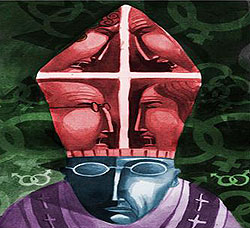
Cardinal George says mayor overstepped with Chick-fil-A remarks

Here is the pot calling out the kettle… This man has no shame!

Cardinal Francis E. George of Chicago says the city’s mayor showed contempt for many residents’ beliefs by stating that Chick-fil-A’s stance on marriage was against “Chicago’s values.”

“Recent comments by those who administer our city seem to assume that the city government can decide for everyone what are the ‘values’ that must be held by citizens of Chicago,” the cardinal wrote in a July 29 online post, responding to Mayor Rahm Emanuel’s assertion.

“I was born and raised here, and my understanding of being a Chicagoan never included submitting my value system to the government for approval,” Cardinal George wrote.

He wondered: “Must those whose personal values do not conform to those of the government of the day move from the city? Is the City Council going to set up a ‘Council Committee on Un-Chicagoan Activities’ and call those of us who are suspect to appear before it?”

“I would have argued a few days ago that I believe such a move is, if I can borrow a phrase, ‘un-Chicagoan.’”

The cardinal made his remarks on the Catholic Chicago blog after the mayor ventured into an ongoing controversy about the Chick-fil-A restaurant chain.

Many homosexual “marriage” advocates took offense at company president Dan Cathy’s support for “the biblical definition of the family unit” in a recent interview.

During a July 30 press conference, Mayor Emanuel said he stood by his July 25 statement that was interpreted by some as supporting a plan to bar the restaurant from the city’s First Ward.

After Alderman Proco Moreno said he would block the restaurant’s plan to open a new location, Emanuel issued a statement saying that “Chick-fil-A values are not Chicago values.”

“They disrespect our fellow neighbors and residents,” the mayor stated. “This would be a bad investment, since it would be empty.”

But a spokesman for the mayor told NBC 5 Chicago that Emanuel did not intend to stop Chick-fil-A from opening, despite his conviction that the Christian-run company’s values were not those of the city.

In Monday’s remarks, the mayor appeared to identify the city’s “values” with government policy on homosexual unions, saying: “When it comes to values, there’s a policy as it relates to gay marriage. The values of our city are ones that welcome and recognize that, and I will continue to fight for that.”

Emanuel’s statement also appeared to identify civil unions – which Illinois implemented in 2011 – with homosexual “marriage,” which has never been instituted in the state. The mayor personally supports a measure to redefine marriage, which was introduced in February but has stalled in the legislature.

In his response to the mayor on Sunday, Cardinal George spoke out on behalf of Catholics, and others, whose “values” do not include what he called “gender-free marriage.”

The cardinal stressed that authentic marriage exists prior to any decree of the state or Church, due to the complementarity of the two sexes and their procreative potential.

The natural definition of marriage is not “bigotry,” nor is it unique to a particular religion, he said.

“People who are not Christian or religious at all take for granted that marriage is the union of a man and a woman for the sake of family and, of its nature, for life,” Cardinal George noted. “The laws of civilizations much older than ours assume this understanding of marriage.”

But the Chicago archbishop also pointed to Jesus Christ’s teaching on marriage in the Gospel of Matthew, in which the Lord affirms marriage as the unbreakable union of a man and woman as “one flesh.”

The citation prompted him to pose a question as to whether Jesus’ own “values” were still welcome in Chicago by Mayor Emanuel’s standards.

“Was Jesus a bigot?” he asked. “Could Jesus be accepted as a Chicagoan?”

To answer your question, Francis; Jesus wasn’t a bigot. But the same can’t be said about you. Sheesh!

Complete Article HERE!

Church and its accepting environment taking hold

Ogden is the first Western state to host The General Episcopal Synod, an international conference for members and leaders of the North American Old Catholic Church. About 100 representatives from across the United States and several countries will be in attendance this weekend.

“It is noteworthy because it signals to the world that you can be Catholic and not be locked into a Middle Ages mindset,” said the Rev. Jim Morgan, who oversees the Glory to God North American Old Catholic Church, at 375 Harrison Blvd. He said the gospel is “relevant, vital and apposite to the people of our world and time. We are committed to bringing this truth to the forefront.”

Although the Old Catholic Church is a community of Christian churches with Catholic roots, members of Ogden’s congregation are especially attracted to the church for the love and acceptance they feel there.

“We’re a very caring, praying church,” said Robbin Hansen, who helps manage the office for the Ogden church. “A lot of people kick you out. You feel you are not wanted in other churches.”

She said her service animal as well as her domestic living situation seemed to be a problem at other churches. But not at Glory to God.

“It doesn’t matter who you are, we love you. We care about you,” said Hansen, who has been attending Glory to God for more than three years. “This church is an amazing church you dream of that will accept you. This is a personal church.”

She said many girls come from Park City, Kamas and Heber City to have their quinceañera Mass celebrated at the church.

Glory to God offers bilingual Mass every Saturday at 6 p.m. as part of its outreach to Latino and Hispanic populations. Morgan also celebrates baptisms and 3-year-old presentations.

Hansen is looking forward to watching the deacon and priest ordinations today at 6 p.m. So is Morgan. He said with the ordination of locals Robert Patrick Trujillo and Mark Dexheimer Trujillo to the priesthood, the church can “offer even more to the families and persons who are routinely ignored or shunned by other churches in our area.”

“It has been my experience that our congregation is made up of diverse populations, some gay, many straight, young and old,” Dexheimer Trujillo said. “We come from a variety of denominational backgrounds, some Roman Catholic, others Episcopalian, LDS or nondenominational communities.

“Our parishioners are folks on the margins, folks who have never found their home in other settings,” said Dexheimer Trujillo, who was raised in a “very establishment, Episcopalian” environment. “We are small but have created a marvelous mosaic. We are a very human group of people whose lives are changed by Christ. It is a beautiful encounter.”

In contrast to many churches, Glory to God accepts members of all sexual orientations.

“We consider gender diversity a blessed part of life and promote the full inclusion of LGBT persons in our religious life, sacraments, and clergy,” Morgan said. “Similarly, we advocate for the full inclusion of LGBT persons throughout society.

“I would like my sisters and brothers — old and young, regardless of sexual orientation — to know that the gracious, almighty God that created them and all that is, loves them unconditionally, unreservedly and totally just the way he created them, and so do we,” Morgan said. “There is a church, family and home waiting for them here at Glory to God.”

Morgan said the best part of the church is the church family it creates.

“We come together to love, lend support, encourage and lift up each other,” he said. “We celebrate with each other and console one another.”

He said he particularly likes the church’s monthly potlucks, especially because his congregation has some great cooks.

Congregation members also like the church’s engaging, relevant preaching and lively approach to music.

Glory to God uses 21st-century tools such as contemporary music and multimedia “to engage heart, mind and soul,” Trujillo said.

Members of Glory to God — the first Old Catholic congregation established in Utah — want to expand it to other areas of the state.

Dexheimer Trujillo, a teacher at Tooele High School, plans to plant a mission in Tooele. Three other Salt Lake City-area congregations may join the church within a year.

“It makes perfect sense to grow the church in Utah,” he said. “The culture in Utah tends to be folks who take their faith seriously.

“We are Christians and serious Catholics,” he said. “We are constantly working to stay balanced. Our denomination strives not be become institutional.”

The North American Old Catholic Church was established in Ogden on June 6, 1996, and is now the Glory to God Church. Morgan said an average of 30 to 40 people attend Mass on any given Sunday, and church records include 65 people.

Dexheimer Trujillo said the goal is to keep congregations small.

“It sits within the context of being accepting. On purpose we keep small congregations, as opposed to getting lost in a large institution.”

He said the approach helps him to focus on pastoring instead of “church stuff.”

The Old Catholic Church originally split from the Roman Catholic Church over doctrines, most importantly papal infallibility, the belief that the Pope is preserved from the possibility of error. The Old Catholic Church holds to the belief that the total church acting in unity — or Ecumenical Council — may speak infallibly.

Morgan said the faith is rooted in tradition and the early days of Jesus and his teachings on peace, love, justice and equality. He said congregation members strive to care for the oppressed, disenfranchised, poor and unwell.

According to a church statement, “We are a church that worships God by living our faith every day of the week, speaking out against injustice and praying for healing in the world by being active believers, committed to loving our neighbors.”

Complete Article HERE!

Former Argentinian dictator says he told Catholic Church of disappeared

BEWARE the collusion of a national hierarchy with it’s national political leadership. These men, and they are all men, have no conscience.

ARGENTINA’S FORMER military dictator said he kept the country’s Catholic hierarchy informed about his regime’s policy of “disappearing” political opponents, and that Catholic leaders offered advice on how to “manage” the policy.

Jorge Videla said he had “many conversations” with Argentina’s primate, Cardinal Raúl Francisco Primatesta, about his regime’s dirty war against left-wing activists. He said there were also conversations with other leading bishops from Argentina’s episcopal conference as well as with the country’s papal nuncio at the time, Pio Laghi.

“They advised us about the manner in which to deal with the situation,” said Videla in a series of interviews conducted by the magazine El Sur in 2010 but published only on Sunday.

He said that in certain cases church authorities offered their “good offices” and undertook to inform families looking for “disappeared” relatives to desist from their searches, but only if they were certain the families would not use the information to denounce the junta.

“In the case of families that it was certain would not make political use of the information, they told them not to look any more for their child because he was dead,” said Videla. He said the church “understood well . . . and also assumed the risks” of such involvement.

The confession confirms long-held suspicions that Argentina’s Catholic hierarchy collaborated with the military’s so-called process of national reorganisation, which sought to root out communism. In the years following the 1976 coup led by Videla, thousands of left-wing activists were swept up into secret detention centres where they were tortured and murdered. Military chaplains were assigned as spiritual advisers to the junior officers who staffed the centres.

In contrast to the Catholic hierarchy in Brazil, where church leaders denounced that country’s military dictatorship and provided sanctuary to its victims, in Argentina bishops were prominent defenders of the regime against accusations of human rights abuses from abroad.

At the height of the state’s offensive, Cardinal Primatesta refused to meet with mothers of the disappeared who, in the face of violent intimidation and media silence, were seeking help in finding out what had happened to their missing loved ones. He also prohibited the lower clergy from speaking out against state violence, even as death squads targeted Catholic priests critical of the regime.

The cardinal’s defenders said he believed a break with the regime would be counter- productive and that in private he characterised disappearances and torture as against the Christian spirit. On his death in 2006 human rights campaigners in Argentina said he took to the grave many of the junta’s secrets after they failed to force him to testify about his dealings with it.

Accusations of collaboration with the junta also dogged the subsequent career of Laghi, who had been a regular tennis partner of the navy’s representative in the junta, Admiral Emilio Eduardo Massera, when in Buenos Aires.

The Mothers of the Plaza de Mayo human rights group tried to prosecute him in Italy for his involvement with Argentina’s dictatorship but the effort failed.

Videla is serving life in prison for human rights abuses committed while in power. Earlier this month a court sentenced him to 50 years for orchestrating the theft of babies born in captivity to women subsequently murdered by their military captors.

He gave the interview to El Sur on condition that it be published only after his death, saying he did not want to cause any more pain. But the magazine said it was released from its obligation after Videla subsequently gave a series of interviews to other journalists that were published.

Complete Article HERE!

A church celebrates with women as priests

Several months ago, Kathy Schuck’s 15-year-old daughter posed a question that seemed innocuous but that became a call to action.

The gist of Ann Schuck’s question: Why did girls and women seem to be less important than men in their church, St. Rose of Lima in North Wales?

Kathy Schuck, 56, of Blue Bell, said she had long felt women were confined to secondary roles in the Roman Catholic Church, where she did not hear a message of inclusion. The hierarchy and exclusion of the voices of the lay members troubled her, she said. So, after 15 years, she left her parish.

“It disturbed me that the hierarchy of the Roman Catholic Church uses a term like ‘radical feminism’ to . . . categorize any woman who wants to have a voice in the church when that voice is not in total compliance with doctrine and orthodoxy,” Schuck said. “It was clear to me that my lack of action reinforced that that behavior was acceptable – and it isn’t.”

On Sunday, she joined more than 50 others belonging to the St. Mary Magdalene Community in celebration of its fifth anniversary. The group is led by two Roman Catholic female priests not recognized by the Vatican. Sunday’s celebratory service was held in rented space at the Drexel Hill United Methodist Church.

St. Mary Magdalene is one of several worship communities being led by women in 28 states, said Suzanne Thiel, president of Roman Catholic Womenpriests USA, a nonprofit group that prepares women for ordination and carries out the ceremonies.

“We provide spiritual comfort and solace for people who no longer find it in the Roman Catholic Church,” said Eileen McCafferty DiFranco, who was ordained in 2006 and who, along with her St. Mary’s co-pastor, is one of 113 female Roman Catholic priests, bishops, and deacons worldwide, according to Thiel.

At least eight more ordinations, which the organization maintains are valid, are planned worldwide by Christmas, Thiel said.

“We know the Vatican and the hierarchy are not happy with us,” Thiel acknowledged. “What’s important is the Catholic people have accepted us.”

Since 1976, the Vatican has been strongly reiterating that women are not full members of the Roman Catholic clergy after the Episcopal Church validated the illicit ordination in 1974 of 11 women in Philadelphia.

Then Pope Paul VI reminded Catholics that an all-male clergy was a “constant and universal tradition” of the Roman church because Jesus freely chose only men to be his apostles. By their “natural resemblance” to Christ, male priests also serve as the “sacramental sign” of him, the pontiff said.

Advocates of female clergy had long accused the church hierarchy of misogyny.

St. Mary Magdalene has drawn male and female members, some from as far as Delaware. In general, members said they did not feel fulfilled by their home Catholic parishes and sought a more intimate community with less hierarchy where their voices would be more valued.

“It’s all about intimacy. You can’t be intimate with a parish that has 2,000 to 3,000 members and no mechanism to get to know people on a deeper level,” said Judy Miller, 73, of Hockessin, Del., a member of St. Mary for three years with her husband, Chuck.

Schuck said she was welcomed, greeted by name, and introduced. “I was as comfortable as I was in someone’s home,” she said.

The St. Mary Magdalene Community has grown from 10 members to about 90, with a satellite community in Northeast Philadelphia, said DiFranco, who, along with being a priest, is a school nurse in the city. Services usually draw 30 to 40 members.

St. Mary members said that they enjoyed the congregation’s interactive homilies and that everyone was welcome to take communion. DiFranco said she doesn’t use prayers routinely heard in traditional Catholic Masses, opting instead for “non-sexist” prayers.

Members collectively decide which charities to support.

Maryrose Petrizzo, a member of St. Mary of Magdalene, said leadership opportunities were limited in her church in Wilmington. Among the positions she held was youth minister and eucharistic minister. “I could only do so much,” she said.

But at St. Mary Magdalene, she has led the liturgy and given the homily.

“That’s been so life-giving to be able to give a homily,” said Petrizzo, who has applied to be ordained.

After DiFranco’s ordination in 2006 in Pittsburgh, staff from St. Vincent de Paul in Germantown visited her and asked her not to show up for communion.

She preached on Sunday about following one’s dreams, much like women who have heeded the call to be priests.

“We succeeded in being priests in spite of the church,” she said after the homily. “Where human beings shut the door, God opens the window.”

Complete Article HERE!

Female bishop speaks up for views, talks about ‘Womenpriest Movement’

Bishop Patricia Fresen says she dreams of establishing a church in which people of all genders, races and sexual orientations are treated equally and allowed to assume positions of leadership.

Fresen, a leader of the Roman Catholic Womenpriest Movement, spoke Sunday to members of the Mary Magdalene First Apostle Church about the need for an all-inclusive church after Mass at St. John’s Episcopal Church.

“There needs to be an emphasis on what unites us, rather than what divides us,” she said.

Fresen’s story
Born and raised in South Africa, Fresen was a nun in the Dominican Sisterhood for 45 years. She taught at St. John Vianney Seminary in Pretoria, South Africa, and at St. Augustine’s University in Johannesburg.

In 2003, Fresen was ordained a priest, which is a role the Roman Catholic Church reserves solely for men. As a result, she was excommunicated from the church and forced to leave her teaching positions.

Two years later, she was appointed a bishop and has been instrumental in bringing what supporters call the Womenpriest Movement to the United States. It is not recognized by the Catholic Church.

The Womenpriest Movement has support but there is still resistance, Fresen said.

“The resistance comes from a great fear of women and sexuality, and the long patriarchal tradition of the Roman Catholic Church,” she said.

Structure
Fresen said members of the Womenpriest Movement still consider themselves Catholic, but there are fundamental differences in how the churches are structured.

The Womenpriest Movement’s church is non-hierarchical and has a circular model in which leaders work in teams. Fresen said there are six regions of the Womenpriest Movement in the U.S.: North, West, South, East, the Great Waters region and the Midwest region.

Each region is led by a bishop, administrator and program director who are all elected by the people, Fresen said. The administrator is the main position in charge while the bishop has pastoral responsibilities and guides priests and deacons.

The second main difference between the churches is that women are allowed to hold leadership positions and nearly all the women involved in the Womenpriest Movement are married. Fresen said celibacy is not a requirement of ordination and neither is a vow of obedience to the bishop.

Fresen said the Womenpriest Movement advocates showing mutual respect for all religions, and expressing different cultures through liturgy and music.

Regina Nicolosi, bishop of the Midwest region of Roman Catholic Womenpriests, said it is important to her to spread the message of the movement because she believes in total equality for men and women.

Nicolosi said the law that does not allow women to be ordained as priests in the Roman Catholic Church is unjust, and she feels a strong call to advocate against the law.

“Being part of the Womenpriest Movement has helped me answer that call,” she said. “I want to belong to a church that is accepting of all races, all genders, all sexual orientations and takes that very seriously.”

Fresen said she uses humor to cope with the unjust structures of the Roman Catholic Church, and if the Womenpriest Movement is strong in its beliefs, “the church will back down, like a bully usually does.”

Fresen told audience members they must lose all fear of excommunication if the Womenpriest Movement is to be successful. She cited Nelson Mandela as an example of someone who spent 27 years in prison because he refused to obey what he considered an unjust law.

“In good conscience, one must not obey an unjust law … but you must be prepared to pay the price,” Fresen said.

Complete Article HERE!

Psychologist: Bishops’ lashing out at sisters is a distraction

COMMENTARY — Kathy Galleher

Since the Vatican’s public release April 18 of the results of the doctrinal assessment of the Leadership Conference of Women Religious, many American Catholics have been confused and angry. These women, who work tirelessly with the poor and marginalized, whom many of us see as embodying Christ’s love, are being accused of doing grave harm to the church. In conversation after conversation, I have heard, “Why so much anger directed at women religious?”, “What is this about?” and “It just seems … abusive.” As I pondered this last observation, I recognized a familiar dynamic.

For nearly eight years I worked as a psychologist at a treatment center for priests and religious. During that time I worked with a number of men who had committed sexual abuse. An essential part of the therapeutic work was for these men to understand the deep pain they had caused, to accept responsibility for it, and to move forward with a commitment not to let it happen again, which included accepting restrictions and consequences. Often the largest obstacle to healing was the first task: accepting and understanding the amount of pain they had caused.

When we harm someone, healing requires that we recognize the extent of the injury we caused. Only when we are able to see this clearly and take responsibility for it can we respond with appropriate guilt. Appropriate guilt focuses us on how to repair the injury (if that is possible) and what actions we must take to prevent it from occurring again. If we cannot recognize the pain and take responsibility for it, we get stuck and assume an aggressively defensive stance, lashing out and blaming others as a way to deflect attention from our actions, actions we find too painful to look at honestly.

In treatment, when a client was stuck in this way, we would see this blaming/lashing-out dynamic, and he would start a fight. The greater the unacknowledged pain, the more furious the fight. Often the fury was directed toward a bishop or superior who was removing him from ministry. “You’re ruining my life,” he would say. “I feel betrayed. You have no idea how much pain you are causing me and you don’t even care.” Although he was the abuser, in his mind in that moment, he was the victim of the bishop or superior. The real victim had vanished from his awareness.

Fights like these were so provocative that the instinctive reaction of those on the receiving end was to respond with their own aggression. So the fight would escalate, take on more heat, and distract from the work at hand. As therapists, we tried to contain these fights and give them as little energy as possible (like depriving a fire of oxygen). Our job was to say, “This is a distraction. Let’s get back to work.” Then we would support the client in leaving the fight behind and returning to his unfinished work: looking deeply at his own pain, taking responsibility for the pain he had caused, and taking action to prevent it from occurring again.

I see strong parallels between this and the church’s dealings with LCWR. The level of anger and blame in the doctrinal assessment document feels like someone is picking a fight, and the intensity of it hints at the enormous amount of still unworked pain at the heart of the church’s sexual abuse crisis. To me, this fight looks like a distraction.

In the past 10 years, the church has taken steps toward responding to the tragedy of sexual abuse in the church at the individual level, including responding to allegations more quickly, involving law enforcement, and developing child protection policies. However, the church has not yet been willing or able to examine its own role as an institution in concealing and enabling decades of abuse. The bishops have not taken collective responsibility for their actions (and inactions) and for the enormous pain they have caused. As much as the abuse itself, it is this failure by the hierarchy to acknowledge and accept their responsibility that has angered and disillusioned so many current and now-former Catholics. Too much pain is still unacknowledged and unworked.

The church hierarchy seems to be stuck and they are blaming and lashing out. They have started a fight with LCWR and the women religious. In the doctrinal assessment, they have accused the women of the church of betraying the core values of the church, of causing scandal and leading the faithful astray, and of not being sufficiently trustworthy to reform themselves. They have ordered the women to be closely supervised. These accusations seem more rightly to belong to the sexual abuse scandal rather than to the actions of LCWR. It was the bishops who, by protecting sexual abusers, betrayed core values of the church and caused scandal to the faithful. It is the institutional church that appears not to be able to reform itself and to be in need of outside supervision.

This fight with LCWR is a distraction from the work the bishops still need to do in order to bring about genuine healing in the church.

In response to the misdirected accusations and the severe punishment directed at LCWR, many Catholics feel outraged and want to fight back. But as we saw above, to do so stokes the fire and continues the distraction. We can all be grateful to the women of LCWR for their powerful model of non-reactivity and reflection in their response to this situation. They have spoken their truth, but have not thrown wood on the fire. Similarly, public statements of support from men religious — notably the Franciscans — are courageous and direct but nonviolent. I hope that all of us will follow their lead — speaking our truth with courage and nonviolence, and, like the sisters, keeping our eyes on the real work we are called to do as a church.

It seems the moment to say clearly to the Vatican and to the bishops, “This fight with LCWR is a distraction. The women are not to blame. The church is not the victim. There is still a great deal of pain to address. Let’s get back to work.” Let us hope that with our prayers and support they will be able to look more deeply. Let us hope they can return to and complete the work that is still theirs to do, and in that way bring about healing and transformation for themselves and for our entire church.

Complete Article HERE!

An American Nun Responds To Vatican Criticism

Sister Pat Farrell is the president of the Leadership Conference of Women Religious and the vice president of the Sisters of St. Francis in Dubuque, Iowa.


As an aside, the Sisters of St. Francis in Dubuque, Iowa were the spirit-filled women who formed me in grade school at St John Brebeuf Parish in Niles IL. God bless them all.


Bishops, Oaths, and Conscience

Today’s Washington Post reports on a highly troubling story (Arlington Diocese parishioners question need for fidelity oath) about a rising trend in Catholic dioceses to require workers — including volunteers who teach religious education — to affirm some sort of “fidelity oath” in order to continue their work or ministry. The story ends with this:

The Rev. Ronald Nuzzi, who heads the leadership program for Catholic educators at the University of Notre Dame, said many bishops “are in a pickle.” They want Catholic institutions to be staffed by people who not only teach what the church teaches but whose “whole life will bear witness.”

Nuzzi said he keeps a photo on his desk from the 1940s that shows all the German bishops in their garb, doing the Nazi salute.

“I keep it there to remind people who say to do everything the Church says, that their wisdom has limitations, too.”

Anyone who fully understands and values the breadth and depth of Catholic Christianity must be appalled by this trend, especially when such oaths appear to be written in ways that clearly are contrary to Catholic teaching. What is more troubling, however, is the perspective expressed by some — both clergy and laity — who see no problem with such a practice.

Complete Article HERE!

Flaccid ‘Fortnight for Freedom’ fizzles for fathers

COMMENTARY – Fred Clark

The “Fortnight for Freedom” was a flop.

This was supposed to be a game-changer — the U.S. Conference of Catholic Bishops’ big display of political might. But instead it exposed the bishops as inept campaigners and as generals without an army.

I thought they’d be better at this sort of thing. They had some formidable assets to work with. For weeks ahead of time, Fortnight events were publicized and promoted in every diocese and every parish across the country. And they had some serious money to work with thanks to deep-pocketed (anonymous) donors. They even got a big boost of support from their allies in the evangelical religious right.

But still, it flopped. Big time.

This two-week extravaganza was supposed to redefine the political conversation, but instead it went mostly unnoticed and unattended. It was supposed to show massive grassroots support for the bishops’ contention that allowing women to purchase comprehensive health insurance constitutes an intolerable threat to the religious liberty of employers who wish to prohibit that. But instead it showed, definitively, that there is no grassroots support for that strange argument.

The bishops declared themselves the grand marshals of what was to be a glorious parade, but no one showed up to march behind them and only a meager handful turned out to line the route as spectators.

It was pathetic, really. A bunch of nuns on a shoestring-budget bus tour drew more enthusiasm and more support for their polar-opposite message. For all the millions spent and all the weeks of elaborate, top-down fanfare, the Fortnight for Freedom came and went almost without notice.

“Oh, right, the bishops’ big rally, when is that again? Oh, it happened already? Oh.”

Yawn.

All that time and money invested and almost nothing to show for it.

Part of what we learned here, I think, is that if you’ve got a top-down, hierarchical mentality that regards listening to anyone else as beneath you, as an affront to your righteous authority, then you’re probably not well-suited to rallying grassroots support. When that arrogant mentality shapes your outlook, it seems, you’re probably not even capable of recognizing that you’ve utterly lost all grassroots support.

The bishops did their best to put a happy face on their embarrassing fortnight of failure. “Thousands rally in Washington,” one press release said. And that was true — “thousands” plural because two is a plural number. The largest Fortnight event drew about 4,000 — or, in other words, it was a bit smaller than the crowd at a Bowling Green Hot Rods game on Fireworks Night. (Yes, the Rays’ single-A farm team may outdraw the bishops despite a much-smaller PR budget, yet as far as I know the Hot Rods are not making any claims that this gives them the right to dictate national policy to the president.)

By the end of the fortnight, the affiliated Republican effort “Conscience Clause” had also collected 6,000 signatures for a petition in support of the bishops — or nearly half the number of signatures collected so far in the “Save Pan Am” campaign to get ABC to revive that failed show.

The Fortnight for Freedom was a failure. I suppose, though, that it did succeed in at least one way: providing a handle for plenty of insightful commentary on the bishops’ demands for religious privilege and their increasingly partisan political activism. A sampling of some of that commentary below the jump.

Jessica Coblentz: “Fortnight for Freedom: Whose Religious Liberty?

In the reaction against Fortnight for Freedom, some are responding to the bishops on their own terms. If the campaign is about religious liberty, they ask, then whose liberty is at stake? The bishops present the Catholic exercise of religious liberty as the ability to reject the use of contraception, or at least the financing of insurance plans that cover contraceptive services. The irony, to those on the other side, is that a campaign meant to promote religious liberty actually denies the religious freedom of many Catholic women, who rely on their personal religious convictions to determine their stance on contraception and the mandate. Studies show that as many as 98 percent of sexually experienced American Catholic women over the age of 18 have used contraception. A recent PRRI/RNS poll reports that a majority of American Catholics do not see the contraception mandate as a threat to religious freedom, indicating that many hold a broader understanding of religious liberty than the bishops maintain. The debate surrounding the mandate, then, is not only about contraception and religious liberty. It is also about who gets to define religious liberty’s very meaning.

… Critics of the bishops’ current battle can call on this Catholic history of religious liberty and individual freedom. In their view, women’s choices are an issue of religious liberty — not merely a threat to it. Still, who defines religious liberty remains a matter of authority — and a highly gendered one at that. When the USCCB conveys that the rejection of contraception is the only religiously-motivated choice that warrants the protection of religious liberty among Catholics, they assert the message that only church leaders have the authority to determine what counts as religious behavior. This strips other Catholics of the legitimate authority to negotiate their tradition when determining their own religiously-motivated actions. What is more, so long as the all-male Catholic clergy solely possess the authority to identify what does and does not constitute a free, religiously-motivated choice worthy of legal protection, women have no official authority in Catholic religious liberty conversations whatsoever. As it stands, the religious decisions and actions of all Catholics other than clergy — be they for or against contraception and contraceptive coverage — are seemingly insignificant in “Catholic” concerns about religious liberty.

… The bishops, or anyone for that matter, need not theologically condone the contraceptive decisions of Catholic women in order to recognize them as exercises of free, religious choice. Yet the current rhetoric of the USCCB’s “Fortnight for Freedom” campaign does not. … If the bishops continue to exclude so many American Catholics from their representation of religious liberty — notably, the majority of Catholic women — the USCCB fails in its own stated aim to protect the religious liberty of all.

Katherine Stewart: “How Corrupt Catholics and Evangelicals Abuse Religious Freedom

In the writings and speeches of Catholic bishops and evangelical leaders in recent months, “religious freedom” has come to mean something close to its opposite. It now stands for “religious privilege.” It is a coded way for them to state their demand that religious institutions should be allowed special powers that exempt them from the laws of the land.

… This is a war of conquest, designed to expand the power of religious institutions at the expense of the rest of society and the state. It is about carving out an even larger share of the special privileges and exemptions that are already made available only to organized religious institutions.
Such privileges are already substantial. Religions already receive hefty subsidies – by some estimates, as much as $71bn a year – through broad tax exemptions, deductions, and faith-based government programs. A “ministerial exemption” allows them to hire and fire people directly involved in religious activity without regard to anti-discrimination laws.
But they want more. And they are willing to turn the meaning of the word “persecution” on its head to get it.

Sally Rasmussen: “The Bishops on Religious Freedom: ‘We Get More Than You’

The Catholic bishops have been talking a lot recently about the First Amendment. They’ve made the remarkable claim that their tradition is a source of First Amendment freedoms, but their interpretation of such freedom is that it should shield them from prosecution for collaborating in the sexual abuse of children, at the same time that they are doing their best to deny freedom of religion, speech, and assembly to American nuns. Nor do they believe in freedom of conscience for the Catholic Church which is the people of God – a Church that has thoughtfully concluded that contraception is morally acceptable.

Mark Silk: “Religious Freedom, Becket Style

I can’t help suspecting that the bishops’ rage against the contraception mandate is actually displaced anger at losing their de facto power to decide the fate of sexually abusive priests.

The real lesson of the conviction of Msgr. William Lynn in Philadelphia last month and the impending trial of Bishop Robert Finn in Kansas City is that if church authorities don’t behave like secular executives when confronted with a subordinate suspected of abuse, then they too will be criminally prosecuted. Archbishop Becket would have considered that an assault on his religious freedom. No one in America can do so anymore, Fortnight or no Fortnight.

Complete Article HERE!

Nuns’ leader decries church environment of fear

The leader of the group representing most American nuns challenged the Vatican’s reasons for disciplining her organization, insisting that raising questions about church doctrine should not be seen as rebellion.

Sister Pat Farrell, president of the Leadership Conference of Women Religious, said Monday that Catholics should be able to search for answers about faith without fear.

“I don’t think this is a healthy environment for the church,” Farrell said in a phone interview. “We can use this event to help move things in that direction – where it’s possible to pose questions that will not be seen as defiance or opposition.”

Farrell’s remarks are her first since she met last week in Rome with the Vatican orthodoxy office, the Congregation for the Doctrine of the Faith, which concluded in April that the group had strayed broadly from church teaching. The Vatican has appointed three American bishops to conduct a full-scale overhaul of the organization, sparking protests globally in support of the sisters.

In the Rome meeting, Farrell said she did not ask Vatican officials in to drop their demand for reform. “I think we could clearly see in the tenor of the conversation that that was not an option,” she said. She characterized the meeting as frank and open but difficult, and said she did not leave the talk feeling any more hopeful about what’s ahead.

The Vatican has directed the three American bishops to oversee rewriting the statutes of the Leadership Conference, reviewing its plans and programs including approving speakers, and ensuring the group properly follows Catholic prayer and ritual.

“I don’t yet feel that we’re any further than just the initial conversation,” Farrell said.

The Leadership Conference of Women Religious, based in Silver Spring, Md., represents about 80 percent of the 57,000 U.S. nuns.

After an investigation starting around 2008, the Vatican office concluded that the nuns’ group had failed to emphasize core teaching on abortion, while promoting “certain radical feminist themes” that undermine Catholic teaching on the all-male priesthood, marriage and homosexuality.

The Leadership Conference has called the claims unsubstantiated and the investigation flawed. Farrell said the Leadership Conference “cooperated to the best of our ability” with the doctrinal assessment, but said the group was not shown the final report before it was sent to the Vatican.

Vatican officials and U.S. bishops have stressed that its report targeted the leadership organization, not individual orders of religious women. But in a statement Monday, the board of the Leadership Conference said the Vatican crackdown had been felt by “the vast majority of Catholic sisters” and lay Catholics globally. At a meeting last week of the U.S. Conference of Catholic Bishops in Atlanta, protesters presented church leaders with petitions signed by more than 57,000 people condemning the Vatican inquiry.

Farrell said the nuns’ group would decide its next steps in regional meetings that will culminate in a national assembly in August.

Complete Article HERE!