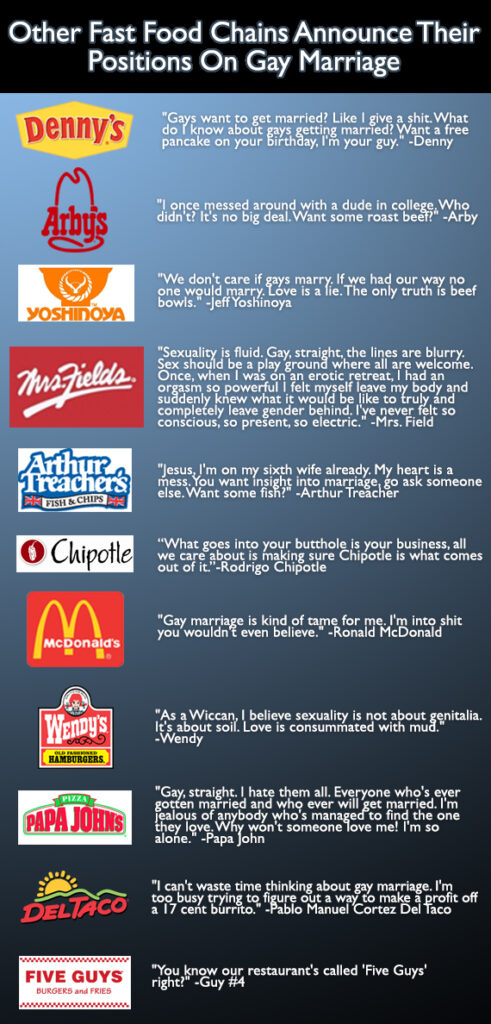
Announce Their Positions On Gay Marriage

The Gay Catholic Priests' Blog
On Monday bishops of the Episcopal Church in the United States – the 14th largest denomination in the country, with almost 2 million members – “overwhelmingly” approved a rite for blessing gay marriages, making it the first big U.S. church to say “yes” to gay marriage.
Speaking to Reuters, Ruth Meyers, a chair of the Episcopalians’ Subcommittee on Prayer Book, Liturgy and Church Music, said the Episcopal Church’s Chamber of Bishops agreed to the proposed blessing at a meeting in Indianapolis and its House of Deputies should formally approve it later this week.
“The decision would go into effect in December and make the Episcopal Church, an independent U.S.-based institution affiliated with global Anglicanism, the biggest U.S. church to allow a liturgy for same-sex marriages,” Reuters said.
Up until now, it had been the United Church of Christ, a mainstream Protestant denomination counting approximately 1 million members, which had done more than any other U.S. church to support same sex marriage voting in favour of it in 2005.
The new Episcopal same-sex liturgy is called “the Witnessing and Blessing of a Lifelong Covenant,” and would become the standard rite for same-sex marriage, Reuters reported.
In the past, it was bishops who showed the strongest opposition to such measures but the result of Monday’s vote showed a different attitude altogether, with 111 voting in favour and 41 against. Abstentions totalled 3.
The convention also approved inclusion of transgender people among those who should not be discriminated against, either for ordination or as lay leaders.
“Today the Episcopal Church affirmed the human dignity of a deeply stigmatized population that is far too often victim to discrimination, bullying and abuse,” the Reverend Lowell Grisham, a leader of the Chicago Consultation, a group that supports equality, said in a statement quoted by Reuters.
The Episcopal Church allowed gay priests 16 years ago and approved its first openly gay bishop 9 years ago.
Today, gay marriage is legal in six states and the District of Columbia and as Reuters reported, the legislatures of three states – New Jersey, Maryland and Washington State – approved gay marriage this year, although New Jersey Governor Chris Christie vetoed it. Governors in the other two states signed the legislation but there are attempts being made to block it through a referendum. Monday’s decision has nevertheless marked yet another victory for gay-rights advocates in the U.S., after President Barack Obama endorsed gay marriage in May.
Complete Article HERE!
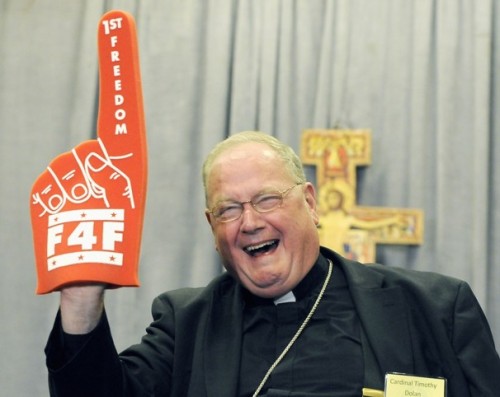
The “Fortnight for Freedom” was a flop.
This was supposed to be a game-changer — the U.S. Conference of Catholic Bishops’ big display of political might. But instead it exposed the bishops as inept campaigners and as generals without an army.
I thought they’d be better at this sort of thing. They had some formidable assets to work with. For weeks ahead of time, Fortnight events were publicized and promoted in every diocese and every parish across the country. And they had some serious money to work with thanks to deep-pocketed (anonymous) donors. They even got a big boost of support from their allies in the evangelical religious right.
But still, it flopped. Big time.
This two-week extravaganza was supposed to redefine the political conversation, but instead it went mostly unnoticed and unattended. It was supposed to show massive grassroots support for the bishops’ contention that allowing women to purchase comprehensive health insurance constitutes an intolerable threat to the religious liberty of employers who wish to prohibit that. But instead it showed, definitively, that there is no grassroots support for that strange argument.
The bishops declared themselves the grand marshals of what was to be a glorious parade, but no one showed up to march behind them and only a meager handful turned out to line the route as spectators.
It was pathetic, really. A bunch of nuns on a shoestring-budget bus tour drew more enthusiasm and more support for their polar-opposite message. For all the millions spent and all the weeks of elaborate, top-down fanfare, the Fortnight for Freedom came and went almost without notice.
“Oh, right, the bishops’ big rally, when is that again? Oh, it happened already? Oh.”
Yawn.
All that time and money invested and almost nothing to show for it.
Part of what we learned here, I think, is that if you’ve got a top-down, hierarchical mentality that regards listening to anyone else as beneath you, as an affront to your righteous authority, then you’re probably not well-suited to rallying grassroots support. When that arrogant mentality shapes your outlook, it seems, you’re probably not even capable of recognizing that you’ve utterly lost all grassroots support.
The bishops did their best to put a happy face on their embarrassing fortnight of failure. “Thousands rally in Washington,” one press release said. And that was true — “thousands” plural because two is a plural number. The largest Fortnight event drew about 4,000 — or, in other words, it was a bit smaller than the crowd at a Bowling Green Hot Rods game on Fireworks Night. (Yes, the Rays’ single-A farm team may outdraw the bishops despite a much-smaller PR budget, yet as far as I know the Hot Rods are not making any claims that this gives them the right to dictate national policy to the president.)
By the end of the fortnight, the affiliated Republican effort “Conscience Clause” had also collected 6,000 signatures for a petition in support of the bishops — or nearly half the number of signatures collected so far in the “Save Pan Am” campaign to get ABC to revive that failed show.
The Fortnight for Freedom was a failure. I suppose, though, that it did succeed in at least one way: providing a handle for plenty of insightful commentary on the bishops’ demands for religious privilege and their increasingly partisan political activism. A sampling of some of that commentary below the jump.
Jessica Coblentz: “Fortnight for Freedom: Whose Religious Liberty?”
In the reaction against Fortnight for Freedom, some are responding to the bishops on their own terms. If the campaign is about religious liberty, they ask, then whose liberty is at stake? The bishops present the Catholic exercise of religious liberty as the ability to reject the use of contraception, or at least the financing of insurance plans that cover contraceptive services. The irony, to those on the other side, is that a campaign meant to promote religious liberty actually denies the religious freedom of many Catholic women, who rely on their personal religious convictions to determine their stance on contraception and the mandate. Studies show that as many as 98 percent of sexually experienced American Catholic women over the age of 18 have used contraception. A recent PRRI/RNS poll reports that a majority of American Catholics do not see the contraception mandate as a threat to religious freedom, indicating that many hold a broader understanding of religious liberty than the bishops maintain. The debate surrounding the mandate, then, is not only about contraception and religious liberty. It is also about who gets to define religious liberty’s very meaning.
… Critics of the bishops’ current battle can call on this Catholic history of religious liberty and individual freedom. In their view, women’s choices are an issue of religious liberty — not merely a threat to it. Still, who defines religious liberty remains a matter of authority — and a highly gendered one at that. When the USCCB conveys that the rejection of contraception is the only religiously-motivated choice that warrants the protection of religious liberty among Catholics, they assert the message that only church leaders have the authority to determine what counts as religious behavior. This strips other Catholics of the legitimate authority to negotiate their tradition when determining their own religiously-motivated actions. What is more, so long as the all-male Catholic clergy solely possess the authority to identify what does and does not constitute a free, religiously-motivated choice worthy of legal protection, women have no official authority in Catholic religious liberty conversations whatsoever. As it stands, the religious decisions and actions of all Catholics other than clergy — be they for or against contraception and contraceptive coverage — are seemingly insignificant in “Catholic” concerns about religious liberty.
… The bishops, or anyone for that matter, need not theologically condone the contraceptive decisions of Catholic women in order to recognize them as exercises of free, religious choice. Yet the current rhetoric of the USCCB’s “Fortnight for Freedom” campaign does not. … If the bishops continue to exclude so many American Catholics from their representation of religious liberty — notably, the majority of Catholic women — the USCCB fails in its own stated aim to protect the religious liberty of all.
Katherine Stewart: “How Corrupt Catholics and Evangelicals Abuse Religious Freedom”
In the writings and speeches of Catholic bishops and evangelical leaders in recent months, “religious freedom” has come to mean something close to its opposite. It now stands for “religious privilege.” It is a coded way for them to state their demand that religious institutions should be allowed special powers that exempt them from the laws of the land.
… This is a war of conquest, designed to expand the power of religious institutions at the expense of the rest of society and the state. It is about carving out an even larger share of the special privileges and exemptions that are already made available only to organized religious institutions.
Such privileges are already substantial. Religions already receive hefty subsidies – by some estimates, as much as $71bn a year – through broad tax exemptions, deductions, and faith-based government programs. A “ministerial exemption” allows them to hire and fire people directly involved in religious activity without regard to anti-discrimination laws.
But they want more. And they are willing to turn the meaning of the word “persecution” on its head to get it.
Sally Rasmussen: “The Bishops on Religious Freedom: ‘We Get More Than You’”
The Catholic bishops have been talking a lot recently about the First Amendment. They’ve made the remarkable claim that their tradition is a source of First Amendment freedoms, but their interpretation of such freedom is that it should shield them from prosecution for collaborating in the sexual abuse of children, at the same time that they are doing their best to deny freedom of religion, speech, and assembly to American nuns. Nor do they believe in freedom of conscience for the Catholic Church which is the people of God – a Church that has thoughtfully concluded that contraception is morally acceptable.
Mark Silk: “Religious Freedom, Becket Style”
I can’t help suspecting that the bishops’ rage against the contraception mandate is actually displaced anger at losing their de facto power to decide the fate of sexually abusive priests.
The real lesson of the conviction of Msgr. William Lynn in Philadelphia last month and the impending trial of Bishop Robert Finn in Kansas City is that if church authorities don’t behave like secular executives when confronted with a subordinate suspected of abuse, then they too will be criminally prosecuted. Archbishop Becket would have considered that an assault on his religious freedom. No one in America can do so anymore, Fortnight or no Fortnight.
Complete Article HERE!
Melinda Gates talks to Joanna Moorhead about reconciling her Catholic faith with her work promoting family planning. Gates is in London to discuss promoting contraception in the developing world with UK government representatives. The Gates Foundation hopes to encourage donor pledges that will enable 120 million women to have access to contraceptives by 2020
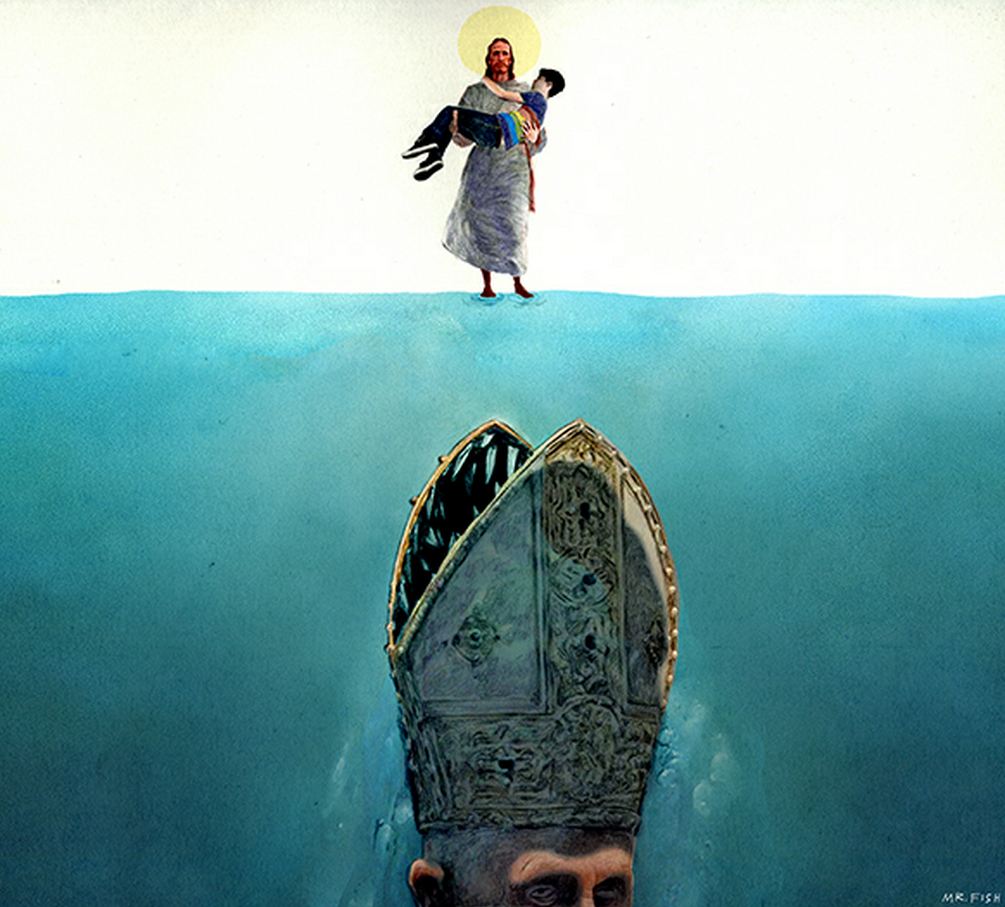
“Too many of my sisters and brothers in the gay community don’t seem to understand the power of religion,” White lamented. “They have been rejected by religion. They hate the idea of religion. Therefore, they’re not going to deal with religion, which is fatal, because religion is the heart of homophobia. Without religion there would be no homophobia. What other source of homophobia is there but six verses in the Bible? When Bible literalists preach that LGBT people are going to hell they become Christian terrorists. They use fear as their weapon, like all terrorists. They are seeking to deny our religious and civil rights. They threaten to turn our democracy into a fundamentalist theocracy. And if we don’t reverse the trend, there is the very real possibility that in the end we will all be governed according to their perverted version of biblical law.”
Gay activist and Christian pastor Mel White quoted in a post by Chris Hedges over at TruthDig titled, The War on Gays.
Thanks, Martina, for the heads up on this.
All children will likely get teased at some point while growing up, and sadly, there isn’t much that their parents can do about it. However, when a child has gay parents, it often opens the door to teasing that is much more targeted and intense, and that can prove difficult to manage. Learning how to handle teasing can help boost confidence and empower a child to seek help from a trusted adult.
If you’re a gay parent who is concerned that their child is getting teased, encourage your child to:
Many children who tease others do so because they are afraid of what they don’t understand, and to cover their lack of knowledge they tease rather than to admit that they are ignorant. Helping your child learn to deal with teasing can help him to grow stronger and more confident in who he is as an individual.
Complete Article HERE!
Are religious people more moved by compassion than those who described themselves as less religious or non-religious?
A group of scientists at the University of California, Berkeley set out to answer that question and what they found would surprise some: In three experiments, the social scientists found that the less religious were more generous when presented with situations that stimulated their compassion, which the scientists defined as “an emotion felt when people see the suffering of others which then motivates them to help, often at a personal risk or cost.”
Here’s how Berkeley sums up the study in its press release:
“The results challenge a widespread assumption that acts of generosity and charity are largely driven by feelings of empathy and compassion, researchers said. In the study, the link between compassion and generosity was found to be stronger for those who identified as being non-religious or less religious.
“‘Overall, we find that for less religious people, the strength of their emotional connection to another person is critical to whether they will help that person or not,’ said UC Berkeley social psychologist Robb Willer, a co-author of the study. ‘The more religious, on the other hand, may ground their generosity less in emotion, and more in other factors such as doctrine, a communal identity, or reputational concerns.’”
So how did scientists test this? First they looked at survey of 1,300 Americans. That showed that the non-religious were more motivated by emotion to be generous.
Next, they tested it in the lab. In one experiment Americans were shown a neutral video and a “heartrending one.” The participants were given “lab money,” which they could donate after they watched each video.
“The least religious participants appeared to be motivated by the emotionally charged video to give more of their money to a stranger,” the scientists found.
In another study participants were told that a participant before them had given a portion of their reward to them. The participant, scientists told them, were free to reward the person before them by giving them back a portion of the money, which had now doubled.
Those who reported feeling more compassionate and less religious, were also more generous in this experiment.
The findings are published in the latest edition of the journal Social Psychological and Personality Science.
Complete Article HERE!
The death penalty no longer applies to people who divorce or sleep with women during their periods, as described in the Bible. So why can’t attitudes on homosexuality change as well?
COMMENTARY
On St. Patrick’s Day I had the pleasure of speaking to about 350 Catholics who gathered together to attend a conference put on by New Ways Ministry, which is an effort to support the LGBT community in the Catholic Church. The women and men I spoke to included nuns and priests, children who had come out and parents who wanted to be supportive. Two female priests gave me special blessing and I left the meeting inspired by the devotion of those who attended.

New Ways Ministry has a critical mission, since changing the Church will help those who suffer from ill treatment not only here in the United States but around the world, where the Church has so much clout. The Church has millions of members in Africa and South America, where being gay or lesbian can lead to a death sentence.
Worse, the Church’s own teaching encourages bigotry and harm. Just last year, my father’s memorial, the Robert F. Kennedy Center for Justice and Human Rights, gave its human rights award to Frank Mugisha, a gay activist in Uganda whose good friend had just been brutally killed in his own home. American missionaries have encouraged the discrimination Mugisha suffers. Refuting their religious arguments is critical, and so is making a moral and religious case for gays. What we need is a transformation of hearts and minds, not merely a change of laws.
The Catholic Church’s attitude towards homosexuality is at odds with its tradition of tolerance and understanding. The actual practice of the Church is true to this tradition. What other institution separates men and women and encourages them to live together in monasteries and convents where they can develop deep relationships with those who share their kind of love?
The fight for the dignity of the LGBT community is a fight for the soul of today’s Church. Some conservatives see the hierarchy’s current, traditional teaching on sex as the Church’s defining position. They don’t really like to talk about, or even be reminded of, the Church’s teachings on immigration, or protection of the environment, or the greed that produces financial meltdowns, all of which they would find distastefully liberal.
For them there is only one issue — sex, or pelvic politics as some call it. The Pope himself pointed this out on in visit to Mexico, where he said that “not a few Catholics have a certain schizophrenia with regard to individual and public morality…. In public life they follow paths that don’t respond to the great values necessary for the foundation of a just society.”
If we wish to change the Church, we must first convey our views in language, images, and theology that reach people where they are. And secondly, we should make it clear that disagreement with the hierarchy is a critical part of our history.
The fact that so many Americans see themselves as religious, as God-loving church goers, means we have a better chance of reaching them if we use a language, a book, and symbols they understand. Polls find that 85 percent say that they believe in God and 50 percent claim that they go to church every Sunday. The fact that only 25 percent do just goes to show that you can’t trust everybody’s self-reporting.
In The Good Book: The Bible’s Place in Our Lives, the recently deceased Peter Gomes describes interviews with 400 people who had been jailed for hate crimes against gays. None felt remorse. They thought gays were the devil, so fighting them was cause for pride, not shame or regret. Laws are important, but the moral case can be even more compelling.
When my father visited South Africa in 1966, he spoke with students in Cape Town about apartheid. They defended the abhorrent practice by pointing to Biblical passages that suggested that discrimination was fine. In an effort to reach them, my father asked, “Suppose you die, and you go up to heaven, and you enter the pearly gates, and suppose, just suppose when you get there, you find that God is black.” Today we can ask, “Suppose God is gay.”
My father grasped, as did John Kennedy and Martin Luther King, that in America the leader who wishes to enlarge freedom’s sphere must appeal to an audience’s religious beliefs as well as to their understanding of American liberty. This is what I wrote about in my book, Failing America’s Faithful. While researching it, I gained many insights into the Church and its history of both prejudice and tolerance.
The Great Awakening of the 1740s gave people the idea that they could find God within themselves and need not trust preachers. As one perceptive British writer pointed out, if they don’t need rectors, soon they won’t need British rulers. Sure enough, once Americans got used to trusting themselves, they did rebel. Then the Second Great Awakening, in the 1850, instilled in Americans the idea that not only did the divine reside within them, it also resided in women and slaves. The Abolitionist movement grew from that religious revival, as did the suffragettes.
A few years ago, I read the Bible from Genesis to Revelations, and to me the biggest revelation was how misogynistic it was. That made me realize that the Catholic Church was on to something when it allowed only educated priests to read the Bible. My mother’s generation was prohibited from reading the Bible, and when I told my grandmother that my father used to read the Bible to us, she was shocked, “Catholics don’t read the Bible,” she said. The Church figured that people could take passages out of context and come to unwarranted conclusions. This changed after Vatican II and now Catholic parishes offer Bible study classes.
But those outrageous passages did not deter either the abolitionists or the suffragettes. They boldly rejected them as cultural detritus. Instead, they asserted that the primary message was that all people were made in God’s image. Thus we are born to be free.
Unfortunately, a century later, in the 1970s, feminists and gay rights activists did not adopt the same strategy and tactics. I think this happened because their movement grew out of the non-religious part of the civil rights movement. Recall that the civil rights movement was split between the followers of Reverend Martin Luther King on the one hand and Stokely Carmichael and the Black Panthers on the other. The latter group felt that religion was weak. Why turn the other cheek? Why not fight back? This secular strain also attracted many intellectuals who were, to put it bluntly, uncomfortable with religion.
Happily, that has now changed. Women have entered schools of theology and can now show that Jesus was one of the first great feminists. Mary Magdalene is no longer thought of as a prostitute but as the “apostle to the apostles.” Gays, though, are still excluded.
Progressive Christian and Jewish believers have accepted gay rights. Theologians now argue that verses in Leviticus that call for the killing of men who sleep with men apply only to a particular historical moment. The death penalty no longer applies to people who divorce, curse their parents, or sleep with women during their period — rules that are also in Leviticus.
Obviously, some people continue to read scripture simply to sustain their preexisting prejudice against homosexuality and homosexuals. But theologians now point out that the word “homosexual” didn’t even exist until the 19th century, and it wasn’t included in the Bible until 1946.
Choose your passage. King David talks about sleeping with his friend Nathan as “better than sleeping with a woman.” The Ten Commandments don’t mention homosexuality. Nor does Jesus. In fact, our Lord teaches us that love of God and love of our fellow human being are the two most important commandments. He doesn’t exclude the love that one man can have for another, or one woman for another.
The 2000-year-old passages favored by Church authorities don’t hold up as being anti-gay. Not only is the hierarchy — the Church’s cardinals and bishops — imposing its own interpretations, its views are harmful to many men and women. I would hope that the lens through which one reads scripture would be one of love and openness to others, not fear and anger and meanness.
Contrary to conservative propaganda, though, the Vatican is not immovable. It has a long history of changing position to follow new understandings of society and morality. Usury is no longer a sin. Women are no longer considered “the devil’s gateway.” Railroads are no longer cursed as the work of the devil, and teaching that there is such a doctrine as “freedom of conscience” does not merit censure, as it did for John Courtney Murray in the 1950s: In fact, Vatican II now recognizes “freedom of conscience.” Pope John Paul II apologized for the Church’s treatment of women and its persecution of Galileo. Sex between husband and a wife is no longer just for procreation but has value in itself.
That history can continue with its position on gays — and the laity has a critical role to play in pushing for these changes. As Cardinal John Henry Newman, the foremost 19th-century Catholic theologian asserted, bishops have at times “failed in their confession of the faith.” There can be instances of “misguidance, delusion, hallucination.” He said that the body of the faithful has the “instinct for truth.”
Already, I have witnessed that instinct for truth in the argument over contraception. Despite the hierarchy’s position, 98 percent of Catholic women in the United States use contraception. I believe that Human Vitae was the Holy Ghost’s way to teach us that we must use our conscience, and not lazily rely on the hierarchy when it is in error.
At this time, when the hierarchy does not want to recognize that we are all made in the image and likeness of God, and that the one of the two most critical commandments is to love one another, it is critical to assert that God loves the LGBT community equally. Sometimes the Church moves slowly, sometimes quickly. The point is to make sure the voices of dissent are not quiet and the Holy Spirit can be heard.
Complete Article HERE!
As part of a survey to understand why they have stopped attending Mass, a few hundred Catholics were asked what issues they would raise if they could speak to the bishop for five minutes.
The bishop would have gotten an earful.
Their reasons ranged from the personal (”the pastor who crowned himself king and looks down on all”) to the political (”eliminate the extreme conservative haranguing”) to the doctrinal (”don’t spend so much time on issues like homosexuality and birth control”).
In addition, they said, they didn’t like the church’s handling of the clergy sex abuse scandal and were upset that divorced and remarried Catholics are unwelcome at Mass.
The findings, based on responses to a survey in the Diocese of Trenton, N.J., are included in a report presented March 22 at the “Lapsed Catholics” conference at the Catholic University of America in Washington, D.C.
Conducted by Villanova University’s Center for the Study of Church Management, the survey, called “Empty Pews,” asked Catholics in the Trenton Diocese a series of questions about church doctrine and parish life to better understand why they are staying home.
While the study was restricted to one diocese, chances are the responses could come from just about anywhere in the U.S., where a 2007 report by the Pew Forum on Religion & Public Life found one-third of Americans were raised Catholic but one-third of those had left the church.
Or, as Villanova’s Charles Zech put it, “These are issues that affect the whole church.”
The responses can be divided into two categories, said Zech, who co-authored the study and is director of the Villanova center. In one category are “the things that can’t change but that we can do a better job explaining.” The other category, he said “are some things that aren’t difficult to fix.”
Zech and the Rev. William Byron, professor of business and society at St. Joseph’s University in Philadelphia, conducted the survey of 298 parishioners who have stopped attending Mass.
Almost two-thirds of the respondents were female, and the median age was 53, two facts that Zech finds troubling. “That’s a critical demographic. If we’re losing the 53-year-old women, we risk losing their children and their grandchildren,” he said.
About a quarter of the respondents said they still consider themselves Catholic despite not attending Mass. About half offered negative comments about their parish priests, whom they described as “arrogant,” ‘’distant” and “insensitive.”
“One respondent said, ‘Ask a question and you get a rule, you don’t get a “let’s sit down and talk about it” response,’” Zech said. “They feel no one is willing to explain things to them.”
Respondents also said they were troubled by the church’s views of gays, same-sex marriage, women priests and the handling of the sex abuse crisis.
Criticism of the sex scandal was predictable, Zech said. “That doesn’t surprise anybody. They did not manage that well, and they are still not managing it well,” Zech said. “It hasn’t gone away.”
The respondents also called for better homilies, better music and more accountability of the church staff.
Trenton Bishop David O’Connell, a former president of Catholic University, declined to be interviewed about the survey’s results, saying through a spokeswoman that he “needed to spend time with the findings and develop his own analysis of them.”
Though the project was undertaken to learn more about why church attendance continues to decline in the Trenton Diocese, it’s findings have broader implications, Zech said. “These are issues that affect the whole church,” he said.
Although it was an anonymous survey, about one in eight respondents said they welcomed a call from a church official and provided their names and contact information for that purpose. Many more indicated they were pleased to be asked for their input.
“The fact that they took the time to respond gives us a chance,” Zech said. “If some things change, or we do a better job of representing the church’s position, we might woo some of them back.”
Complete Article HERE!

COMMENTARY
By a revolting combination of con men and fanatics, the current primary race has become a demonstration that the Republican party does not deserve serious consideration for public office. Take the controversy over contraceptives. American bishops at first opposed having hospitals and schools connected with them pay employee health costs for contraceptives. But when the President backed off from that requirement, saying insurance companies can pay the costs, the bishops doubled down and said no one should have to pay for anything so evil as contraception. Some Republicans are using the bishops’ stupidity to hurt the supposed “moderate” candidate Mitt Romney, giving a temporary leg up to the faux naïf Rick Santorum; others are attacking Barack Obama as an “enemy of religion.”
Pusillanimous Catholics—Mark Shields and even, to a degree, the admirable E. J. Dionne—are saying that Catholics understandably resent an attack on “their” doctrine (even though they do not personally believe in it). Omnidirectional bad-faith arguments have clustered around what is falsely presented as a defense of “faith.” The layers of ignorance are equaled only by the willingness of people “of all faiths” to use them for their own purposes. Consider just some of the layers:
The Phony Religious Freedom Argument
The bishops’ opposition to contraception is not an argument for a “conscience exemption.” It is a way of imposing Catholic requirements on non-Catholics. This is religious dictatorship, not religious freedom.
Contraception is not even a religious matter. Nowhere in Scripture or the Creed is it forbidden. Catholic authorities themselves say it is a matter of “natural law,” over which natural reason is the arbiter—and natural reason, even for Catholics, has long rejected the idea that contraception is evil. More of that later; what matters here is that contraception is legal, ordinary, and accepted even by most Catholics. To say that others must accept what Catholics themselves do not is bad enough. To say that President Obama is “trying to destroy the Catholic Church” if he does not accept it is much, much worse.
To disagree with Catholic bishops is called “disrespectful,” an offense against religious freedom. That is why there is a kind of taboo against bringing up Romney’s Mormonism. But if Romney sincerely believed in polygamy on religious grounds, as his grandfather did, he would not even be considered for the presidency—any more than a sincere Christian Scientist, who rejects the use of medicine, would be voted for to handle public health care. Yet a man who believes that contraception is evil is an aberrant from the American norm, like the polygamist or the faith healer.
The Phony Contraception Argument
The opposition to contraception has, as I said, no scriptural basis. Pope Pius XI once said that it did, citing in his encyclical Casti Connubii (1930) the condemnation of Onan for “spilling his seed” rather than impregnating a woman (Genesis 38.9). But later popes had to back off from this claim, since everyone agrees now that Onan’s sin was not carrying out his duty to give his brother an heir (Deuteronomy 25.5-6). Then the “natural law” was fallen back on, saying that the natural purpose of sex is procreation, and any use of it for other purposes is “unnatural.” But a primary natural purpose does not of necessity exclude ancillary advantages. The purpose of eating is to sustain life, but that does not make all eating that is not necessary to subsistence “unnatural.” One can eat, beyond the bare minimum to exist, to express fellowship, as one can have sex, beyond the begetting of a child with each act, to express love.
The Roman authorities would not have fallen for such a silly argument but for a deep historical disrelish for sex itself. Early Fathers and medieval theologians considered sex unworthy when not actually sinful. That is why virgin saints and celibate priests were prized above married couples. Thomas Aquinas said that priests must not be married, since “those in holy orders handle the sacred vessels and the sacrament itself, and therefore it is proper (decens) that they preserve, by abstinences, a body undefiled (munditia corporalis) (Summa Theologiae, Part 3 Supplement, Question 53, article 3, Response). Marriage, you see, makes for defilement (immunditia). The ban on contraception is a hangover from the period when the body itself was considered unclean, as Peter Brown overwhelmingly proved in The Body and Society (1988).
The Phony “Church Teaches” Argument
Catholics who do not accept the phony argument over contraception are said to be “going against the teachings of their church.” That is nonsense. They are their church. The Second Vatican Council defines the church as “the people of God.” Thinking that the pope is the church is a relic of the days when a monarch was said to be his realm. The king was “Denmark.” Catholics have long realized that their own grasp of certain things, especially sex, has a validity that is lost on the celibate male hierarchy. This is particularly true where celibacy is concerned.
There was broad disagreement with Pius XI’s 1930 encyclical on the matter. Pope Paul VI set up a study group of loyal and devout Catholics, lay and clerical, to make recommendations. The group overwhelmingly voted to change the teaching of Pius XI. But cardinals in the Roman Curia convinced Paul that any change would suggest that the church’s teachings are not eternal (though Casti Connubii had not been declared infallible, by the papacy’s own standards).
When Paul reaffirmed the ban on birth control in Humanae Vitae (1968) there was massive rejection of it. Some left the church. Some just ignored it. Paradoxically, the document formed to convey the idea that papal teaching is inerrant just convinced most people that it can be loony. The priest-sociologist Andrew Greeley said that Humanae Vitae did more damage to the papacy than any of the so-called “liberal” movements in Catholicism. When Pius IX condemned democracy and modern science in his Syllabus of Errors (1864), the Catholic historian Lord Acton said that Catholics were too sensible to go crazy every time a pope does. The reaction to Humanae Vitae proves that.
The Phony “Undying Principle” Argument
Rick Santorum is a nice smiley fanatic. He does not believe in evolution or global warming or women in the workplace. He equates gay sex with bestiality (Rick “Man on Dog” Santorum). He equates contraception with the guillotine. Only a brain-dead party could think him a worthy presidential candidate. Yet he is praised by television pundits, night and day, for being “sincere” and “standing by what he believes.” He is the principled alternative to the evil Moderation of Mitt Romney and the evil Evil of Newt Gingrich. He is presented as a model Catholic. Torquemada was, in that sense, a model Catholic. Messrs. Boehner and McConnell call him a martyr to religious freedom. A young priest I saw on television, modeling himself on his hero Santorum, said, “I would rather die than give up my church’s principles.” What we are seeing is not a defense of undying principle but a stampede toward a temporarily exploitable lunacy. Acton to the rescue!
Complete Article HERE!