Tom Rastrelli: Priests who lie; the dilemma of sexual orientation and the priesthood

People don’t expect their priests and bishops to lie, but as Michelangelo Signorile’s recent post illustrated, clerics do lie. Some even make a virtue of it. I know this from experience, for I was ordained a Catholic priest on a lie.

In spring 2002 I walked with my spiritual director along the blacktop road encircling the seminary. He’d been my confessor and guide for two years, helping me discern God’s presence in all aspects of my life, intimate and mundane. Over our heads, a canopy of newborn leaves rustled in a sunny breeze, a welcome relief from the bitter fog that had engulfed the church and my vocational surety.

For the previous two months an unprecedented number of bishops and priests, starting with Cardinal Law of Boston, had fallen from grace for participation in the sexual abuse of children and the ensuing cover-up. Their duplicity was palpable in my knotted back and abdomen. In a few months I’d be ordained a priest. I didn’t want to do so on a lie.

“I’m coming out of the closet,” I said.

My spiritual director loosened his clerical collar and lit a cigarette. “Where’s this coming from?” he asked. A couple of chattering wrens whooshed past.

I backtracked through six years of seminary formation. At events I had hobnobbed with supposedly holy men, some of whom had been harboring pedophiles. A few had done the deed themselves. By shaking their hands, mine were dirty. I knew the ecclesiology, how the bishops’ authority stemmed from a direct line to Jesus, but they were still criminals. Who were they to declare homosexuals “intrinsically depraved”?

When I’d applied for seminary, the director of seminarians — the priest who’d recruited me — explained that orientation didn’t matter, only celibacy. But on my intake interviews he’d told me to answer “yes” when the archdiocesan psychologist asked if I was attracted to women, and “no” when he asked if I was attracted to men. It was for the greater good, he said. Frightened of being cast out and ashamed of my true nature, I had lied as instructed.

In light of the sexual abuse scandal, lying about my orientation was no longer acceptable. I thought of what a gay friend who’d left seminary had said. His words became my own: “I don’t know if I can separate my private and public selves. Isn’t integration the goal of spiritual direction?”

“Of course it is,” my spiritual director said, more gravelly than usual. He stopped and turned to me. A tree cast a web of shadows over his face. His strawberry nose grew flushed, as he gestured with his hands. “Here’s the thing, Rastrelli. You have to ask yourself: Am I going to be a gay priest, or a priest” — he rolled his fingers and cigarette through the air like a barrel — “who happens to be gay?”

“What’s the difference?” I turned my head to inhale, trying to avoid his secondhand smoke. “Either way I’m gay. It’s a part of me.”

“But are you gay first, and then a priest? Or a priest first, and then gay?” He smiled, satisfied with the distinction.

“Both/and.” I’d hit him with what he’d taught me in class. “Both/and” was the paradoxical answer for every ultimate question in Catholic theology: Scripture or tradition? Faith or works? Is Jesus divine or human? Are we sinful or good? is faith a solo or communal experience?

“Touché,” he said. We walked. He sucked his cigarette. “You’re a smart guy, Rastrelli. Give it some thought.”

I kicked a pebble onto the grass. “I have. I don’t want to lie about my sexuality.”

“It’s not lying if those asking don’t have a right to the information.”

He hadn’t even flinched. I wanted to shake the nicotine from his bones, to scream, “It was that kind of thinking that landed the bishops in the papers!” Still, part of me wanted him to be right. Silence was simpler, easier, and maybe my need to come out was just pride at work. My promise of obedience demanded that I surrender my ego. My vocation was about God, not my orientation. But couldn’t we priests be honest with one another? I had to try.

“Gay Catholics don’t have positive role models,” I said. “I don’t know of a single gay priest that’s healthy. Do you?” I stopped. He kept walking. This was as close as I’d ever come to asking him if he was gay. I suspected he was. He’d lived with another priest for decades. They vacationed and picked out carpeting together. They spoke about their cat as if she were their child. Even if he and his housemate weren’t having sex, they were a couple. I stepped in stride with him. “How am I supposed to be an integrated gay priest when I have no one to look up to? How does celibacy actually work?” I stopped again. “I’m asking you.”

He turned to me. His face became whiter than a funeral pall. “I’m sorry, Rastrelli, but that’s not a conversation I’m comfortable having with a student.”

He resumed his pace. I followed silently.

The breeze picked up. The undulating trees sounded like the ocean breaking on the shore. I choked back the urge to ask, “Are you gay?” I felt like a sinking ship in a fleet that had wandered into a minefield. After laying the mines himself, the fleet commander had ordered radio silence.

I didn’t want to drown alone. I didn’t want to hear him lie. I wanted the truth, but the truth was dangerous. Were I to come out amid sexual-abuse headlines, homophobic Catholics wrongly blaming gay priests for the scandal would demand my dismissal.

My spiritual director was right. Who were they to judge, to put my orientation before my vocation? They had no right to that knowledge. It was safer to be a priest who happened to be gay. Perhaps it was God’s will. The fear accompanying us back to the seminary told me so.

That day, I learned the unspoken rule passed down through generations of priests: the doctrine of justification for lying by clergy. I went on to be ordained a priest. I preached that “the truth will set you free” while living in silence and shame. After a long journey and much pain, I came out. I left the priesthood, finally refusing to live the lies that I’d been taught to venerate.

Complete Article HERE!

‘We’re not supposed to touch,’ said Woodburn priest accused of sex abuse

The ordination of Rev. Angel Perez in 2002 was significant for two reasons: He was the rare Mexico native among priests in Oregon and, in a year when the Catholic Church sex abuse scandals were making national news, he was the rare priest ordained period in the state.

A decade ago, Oregonian reporter Shelby Oppel wrote a profile of Perez that described his ascent from a seminary student in Mexico to the archdiocese in Portland. The piece, which follows in its entirety, was published on the front page on Aug. 5, 2002.

On Monday, Perez, now the parish priest at Saint Luke Catholic Church in Woodburn, was arrested after police responded to a complaint at about 1:30 a.m. Monday alleging inappropriate contact between the priest and a 12-year-old boy.

He faces accusations of sexual abuse, use of a child in a display of sexually explicit conduct and furnishing alcohol to a minor. Perez, 46, was booked into Marion County Jail Monday evening and remains held without bail. He is scheduled to be arraigned at 3 p.m. in Marion County Circuit Court, according to the jail.

Perez is only the second priest to face criminal charges in Oregon since 1983, when the Rev. Thomas Laughlin was convicted of molesting two boys in Multnomah County.

Complete Article HERE!

Belgian bishop faces new abuse allegations
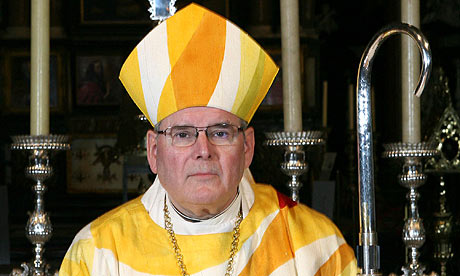
A Belgian lawyer said on Monday he had launched an inquiry into a new case of alleged sexual abuse by the former bishop of Bruges, Roger Vangheluwe, who has already admitted to having abused his under-age nephews.

“The present case concerns sexual abuse in the 1990s,” at a care home in Loker, in western Belgium near the French border, the lawyer, Walter Van Steenbrugge, said.

He said he had handed the allegations to a court in Brussels and lodged an inquiry with it. It was up to the court to decide whether the statute of limitations ruled out a prosecution, and if not, whether or not to prosecute the bishop, he added.

Vangheluwe, who was bishop of Bruges from 1984 to 2010, is the highest-ranking member of the Belgian Catholic Church to be involved in a child abuse scandal which resulted in 475 complaints of molestation by priests.

Vangheluwe admitted in 2010 that he had abused one of his nephews during the 1980s, when the nephew was a child.

That case was beyond the statute of limitations, but he was forced to resign as bishop and left Belgium under Vatican orders.

He caused outrage in 2011 when he told a Belgian TV station that he had also abused a second nephew but that he did not consider himself a paedophile.

Complete Article HERE!

Pope’s ex-butler Paolo Gabriele to stand trial

The former butler to Pope Benedict XVI will stand trial for stealing confidential papers and leaking them to the press, a magistrate has ruled.

Paolo Gabriele was arrested in May after police found confidential documents at his Vatican flat.

He has been charged with aggravated theft, including stealing a 100,000-euro (£78,000) cheque, while a computer analyst faces complicity charges.

The Vatican says it will continue to investigate the leaks.

Mr Gabriele admitted he was the source of leaked letters published in a controversial book by an Italian investigative journalist in May.

The bestseller, entitled His Holiness, revealed private correspondence between the Pope and his personal secretary discussing corruption and malpractice among Vatican administrators.

The Vatican called the book “criminal” and vowed to take legal action against the author, publisher, and whoever leaked the documents.

‘Evil everywhere’

Mr Gabriele told investigators he acted because he saw “evil and corruption everywhere in the church” while the pope was “not sufficiently informed”.

As the Pope’s butler and personal assistant, Mr Gabriele was one of a select few lay people with access to the papal apartments.

If convicted, he faces up to six years in prison.

The 46-year-old has been living under house arrest at his family’s flat in Vatican City, where police discovered a stash of confidential correspondence taken from the Pope’s Secretariat of State.

As the Vatican has no jail, Mr Gabriele would probably serve his sentence in an Italian prison under an agreement between Italy and the Vatican, Italian media reported.
The Pop’s butler Paolo Gabriele sits in the Popemobile on 18 April 2012 Mr Gabriele had worked as the Pope’s personal valet since 2006

The Holy See also accuses Vatican employee Claudio Sciarpelletti, a computer analyst and programmer, of acting as Mr Gabriele’s accomplice.

He has been charged with aiding and abetting a crime.

The trial is not expected to start until October at the earliest, court officials said.
Scapegoat theory

Vatican spokesman Federico Lombardi said the Pope, as the sovereign head of Vatican City, could intervene at any time to stop the trial or pardon Mr Gabriele.

The BBC’s David Willey, in Rome, says some Vatican observers believe Mr Gabriele may be the scapegoat for a wider conspiracy to smear certain of the Pope’s top aides.

The highly sensitive media leaks, dubbed “Vatileaks”, have been an evident embarrassment to the Pope, prompting the rare investigation, our correspondent says.

The scandal has dominated the columns of Italian newspapers, filling TV programmes and magazines.

The controversy began in January, when investigative journalist Gianluigi Nuzzi published letters from a former top Vatican administrator begging the Pope not to transfer him for having exposed alleged corruption.

Other leaked documents concerned “poison pen” memos criticising Cardinal Tarcisio Bertone, the pope’s number two, and the reporting of suspicious payments by the Vatican Bank.

Complete Article HERE!

Bishop Patricia Fresen on Excommunication to Ordination

Imprisoned for breaking apartheid law, excommunicated for breaking Vatican law, Bishop Patricia Fresen looks more sweet grandma than warrior ​— ​especially carrying the stuffed black sheep she presents with a smile: “We’re the black sheep of the church,” she said.

She’s no stranger to working the outskirts.

Raised “a proper white South African,” Fresen was stunned upon entering her convent after matriculation (and years of segregation), greeted by 55 women ​— ​15 of them black. “I didn’t know it would be racially mixed,” she says now. “It never occurred to me. But I became colorblind.”

That journey would prove significant. After university, Fresen ​— ​in Santa Barbara last week to teach a workshop at La Casa de Maria ​—  worked in the city of Welkom as principal of a school for whites. But by the 1970s, Fresen remembered she and her fellow Dominicans began thinking, “Something’s wrong; we can’t go on like this.”

Apartheid was law by then, but a debate — ​that would prove a theme of Fresen’s life ​— ​ensued. On one side were those who said they couldn’t change apartheid: “The law must change first,” Fresen recounted. She said the others believed, “We mustn’t follow an unjust law; we must follow our conscience.” Their bishop, Denis Hurley, agreed with the latter group. It was risky and illegal, but he believed breaking the law was the only way it would change.

Essentially ignored by the police, they had some wiggle room to plot. Bishop Hurley challenged the principals to bring black students into their schools. They spent a year preparing ​— ​ensuring white students’ families were comfortable, reaching out to black families, teaching black children English ​— ​all while keeping it out of the papers to hold trouble at bay, relying instead on the African drum to spread the word.

On the first day of school, Fresen was overcome watching the children ​— ​black, white, all in the same uniform ​— ​streaming in. But before the goosebumps could dissolve, the hairs on the back of her neck stood up: She heard the stomping of police boots approaching her office. They gave her a week to get in line.

One week later, they took her to prison. Not one child was sent away; today the school is flourishing.

Years later, after receiving her doctorate in theology in Rome, Fresen began teaching seminary ​— ​teaching men to be priests ​— ​in Pretoria. And a longing to be a Catholic priest herself began to nag. She shushed it as best she could, telling herself, “Don’t be stupid.”

In 2002, while teaching at Johannesburg’s Catholic university, she heard about the Danube Seven ​— ​seven women who were ordained Catholic priests on Germany’s Danube river. Two months later, fate intervened: Fresen was sent to Germany for a weeklong course. She spent a day with two of those women; they asked if she felt called to the priesthood. She said yes. They rendezvoused in Barcelona on August 7, 2003 (nine years to the day of our interview); Fresen was ordained.

And then, all hell broke loose. Her parish phoned the Vatican; the cardinal ordered her to recant. Or, he said, leave.

Heartbroken and staggered, she left. She lost her job, her congregation, her family, and moved to Germany.

Since then, she’s found a home, a community. She’s been ordained bishop (by proper apostolic succession ​— ​which means sympathetic male bishops are ordaining women, at great personal risk), ordains women, performs sacraments, and leads workshops.

She’s also been excommunicated. While in St. Louis performing an ordination (in a borrowed sacred space where these clandestine events take place: this time a Jewish synagogue), Cardinal Raymond Burke sent a cadre of “spies,” with cameras. (He followed up, excommunicating any identifiable participants.) Someone handed Fresen an envelope (she thought it might be a check): inside, a summons. She ignored it. Three weeks later, the mail carrier delivered an official decree of excommunication, “with my name beautifully written,” she says, eyes shining.

Burke was promoted.

As for the big question ​— ​why stay? ​— ​Fresen says she believes there are two churches: the hierarchy and the people. She believes the people, the ones who want reform ​— ​the separation of celibacy and priesthood, the ordination of women ​— ​are reaching a critical mass. And this: “If I left, nothing would change. The hierarchy would take no more notice of us. We can only make change if we stay, so we are not going away.”

Complete Article HERE!

Rainbow Sash Movement challenges San Francisco New Archbishop on Bigotry

Press Release

Rainbow Sash Movement challenges San Francisco New Archbishop on Bigotry

Bishop Cordileone has been appointed the next Archbishop elect of San Francisco. The sad situation at Most Holy Redeemer parish only emphasizes how deeply homophobia is ingrained in the culture of the Church. The Cathedral of Saint Mary of the Assumption will be the stage for all the world to see how the Church celebrates in a public fashion this culture of homophobia on October 4, 2012. The Archbishop’s instillation will be used as another launching pad to promote hate directed at the San Francisco LGBT Community,the national LGBT Community and women. The sad reality about this appointment is how far you can get in the church by promoting a closet mentality and hate of women. Integrity will apparently have no place at Bishop Cordileone’s Cathedral Eucharistic table.

People of good will and reason will understand this liturgical service for what it is, and will respond appropriately and non violently. The Rainbow Sash Movement (LGBT Catholics) is inviting San Francisco’s Drag Community, and the Catholic women’s community to stand with us both outside and inside the Cathedral as we witness this betrayal of the Church’s Social Justice Ministry at the installation ceremony at the Cathedral. The dignity of the human person apparently has more to do the with clothing you wear, the medication you use for family planning, and what gender you are than your relationship with God.

As we approach the 50th anniversary of Vatican II the Cathedral clergy and staff should hang their heads in shame over the part they are playing in the demise of Catholic Social Justice. Because justice will not flow from this installation of bigotry at the Cathedral it will not be a valid liturgy, and therefore will not be bound by the norms that guide the liturgical celebration. We will come to witness this abuse of Christ love for all people.

Contact Person:

Bill O’Connor
Rainbow Sash Movement

The Pope drops Catholic ban on condoms in historic shift

I wrote about this very thing in Part 4 of my five-part series on Catholic Moral Theology. Look for it —> Seismic Shift.

The Pope has signalled a historic shift in the position of the Roman Catholic Church by saying condoms can be morally justified.

After decades of fierce opposition to the use of all contraception, the Pontiff has ended the Church’s absolute ban on the use of condoms.

He said it was acceptable to use a prophylactic when the sole intention was to “reduce the risk of infection” from Aids.

While he restated the Catholic Church’s staunch objections to contraception because it believes that it interferes with the creation of life, he argued that using a condom to preserve life and avoid death could be a responsible act – even outside marriage.

Asked whether “the Catholic Church is not fundamentally against the use of condoms,” he replied: “It of course does not see it as a real and moral solution. In certain cases, where the intention is to reduce the risk of infection, it can nevertheless be a first step on the way to another, more humane sexuality.”

He stressed that abstinence was the best policy in fighting the disease but in some circumstances it was better for a condom to be used if it protected human life.

“There may be justified individual cases, for example when a male prostitute uses a condom, where this can be … a first bit of responsibility, to redevelop the understanding that not everything is permitted and that one may not do everything one wishes.

“But it is not the proper way to deal with the horror of HIV infection.”

The announcement is in a book to be published by the Vatican this week based on the first face-to-face interview given by a pope.

In the interview, he admits he was stunned by the sex abuse scandal that has engulfed the Catholic Church and raises the possibility of the circumstances under which he would consider resigning. The 83-year-old Pontiff says in passages published exclusively in The Sunday Telegraph today that he is aware his “forces are diminishing”.

However, he appears determined to fight for the place of faith in the public domain.

His language in attacking the use of recreational drugs in the West and its impact on the rest of the world is particularly striking.

He describes drug trafficking as an “evil monster” that stems from the “boredom and the false freedom of the Western world”. Most significant, however, are his comments on condoms, which represent the first official relaxation in the Church’s attitude on the issue after rising calls for the Vatican to adopt a more practical approach to stopping the spread of HIV.

The Pope’s ruling is aimed specifically at stopping people infecting their partners, particularly in Africa where the disease is most prevalent.

However, it will inevitably be seized upon by liberal Catholics in Britain who oppose the Church’s stance against contraception.

High profile Catholics such as Cherie Blair have stated publicly that they use birth control.

The Pope’s comments are surprising because he caused controversy last year by suggesting that condom use could actually worsen the problem of Aids in Africa.

He described the epidemic in the continent as “a tragedy that cannot be overcome by money alone, that cannot be overcome through the distribution of condoms, which even aggravates the problems”.

The Vatican amended an official version of the remarks to indicate that he said merely that condoms “risk” aggravating the problem.

However, there have been growing calls for the Church to clarify its position.

Theologians suggest that condoms are not a contraceptive if they are intended to prevent death rather than avoid life.

The Pope’s comments in the book, Light of the World, are likely to be welcomed by Catholic leaders in the West who have struggled to explain its current teaching.

Asked last year whether a married Catholic couple should use condoms where one of them had Aids, Archbishop Vincent Nichols, head of the Church in England and Wales, disclosed the confusion over the issue. “Obviously that’s a sensitive point and obviously there are different views on that,” he said.

Hardline Catholics are likely to be surprised and dismayed by the Pope’s comments as they argue that condoms can be used only as contraceptives.

There has been great anticipation before the book’s release, heightened by its author, Peter Seewald, who said in a teasing comment that it could be “a big sensation”.

“It is the first time that a Pope gives an account of himself in this form,” he said.
“It is the first personal interview with a pope in the Church’s history.”

The Pope gives his most personal account of the distress caused to him by the clerical sex abuse scandal, with particular reference to Germany and Ireland.

He says: “It was really almost like the crater of a volcano, out of which suddenly a tremendous cloud of filth came, darkening and soiling everything, so that above all the priesthood suddenly seemed to be a place of shame and every priest was under the suspicion of being one like that too.” He did not consider resigning over the crisis but does raise the possibility of a pope resigning if he were to lose his mental capacities.

“If a Pope clearly realises that he is no longer phys-ically, psychologically, and spiritually capable of handling the duties of his office, then he has a right and, under some circumstances, also an obligation to resign.” He tells of the last time he saw Pope John Paul II, his predecessor; talks of his reluctance to be Pontiff; and speaks of his increasing frailty.

“I had been so sure that this office was not my calling, but that God would now grant me some peace and quiet after strenuous years,” he says. While the Pope stresses the importance of dialogue with Islam, he nevertheless says the religion needs to “clarify … its relation to violence” and suggests it can be intolerant.

The Pontiff is highly critical of the “craving for happiness” in the West.

“I believe we do not always have an adequate idea of the power of this serpent of drug trafficking and consumption that spans the globe,” he says.

“It destroys youth, it destroys families, it leads to violence and endangers the future of entire nations.

“This, too, is one of the terrible responsibilities of the West: that it uses drugs and that it thereby creates countries that have to supply it, which in the end exhausts and destroys them.”

He continues: “A craving for happiness has developed that cannot content itself with things as they are.”

Talking about sex tourism, he says: “The destructive processes at work in that are extraordinary and are born from the arrogance and the boredom and the false freedom of the Western world.”

Complete Article HERE!

Drag Queens Prohibited at Most Holy Redeemer Parish

Nice goin’ (Archbishop) Sal; piss of the drag queens first thing out the gate.

A local gay recovery group will not be holding its annual fall fundraiser in the social hall of the Castro neighborhood’s Most Holy Redeemer Catholic Church after officials said that no drag queens would be allowed.

For the past couple of years the Castro Country Club has held its event in the church’s social hall and had drag queens as entertainment.

As a statement issued by the country club’s board of directors explained, the new no-drag-queen policy at the church is simply unacceptable.

“The Castro Country Club had planned to hold our third annual Harvest Feast on October 20, 2012, at Most Holy Redeemer Church, where we have held this and other events in the past,” the directors said in a statement.

But that changed when the club was notified by the church last week that they would not be able to hold the dinner if any drag queens were part of the program, the board said.

“In previous years, we have had Ivy Drip and Heklina, both well-known entertainers and community fundraisers, serve as emcees of the event, and we felt we could not in good conscience abide by the church’s new policy,” the board said.

“It is our organization’s policy to be inclusive and welcoming to all. Drag queens are no exception. We are currently seeking an alternative venue for the Harvest Feast, which provides an important source of revenue for our annual budget,” the board added.

Individual members of the country club declined to comment and referred to the board’s statement.

Most Holy Redeemer’s new pastor, the Reverend Brian Costello, confirmed over telephone on Monday, August 6, that drag queen performers and emcees are no longer permitted to participate in events at the church.

Costello said that during a telephone conversation with a Castro Country Club representative, when the topic of drag queens came up, he told the person, “That is not going to work under the present circumstances.”

“I said work with me. You can still have the dinner. You can have a regular emcee, but not drag queens on church property,” Costello said.

New leadership
It seems the directive is the result of several factors.

“I am the new pastor,” Costello added. “There is a new archbishop. The archdiocese told me straight out, ‘No drag queens.’”

The change of policy at Most Holy Redeemer was greeted with charges of discrimination, homophobia, and calls for compromise, even reconciliation.

“It’s really ridiculous and discriminatory,” said Zachary Davenport in a phone interview. “I mean it’s like, who’s next?”

Most Holy Redeemer Catholic Church in the Castro has banned drag queens, forcing the Castro Country Club to find a new venue for its fall fundraiser.
(Photo: Rick Gerharter)
The drag queen ban is personal for Davenport, who, in drag as Laybelline has served as emcee for a variety of sobriety-related nonprofit events held at Most Holy Redeemer.

“What constitutes drag?” he said. “If we want to get funny, let’s talk about the priests. Hello.”

Davenport also pointed to a nuanced landscape of gender identity and expression, which the new policy at Most Holy Redeemer seemingly blocks. “There are members of our community who express their gender all the time, and are not necessarily performing, but would say, ‘Yes, I am in drag,’” he said.

“Yes, I realize [Most Holy Redeemer] is a church. But it is in the Castro,” said Davenport. If, “the new archbishop is wanting to do away with drag queens and the gays,” then “look where you are. [The neighborhood] has a history of 30 to 40 years of being a safe place.”

A California native from Watsonville, Davenport, 28, who is not Catholic, added, “I know gay people who go to Most Holy Redeemer and love the church.”

Dignity San Francisco offered its take on the new policy at Most Holy Redeemer.

“This is an unfortunate development between Most Holy Redeemer and the Castro County Club,” said Ernest L. Camisa, treasurer of the Dignity/SF chapter, speaking for the organization by e-mail and over the telephone.

“It looks like the Archdiocese of San Francisco wants to protect its image by not condoning cross-dressers. By doing so they show that they care more for their image than they do for gay people trying to overcome alcohol addiction. Here the church looks like it values its own image more than it does human life. This is not Christian, but callous,” Camisa said.

A couple of Most Holy Redeemer parishioners declined to comment. No one from Castro Country Club was willing to speak on the record.

Reached by phone, George Wesolek, department head for communications and public policy for the archdiocese, said he was not in the policy conversation “loop.” Nonetheless, Wesolek acknowledged, the situation is “difficult pastorally,” particularly in “very divided and fractious church.”

Others weigh in
Meanwhile, across the country, the new no-drag queen policy has struck a chord among gay Catholic activists and those in ministry.

“I think this is a very difficult and complex time for not only the pastor and the people of Holy Redeemer parish, but also for members of the drag community. All three groups are an example of ordinary people being called to do some extraordinary things for their neighbors. The pastor and parish of Most Holy Redeemer have to be very careful not to throw out the baby with the water in the name of homophobia. Jesus, not homophobia, should guide us in this matter,” said Joe Murray, a founder of the Chicago-based the pro-LGBT Catholic Rainbow Sash Movement.

The Rainbow Sash Movement, stateside and abroad, advocates reception of Eucharist by visibly gay persons during Mass. The movement is best known for donning rainbow sashes on Pentecost and approaching the altar for communion during Mass that day.

At the same time, New Ways Ministry Executive Director Francis De Bernardo offered his assessment via e-mail correspondence.

“Drag is a historically-based, time-honored entertainment tradition that has existed, at least, since classical times,” he said.

“Canceling this program without any explanation or substantial reason is simply caving into fear of reprisals from higher authorities. If the [Most Holy Redeemer] community has supported this event for years, there has obviously been a relationship that has developed between the sponsoring organization and the parish, and it would be great if the two groups could work together to find some resolution. Reconciliation is what any and every parish should be about. If the parish does not offer a substantial intervening reason, we can only assume that other forces have had influence,” said DeBernardo.

Located just outside Washington, D.C., New Ways is a pro-gay Catholic ministry of education, healing, and reconciliation for LGBT Catholics, their families, friends, and the wider church.

For his part, Costello said the Castro Country Club event would have been in its third year at Most Holy Redeemer.

“It’s not a 20- to 25-year relationship,” he said.

Nonetheless, Costello lamented the course of events.

“I am big on compromising,” he said. But “[Castro Country Club] would not work with me. It was all or nothing. And they got nothing.”

Costello also said that with respect to drag queens, “We have had bad experiences, not only in church, but also the [social] hall.”

Still, “I feel bad because [Castro Country Club] do[es] good work in the community,” he said.

While Costello did not elaborate on any social hall “bad experience,” one church incident nearly five years ago caused a media stir.

During Sunday Mass on Sunday, October 7, 2007, Archbishop George Niederauer gave communion to two members of the activist group and drag troupe Sisters of Perpetual Indulgence, an indecent that angered, hurt, and even horrified some conservative Catholics, as well as it grabbed local and national headlines.

Called to task locally by the California Catholic Daily and a “90 years young” priest, the Reverend John Malloy, on A Shepherd’s Voice blog, Niederauer apologized for giving communion to gays dressed as nuns.

Attempts to reach the Sisters for comment on the recent change of policy at Most Holy Redeemer were unsuccessful.

Meanwhile, as recent as April 29, in a Shepherd’s Voice post Malloy blasted the “gay parish” for hosting an April 14 “drag show” to benefit the Castro Country Club, “a substance abuse treatment organization.”

“Hosting a drag show at [Most Holy Redeemer] is the equivalent of sending a case of wine to Castro Country Club,” wrote Malloy. “It is beyond irresponsible for the Archdiocese of San Francisco to allow it.”

And while local conservative bloggers and orthodox Catholic activists may well exacerbate tensions at Most Holy Redeemer, Rainbow Sash Movement’s Murray noted, “The appointment of Archbishop-elect [Salvatore] Cordileone has brought this matter to a head.”

And yet, said Murray, “Let’s be very clear homophobia in the church existed prior to this event.”

He went on to fault the teaching of the Catholic Church, the Catechism, “for saying on the one hand that homosexuals are to be welcomed and every form of unjust discrimination is to be condemned, while saying at the same time saying we are morally disordered for our love.”

“Either gay and lesbian people are welcome at Most Holy Redeemer or they are not. It’s that simple. If the tradition of Most Holy Redeemer is to allow for drag queens to raise money for charity, then to fault those who are raising the money in the name of homophobia, I think, speaks volumes to what type of ministry is going on at Most Holy Redeemer; and that deeply disturbs me. If that is the case, I like the parishioners of Most Holy Redeemer have been misled,” said Murray.

Complete Article HERE!

Monsignor Is Caught in a Lie as Diocese Backs Out of Selling Property to a Gay Couple

–Francis DeBernardo, New Ways Ministry

The following story is a cautionary tale about how far some Catholic officials will go to dissociate themselves from marriage equality. It’s also a cautionary tale about lying and diligently checking to whom you may be forwarding an email.

Dianne Williamson, a columnist for Massachusetts’ Worcester Telegram, reports that when a gay couple offered to buy a mansion for sale from the Diocese of Worcester, they were rejected as buyers. A mistakenly forwarded email to the couple reveals that the diocese was concerned that the new owners might use the building to host gay weddings. Moreover, a diocesan official has been caught in a lie to the newspaper about why the diocese refused the sale.

Williamson’s column begins:

“It’s bad enough that the Catholic Church discriminates against gay people. But it’s poor form — and possibly illegal — to document the bigotry and then mistakenly email it to the victims.

“This embarrassing etiquette lapse occurred as James Fairbanks and Alain Beret were pursuing the purchase of Oakhurst, a 44-bedroom mansion in Northbridge, owned by the Diocese of Worcester. Fairbanks and Beret had searched for two years for the perfect renovation project, and hoped to turn the run-down estate into a banquet facility. Previously, the pair had transformed mansions in Vermont and Barre into similar businesses.”

The diocese originally seemed very happy to sell the building, going so far as to suggest a lower bid because of renovations that had been done. But after they rejected the deal which was in progress, Williamson called a diocesan official to get an explanation:

“This week, Monsignor Thomas Sullivan, who oversees the sale of diocesan property, told me the deal fell through because of financing.

“ ‘They couldn’t come up with the money,’ he said. ‘This happens all the time.’

“I told him the potential buyers believed that he rejected the deal because of their sexual orientation, or the prospect of gay marriages someday being performed at Oakhurst. Was that an issue?

“ ‘No, it wasn’t,’ Msgr. Sullivan said. ‘It was an issue of them not having the financing. That was all.’

“As noted, if you’re going to discriminate, you should cover your tracks. Inadvertently attached to the email rejecting the counter offer is an email from Msgr. Sullivan to the diocesan broker:

‘I just went down the hall and discussed it with the bishop,’ Msgr. Sullivan wrote. ‘Because of the potentiality of gay marriages there, something you shared with us yesterday, we are not interested in going forward with these buyers. I think they’re shaky anyway. So, just tell them that we will not accept their revised plan and the Diocese is making new plans for the property. You find the language.’ ”

Fairbanks and Beret are now planning to sue the diocese; in Massachusetts it is illegal to refuse to sell because of a purchaser’s sexual orientation.

An added wrinkle in this story is that the Oakhurst mansion had previously been used as a treatment center for pedophile priests, but had been closed because of allegations of sexual abuse and financial mismanagement:

“Speaking of reprehensible, Oakhurst is perhaps best known as the former House of Affirmation, a treatment home for pedophile priests, which closed amid scandal in the late 1980s. Ironically, Beret was willing to overlook that history; he’s a devout Christian who at one time studied for the priesthood.

“ ‘I have plenty of sins,’ Beret said. ‘But being gay isn’t one of them. This is not a fight I wanted to pick. But for the sake of my dignity, I’m not walking away.’ ”

Complete Article HERE!

Cardinal George says mayor overstepped with Chick-fil-A remarks

Here is the pot calling out the kettle… This man has no shame!

Cardinal Francis E. George of Chicago says the city’s mayor showed contempt for many residents’ beliefs by stating that Chick-fil-A’s stance on marriage was against “Chicago’s values.”

“Recent comments by those who administer our city seem to assume that the city government can decide for everyone what are the ‘values’ that must be held by citizens of Chicago,” the cardinal wrote in a July 29 online post, responding to Mayor Rahm Emanuel’s assertion.

“I was born and raised here, and my understanding of being a Chicagoan never included submitting my value system to the government for approval,” Cardinal George wrote.

He wondered: “Must those whose personal values do not conform to those of the government of the day move from the city? Is the City Council going to set up a ‘Council Committee on Un-Chicagoan Activities’ and call those of us who are suspect to appear before it?”

“I would have argued a few days ago that I believe such a move is, if I can borrow a phrase, ‘un-Chicagoan.’”

The cardinal made his remarks on the Catholic Chicago blog after the mayor ventured into an ongoing controversy about the Chick-fil-A restaurant chain.

Many homosexual “marriage” advocates took offense at company president Dan Cathy’s support for “the biblical definition of the family unit” in a recent interview.

During a July 30 press conference, Mayor Emanuel said he stood by his July 25 statement that was interpreted by some as supporting a plan to bar the restaurant from the city’s First Ward.

After Alderman Proco Moreno said he would block the restaurant’s plan to open a new location, Emanuel issued a statement saying that “Chick-fil-A values are not Chicago values.”

“They disrespect our fellow neighbors and residents,” the mayor stated. “This would be a bad investment, since it would be empty.”

But a spokesman for the mayor told NBC 5 Chicago that Emanuel did not intend to stop Chick-fil-A from opening, despite his conviction that the Christian-run company’s values were not those of the city.

In Monday’s remarks, the mayor appeared to identify the city’s “values” with government policy on homosexual unions, saying: “When it comes to values, there’s a policy as it relates to gay marriage. The values of our city are ones that welcome and recognize that, and I will continue to fight for that.”

Emanuel’s statement also appeared to identify civil unions – which Illinois implemented in 2011 – with homosexual “marriage,” which has never been instituted in the state. The mayor personally supports a measure to redefine marriage, which was introduced in February but has stalled in the legislature.

In his response to the mayor on Sunday, Cardinal George spoke out on behalf of Catholics, and others, whose “values” do not include what he called “gender-free marriage.”

The cardinal stressed that authentic marriage exists prior to any decree of the state or Church, due to the complementarity of the two sexes and their procreative potential.

The natural definition of marriage is not “bigotry,” nor is it unique to a particular religion, he said.

“People who are not Christian or religious at all take for granted that marriage is the union of a man and a woman for the sake of family and, of its nature, for life,” Cardinal George noted. “The laws of civilizations much older than ours assume this understanding of marriage.”

But the Chicago archbishop also pointed to Jesus Christ’s teaching on marriage in the Gospel of Matthew, in which the Lord affirms marriage as the unbreakable union of a man and woman as “one flesh.”

The citation prompted him to pose a question as to whether Jesus’ own “values” were still welcome in Chicago by Mayor Emanuel’s standards.

“Was Jesus a bigot?” he asked. “Could Jesus be accepted as a Chicagoan?”

To answer your question, Francis; Jesus wasn’t a bigot. But the same can’t be said about you. Sheesh!

Complete Article HERE!