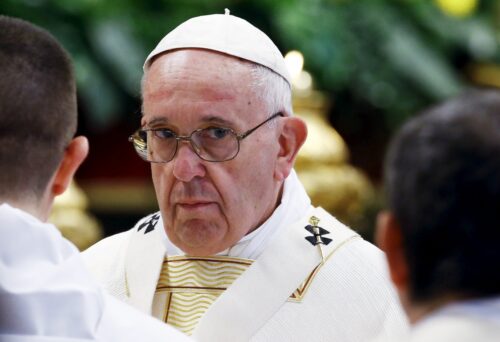
Popular Stockton priest announces he’s fathering a child

Dean McFalls, a well-known priest in the Stockton Diocese, has resigned after telling parishioners he’s about to become the father of a baby boy.

“I definitely have disappointed many people,” McFalls said. “That’s why I’ve talked about it openly, so they won’t be left guessing about what’s going on.”

McFalls was the pastor at St. Mary’s Church in downtown Stockton. He announced his resignation in a statement read during mass on Sunday.

McFalls came to Stockton in 2008 from Lathrop’s Our Lady of Guadalupe Church, according to The Record newspaper in Stockton. He has been outspoken about the city’s struggles with crime and violence, among other issues.

The Catholic Church requires priests to be celibate and unmarried. McFalls discussed those rules and his resignation in an interview with News10′s Tim Daly.

“If the situation in the Catholic Church were different, I would be a better man,” he said. “More stable, more effective in the long run as a human being.”

McFalls would offer little information about the woman about to give birth to his child.

“She’s a better person than I,” he said.

McFalls said it’s not clear what he’ll do after leaving the Stockton Diocese. He said he told Bishop Stephen Blaire about two weeks ago what was happening.

Watch Tim Daly’s report during the 6 p.m. newscast on News10.

Full text of statement by Father Dean McFalls read during mass:

“Dear Friends, I wish to express my profound sorrow that, beginning today, I will no longer be serving as your pastor. I have been blessed by your support and participation during the past five years. However, I have been granted a leave of absence from active ministry in the priesthood, and thus have also resigned as pastor of St. Mary’s. I would have remained longer, at least until our parish festival concludes, but circumstances did not allow this to be. A child will soon be born, and I am the baby’s father. I know this comes as a shock to you, and to many a disappointment. I assume full responsibility for my actions and will do all that I can so that my child receives the care and love that he deserves. Once he was conceived, I had no other option, as a Christian and a priest, than to do everything possible that he might have life, and have it to the full. As St. Paul told the Romans: “God makes all things work together for the good of those who love him, who have been called according to his decree,” and though the Lord never decreed that I sin, he does command that all life be respected and nurtured.

“I apologize sincerely to each and every one of you for any grief, hurt, or sense of abandonment that you may experience. Please welcome the priest who has come to take my place with generous hearts. Know that I will miss you deeply, and that you will always be carried in my heart. Fr. Dean”

Full text of statement from Stockton Bishop Stephen Blaire:

“September 21, 2013

“Dear Parishioners of St. Mary’s,

“With sadness in my heart, I announce to you that your Pastor, Father Dean McFalls, has requested a leave of absence from active ministry in the Priesthood for personal reasons which do not allow him to continue in active ministry as a priest. I have granted the leave of absence and have accepted his resignation as Pastor of St. Mary’s Parish.

“I have appointed Father Jose Luis Gutierrez, the Diocesan Director of Vocations and Associate Pastor at Presentation Parish, as the interim administrator. Please welcome him at this time and support him.

“Also be assured of my prayers for all of you at St. Mary’s. The well-being of the parish and you the parishioners weighs heavily on me. I trust in God in the days ahead.

“Sincerely Yours in Christ,

“Bishop Stephen Blaire”

Complete Article HERE!

Catholic Chaplains Won’t Bury Married Gay Soldiers

File under:  For the love of Jesus!


“No Catholic priest or deacon may be forced by any authority to witness or bless the union of couples of the same gender. No Catholic priest or deacon can be obliged to assist at a [marriage counseling retreat] if that gathering is also open to couples of the same gender…

“Participation in retirements, changes of command, and promotion ceremonies is possible, as long as the priest is not required to acknowledge or approve of a ‘spouse’ of the same gender.

“While the tradition of the Catholic Church always tries to find reasons to bury the dead, a priest may not be placed in a situation where his assistance at a funeral for a Catholic would give the impression that the Church approves of same sex ‘marital’ relationships.”


Renewed Fidelity in Favor of Evangelization

Archbishop Broglio has issued a steatement which provides guidance for Catholic chaplains and contract priests and deacons who may encounter ministry situations involving Catholic or non-Catholic parties in same gender “marital” relationships.  The full text for Archbishop Broglio’s statement Renewed Fidelity in Favor of Evangelization can be found below:

“As members of the Church founded by Jesus Christ to meet the needs of the baptized and to proclaim that good news about the salvation given by Him, we are also aware of His clear teaching about the danger of scandal (Mt. 18:6). This world is a pilgrimage to life without end. At the conclusion of our walk through life we must stand before the Throne of Grace to give an accounting of our fidelity.

St. Paul reminds priests to be all things to all people (1Cor. 9:22). A clear disservice is rendered if the truth of the Gospel is confused by the actions of those ordained to disseminate that truth. The current situation makes it necessary to reiterate with clarity the teaching of the Catholic Church regarding homosexuality. However, it must never be forgotten that the human condition occasions many failings. St. Paul continually reminds us of that fact in his letters to the communities of believers.

Priests ordained to minister Word and Sacrament and endorsed to serve Catholics in the Armed Forces, the Veterans Administration Medical Centers, and those who serve the US Federal Government outside the borders of the United States of America know that theirs is a twenty-four-seven vocation. By speech, action, and example they witness to the truth revealed by the Lord in all that they do (see Eph. 4:14).

Recent changes in interpretations of the laws of the Federal Government oblige me to recall what is clearly held by the Catholic Church. At the same time I am grateful to the Congress of the United States for its passage of renewed conscience-protection language, specifically for chaplains in the Armed Forces.

Ministry

No Catholic priest or deacon may be forced by any authority to witness or bless the union of couples of the same gender. No Catholic priest or deacon can be obliged to assist at a “Strong Bonds” or other “Marriage Retreat”, if that gathering is also open to couples of the same gender. A priest who is asked to counsel non-Catholic parties in a same-gendered relationship will direct them to a chaplain who is able to assist. Catholic parties will, of course, be encouraged by the priest to strive to live by the teaching of the Gospel.

Participation in retirements, changes of command, and promotion ceremonies is possible, as long as the priest is not required to acknowledge or approve of a “spouse” of the same gender.

While the tradition of the Catholic Church always tries to find reasons to bury the dead, a priest may not be placed in a situation where his assistance at a funeral for a Catholic would give the impression that the Church approves of same sex “marital” relationships (see CIC, c. 1184, §1,3º). In the case of doubt, the Archbishop for the Military Services, USA must be consulted (see CIC, c. 1184, §2).

Lay Ministries

Obviously, anyone who is known to be in a sinful relationship is excluded from ministries in the Catholic community. While this list is not intended to cover every situation, lectors, extraordinary ministers of Holy Communion, altar servers, catechists, and members of the Catholic Council immediately come to mind.

Participation

We are also mindful of the Lord’s words, “Let the one among you who is guiltless be the first to throw a stone…” (Jn. 8:7b). The Church must minister to all regardless of their sexual inclination. While the invitation to conversion cannot be diluted, the door to the mercy of Christ, obtained through His Cross, must be kept open. Priests and deacons will be guided by the principles of the Catechism of the Catholic Church (cf. nos. 2358-2359) and never forget that it is the sin that is hated and never the sinner.

In the quest for continued fidelity to the truth of the Gospel, it must not be forgotten that estimates indicate that same-gender couples represent less than half of one percent of those in the Armed Forces. While every individual is important, such a small group cannot be allowed to mandate policy for all.

Guidance for Catholics in Command Positions

I am not unaware that the faithful entrusted to my pastoral care also include those Catholics who exercise command positions. They can be faced with additional questions as they fulfill their responsibilities to those above and below them in the chain of command. Consequently in response to a doubt raised by the AMS regarding the question of a person’s possible cooperation with evil, the National Catholic Bioethics Center (NCBC) stated:

“Commanders of United States military installations/veterans’ facilities (hereafter, ‘commanders’) would not be engaging in morally illicit cooperation, but rather tolerable remote mediate material cooperation with evil by implementing federal employee benefits accruing pursuant to same-sex marriage, as required by United States v. Windsor. Our determination is contingent on the situations in which commanders are unable to avoid such cooperation without jeopardizing their own just right to their employment security for themselves and/or their families. This is also contingent on the commander making known his/her objection to being required to so participate, as well as on attempting through legal channels to continue to accomplish changes in policy consistent with the historic understanding of marriage and family as based on natural moral law. Also, if without incurring a demotion of loss or downgrade of position/rank/grade or other serious harm, there is a mechanism to have others more senior in the chain of command to carry out the implementation of such policy, this should be pursued.”

Most Reverend Timothy P. Broglio
Archbishop for the Military Services

Melbourne Priest Greg Reynolds Defrocked And Excommunicated By The Vatican

File under:  Nice goin’ Francis!  You talk a good line, but when push comes to shove, you’re just like your predecessor.  SHAME!

By Anne Lu

Melbourne priest Greg Reynolds has not only been defrocked, but also excommunicated by the Catholic Church over his support for women priests and homosexuals. The order came directly from Vatican under the authority of Pope Francis, who just recently said that the Church focuses too much on gays and abortion.

Mr Reynolds resigned as a parish priest in 2011, and has founded Inclusive Catholics in 2012. He said that although he was expecting to be laicised or defrocked for his views on ordination of women and homosexuality, he didn’t know he was to be excommunicated as well.

Excommunication is a form of medicinal penalty for members of the Catholic Church. Those who are excommunicated are barred from receiving the Eucharist and other Sacraments of the church.

“In times past excommunication was a huge thing, but today the hierarchy have lost such truth and respect,” he was quoted by The Age as saying.

“I’ve come to this position because I’ve followed my conscience on women’s ordination and gay marriage.

The order, written in Latin, came from Vatican through the authority of Pope Francis, and gave no reason for the former priest’s excommunication.

The letter was dated May 31, months before the Pope told his subjects to go easy on how they deal with gays, abortion, and contraception. Mr Reynolds continued to The Age that he wants the same thing as the Pope, adding that he believes that the Church is in need of reform and renewal.

“My motivation is trying to encourage reform and clear need for renewal in the church,” he said. “I still love the church and am committed to it, I’m just trying to bring about in my own little way to help highlight some of the failing and limitations.”

Melbourne Archbishop Denis Hart, who made headlines in May after appearing at a Victorian parliamentary inquiry into a child sex abuse case of another priest, apparently was not the one who requested the order, “but someone else unknown has gone over his head and contacted the Congregation of the Doctrine of the Faith,” Mr Reynolds said.

Archbishop Hart explained that Mr Reynolds was excommunicated because he continued to celebrate the Eucharist publicly after his priestly faculties were withdrawn. He was also preaching contrary to the teachings of the church.

As per its official Web site, Inclusive Catholics is an evolving movement/community in Melbourne that has recognises the hierarchical nature of the Catholic Church, but opposes its views on homosexuality and the ordination of women.

Mr Reynolds said that his being excommunicated would not make a different to his ministry.

He was offered $5000 as a payout for his 32 years of service in the church when he resigned, though he claimed he should have received $48,000 as the usual payout figure is about $1500 per year.

Complete Article HERE!

Catholic Priest, Caught With Pantless 15-Year-Old In Pennsylvania

A Pennsylvania priest has been charged with molesting a teenage boy after police allegedly found him in a car on a college campus with a 15-year-old who was wearing no pants, according to a police criminal complaint filed Friday in Lackawanna County.

Father W. Jeffrey Paulish was charged with one felony count of involuntary deviate sexual intercourse and one felony count of unlawful contact with a minor after Dunmore police say they found him and the boy on Thursday in a car on the Worthington Scranton campus of Penn State University, according to the complaint.

Paulish, 56, of Scranton, was also charged with three misdemeanor counts — indecent contact with a person under 16, indecent exposure and corruption of a minor. He is being held at the Lackawanna County jail on $50,000 bail.

Dunmore police officers say they discovered Paulish and the boy after responding to a call of a suspicious vehicle, according to an arrest warrant affidavit filed with the court.

Allegedly Paulish told police he was at the campus working on his homily when he met the teen, who he said was in emotional distress, and began counseling him.

According to the affidavit, he later admitted to police that he had arranged the meeting with the teen through the “casual encounters” section of Craigslist. Paulish told investigators that he had asked the boy three times if he was over the age of 18, the affidavit said.

A telephone message left by CNN for Paulish’s attorney, Bernard J. Brown, was not immediately returned Friday.

Paulish has been removed from his post at the Prince of Peace parish and has been suspended from acting in the capacity of a priest, according to a statement released by the Diocese of Scranton.

The diocese pledged its cooperation with the investigation, and it called on anyone who “may have been sexually abused by Father Paulish or any member of the clergy” to notify the district attorney’s office.

“I wish to acknowledge how unsettling this is to me personally and to countless others, that yet again a priest has been involved in such inappropriate, immoral and illegal behavior,” the Bishop of Scranton, the Rev. Joseph Bambera, said in the statement.

Complete Article HERE!

New sex abuse crisis in Scottish Catholic church

Priest claims he was abused by older cleric, and church is punishing him for speaking out

By Catherine Deveney

The Catholic church in Scotland faces a fresh sex-abuse crisis involving some of the country’s senior clerics. The Observer has seen documents suggesting a scandal similar to the one that led to the resignation of Cardinal Keith O’Brien as Archbishop of Edinburgh and St Andrews.

Paul MooreAs a seminarian, a priest known as “Father Michael”, who wishes to remain anonymous while an appeal to Rome is made, said he was sexually assaulted by a parish priest, Father Paul Moore. Father Michael said the church failed to deal appropriately with his complaint over a 17-year period, and that he is now being ousted from the church while, he feels, his abuser is being protected.

Father Michael is recovering from cancer but has been refused permission by Bishop John Cunningham of Galloway to reduce his workload during his convalescence.

The church has demanded that he resign or face removal. The priest, who reported Moore to the police in 1997, said he feels this treatment amounts to punishment for whistle-blowing.

“It’s a tragic story,” said Father Michael. “It’s about cover-up, deceit and lies. The church is a big mafia, and they trash you. They will do everything to destroy me.”

The bitter internal division comes just days after the “new broom” appointment of Vatican diplomat Leo Cushley to replace O’Brien, who resigned after admitting inappropriate sexual behaviour towards priests in his care. Father Michael requested Cardinal O’Brien’s intervention in 1996 and again in 2013. O’Brien expressed “shock”, he said, but said he could not help. Father Michael also appealed to Cunningham’s predecessor, Bishop Maurice Taylor, and, recently, to O’Brien’s temporary successor, Archbishop Philip Tartaglia. Tartaglia, the senior cleric in Scotland, claimed he could not help as he had no authority in the matter. “I think it is better for me to return these documents to you,” he wrote in March 2013.

Father Michael alleged the assault took place at St Quivox church in Prestwick in 1996. “I woke to find Moore fondling me under the bedclothes. I placed a chair behind the door and would sometimes hear it rattling,” he said. He claimed the incident was repeated and he didn’t know where to turn.

While Moore was away from the parish, a young man visited. He claimed to Father Michael that Moore had sexually abused him as an altar boy. He gave Father Michael details of another alleged victim.

Father Michael claims that Taylor insisted he remain in the parish and advise Moore to visit him. Confronted by Father Michael, he alleges Moore reacted violently and a scuffle broke out. Suddenly, Moore began to weep, confessing everything, including inappropriate behaviour with relatives. He also admitted the abuse to Taylor.

Moore emerged, euphoric, from a subsequent meeting with Taylor. He understood that the bishop said Moore had come voluntarily, so nobody could blame him. Father Michael said he was instructed by Taylor to remain silent. But he became suicidal and informed police about the incident with Moore.

Taylor later said that he spoke to the authorities, but that was after Father Michael had reported the matter to the police. The Procurator Fiscal told Father Michael the case would proceed, but it did not happen.

Moore, who now lives in a church-owned home, is reported to have said that he regretted any of his actions being seen as abusive, and he had not intended them to be so. Taylor refused Father Michael’s repeated pleas for help, it is understood, only allowing him counselling when a centre waived the fee. Moore, however, was sent to Southdown, a Canadian treatment centre for clergy with psychological problems, for reasons that were not made clear. “A letter has been issued to the parish saying I am on leave of absence after sabbatical,” he wrote to Father Michael.

When Moore returned from Canada he went to Fort Augustus Abbey, following which Taylor tried to place him in a home for the elderly in Scotland. Protests ensued and Moore retired to the church property. “He should have been laicised,” insisted Father Michael.

When Taylor retired, Father Michael lobbied his successor. “I know Maurice made mistakes but it’s too late,” Bishop Cunningham allegedly told him. “What would Maurice think of me?”

In 2004, Father Michael was posted to a three-church parish. He merged two but when he was diagnosed with cancer, doctors advised him to drop the third. In February, the Diocese’s vicar general, Willie McFadden, told parishioners to put complaints in writing. Father Michael was told there were 23 complaints but more than 130 letters of support, including one from the parish council, which has petitioned Rome. “This is really about his stance over Paul Moore,” one member claimed.

In June, Bishop Cunningham insisted that Father Michael, who is in his mid-fifties, retire. Still physically weak, he sought counselling. Supportive letters from both his doctor and his therapist were sent to the Bishop but he feels they were used against him.

Last week, a letter signed by Bishop Cunningham told Father Michael he must retire because of “your ill-health, both physical and psychological, as you yourself have detailed to me in your letters and in those sent by your medical doctors and psychotherapist”.

Father Michael has been told to leave by mid-August. “What I have had to face is something very evil. Had I known what I would experience when I was lying on the floor at ordination, I would have stood up and walked out. I focused my life on priesthood, thinking it was about goodness, kindness and everything I wanted to aspire to. I discovered it was nothing like that.”

The Catholic Church refused to comment, “due to the complex legal situation, criminal, civil and canonical”.

Complete Article HERE!

Tutu: I’d prefer hell over homophobic heaven

File under: The Real (and only) Christian Response


South African social rights activist Desmond Tutu says he would rather go to hell than worship a homophobic God.Archbishop Desmond Tutu

The 81-year-old Nobel Peace Prize laureate told the launch of a UN “Free and Equal” campaign in Cape Town that there’s no religious justification for anti-gay prejudice.

“I would refuse to go to a homophobic heaven,” Tutu said. “No, I would say sorry, I mean I would much rather go to the other place… I would not worship a God who is homophobic and that is how deeply I feel about this.”

He added: “I am as passionate about this campaign as I ever was about apartheid. For me, it is at the same level.”

Complete Article HERE!

Evangelizing the institutional church: an interview with Helmut Schüller

By Jamie Manson

Much has been written about Austrian priest and reformer Helmut Schüller since he opened his 15-city U.S. tour, called “The Catholic Tipping Point,” in New York last week.
Schüller has been making news in the Roman Catholic church reform movement since 2006, when he and a group of fellow priests organized the Austrian Priests’ Initiative. In 2011, they made global headlines when they launched the “Call for Disobedience,” an appeal to the Vatican to address the shortage of priests and other predicaments facing the institutional church.

The Austrian Priests’ Initiative is concerned that the dwindling number of clergy is impacting the quality of pastoral care offered to baptized Catholics. Their “Call for Disobedience” suggests reforms such as the ordination of women and married men to address this unfolding crisis.

What makes Schüller an intriguing figure among reformers is that he is not simply an upstart parish priest. He spent years as a hierarchical insider, filling the very public roles of president of Caritas Austria and vicar general under Austrian Cardinal Christoph Schönborn. He has the rare insight of one who has served both in the hierarchy and in the parish. Rarer still, he has risked his position and privilege to be in full, outspoken solidarity with lay Catholic reformers.

Hours before Schüller’s July 16 debut in New York City, he and I sat down for an interview. Since many of the goals and ideas we discussed — such as the plan for an international meeting of priests, the new evangelization, his thoughts about Cardinal Sean O’Malley’s barring him from speaking, and the institutional church’s treatment of same-sex couples — have not made it into most of the media coverage of his speaking engagements, I am offering the text of our conversation, which has been edited for length and clarity.

There’s more to NCR than what you read online. Preview our Spirituality special section from the July 19 edition.
You are using your summer break to embark on a 15-city U.S. tour. What are you hoping to accomplish?

This tour is a way for reform organizations and reform-minded priests to connect with one another. Our goal is to build up an international network of reform movements. We want to make public our sorrows, questions, issues and desire for our church and make it clear that reform-minded Catholics can be found throughout Europe and the United States.

In the United States, there aren’t many priests who openly belong to church reform groups. How will you reach out to them?

As I travel city to city, I’ll be meeting with priests informally in closed sessions. I’m encouraging priests in the U.S. to stay together with the lay movements. The priests here are cautious because there is a lot of pressure from the American bishops. We must be advocates for the people of God, especially when their initiatives are sidelined. I’m not completely familiar with the situation in the U.S. I’m hoping that the next few weeks will enrich my point of view of the struggles here.

Are reform movements in Austria similarly sidelined?

In Austria, we are in somewhat of a different situation. It is clear to our bishops that reformers have a very large majority behind them. We estimate that, in Austria, 80 percent of the Catholic faithful and two-thirds of the priests agree with our platform. If there is pressure from the bishops, the media helped to make it public. The bishops can’t sideline us easily because of public pressure.

Is there a plan to gather reform-minded priests together for a meeting?

The Austrian Priests’ Initiative, which I helped to found, is calling 2013 “a year of internationalization.” In October of this year, we are planning an international meeting of priests from Austria, Germany, France, Ireland, Great Britain, the U.S. and other countries to try to enlarge our network and further discuss the “Call to Disobedience.”

What motivates the “Call to Disobedience”and all of this organization by priests in Austria?

The priests in Austria have realized that after we retire, our communities will be merged. The priest shortage is an urgent, desperate situation. The lay members of our communities are the ones who are building up the church. The more parishes merge, the more that priests are losing the chance to walk with members of their communities through their daily lives. This is about more than compassion. It is about companionship and solidarity with laypeople. Life is not going to get any easier, and we want to offer people the service of the church.

Our second motivation comes from the questions that have arisen out of our pastoral care of our parish communities. The church’s doctrines on divorced and remarried Catholics and same-sex couples have created a lot of pastoral problems. We need a new teaching model on sexual relations. Our teaching should concentrate on the quality of relationships, not the form. Rather than condemning remarried Catholics or same-sex couples, we should be asking: How are they living in relationship? Are they respecting one another’s dignity? We have to respect that people want to live together, that they feel responsible for one another, and that they care for one another.

How did you become the public face of the Austrian Priests’ Initiative?

I was president of Caritas Austria and also served as vicar general for Cardinal Christoph Schönborn. I am better known in Austria because of these public roles, so I became the speaker of group. It helps with the media because they tend to only respect individual persons rather than whole movements. But the initiative is not my movement. A group of priests founded it, and we work as a community. We have a board that meets regularly to reflect on our work, discuss problems and give assistance to parish priests who are alone.

Some have claimed that the Roman Catholic church in Europe is either dying or being replaced by secularism. How do you respond to those claims?

Because of the history of reformation in Europe, the church has had to seriously engage with modern society. This doesn’t mean the church is dying. It is simply struggling with the questions of modernity. Yes, some faith communities are small, but they are very active.

We are confronting the questions, not giving in to secularism. Some want a “contrast church” that is contrary to society. But that’s not the idea of Jesus or the Gospels. The church should go into society and share the daily lives of the people.

Early in his pontificate, Pope Benedict XVI spoke of re-Christianizing Europe. Pope Francis appears passionate about the new evangelization. Do you think Europe needs to be evangelized?

If evangelization means that the Gospel has to be brought from “us” to “them” and that “they” have to accept that we [the hierarchy] have the wisdom, then I think there will not be success with the new evangelization. The first evangelization that is needed is the evangelization of the church.

Pope Francis seems to have started it now: to be simple, for the poor, to separate himself from wealth. Evangelization has to meet the people, to understand their questions, to understand changes in society, to respect that this modern society has realized a lot of originally Christian ideas, and to find again the origin of our Gospel.

If the new evangelization should become a monologue, there will be a problem. Yes, we have to preach the Gospel, but we must bring it in the language of our time. That’s not watering down the Gospel, but coming into dialogue with world about the Gospel.

What do you think of the claim that we are living in a “culture of death”?

The Second Vatican Council had an optimistic view of modern society. There was no talk of a culture of death. The bishops respected the successes of human society. Of course, Gaudium et Spes recognized that modern society has its darkness, chaos and conflict, but it also recognized that modern society developed the ideas about a fair and just society, about the equal participation of human beings, and the right to individual conscience. This really is the spirit of the [United Nations’] Declaration of Human Rights, and the council respected it.

Mater et Magistra made the point that the church’s position is not to look down on society and say it is dying, but rather to look at what is good in society and discuss what is problematic. The church should be a good companion to modern society. Of course, this is risky. It’s more comfortable to be in a fortress. But the way of Jesus is to go with the people wherever they are.

You were banned from speaking on Catholic grounds in Boston by Cardinal Sean O’Malley. Does it concern you that Cardinal O’Malley was one of eight cardinals Pope Francis chose for his “kitchen cabinet” of advisers?

Well, it’s not really a sign of hope, but let it be. These are the old-fashioned reflexes of an old-fashioned system of thinking. Rather than forbidding these discussions, the hierarchy could instead ask to be represented in these conversations. To forbid someone to speak is a sad thing, but the real sadness is forbidding people to listen.

For me, being banned from speaking is not dramatic — I’ll just go to another church. But for a bishop to say, “You must not listen”? That’s just not possible in our time. We live in an open society. People can get information wherever they want. But this vision of a church where the baptized are “protected” against getting information that the bishop doesn’t want them to have? It is a ridiculous point of view, I think. Maybe what we are seeing are the last reflexes of a dying system. I feel that these ways are fading out. Let’s forget it and be hopeful.

What about the hierarchy’s claim that you are creating disunity in the church?

In these conversations, we are gathering people here who are engaged in this church. They have discussions with me and one another, and then they return to their communities and continue their work for the church. We are not driving them out of the church; we are inspiring them to continue to ask for reform. It is their church. If the bishop could see who the people are who are gathering here, they would not be afraid that we are dividing the church. I think the contrary is happening. I have had people say to me: “I would have left, but after hearing you, I feel there is some hope in fighting for the church and its reform, so I will stay.”

What are the first steps you would like to see the pope and the bishops take in bringing about reform?

One of the important steps would be to encourage the bishops to be with the people, not to be against them in the name of the Vatican. A key move will be to decentralize papal authority and to call the bishops to collegiality and shared responsibilities. The bishops’ synod must function like a real synod. It’s the only way to give the bishops the possibility of filling the space with new ideas. Also, laypeople must be brought into the church’s decision-making. We must put pressure on church leaders to open dialogue and to use the gifts and charisms of the faithful.

What do you say to those who argue that your issues with the institutional church are unique to Europe and the U.S. and that the majority of the Roman Catholics who live in the global South and Asia do not share these concerns?

These societies will be confronted with same questions. Our Latin American and South American colleagues are already saying to us, “Don’t think we don’t have the same problems.” Globally, societies are changing very quickly. In 10 or 20 years, the global South will face the same questions we [face]. In mega-cities, they already are. Church leaders must not hope they can get around these questions. They will arise. Maybe the church in Europe and the U.S. should be thought of not as a dying church, but as a laboratory for the future, where the church engages with the modern society. We should not overestimate the numbers of people going to church, and we should not underestimate the problems the church is facing.

Complete Article HERE!

Ohio Officials Ordered To Recognize Gay Couple’s Marriage

Ohio Officials Ordered To Recognize Gay Couple’s Marriage

Married on July 11 in Maryland, John Arthur is in hospice care and “certain to die soon.” He and his husband have sued to ensure their marriage is recognized by Ohio officials at Arthur’s death.

By Chris Geidner

A federal judge in Ohio ordered state officials Monday to recognize the marriage of two men that was performed in Maryland on the death certificate of an Ohio resident in hospice care who the judge says “is certain to die soon.”

John Arthur & husband“The end result here and now is that the local Ohio Registrar of death certificates is hereby ORDERED not to accept for recording a death certificate for John Arthur that does not record Mr. Arthur’s status at death as ‘married’ and James Obergefell as his ‘surviving spouse,’” Judge Timothy Black wrote in granting the couple a temporary restraining order Monday. The order is in effect until 5 p.m. Aug. 5, unless the court extends the order at a later date.

“By treating lawful same sex marriages differently than it treats lawful opposite sex

marriages,” the judge concluded, Ohio’s 2004 constitutional amendment banning recognition of same-sex couples’ marriages and Ohio’s statute addressing the same issue “likely violate[] the United States Constitution.”

The couple’s attorney, Al Gerhardstein, said in a statement, “This order is a major step on the march toward marriage equality in Ohio.”

Addressing the constitutional question, Black explained, “Although the law has long recognized that marriage and domestic relations are matters generally left to the states, the restrictions imposed on marriage by states, however, must nonetheless comply with the [U.S.] Constitution.”

To that end, the court examined the Supreme Court’s decision striking down part of the Defense of Marriage Act this June in United States v. Windsor, the 1996 decision in Romer v. Evans, and in other decisions addressing differential treatment found to be unconstitutional under the Constitution’s guarantee of equal protection of the laws.

Looking at Ohio’s bans on recognizing same-sex couples’ out-of-state marriages, while acknowledging its recognition of the marriages of opposite-sex couples who would not be allowed to marry in Ohio, Black concluded, “The purpose served by treating same-sex married couples differently than opposite-sex married couples is the same improper purpose that failed in Windsor and in Romer: ‘to impose inequality’ and to make gay citizens unequal under the law.”

According to the order, Obergefell and Arthur live in Cincinnati, Ohio, and “have been living together in a committed and intimate relationship for more than twenty years.” The order also notes “they were very recently legally married in the state of Maryland pursuant to the laws of Maryland recognizing same sex marriage.”

The order notes that Arthur is dying of amyotrophic lateral sclerosis (ALS), which prompted the couple to fly to Maryland on July 11 to get married.

As Black put it, the couple “traveled to Maryland in a special jet equipped with medical equipment and a medical staff necessary to serve Mr. Arthur’s needs, whereupon Plaintiffs were married in the jet as it sat on the tarmac in Anne Arundel County, Maryland. They returned to Cincinnati that same day.”

The lawsuit seeking to have the couple’s marriage recognized was filed against Gov. John Kasich and other state and local officials on July 19.

Ohio Attorney General Mike DeWine’s office defended the state’s laws in filings with the court on Monday, but Cincinnati city lawyers representing Dr. Camille Jones, the vital statistics registrar for the city, declined to defend the law, telling the court, “The City will not defend Ohio’s discriminatory ban on same-sex marriages,but the City’s vital statistics registrar is bound to follow Ohio law until that law is changed or overturned.”

Asked about the court’s issuance of the order on Monday evening, Kasich spokesman Rob Nichols told BuzzFeed, “We don’t comment on pending litigation other than to say the that the governor believes that marriage is between a man and a woman.”

Complete Article HERE!

Pope’s bank clean-up man ‘found stuck in lift with rent boy’

As the man charged with cleaning out the stables at the scandal-struck Vatican bank, Monsignor Battista Ricca will need Machiavellian cunning, good fortune and a whiter-than-white record to have even a fighting chance.

Monsignor Battista RiccaBut Pope Francis’s new banker appears to possess none of these attributes after it was reported yesterday that he was found stuck in a lift with a rent boy. Msgr Ricca, as Francis’s new primate with responsibility for the troubled financial institution, known officially as the IoR (Institute for Religious Works), is supposed to usher in new transparency and badly needed reforms after years of financial scandal.

Earlier this month, a major report from finance police and magistrates warned that a lack of checks and controls by the IoR and the Italian financial institutions it had dealings with made the Vatican’s bank a money-laundering hot spot.

It is claimed that Msgr Ricca, 57, impressed Francis with the way he ran three key residences used by cardinals, bishops and priests visiting Rome. But detailed claims have emerged detailing how in 1999, Ricca took a Vatican diplomatic posting in Uruguay and moved his lover, Patrick Haari, a Swiss army captain, in with him, to the outrage of church figures and locals in the conservative South American nation. Captain Haari was forced out by the hardline Polish nuncio Janusz Bolonek in 2001.

But there were more problems for Ricca when he was attacked in a cruising ground that year, and soon after firemen had to rescue him from a broken lift, in which he was trapped with a youth known by local police. The weekly news magazine L’Espresso claims that Msgr Ricca was able to get the position as IoR prelate because the supposedly powerful “gay lobby” in the Vatican airbrushed his colourful CV.

Gay sex scandals at the Vatican have made the headlines before. In 2010 it emerged that one of Pope Benedict’s ceremonial ushers and a member of the Vatican choir were involved in a gay prostitution ring.

Vatican spokesman Padre Federico Lombardi sought to dismiss the claims about Msgr Ricca’s private life. “What has been claimed about Msgr Ricca is not credible,” he said. Msgr Ricca himself has not yet responded to the allegations. But La Repubblica noted that the Vatican had emphasised that his appointment as prelate for the IoR was technically an interim one, thus raising the possibility that the job might not last long.

Complete Article HERE!