A Papal Surrender?

I thought this was a particularly insightful article. A bit dated, but still.

By Paolo Flores d’Arcais

“There’s no place for a Pope Emeritus,” John Paul II (born Karol Józef Wojtyła) declared dryly as recently as 1994. Yet beginning at 8 PM today, we have an Emeritus Pope, with consequences for the Catholic Church that are impossible to overstate. The decision announced two and a half weeks ago by Joseph Ratzinger—from now on simply ex-Benedict XVI—took a kind of courage that many cardinals and men of the curia find rash; some see it rather as a sign of weakness bordering on cowardice.
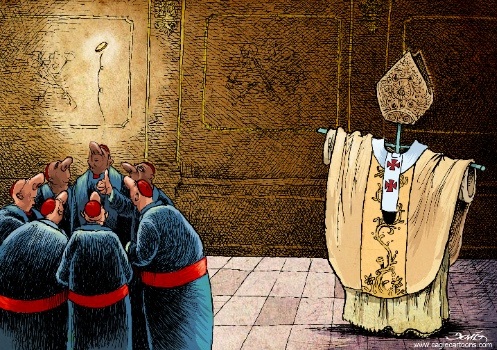
Indeed, Ratzinger’s decision has the momentous effect of desacralizing the Papacy, reducing it, in the minds of the faithful, to the office of a great religious leader and nothing more. This is a paradoxical outcome for a Pope who can claim (from his point of view) a notable record of success, having brought to completion the process begun by Wojtyła of reestablishing traditional Church doctrine and the conservative hierarchy that had been challenged after the Vatican II Council.

The Pope is often described as the world’s last absolute sovereign, but he is more than that. The Pope is—or was—an absolute sovereign who also had, in the eyes of his believers, a unique aura as the Vicar of Christ on Earth, representing the Holy Spirit in the Holy Trinity—a Deputy God, in other words. But an ex-Deputy God is meaningless. The Bishop of Rome will now become merely the leader of a church, like the Archbishop of Canterbury, even if he has vastly more members in his flock than his English counterpart.

And here is a second paradox. By stepping down, Ratzinger has given credence to the more “secularist” view of the modern Church put forward by his longtime antagonist Hans Küng and by the most progressive members of the Vatican II Council, whose influence Ratzinger had succeeded in marginalizing. In short, the Catholic Church now has to contemplate the coexistence of an Emeritus Pope and a Pope-Pope. The new Pope will certainly exercise the full powers of the Papacy (on the assumption that the ex-Pope will truly withdraw to a life of seclusion and prayer), but he will no longer have a divine aura.

Why then did Benedict XVI make such an extreme decision? Why did he want to discard the seemingly inviolable tradition of leaving the length of Papal tenure up to God, even when the Pope reaches a point of great frailty, with the certainty that the Holy Spirit would transcend the human inadequacy of the pastor? The long decline of Wojtyła was a very recent and decisive example of the Church’s adherence to that exceptional principle.

In contrast, by emphasizing his own physical decline, Ratzinger has introduced an element of rational human calculation into the question of what is “good for the Church”: an approach that in fact suggests a more limited view of the Holy Spirit’s gifts, which are presumed to guarantee papal infallibility at all times. It is a further paradox that the Pope’s recourse to such worldly realism has been blamed on a cowardly desire to evade responsibility precisely for the misdeeds of the most worldly members of the Church hierarchy. (We might add that if Ratzinger’s decision is a demonstration of humility, then we must consider Wotjyla’s decision to remain in power during his long illness arrogant.)

Yet Benedict XVI has explained that he prefers to retire because, as he put it,

in order to govern the bark of St. Peter and proclaim the gospel, both strength of mind and body are necessary, strength which in the last few months has deteriorated in me to the extent that I have had to recognize my incapacity to adequately fulfill the ministry entrusted to me.

Ratzinger emphasized “strength of mind” because that is the key to his reasoning; he added in his statement that he is “well aware of the gravity of this decision.”

In what sense can Benedict XVI regard himself as being unable to “adequately fulfill” his ministry? After all, under his leadership, the Church hierarchy has become more unified than ever; there are no longer major doctrinal rifts between “progressives” and “conservatives.” Never have the bishops shown such doctrinal homogeneity; the last voice that was out of tune with the choir was that of the late Cardinal Martini, who described the Church, in an interview published posthumously last year, as “two hundred years out of date.”

Beyond the Church as well, the theologian-Pope can boast of considerable achievements. Jürgen Habermas, Europe’s leading secular philosopher, has praised his thought; not to mention Julia Kristeva and other fashionable intellectuals in ultra-secular Paris. Indeed, Ratzinger’s counter-enlightenment critique has appealed to a surprisingly long list of secular admirers: for example, his suggestion to non-believers to lead their lives veluti si Deus daretur, as if God existed, because without God, and the ethical principles connected to God, Western society is heading toward collapse.

There is one area of his pontificate, however, in which Benedict XVI can claim “mea culpa, mea culpa, mea maxima culpa”: the administration of the Church in the stricter sense of the Roman curia itself. The feud among cardinals that turned the inner sanctum of the Vatican into a vipers’ nest, the war between factions that has unfolded beneath the frescoes of Michelangelo and Raphael, with shining daggers and poison, in the fatal form of secret dossiers and blackmail.

This battle, the so-called Vatileaks controversy, has been provoked by two problems in particular: the twin scandals of priest pedophiles and the Vatican bank (IOR), which is under investigation for money laundering and mismanagement. Sex and money, the seductions of Mammon to which prelates robed in purple, the symbol of their Christian devotion “till martyrdom,” should be perfectly immune.

Ratzinger chose to deal with these problems in the most circumspect and gradual manner. His efforts to uncover the iniquity of priests, and even that of the rogue finance of the Vatican bank, met with enormous resistance, setting in motion a Catherine’s Wheel of machinations. The pedophile crisis (and the related scandal over the powerful Legion of Christ and its leader, the notorious Marcial Maciel Degollado) was the one area in which Ratzinger had had a major disagreement with Wojtyła. Then-Cardinal Ratzinger insisted that the Polish Pope take a firm and clear stand, but was over-ruled by more powerful members of the Curia at a point when John Paul II, by then in the final years of his illness, was largely incapable of governing—a specter that surely played into Benedict’s XVI own decision to retire.

Vatileaks was only the tip of the iceberg, as even lay observers of the Church are now aware. The secret internal investigation of the Vatican leaks submitted in December by Cardinals Julian Herranz, Josef Tomko, and Salvatore De Giorgi must have shaken the Pope. As La Repubblica has now reported, the investigation apparently describes a hugely influential “homosexual underground” within the Curia, while documenting at length the ferocious struggle among cardinals and factions. Even worse, Tarcisio Bertone, the Vatican Secretary of State and the Pope’s closest advisor going back to the time when Ratzinger was in charge of the Doctrine of the Faith, seems to be up to his neck in the allegations.

Benedict XVI was unable to take sides in this internal struggle, because Bertone’s rivals themselves are not shining with sanctity. (Bertone’s predecessor and archenemy, Cardinal Sodano, was one of the long-time protectors of Degollado, the disgraced former Legion of Christ leader.) Confronted with such an overflowing sewer of Church filth, Benedict XVI instead decided to surrender, pleading his own incapacity and choosing the only alternative still open to him: prayer.

Complete Article HERE!

Strong policies on abusive priests vital, O’Malley says

Ya gotta love this guy!

By Lisa Wangsness

Cardinal Sean P. O’Malley said Tuesday that the next pope must make sure the Roman Catholic Church adopts measures to deal with bishops whose “malfeasance” allowed abusive priests to ­remain in ministry.

O’Malley said in an interview that the successor to Pope Benedict XVI will need to continue Benedict’s campaign to get bishops across the world to adopt policies for dealing with accused abusers. That should include procedures for disciplining bishops who protect abusive priests, said O’Malley, among dozens of cardinals gathered at the Vatican.

The US bishops adopted a zero-tolerance policy on clergy sexual abuse a decade ago, requir­ing removal from ministry of any priest credibly ­accused of abusing a minor, but some church leaders have not followed it. The bishop of Kansas City was convicted last fall of failing to report child abuse by a priest, but the church has not sanctioned him.

“There needs to be a path” for disciplining bishops, O’Malley said. “Right now, it’s not terribly clear, but it’s something the next pope will have to deal with.”

Without a protocol in place, he said, it falls to the Vatican to decide what to do with each ­errant bishop on a case-by-case basis. “My point is always that if you don’t have policies, you’ll be improvising, and when you improvise, you make a lot of mistakes,” he said.

‘There needs to be a path’ for disciplining bishops. ‘Right now, it’s not terribly clear.’

The Roman Catholic archbishop of Boston discussed some of the issues at stake in the papal election in a brief inter­view Tuesday in a corridor of the Pontifical North American College in Rome, a peaceful hilltop seminary about 10 minutes by foot from the Vatican.

O’Malley is among the US cardinals staying there before the conclave. Once voting ­begins, the cardinals will move to lodgings within the Vatican and remain isolated from the world until they elect a pontiff.

The conclave is held in the Sistine Chapel, which closed at 1 p.m. Tuesday so that work crews could begin installing a raised floor, under which they will put antibugging devices, and the stoves in which the ballots will be burned.

O’Malley, who during the inter­view wore a gray cardigan over his hooded brown habit and blue socks peeking through his sandals, spent the morning in one of a series of meetings the cardinals are holding before the conclave, called general congregations, in which they discuss issues facing the church.

Being part of the papal process is “surrealistic,” he said, but also moving.

“Growing up a Catholic and knowing a little bit about these traditions and the way the Holy Father is selected in the church — it’s a far cry from seeing it up close and being part of it,” he said.

O’Malley also seemed to ache for a little down time. He had just finished a long press conference and had more report­ers to speak with before a dinner with cardinals. He said he had not been able to spend much time going out to dinner or otherwise enjoying the city. “If I didn’t have all these interviews,” he said with a laugh, “I could be in a bookstore right now.”

Yet the shy O’Malley seemed at ease at the press conference. He said that after almost 30 years of being a bishop, he had grown accustomed to being the face of the church and interacting with the press. “It’s not ­always easy, but it’s important; it’s the way we can communicate with the largest number of people,” he said.

He has been highly sought after by the Spanish-speaking press because of his fluency in the language and his work with the Hispanic community in the United States and with the church in Latin America.

Asked in the Globe interview what he was looking for in a poten­tial candidate, O’Malley said the next pope must “relate well to the universal church.” The Catholic Church is growing quickly in Africa, and more than 40 percent of the world’s Catholics live in Latin America.

He said Benedict’s successor also needs the spiritual and ­intellectual capacity to deal with the church’s many challenges. Governance of the Vatican, he added, is also an ­issue.

“We want the Holy Father to have a good team of people around him in a way that will support his ministry and allow him to focus on his teaching office, which we see as so important,” he said.

O’Malley has been deflecting a lot of questions lately about the possibility he could be a contender for pope. Most Vatican analysts consider the ­notion of an American pope a long shot, but some say that O’Malley’s chances could ­improve if there is no consensus after a few days of voting.

One reporter at the news conference said she had a question from her daughter: Would O’Malley continue to wear his “cappuccino robe” if elected pope? O’Malley, a Capuchin friar whose order’s name derives from the brown hooded habits its members wear, blushed and chuckled with his audience.

“I have worn this uniform for over 40 years, and I presume I will wear it until I die, because I don’t expect to be elected pope,” he said. He stammered slightly. “So — I don’t ­expect to have a change of wardrobe.”

The press conference ­focused on the general congregation meetings, a tricky subject, because the cardinals take oaths promising not to reveal the content of the discussions to outsiders.

As described by cardinals and Vatican representatives, there is little back and forth in these sessions. Cardinals sign up to speak and essentially make speeches without debate.

A half-hour coffee break gives the cardinals time to chat informally. Cardinals who are over 80 years old — the cutoff for being eligible to vote in the conclave — are invited to join the general congregations.

Cardinal Daniel DiNardo, the archbishop of Galveston-Houston, who presided alongside O’Malley at the press conference, said the congregations were “pretty serene — it’s not campaign-like.”

The College of Cardinals has not yet set a date for the conclave, nor have cardinals decided when they will set a date. All electors must be present for the date to be set, and a Vatican representative said 5 of the 115 electors were not yet in Rome. Church law requires the conclave to begin no more than 20 days after a papal vacancy.

O’Malley said the cardinals want to be sure they allow themselves enough time to weigh issues and contenders before the conclave to make sure the voting itself does not “drag on.” All the conclaves in the last century have ended within five days; in earlier centuries, some voting sessions lasted for months or even years.

O’Malley and DiNardo said cardinals who, like themselves, were in charge of dioceses, hoped to return home by March 24 for Palm Sunday, the beginning of Holy Week. But they said the prelates do not want to rush. “This is the most important decision that some of us will ever make, and we need to give it the time that’s necessary,” O’Malley said.

He told the National Catholic Reporter Sunday that he hoped the cardinals would meet twice a day every day this week to move the process along. But Tuesday the cardinals decided against meeting twice that day, and they plan on meeting only during the morning Wednesday. O’Malley smiled a little tightly when asked about that. “This is Rome,” he said.

Complete Article HERE!

College of Cardinals imposes media blackout

These old men will never get that their pathological need for secrecy is one of the main reasons their church is in crisis. When all else fails, redouble the effort to keep the lid on.

By Jason Horowitz

The College of Cardinals that will elect the next pope cut off formal communications with the news media on Wednesday after their private deliberations emerged in the Italian press, raising the specter of a leaking scandal that cast a pall over the last year in office of Pope Benedict XVI.

“Concern was expressed in the General Congregation about leaks of confidential proceedings reported in Italian newspapers,” said Sister Mary Ann Walsh, director of media relations for the U.S. Conference of Catholic Bishops, who has organized news conferences with American cardinals in recent days. “As a precaution, the cardinals have agreed not to do interviews.”

The decision, communicated only an hour before a scheduled news conference with American cardinals on Wednesday afternoon, marked a quick end to a brief period of openness on the part of the Americans, who had said they hoped to keep reporters as informed as possible without breaking vows of secrecy.

The Vatican declined to specify who in the college expressed opposition to the news briefings, saying only that as the cardinals prepare for the conclave that will elect the next pontiff, “they realize the importance of keeping things among themselves,” said the Rev. Tom Rosica, a Vatican spokesman.

A report Wednesday by Italy’s most authoritative Vatican reporter, La Stampa’s Andrea Tornielli, disclosed details of the cardinals’ private deliberations, including the revelation that they had called for reforms of the Roman Curia, the bureaucracy that governs the Catholic Church, and had asked for more information about the leaking of papal correspondence, a scandal known as VatiLeaks that engulfed the Vatican last year. Tornielli also reported that embattled Cardinal Roger Mahony of Los Angeles had spoken, that cardinals called for better communications between the pope and the heads of the various church departments, and that some cardinals wanted to extend the preliminary talks into next week.

According to Vatican officials and experts, the media blackout might be more than a crackdown in reaction to the leak. It could also have a political dimension. One Vatican official speaking on background said that Italian cardinals, some of whom stand to benefit most from a quick conclave, had expressed misgivings about the American news conferences, during which U.S. prelates articulated what they were looking for in a pope. They often described criteria that did not match the characteristics of cardinals in the curia. The American cardinals also repeatedly said they wanted more time to listen to their colleagues and get to know one another, a position that Vatican experts said diminished the chances and power of better-known Roman officials, many of them Italian, who would gain from a speedier process.

In conclaves, as in comedy, timing is everything. And it has itself been a point of contention.

Contrary to the statements of some of the American cardinals in the news conferences, the Vatican has said that the selection of the conclave’s start date could occur without all the voting members of the college in attendance. In light of his retirement, Benedict had amended the Apostolic Constitution to empower the College of Cardinals to select the start date, as long as everyone was present.

In the last few days, the Vatican briefing theater has amounted to a semantics seminar on the meaning of “attend.” The Rev. Federico Lombardi, the Vatican’s chief spokesman, has argued that if an absent but expected voting cardinal were going to attend, it was tantamount to his already being in attendance, and so the college could consider itself in plenary session.

American cardinals disagreed that they could tackle the start of the conclave without every seat filled.

“If the electors aren’t all there, why bother?” Cardinal Daniel DiNardo of Texas said in one of the news conferences at the North American Pontifical College on a hill overlooking the Vatican. “It takes as long as it takes.”

Of the 115 cardinal electors, only two remained absent Wednesday: Jean-Baptiste Pham of Vietnam and Kazimierz Nycz of Poland. The Vatican said they were expected Thursday.

“The date of the conclave was not decided,” Lombardi said Wednesday. “Rather than try to interpret the so-called delay,” added Rosica, “we should view this in terms of a process of discernment and reflection. All the electors will be here, and they can enter a full discussion about this.”

Vatican experts instead interpreted the delay as they did the tension over talking to the media — as another political power struggle between officials in the Roman Curia and outsiders.

A subsequent statement by Walsh seemed to cast the American cardinals’ lot with the outsiders, a development that could help the papal candidates among them shed their superpower stigma. “The U.S. cardinals are committed to transparency and have been pleased to share a process-related overview of their work with members of the media and with the public,” she said, not mentioning who was not pleased.

“Some people in the curia wanted an early election because it would benefit the front-runners, and it would benefit the curial cardinals who already know everybody in the College of Cardinals,” said the Rev. Tom Reese, a political scientist and author of the book, “Inside the Vatican.”

“Who does it hurt?” he asked. “The unknown candidate who would make a great pope, the younger cardinals; they are going to be dependent on the curial officials.”

Cardinal Sean O’Malley, the archbishop of Boston, is one such person who could benefit from a longer process. Though a long shot, he has remained on many short lists to become the next pope. But in the news conferences, he rejected the idea that there was a political dimension to slower deliberations.

“I don’t think that so much is a factor as many cardinals are concerned that if there is not enough time spent in the general congregations, that once we get into the conclave, it could drag on,” he said at a news conference Tuesday. He said the goal was “to have enough discussions previous that when people go to the conclave, they already have sort of a very clear idea of who they are going to vote for at that point. If you cut short the discussion beforehand, the conclave could go on and on.”

The Vatican said Wednesday there was no connection between extended preliminary meetings and a short conclave. “We should resist the link,” Rosica said.

News that the Americans had canceled their news conferences, which had become a daily ritual here, streamed into the smartphones of reporters during the daily Vatican briefing. It was the first thing reporters asked Lombardi about when he opened the floor to questions, reflecting the inconvenient story lines that can emerge for the Vatican in what is essentially a newsless environment.

It is a vacuum that critics of the church have rushed to fill. Earlier Wednesday, the Survivors Network of those Abused by Priests (SNAP), an organization that supports victims of sex abuse by clerics, held a well-attended news conference in which it released a list of a “dirty dozen” cardinals it considers unacceptable leaders of the church based on their past handling of the child sex-abuse crisis. Among them were cardinals often mentioned as prime candidates for the pontificate, including cardinals Timothy Dolan of New York, O’Malley of Boston, Leonardo Sandri of Argentina, Peter Turkson of Ghana, Angelo Scola of Italy and Marc Ouellet of Canada.

The College of Cardinals, which will choose the next pope, expressed concern about leaks of deliberations.

“It really isn’t up to SNAP to decide who should or should not participate in the conclave,” said Rosica.

One Vatican insider close to the church hierarchy questioned the wisdom of a media blackout, suggesting that the church was only creating a headache for itself.

(The front page of Wednesday’s Il Giornale, an Italian daily, carried a paparazzi-style photo of Benedict, who said before retiring and assuming the title of “pope emeritus” that he would be “hidden from the world,” taking a stroll in a white cassock, coat and ball cap.)

Instead, the Vatican has sought to satiate the army of accredited journalists flowing into Rome with brief glimpses behind the conclave curtain. On Monday, the Vatican showed a video of cardinals sitting, standing and reading in the theater where the congregations are held. On Tuesday, the feature presentation was a silent film with a camera panning over the three urns that will contain ballots during the election.

The video, which had the disembodied hands of a home shopping network presentation and the glacial pace of a Michelangelo Antonioni film, was accompanied by a Vatican press release explaining the significance and artistry of the containers. (“These are treated with a light patina which underlines the various chromatics of the bronze, the irregularities on the surface and the contrast between opaqueness and brightness.”)

On Wednesday, two flat screen televisions above the Vatican spokesmen showed blue-gloved workers carrying boards to protect the floor into the frescoed Sistine Chapel, unscrewing screws and unpacking from wooden crates the ovens that will burn the ballots.

The Vatican said, officially, that 18 cardinals spoke on Wednesday on topics ranging from their expectations, hopes and desired characteristics for the next pope to the church’s new evangelization efforts and the relations between the church government and bishops around the world. Speakers were asked to keep their remarks to about five minutes. Lombardi made a point to mention that the cardinals had wished a member of the college happy birthday.

Complete Article HERE!

Rome exhibition takes aim at the Church as papal vote looms

By Naomi O’Leary

As cardinals flock to Rome to choose the next pope, two artists have taken the opportunity to stage an exhibition taking aim at the wealth of the Roman Catholic Church and the sex abuse scandals that plagued Pope Benedict.

Italian artists Antonio Garullo (L) and Mario Ottocento pose next to their artistic protest in the form of a life-sized statue named “the unspeakable act”, during an exhibition in Rome March 5, 2013. REUTERS/Alessandro Bianchi

Held in an ancient building where Italy’s patron Saint Catherine of Siena died, “The Unspeakable Act” is a life-size model of Benedict in a confessional box, his sumptuous red and cream-coloured robes spread about him.

Installed on the stage of a darkly-lit theatre, the artwork is surrounded by eerie music and a track of Benedict announcing in Latin his decision to resign after eight years topped with the whispering sounds of people confessing their sins.

Benedict’s papal tiara lies on the ground and his bejewelled hands cover his face in apparent horror or shame at a phrase from the Gospel of St. Luke that lies open on his knee: “Let the little children come to me”.

The exhibition is the work of artists Antonio Garullo and Mario Ottocento who became famous for lampooning the scandals of the powerful in 2012 with an exhibit depicting a sleeping Prime Minister Silvio Berlusconi, his hand in his trousers and a satisfied look on his face.

“Too many scandals have been hidden by the Church. Even children were abused in the confessional,” Garullo told Reuters at a preview of the work on Tuesday.

“These jewels and rich clothes contrast with Christ, who was in rags. The Vatican even has a bank, which is hypocrisy.”

A folded paper tucked into the papal tiara represents the ‘Vatileaks’ scandal, when Benedict’s personal butler leaked documents alleging corruption in the Church’s business dealings

The artwork, that opens to the public on Wednesday, has personal importance for Garullo, 48, and Ottocento, 40, an artistic duo for 20 years who were the first Italian gay couple to be married when they wed in Holland in 2002.

Since then they have battled for their union to be recognised by authorities in Italy, which has no legal provision for same-sex couples, although a 2012 survey found 63 percent of Italians support equal rights for gays.

“I don’t understand how the pope could say in one of his last addresses that gay couples are a threat to world peace,” Garullo said. “I don’t understand how we are a threat.”

Their pope statue is surrounded by books by reformist Swiss theologian Hans Kueng and the late Cardinal Carlo Maria Martini, a liberal voice who urged the Church to modernise before his death last year, saying it was “200 years out of date”.

Garullo said the fact that Benedict is ignoring the books is a message to the Church to bring its teaching up to date.

“It shows the Church has remained 200 years in the past, and is not open to the modern world,” Garullo said.

Complete Article HERE!

Cardinal Keith O’Brien: how Britain’s Catholic leader fell from grace

By Catherine Deveney

What is it about a gold mitre, a flowing robe, a flash of cardinal red that so clouds our judgment? It is as if we believe these things hold a kind of magic. Don them and the wearer becomes pure and invincible. No human urges, no troublesome sexuality. Some people are naively enthralled by hierarchy. Priest, good. Bishop, better. Cardinal, best of all. The four complainants in the Cardinal O’Brien affair, who have accused him of inappropriate behaviour, haven’t rated much sympathy within this strange moral hierarchy. “Who are they?” I have been asked all week. “Where are they?” has been another frequent question. But I have rarely been asked: “How are they?”

A narrative has begun to be embroidered on the cardinal’s magic mitre. A fairytale. He is named but his accusers are not, and therefore the accusations are invalid. Let us be clear about one thing: the three priests, and one former priest, who have made complaints are not anonymous. They have given sworn, signed statements to the papal nuncio. The unnerving thing about the hunt to “out” these men (my phone has not stopped ringing with offers to “make it worth my while”) is that it suggests people who have suffered traumatic events have no rights over how to tell their story, or how much information is made public. We demand not just that the appropriate authorities know names – we, the public, should know them, too.

In purely human terms, the story of Cardinal O’Brien’s resignation is tragic. He had spent a lifetime reaching the upper echelons of his church, but after allegations of inappropriate behaviour made in the Observer last Sunday his fall from grace took just 36 hours. Not one of the four complainants takes any satisfaction from that. This is not about the exposure of one man’s alleged foibles. It is about the exposure of a church official who publicly issues a moral blueprint for others’ lives that he is not prepared to live out himself. Homosexuality is not the issue; hypocrisy is. The cardinal consistently condemned homosexuality during his reign, vociferously opposing gay adoption and same-sex marriage. The church cannot face in two directions like a grotesque two-headed monster: one face for public, the other for private.

There have been some misunderstandings about the timing of this tale: ridiculous accusations about the complaints spoiling the cardinal’s retirement and having “the whiff of payback” for petty jealousies. Then it was suggested that this was all a conspiracy to prevent Keith O’Brien going to the conclave.

But in many ways this story was overtaken by events. The four complainants made their statements to the papal nuncio, Archbishop Mennini, around 8 or 9 February. On 11 February the pope resigned. The first response the complainants received from the nuncio said O’Brien should continue to go to Rome because “that will make it easier to arrange his retirement to be one of prayer and seclusion like the pope”. The complainants recognised church subtext. In a message to me one wrote: “This is saying, ‘leave it to us to sweep it under the carpet and you can forget about it. It will fade away as if we have dealt with it.’ Not acceptable.”

On 22 February, the cardinal gave an interview to the BBC about going to the conclave. He also said that church rules on celibacy should be reviewed. Informally, the men heard that the church was unhappy about that interview. Action would be taken. The cardinal would not go to Rome.

So did the church act because it was shocked by the claims against the cardinal or were they were angry he had broken ranks on celibacy? Two days later, the Observer published the story.

But why had the men waited so long to report allegations dating back to the 1980s? The answer is that people who have suffered trauma are not public property. They have the right to come to terms with it in their own time and express it in their own way, when they are ready. Being ready can simply be a collision of circumstances. Often, it’s as straightforward as realising you are not the only one.

Sometimes as a journalist, you hold one piece of a jigsaw puzzle for a very long time. Gradually, you pick up another piece, and then another, until the picture clicks together and makes sense. I had known one element of this story for years: the former priest’s. Let’s call him Lenny. Now married, Lenny had been approached by the cardinal while a seminarian. Lenny says the cardinal was his spiritual director and used bedtime prayers as an opportunity to make advances to his young student.

“I knew myself to be heterosexual,” he says, “but I did say to others that I thought it would be easier to get through seminary if you were gay.”

Last month I received a call from Lenny. He was very shaken. He had had a conversation with a priest – we’ll call him Peter – whom he hadn’t spoken to for years. Peter told Lenny about an inappropriate relationship the cardinal had instigated with him. Two other priests were drawn in: Kenny and John. Both had experienced unwanted advances from the cardinal.

“I’d never wanted to ‘out’ Keith just for being gay,” says Lenny. “But this was confirming that his behaviour towards me was part of his modus operandi. He has hurt others, probably worse, than he affected me. And that only became clear a few weeks ago.”

Last week there were claims the cardinal did not know details of the allegations. How could he respond, the implication was, if he did not know what he was being accused of? That was simply untrue. Last Saturday, the day before the Observer printed the story, the cardinal did not respond to calls and messages left for him. The Scottish Catholic Media Office was approached. Peter Kearney, the communications director, asked for the allegations to be put in writing. They were. In that email, four separate allegations were outlined. At the end, a direct question was posed: “Is it true that the cardinal has broken his vow of celibacy?” The allegations could not have been more specific.

Kearney certainly seemed to understand at the time. His response was brief: “The cardinal is consulting his lawyers. These claims are contested and should not be published.” But I had four statements that described the cardinal attempting to touch, kiss, or have sex with people in his care.

“He started fondling my body, kissing me and telling me how special I was to him and how much he loved me,” one had written. One of the statements was five pages long. Given the strength of the evidence we had, the Observer chose to publish the story.

There have been many questions about the four complainants that cast doubt on them and their motives. So let me tell you about the men I have come to know. They are men of conscience and integrity who desperately want to do “the right thing”. Men who love the church but recognise that the way it covers up scandal and hides wrongdoing is damaging. On a personal level they are funny, kind, spirited, generous, conventional and unconventional in different measures. But above all they are brave. Peter wrote to me saying it had been the worst week of his life. He couldn’t eat, couldn’t sleep. Each of those men spoke out knowing it could ruin their lives. Some of them were trying to work out what order they might be able to take refuge in if the church disowned them for speaking.

The biggest sin in the Catholic church has historically been “scandalising the faithful”. That is why the abhorrent cover-ups of child sex-abuse scandals have been part of the church’s history. They shield their own – and if you speak against them, you stop being their own. Archbishop Tartaglia of Glasgow – who caused outrage last year when he linked the tragically premature death of David Cairns MP to his homosexual lifestyle – publicly said prayers for the cardinal at mass in Edinburgh after being named as the cardinal’s temporary replacement. He invited the cameras in while he did it. It is right that the cardinal is given adequate support. It is not right if the church pretends that he is the victim in this. The gold mitre, the cardinal’s robes, do not make him more worthy of support than the men in ordinary clerical collars.

It seems there is a great deal of displacement activity going on in the Scottish Catholic Church. It is not the behaviour of the four complainants that should be concentrated on. It is the behaviour of the cardinal. How big a crisis this is for the church lies in its own hands. The signs so far do not suggest a new era of openness. But, as the church itself proclaims, redemption is always possible for a sinner.

Priests tell me there is a “gay culture” in the Scottish Catholic church – but not an open, healthy one. In some ways, perhaps it shouldn’t be a surprise. The church has always had a deeply cynical side when it comes to sexual morality. Lenny recalls being a young priest, accompanying an older priest who would rise to great heights in the church. The older man was drunk and was ranting about men who left the priesthood. Why leave to have sex? Why didn’t they just visit a sauna and go to confession in the morning?

A cardinal does not resign overnight over trivia. Some people have questioned, though, whether his alleged behaviour constitutes abuse. After all, this involves adults, not children. One commentator even suggested it’s all just a scandalous homophobic plot. That completely misunderstands the nature of the power a spiritual director has over his seminarians and a cardinal has over his priests. Lenny gave up his priesthood when O’Brien was promoted to be his bishop. He did not want to be in his power. “He harmed me in so many ways,” he explained.

And ask Peter if this story involved abuse. Peter has undergone long-term psychological counselling. His experiences with the cardinal are part of his records. Peter admits he even contemplated suicide. And still people are shouting “Reveal yourself!”

Why should he?

A few nights ago Lenny had a dream. He and his fellow complainants were in a cold, damp church, searching for a piece of scripture for a funeral. The Bible they were looking in was tattered. They could not find the words. When he woke, Lenny knew exactly the passage they had been hunting for: Ecclesiasticus 2. He wants the words read at his own funeral, to be acknowledged in the end as a priest.

“My son, if you aspire to serve the Lord,
Prepare yourself for an ordeal…
…Since gold is tested in the fire
And chosen men in the furnace of humiliation.”

There is the superficial gold of the mitre, and then there is solid gold. The church has to learn the difference. When Lenny told the others his dream, one said he, too, had dreamed about their situation. His dream had been simpler. Keith O’Brien had asked their forgiveness for his behaviour. All of them had granted it.

Complete Article HERE!

Cardinal O’Brien’s confession turns spotlight on Scottish Catholic church

Admission of sexual misconduct exposes former head cleric and church to claims of hypocrisy especially over gay rights

By Severin Carrell

The Scottish Roman Catholic church is facing a series of questions about the conduct of its former leader and its attacks on gay rights, after Cardinal Keith O’Brien admitted to a secret sexual life dating back decades.

O’Brien is expected to face a more detailed investigation by the Vatican after admitting to incidents of sexual misconduct throughout his career, which started in 1965.

After a week of denials over allegations of sexual conduct and approaches by four men, the cardinal said on Sunday he was guilty of conduct that had “fallen beneath the standards expected of me”.

In a statement that left questions unanswered about the nature of that misconduct, he added: “To those I have offended, I apologise and ask forgiveness. To the Catholic church and people of Scotland, I also apologise.”

Those admissions are likely to supersede the original Vatican investigation, first revealed by the Observer, into formal allegations levelled against O’Brien in early February by three serving priests in his former diocese of St Andrews and Edinburgh, and a former priest.

The latter said he left the priesthood after he was sexually propositioned by O’Brien in the 1980s. Other incidents involving O’Brien, who became archbishop in 1985 and then cardinal in 2003, included a series of “drunken fumblings” and unwanted advances, church sources said.

His remarks are an admission that he breached ecclesiastical codes on celibacy and against homosexuality, and that his officials misled the Vatican, the Scottish church and the public in their denials following the Observer article.

While the Vatican inquiry is expected to remain confidential, and will be set up once 116 or so of the church’s cardinals gather in Rome elect Pope Benedict XVI’s successor within the coming days, it will ask O’Brien for further details about that misconduct.

It also exposes the cardinal and the Scottish church to claims of hypocrisy, and raises questions about whether other senior figures in the church knew about his private life and covered it up or failed to take action.

It also emerged last week that a fifth priest had reportedly made accusations to the Vatican against O’Brien late last year, concerning an incident in 2001. In 2003, O’Brien took office as a cardinal, signing an oath about upholding the church’s teachings: until then, he had been regarded as a liberal archbishop.

O’Brien has since become notorious among equal rights campaigners for his vigorous attacks on gay marriage and gay adoptions, calling homosexuality a “grotesque subversion” and “harmful to the physical, mental and spiritual wellbeing of those involved”.

Colin MacFarlane, director of Stonewall Scotland, which named O’Brien “bigot of the year” last year, challenged the cleric and the Scottish church to explain why he had not apologised directly to the gay community.

“We note with sadness that the cardinal didn’t find it in him to apologise to gay people, their families and friends for the harm his vicious and cruel language caused,” he said.

Church officials confirmed on Monday that O’Brien had left Scotland for an undisclosed location to rest and escape the furore over his admission of misconduct. He had been due to attend this week’s conclave in the Vatican. Before being disgraced, he had been scheduled to visit a parish in Dunbar, East Lothian, after retiring on his 75th birthday later this month.

Professor John Haldane, an adviser to the Vatican and a leading commentator on Scottish Catholic affairs at St Andrews University, said the O’Brien affair raised a number of “broad lessons” for the church and a challenge to the Scottish church to reform itself.

Writing in the weekly Catholic newspaper the Tablet, Haldane said the church was guilty of double standards for denouncing homosexuality as an inherently disordered condition while knowing many of its priests and trainees at its seminaries were gay, or wrestling with their sexuality. Regardless of their sexuality, priests ought to be made to explicitly pledge to remain wholly celibate or leave the priesthood, Haldane said.

He added that the Scottish church should abolish at least half of its eight diocese – a throwback to the size and power of the pre-reformation church.

The Scottish church is struggling to fill five bishop vacancies. It has only three full-time, permanent bishops or archbishops in post. It needed a new body of at most six lay advisers to help in that transformation, Haldane said.

Catherine Deveney, the journalist who broke the original story in the Observer, told BBC Radio 4’s Today programme none of the four accusers she had reported on was pursuing a personal vendetta against O’Brien.

“One of the individuals concerned said that to take the cardinal on as an individual himself would have been like running into a brick wall,” she said, adding: “These men are spiritual men – they want to see an open and transparent Catholic church as a result of this, they don’t want to see it destroyed.”

Complete Article HERE!

O’Brien priest worries that church wants to ‘crush’ him

Key figure behind allegations of inappropriate behaviour attacks Catholic church’s response to complaints

By Catherine Deveney

A key figure behind allegations of inappropriate behaviour by Cardinal Keith O’Brien has launched a powerful attack on the Catholic church’s response to the complaints, saying he fears the church hierarchy would “crush” him if they could.

Last Sunday the Observer revealed that the former priest, along with three serving priests, had reported O’Brien’s behaviour to the Vatican, prompting the UK’s most senior Catholic to resign the following day. Now the former priest, who says he was the subject of unwanted attention by O’Brien when he was a 20-year-old seminarian, has come forward to explain why he made his allegations public and to lambast the Scottish church leadership’s reaction to last week’s story.

He is “disappointed” by the “lack of integrity” shown by the Catholic church. “There have been two sensations for me this week. One is feeling the hot breath of the media on the back of my neck and the other is sensing the cold disapproval of the church hierarchy for daring to break ranks. I feel like if they could crush me, they would,” he told the Observer.

He added that he was shocked when Peter Kearney, director of communications for the church in Scotland, claimed O’Brien’s resignation was not linked to the Observer story and that the church did not know the details of the allegations.

Kearney said he was unable to comment on suggestions that a new complaint had been lodged as a result of last week’s story. When asked to outline the church’s programme of support for complainants, he said only that they would be directed to Antonio Mennini, the Papal Nuncio, the Vatican’s ambassador to Britain, to make a formal statement.

“The vacuum the church has created has allowed whimsy and speculation to distort the truth,” the priest said. “And the only support I have been offered is a cursory email with a couple of telephone numbers of counsellors hundreds of miles away from me. Anyway, I don’t need counselling about Keith O’Brien’s unwanted behaviour to me as a young man. But I may need counselling about the trauma of speaking truth to power.”

The former cleric says he feels that he, rather than the cardinal, has been the subject of scrutiny. “I have felt very alone and there is a tendency to become reclusive when people are trying to hunt you down.”

He said he felt particularly angered by demands that the identity of the four complainants be revealed: “To those who want to know my name I would say, what does that change? And what do you think I have done wrong?”

He said that when the four came forward to the church, they were asked to make sworn signed statements to Mennini. But they were also warned that if their complaints became public knowledge, they would cause “immense further damage to the church”. The church, he says, failed to act quickly and appropriately, adding that he fears the matter was in danger of being swept under the carpet.

“For me, this is about integrity. I thought it was best to let the men and women who put their hard-earned cash in the plate every Sunday know what has been happening. If you pay into something you have a right, but also a duty, to know what you are paying for.”

He said that the men’s complaints were not maliciously motivated. “I am as sinful as the next man – as my partner and pals frequently remind me. But this isn’t about trying to own the moral high ground. I feel compassion for O’Brien, more compassion than the church is showing me, but the truth has to be available – even when that truth is hard to swallow.”

He also dismissed suggestions that the accusations contain an element of homophobia. ” This is not about a gay culture or a straight culture. It’s about an open culture. I would be happy to see an openly gay bishop, cardinal, or pope. But the church acts as if sexual identity has to be kept secret.”

Complete Article HERE!

Vatican ‘knew of Cardinal O’Brien claims’

THE Vatican knew of allegations against Cardinal Keith O’Brien five months ago, it was claimed today.

Reports said a priest lodged a complaint in October about “inappropriate behaviour” by the former Archbishop of St Andrews and Edinburgh in 2001.
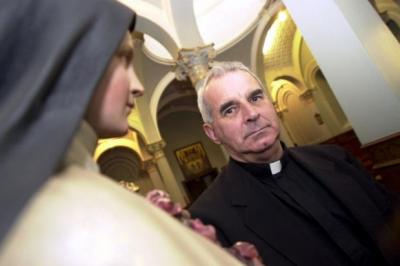
The priest is said to have written directly to Rome because he did not think he could trust the church hierarchy in Scotland to handle the matter.

His claim is said to have been taken seriously and led to the Vatican contacting Cardinal O’Brien and a “deal” being brokered by Cardinal Marc Ouellet of Montreal for the departure of the leader of Scotland’s Catholics.

Cardinal O’Brien quit as archbishop on Monday following revelations at the weekend about allegations from three other priests and one former priest of inappropriate behaviour dating back to the 1980s. The cardinal contests the allegations.

He had already submitted his resignation, which was due to happen on his 75th birthday on March 17, but Pope Benedict XVI ruled it should take effect immediately.

It was claimed today that it was as news of the complaint to the Vatican about the alleged 2001 incident spread inside the church that the four men decided to come forward with their stories.

One source was quoted saying: “Lots of people are pillorying the four priests whose cases came out at the weekend, but this is the context.

“It gave them the confidence that they would be heard. It started people talking and it gave them the confidence. It took someone to put his head above the parapet.”

Despite his resignation as Archbishop of St Andrews and Edinburgh, a post he had held since 1985, Cardinal O’Brien could still have gone to the conclave in Rome to help choose Benedict XVI’s successor, but he announced he would not do so, saying he did not want to distract attention from the task of electing a new pope.

The archbishop temporarily replacing Cardinal O’Brien spoke yesterday of the “pain and dismay” he shares with worshippers as he took Mass at St Mary’s Cathedral for the first time.

Archbishop of Glasgow Philip Tartaglia told worshippers that he understood the archdiocese was in a “state of shock for the loss of its shepherd” following the cardinal’s resignation.

The Pope appointed Archbishop Tartaglia as apostolic administrator to govern the archdiocese of St Andrews and Edinburgh until a permanent replacement is chosen. Archbishop Tartaglia told the congregation yesterday: “I am glad to be with you today, even if I wished, very much wished, that the circumstances were other than they are.”

He asked them to pray for the appointment of a new archbishop and said he did not know how long it would be before one is named.

He added: “The office entrusted to me by the Holy Father is by its nature provisional and temporary.”

Complete Article HERE!

Sex, power scandals to loom over Vatican pre-vote talks

By Tom Heneghan

The sex and power scandals haunting the Catholic Church look set to play a big role in meetings before next month’s papal election after two senior cardinals called on Tuesday for more internal debate about them.
A leading support group for victims of clerical sexual abuse also made what it called a “last-ditch plea” to Pope Benedict to use his authority before resigning on Thursday to discipline bishops who have protected predatory priests in their dioceses.
The abuse issue took on new urgency after Scotland’s Cardinal Keith O’Brien, accused of improper behaviour with young priests, quit as Edinburgh archbishop on Monday and pulled out of the Sistine Chapel conclave to elect a new pope.

A Scottish Catholic Media Office spokesman has said O’Brien was taking legal advice and contested the “anonymous and non specific” allegations against him.

Cardinal Cormac Murphy-O’Connor, now the only British prelate due to attend pre-conclave talks among cardinals at the Vatican next week, said in London the sexual abuse of children was the most serious scandal in the Church.

“That will be one of the main things the cardinals will be discussing,” said Murphy-O’Connor, who cannot vote because he is over 80 years old but can join the cardinal electors in their closed-door discussions about the challenges for the next pope.

French Cardinal Jean-Louis Tauran said in a newspaper interview that the cardinal electors, who number 115 after O’Brien stepped down, should also be informed about a secret report on Vatican corruption prepared for Pope Benedict.

The retiring pontiff has decided to reserve the report for his successor, but the three cardinals over 80 years old who drew it up will be allowed to inform the cardinal electors about some of its findings during next week’s consultations.

ASKING TO NAME NAMES

“The cardinal electors cannot decide to choose this or that name to vote for if they don’t know the contents of this dossier,” Tauran told La Repubblica newspaper.

“If it’s necessary, I don’t see why they should not ask for names,” said Tauran, a former Vatican foreign minister who now heads its department for interreligious dialogue.

Italian newspapers have been speculating for days about conspiracies and alleged sexual scandals inside the Vatican that may have influenced Benedict to become the first pope in some six centuries to step down rather than die in office.

The Vatican has accused these newspapers of spreading “false and damaging” rumours in an attempt to influence the cardinals who are starting to arrive in Rome for the pope’s farewell meeting with them on Thursday.

Two directors of the United States-based abuse victims’ network SNAP arrived in Rome on Tuesday to draw attention to their demands for tougher Church policies.

“We’re here to make a last ditch plea to Pope Benedict to use the remaining hours of his papacy to take decisive action to protect kids,” said David Clohessy, national director of the Survivors Network of those Abused by Priests.

He acknowledged that Benedict had met some abuse victims and made some strong statements condemning the molestation of minors by priests, but said he only acted under public pressure.

“We long for the day when Church officials announce that this cardinal or this bishop is being demoted because Church officials have found proof of wrongdoing and Church officials want to clean things up,” he told journalists.

SNAP saw no papal candidates ready to fire bishops for shielding wrongdoers, he said, but added: “It’s hard to believe there aren’t some cardinals who are grabbing their colleagues by the lapels and saying ‘We simply have to do better’.”

CATHOLICS CRITICAL OF ABUSE HANDLING

Spanish Cardinal Julian Herranz, one of the three who drew up the secret report for Benedict, echoed the Vatican attack on the media in an interview on Monday with the daily El Pais.

“This wanting to see snake pits, warring mafias, internal hatreds – all this is absolutely false,” he said.

Because conclaves are such secretive events, it is hard to see what effect the heightened public pressure over the abuse issue might have on the cardinals who will elect the next leader of the world’s 1.2 billion Catholics around the globe.

Italian newspapers, which dedicate several pages a day to the papal story, have begun mentioning Cardinal Sean O’Malley as a possible “clean hands” candidate because he was sent to Boston to deal with abuse scandals that erupted there in 2002.

But other factors could lead them to choose a man whose main strengths lie elsewhere, such as an aptitude to promote its “new evangelisation” drive, aimed at rekindling the faith in Europe and boost it in other regions.

Recent polls in two important national churches, in the United States and Germany, show that Catholics give their leaders low marks for their handling of the abuse crisis.

A Pew Forum poll last week showed U.S. Catholics have become increasingly critical, with those saying Benedict has done a poor job rising from 40% in 2008 to 63% now.

A survey in January for the weekly Die Zeit showed that only 28% of German Catholics polled believed the Church really wanted to clean up the mess the scandals have caused.

Complete Article HERE!