
Vatican’s term ‘radical feminist’ says more about cardinals than nuns they rebuke

COMMENTARY

It surprises me a little that the men who run things at the Vatican did not use their most favorite recent pejorative – “feminist” — when they rapped the knuckles of Margaret Farley, a nun who has long been a professor at Yale, for having written a book about sex and love that condones masturbation (and as of Thursday morning was in Amazon’s top 20). In a million other ways, it doesn’t uphold their view of Christian sexual morality.

Because unlike the other nuns the Vatican has been reprimanding recently, Sister Farley is, in fact, a feminist. An ethicist who has worked on the problem of HIV/AIDS, Farley was commended in 2005 by her Yale colleagues for her contributions to feminist theory.

A nun looks on as Pope Benedict XVI leads a ceremony commemorating Christ’s gesture of humility toward his apostles on the night before he died at the Basilica of St. John Lateran in Rome April 5, 2012. Pope Benedict recently re-stated the Roman Catholic Church’s ban on women priests and warned that he would not tolerate disobedience by clerics on fundamental teachings.

Members of the Vatican hierarchy are using the word “feminist” and even “radical feminist” the way third-graders use the word “cooties.” In April, the Vatican accused the Leadership Conference of Women Religious, which represents 57,000 nuns nationwide, of allowing “radical feminist” ideas to flow, unchecked, in their communities. In 2008, after he launched an investigation against American nuns (the results of which have not yet been released), Cardinal Franc Rode told a radio interviewer that the nuns are suspected of “certain irregularities,” a “secular mentality,” and “perhaps also a certain feminist spirit.”

The authors of these rebukes never define “feminism” or “radicalism.” In their hands, these words, which can carry legitimate intellectual meanings, appear to signify something like: “Yucky women who fail to heed our instructions and, anyway, don’t meet our standards of womanhood.” In other words, the sisters aren’t behaving as girls should.

Their casual use of these terms convinces me that the cardinals, in their vast experience, have never actually met a radical feminist theologian. Such creatures do exist, although American religious orders are hardly their breeding ground. What the Vatican hierarchy sees as a “radical feminist” is a woman who dares to believe that she’s equal to a man.

“Even large sectors of the church itself have legitimate concern and want to continue to talk about the place of women in the church, and rightful equality between men and women,” Sister Pat Farrell, a member of the LCWR, told the New York Times last week. “So if that is called radical feminism, then a lot of men and women in the church, far beyond us, are guilty of that.”

Lisa Isherwood is a real-life radical feminist theologian. She is editor of the journal Feminist Theology and a professor at Winchester University in England. She believes that the men at the Vatican are using the term “radical feminist” as a right-wing scare tactic, for it evokes other enemies far more dangerous than nuns. Their thinking goes like this, she says: “We hear the word radical Islam, and everyone panics, so let’s chuck that at them.”

The mother of radical feminist theology was the late Mary Daly, who started life as a committed Roman Catholic and spent most of her career teaching at Boston College, a Catholic institution.

She was driven to critique her beloved church after she sat in on sessions of the Second Vatican Council in Rome and felt that women had no meaningful part in the proceedings.She was, she wrote later, appalled by “the contrast between the arrogant bearing and colorful attire of the ‘princes of the church,’ ” she wrote later, “and the humble, self-deprecating manner and somber clothing of the very few women. … Watching the veiled nuns shuffle to the altar rail to receive Holy Communion from the hands of a priest was like observing a string of lowly ants at some bizarre picnic.”

In her breakthrough 1974 book, “Beyond God the Father,” Daly wrote, “If God is male, then the male is God. The divine patriarch castrates women as long a he is allowed to live on in the human imagination.” Now that’s a radical feminist for you. Daly’s work gave voice to generations of feminist scholars.

Isherwood, for one, wears the labels “feminist” and “radical” with pride. She is a Catholic — “in as far as anyone’s trying to hang in there” – she says.

She deeply loves her church and believes that at its core, Roman Catholicism has a radical feminist message. “The church should be radical. It should be saying, ‘More inclusion, more equality.’ An abundance of life is a fundamental Catholic value. The idea of ordination of women and so on is just one very small, very significant point. Radical feminism would want the church to be more proactive in terms of working for a life of abundance for the marginalized.”

Now that’s a threatening idea.

Complete Article HERE!

Vatican Denounces Nun Over Book on Sexuality

The Vatican’s doctrinal office on Monday denounced an American nun who taught Christian ethics at Yale Divinity School for a book that attempted to present a theological rationale for same-sex relationships, masturbation and remarriage after divorce.

The Congregation for the Doctrine of the Faith said that the book, “Just Love: A Framework for Christian Sexual Ethics,” by Sister Margaret A. Farley, was “not consistent with authentic Catholic theology,” and should not be used by Roman Catholics.

Sister Farley, a past president of the Catholic Theological Society of America and an award-winning scholar, responded in a statement: “I can only clarify that the book was not intended to be an expression of current official Catholic teaching, nor was it aimed specifically against this teaching. It is of a different genre altogether.”

The book, she said, offers “contemporary interpretations” of justice and fairness in human sexual relations, moving away from a “taboo morality” and drawing on “present-day scientific, philosophical, theological, and biblical resources.”

The formal censure comes only weeks after the same Vatican office, the Congregation for the Doctrine of the Faith, issued a stinging reprimand of the main coordinating organization of American nuns, prompting many Catholics across the country to turn out in defense of the nuns with protests, petitions and vigils.

The nuns’ organization, the Leadership Conference of Women Religious, said on Friday that its board had declared that the Vatican’s accusations were “unsubstantiated,” and that it was sending its leaders to Rome to make its case. Three bishops have been appointed by the Vatican to supervise a total overhaul of the nuns’ organization.

The censure of Sister Farley, who belongs to the Sisters of Mercy of the Americas, is the second time recently that a book by an American nun has been denounced by the church’s hierarchy. In 2011, the doctrine committee of U.S. bishops condemned “Quest for the Living God: Mapping Frontiers in the Theology of God,” by Sister Elizabeth A. Johnson, a professor of theology at Fordham University in New York.

The Vatican’s doctrinal office, led by an American, Cardinal William J. Levada, has spent more than two years reviewing Sister Farley’s book, which was published in 2006. The office first notified Sister Farley’s superior of its concerns in March 2010, and said it had opened a further investigation because a response she had sent to the Vatican in October 2010 hadn’t been “satisfactory.” It said her book had “been a cause of confusion among the faithful.”

The dean of Yale Divinity School, Harold W. Attridge, a Catholic layman, and the president of the Sisters of Mercy, Sister Patricia McDermott, issued statements in support of Sister Farley. So did 15 fellow scholars who, in a document released by the divinity school, testified to Sister Farley’s Catholic credentials and the influence she has had in the field of moral theology.

Cardinal Levada’s statement about the book, dated March 30 but released on Monday, said, “Among the many errors and ambiguities of this book are its positions on masturbation, homosexual acts, homosexual unions, the indissolubility of marriage and the problem of divorce and remarriage.”

He said that the book “cannot be used as a valid expression of Catholic teaching, either in counseling and formation, or in ecumenical and interreligious dialogue.” The statement said Pope Benedict XVI had approved its contents and ordered its publication. It comes as the Vatican struggles to contain a controversy over leaked documents that have shown infighting and mismanagement in the papacy of Benedict XVI, who on Sunday concluded a three-day meeting in Milan to promote family values.

The Vatican spokesman, the Rev. Federico Lombardi, said the Vatican had not called for any sanctions against Sister Farley and was not expected to do so because she has retired from teaching. He added that it was “quite normal” that documents signed by Vatican offices are published much later than when they were signed, according to “internal bureaucratic and organizational needs.”

Sister Farley’s book finds moral and theological justifications for same-sex marriage, which aside from abortion, has become the major galvanizing political and moral issue for American bishops. The statement took Sister Farley to task for writing that same-sex marriage “can also be important in transforming the hatred, rejection, and stigmatization of gays and lesbians.” She wrote that “same-sex relationships and activities can be justified according to the same sexual ethic as heterosexual relationships and activities.”

“This opinion is not acceptable,” the Vatican statement said. It said that the Catechism of the Catholic Church says that homosexual acts are “acts of grave depravity” that are “intrinsically disordered” and “contrary to the natural law.” It said that Sister Farley’s assertion that sometimes divorce is a reasonable option for couples who have grown apart contradicted church teaching on the “indissolubility of marriage.”

The statement quoted liberally from some of the racier passages in “Just Love,” including ones in which Sister Farley writes that female masturbation “usually does not raise any moral questions at all.” She adds that “many women” have found “great good in self-pleasuring – perhaps especially in the discovery of their own possibilities for pleasure – something many had not experienced or even known about in their ordinary sexual relations with husbands or lovers.”

The Vatican said that this assessment contradicts church teaching that “the deliberate use of the sexual faculty, for whatever reason, outside of marriage is essentially contrary to its purpose.

Complete Article HERE!

Holy Wisdom Monastery provides church services for disaffected local Catholics

Alice Jenson’s faith took an irreversible turn six years ago.

It was Nov. 5, 2006, and she was contributing to Mass at St. Joseph’s Catholic Church in Madison as a lay person, reading Bible passages from the lectern.

The same day, Madison Bishop Robert Morlino required all priests to play a recorded message from him explaining his position on three issues state residents would vote on that week, including a ban on same-sex marriage, which he supported.

When the priest hit “play,” Jenson walked out.

“It was the first time I’d ever outwardly gone against what I was raised to follow,” said Jenson, 67.

She found a new religious home at Holy Wisdom Monastery, a former Roman Catholic monastery in the town of Westport, just outside Madison. Its Sunday service, offered by the sisters who live there, retains many elements of a traditional Catholic Mass but diverges in sometimes startling ways.

Women can lead the service and preach the sermon. Gay relationships are warmly embraced. All parishioners, not just Catholics, can consume the communion wine and bread because the service is ecumenical, meaning welcoming of all Christian traditions.

It’s an alternate universe of sorts — what some think a Catholic Mass might look like today if the liberal spirit of Vatican II in the 1960s had taken root and flowered.

“We’re doing what the hierarchical church was afraid to complete,” said Jim Green, a longtime Holy Wisdom parishioner who is gay and describes himself as “a Catholic in exile.”

The service, called Sunday Assembly, is attended by people from many denominational backgrounds but has become especially popular with Catholics displeased with Morlino or church doctrine in general. Membership doubled in five years to 335, and parishioners estimate a majority are Catholics who left their regular parishes.

Detractors say the parishioners strayed too far from Catholicism to warrant the label.

Approach evolves
Though many self-described Catholics attend Holy Wisdom, it’s no longer an official Catholic Mass.

A little history: In the 1950s, a group of Benedictine nuns opened a high school at the site for girls in the Madison Catholic Diocese. Benedictines belong to a monastic religious order regulated by the canon law of the Catholic Church. Masses at the site were led by Catholic priests, often provided by the diocese.

In 1966, the nuns closed the school and turned the buildings into a Christian retreat center. The sisters, spurred by the Benedictine tradition of hospitality, gradually made the service more inclusive to all Christians. Lay people, especially women, took on greater roles.

In 2000, the Benedictine sisters went a step further, welcoming a Protestant woman to live with them. “When we chose to open our community to Protestant women, it meant other doors closed,” said Sister Mary David Walgenbach, the monastery’s head.

The sisters sought independence from the Catholic Church, and the Vatican granted it in 2006. Consequently, they no longer are tied to the local diocese. They remain affiliated with a Benedictine federation, but they have a special status, not a full membership, because of their ecumenism.

Bishop’s request
When the sisters disassociated from Rome, Bishop Morlino asked them to no longer celebrate Mass at the site so as not to cause confusion, said Brent King, a diocesan spokesman.

“Many people had visited (the monastery) over the years, and the bishop felt it would take time for people to understand that it was no longer a Roman Catholic institution,” King said, adding the bishop “was in no way unfriendly toward their desire to start a non-Catholic ecumenical community.”

The sisters understood the bishop’s position and stopped calling the service a Catholic Mass in 2006, Walgenbach said. Priests ceased to lead the service.
Today, the sisters describe the Sunday Assembly as being “for the celebration of Eucharist,” a term most commonly used to refer to Catholic communion. However, Walgenbach said some Protestant churches also use it. To many people, the service still has the essence of a Catholic Mass.

“You wouldn’t know it wasn’t a Catholic church, except for the person officiating,” said parishioner Pat Hobbins-Kemps, 64. A lifelong Catholic, she said she left her regular parish partly out of a lack of opportunities for women to lead.

Finding a home
Trisha Day, 66, said she came to Holy Wisdom after growing tired of sermons that focused on politically charged issues such as abortion and homosexuality while saying little about social justice and the poor.

Jeanne Marquis, 68, found Holy Wisdom after the terrorist attacks of Sept. 11, 2001. “I needed someone to talk about forgiveness instead of retaliation,” she said. “I needed a place where I was encouraged to ask questions.”

Ann Baltes, 44, a lifelong Catholic, said she sought a place where she and her husband, Bill Rosholt, a Lutheran, could participate in communion together.

Are these parishioners still Catholic? The answers vary.

Jenson says she’s not. “Too much divides us.”

Day calls herself “a transitional Catholic,” unsure where she’ll end up. Green said his Catholic identity can’t be taken from him. “The church is the people of God, not the institution,” he said.

Joanne Kollasch, one of the three Benedictine sisters who live at the monastery, said she “is a Catholic and will remain a Catholic,” adding, “I don’t like to be thought of as less Catholic because I’m ecumenical.”
Said Walgenbach: “The Catholic spirituality is bigger than the Roman Catholic Church.”

Both sisters said they respect the Catholic Church and Morlino and don’t seek controversy.

Detractors
Syte Reitz, a member of Madison’s Cathedral Parish who blogs about Catholic issues, said disaffected Catholics are free to start their own churches, but they shouldn’t confuse people by suggesting they still are faithful Catholics.

“Does it matter whether they are errant Catholics or not Catholics?” asks Reitz. “No matter what we label them, the laws of right and wrong and of morality still stand, and they and others will suffer from the mistakes that they make.”

Reitz said because a male priest is not presiding over the Eucharist, the bread is not being turned into the body of Christ, thus depriving attendees of the Catholic Church’s central sacrament.

King, the diocesan spokesman, said for Catholics to fulfill their obligation to attend Mass on Sundays, they must attend a Catholic Mass validly offered by an ordained Catholic priest.

Does the Holy Wisdom service qualify?

“In charity, we must respond that it does not,” he said.

Complete Article HERE!

Former North Side Catholic nun gets ordained

The Nun’s Story …

A former North Side Catholic nun was ordained a priest recently in an unsanctioned church ceremony in Fort Myers, Fla.
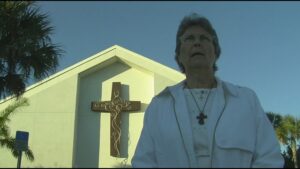
She was immediately ex-communicated from the Catholic church.

“I reject that,” said Judy Beaumont, 74 — the former Sister Mary Daniel — who grew up in Rogers Park before becoming a Benedictine nun who taught theology at St. Scholastica Academy.

Beaumont, who is now referred to as Pastor Judy, was ordained by the Association of Roman Catholic Women Priests.

“We are following our conscience and we are full loyal members of the church,” said Beaumont.

“We will do everything we can to bring about a new way of inclusivity in the church,” said Beaumont, who is now the 11th priest ordained by her group.

The key differences in the women’s “ordination” ceremony are:

† They don’t take a vow of obedience to the bishop. (“It basically denies you the ability to follow your conscience.”)

† Their bishop is a woman, who serves as a spiritual adviser.

† They don’t take a vow of celibacy and allow married, single, grandmothers, gay and straight women into the priestly fold.

† Rather than always referring to God as a “he,” their church language is more inclusive. The “Our Father” prayer reads “Our Mother/Father, who art in heaven.”

“The institutional church will not hire any of us to do church ministry, so we do what we can ministering in hospitals and to the homeless,” she said. “We hold Sunday mass in “church” houses and live on donations. “Stepping outside the institution is hard.”

Two more women are being ordained priests in the next few days, Beaumont added. “I didn’t decide I wanted to become a priest, it was a calling,” she said.

Complete Article HERE!

Contraception’s Con Men

COMMENTARY
By a revolting combination of con men and fanatics, the current primary race has become a demonstration that the Republican party does not deserve serious consideration for public office. Take the controversy over contraceptives. American bishops at first opposed having hospitals and schools connected with them pay employee health costs for contraceptives. But when the President backed off from that requirement, saying insurance companies can pay the costs, the bishops doubled down and said no one should have to pay for anything so evil as contraception. Some Republicans are using the bishops’ stupidity to hurt the supposed “moderate” candidate Mitt Romney, giving a temporary leg up to the faux naïf Rick Santorum; others are attacking Barack Obama as an “enemy of religion.”

Pusillanimous Catholics—Mark Shields and even, to a degree, the admirable E. J. Dionne—are saying that Catholics understandably resent an attack on “their” doctrine (even though they do not personally believe in it). Omnidirectional bad-faith arguments have clustered around what is falsely presented as a defense of “faith.” The layers of ignorance are equaled only by the willingness of people “of all faiths” to use them for their own purposes. Consider just some of the layers:

The Phony Religious Freedom Argument

The bishops’ opposition to contraception is not an argument for a “conscience exemption.” It is a way of imposing Catholic requirements on non-Catholics. This is religious dictatorship, not religious freedom.

Contraception is not even a religious matter. Nowhere in Scripture or the Creed is it forbidden. Catholic authorities themselves say it is a matter of “natural law,” over which natural reason is the arbiter—and natural reason, even for Catholics, has long rejected the idea that contraception is evil. More of that later; what matters here is that contraception is legal, ordinary, and accepted even by most Catholics. To say that others must accept what Catholics themselves do not is bad enough. To say that President Obama is “trying to destroy the Catholic Church” if he does not accept it is much, much worse.

To disagree with Catholic bishops is called “disrespectful,” an offense against religious freedom. That is why there is a kind of taboo against bringing up Romney’s Mormonism. But if Romney sincerely believed in polygamy on religious grounds, as his grandfather did, he would not even be considered for the presidency—any more than a sincere Christian Scientist, who rejects the use of medicine, would be voted for to handle public health care. Yet a man who believes that contraception is evil is an aberrant from the American norm, like the polygamist or the faith healer.

The Phony Contraception Argument

The opposition to contraception has, as I said, no scriptural basis. Pope Pius XI once said that it did, citing in his encyclical Casti Connubii (1930) the condemnation of Onan for “spilling his seed” rather than impregnating a woman (Genesis 38.9). But later popes had to back off from this claim, since everyone agrees now that Onan’s sin was not carrying out his duty to give his brother an heir (Deuteronomy 25.5-6). Then the “natural law” was fallen back on, saying that the natural purpose of sex is procreation, and any use of it for other purposes is “unnatural.” But a primary natural purpose does not of necessity exclude ancillary advantages. The purpose of eating is to sustain life, but that does not make all eating that is not necessary to subsistence “unnatural.” One can eat, beyond the bare minimum to exist, to express fellowship, as one can have sex, beyond the begetting of a child with each act, to express love.

The Roman authorities would not have fallen for such a silly argument but for a deep historical disrelish for sex itself. Early Fathers and medieval theologians considered sex unworthy when not actually sinful. That is why virgin saints and celibate priests were prized above married couples. Thomas Aquinas said that priests must not be married, since “those in holy orders handle the sacred vessels and the sacrament itself, and therefore it is proper (decens) that they preserve, by abstinences, a body undefiled (munditia corporalis) (Summa Theologiae, Part 3 Supplement, Question 53, article 3, Response). Marriage, you see, makes for defilement (immunditia). The ban on contraception is a hangover from the period when the body itself was considered unclean, as Peter Brown overwhelmingly proved in The Body and Society (1988).

The Phony “Church Teaches” Argument

Catholics who do not accept the phony argument over contraception are said to be “going against the teachings of their church.” That is nonsense. They are their church. The Second Vatican Council defines the church as “the people of God.” Thinking that the pope is the church is a relic of the days when a monarch was said to be his realm. The king was “Denmark.” Catholics have long realized that their own grasp of certain things, especially sex, has a validity that is lost on the celibate male hierarchy. This is particularly true where celibacy is concerned.

There was broad disagreement with Pius XI’s 1930 encyclical on the matter. Pope Paul VI set up a study group of loyal and devout Catholics, lay and clerical, to make recommendations. The group overwhelmingly voted to change the teaching of Pius XI. But cardinals in the Roman Curia convinced Paul that any change would suggest that the church’s teachings are not eternal (though Casti Connubii had not been declared infallible, by the papacy’s own standards).

When Paul reaffirmed the ban on birth control in Humanae Vitae (1968) there was massive rejection of it. Some left the church. Some just ignored it. Paradoxically, the document formed to convey the idea that papal teaching is inerrant just convinced most people that it can be loony. The priest-sociologist Andrew Greeley said that Humanae Vitae did more damage to the papacy than any of the so-called “liberal” movements in Catholicism. When Pius IX condemned democracy and modern science in his Syllabus of Errors (1864), the Catholic historian Lord Acton said that Catholics were too sensible to go crazy every time a pope does. The reaction to Humanae Vitae proves that.

The Phony “Undying Principle” Argument

Rick Santorum is a nice smiley fanatic. He does not believe in evolution or global warming or women in the workplace. He equates gay sex with bestiality (Rick “Man on Dog” Santorum). He equates contraception with the guillotine. Only a brain-dead party could think him a worthy presidential candidate. Yet he is praised by television pundits, night and day, for being “sincere” and “standing by what he believes.” He is the principled alternative to the evil Moderation of Mitt Romney and the evil Evil of Newt Gingrich. He is presented as a model Catholic. Torquemada was, in that sense, a model Catholic. Messrs. Boehner and McConnell call him a martyr to religious freedom. A young priest I saw on television, modeling himself on his hero Santorum, said, “I would rather die than give up my church’s principles.” What we are seeing is not a defense of undying principle but a stampede toward a temporarily exploitable lunacy. Acton to the rescue!

Complete Article HERE!

Jacqueline G. Wexler, Ex-Nun Who Took On Church, Dies at 85

Jacqueline G. Wexler, a former Roman Catholic nun who fought the Vatican’s authority and won, then found herself on the other side of the barricades when she became president of Hunter College in 1970, facing student demonstrators storming her office, died on Thursday in Orlando, Fla. She was 85.

Her death was confirmed by her daughter, Wendy Wexler Branton.

While still a nun and battling the church on many issues, Ms. Wexler drew nationwide attention as a bellwether of the liberal reforms of the Second Vatican Council. She fought successfully against church control of Webster College, the small Catholic women’s college near St. Louis that she headed in the 1960s. She advocated greater participation by women in church leadership and criticized the church’s ban on birth control.

Archbishop Fulton J. Sheen, the Catholic televangelist, referred to her as a “Benedict Arnold” in 1967, the year she won autonomy for Webster and simultaneously renounced her vows. Dick Cavett had her as a guest on his late-night TV talk show.

Ms. Wexler’s appointment in 1970 as president of Hunter, one of 11 colleges in the City University of New York system, coincided with a turbulent year in its history. Students, roiled by a combination of antiwar politics and local tensions caused by rising fees and a new university-wide open admissions policy, held demonstrations that shut down the campus repeatedly that spring.

Protesters blocked building entrances and elevators, forcing others to use emergency doors and stairways. Ms. Wexler, refusing at first to call the police, waded into angry crowds to talk, only to be shouted down. Barricaded in her office several times, she finally called the police.

A reporter for The New York Times was in the president’s office one afternoon that April when the phones rang, bringing news that students had blocked elevators and entrances for the second time that month.

“Here we go again,” Ms. Wexler said.

Outside her window, protesters chanted in rhyme, accusing her of colluding with “pigs,” the epithet they used for the police.

Ms. Wexler said that if anything had prepared her for the turmoil, it was having been a lightning rod for condemnation by conservatives in the church.

“Zealotry is the enemy,” she said, adding: “The far right called you every name, from daughter to Beelzebub on, and you learned to take it.”

She was born Jean Grennan on Aug. 2, 1926, the youngest of four children of Edward and Florence Grennan, who owned a small farm in Sterling, Ill. She later took the name Jacqueline in honor of an older brother, Jack, who died of a brain tumor at 21.

After graduating from Webster College, she entered the order of the Sisters of Loretto in 1949, and taught high school math and English in St. Louis and El Paso, Tex. She received her master’s in English from the University of Notre Dame in 1957, and returned to Webster in 1959 as an instructor and administrator.

Sister J., as she was known, was named president of Webster in 1965. She began initiatives aimed at raising educational standards and halting declining enrollment, then common among Catholic women’s colleges.

Sister J. made institutional separation from the church her first priority. “The very nature of higher education is opposed to juridical control by the church,” she said at the time.

She also led the transition to co-education, built new facilities, and started a social-justice program that sent students to work in the poorest neighborhoods of St. Louis, attracting the attention of the Kennedy administration.

She was appointed to the president’s advisory panel on research and development in education and to the original steering committee that developed Project Head Start, the federal program for low-income children.

After several years of well-publicized jousting with Sister J., the Vatican, in 1967, granted the Sisters of Loretto permission to put Webster under the control of an independent, secular board of trustees. It was one of the first Catholic colleges to cut its ties to the church. Asked for his reaction, Archbishop Sheen replied to a reporter: “No comment. I am more interested in Nathan Hales than Benedict Arnolds.”

In 1969, the former Sister Jacqueline married Paul Wexler, a record company executive, and adopted his two children, Wayne and Wendy. Besides Ms. Wexler Branton, Ms. Wexler is survived by her husband and son, as well as four grandchildren, two great-grandchildren and two sisters.

Ms. Wexler was known as a calming presence at Hunter. She led it through the rocky early 1970s and helped make it the city university’s premier center for health care education. Before stepping down in 1979, she brought Bellevue Hospital’s nursing school into the college, expanded health care training, raised money to start a gerontology program in the school of social work and inaugurated a women’s studies program.

From 1982 until 1990, she was president of the National Conference of Christians and Jews.

After receiving an honorary degree from her alma mater, now Webster University, in 2007, Ms. Wexler, then 81, was given a tour of the campus by the president accompanied by a reporter for The St. Louis Post-Dispatch.

Many buildings had been added since she left. She was eager to see them all, the newspaper said, and seemed to grow impatient when the elevator in one building was slow to arrive.

Whether out of eagerness or habit forged in the crucible of 1970, Ms. Wexler proceeded to the stairs.

“Let’s walk,” she said. “I wore comfortable shoes.”

Complete Article HERE!