Pope resignation: Full text

Pope Benedict XVI has announced his resignation. Here is the full text of his statement from the Vatican translated from the Latin:

Dear Brothers,
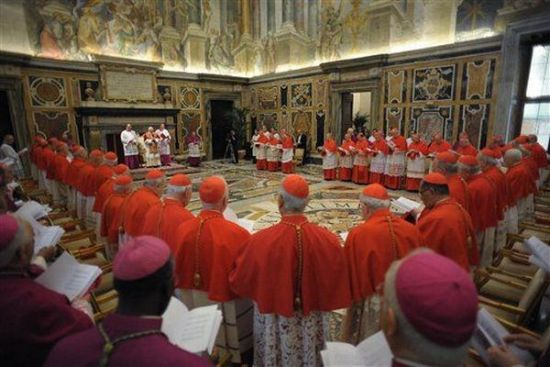
I have convoked you to this Consistory, not only for the three canonisations, but also to communicate to you a decision of great importance for the life of the Church.

After having repeatedly examined my conscience before God, I have come to the certainty that my strengths, due to an advanced age, are no longer suited to an adequate exercise of the Petrine ministry.

I am well aware that this ministry, due to its essential spiritual nature, must be carried out not only with words and deeds, but no less with prayer and suffering.

However, in today’s world, subject to so many rapid changes and shaken by questions of deep relevance for the life of faith, in order to steer the boat of Saint Peter and proclaim the Gospel, both strength of mind and body are necessary, strength which in the last few months, has deteriorated in me to the extent that I have had to recognise my incapacity to adequately fulfil the ministry entrusted to me.

For this reason, and well aware of the seriousness of this act, with full freedom I declare that I renounce the ministry of Bishop of Rome, Successor of Saint Peter, entrusted to me by the Cardinals on 19 April 2005, in such a way, that as from 28 February 2013, at 20:00 hours, the See of Rome, the See of Saint Peter, will be vacant and a Conclave to elect the new Supreme Pontiff will have to be convoked by those whose competence it is.

Dear Brothers, I thank you most sincerely for all the love and work with which you have supported me in my ministry and I ask pardon for all my defects.

And now, let us entrust the Holy Church to the care of Our Supreme Pastor, Our Lord Jesus Christ, and implore his holy Mother Mary, so that she may assist the Cardinal Fathers with her maternal solicitude, in electing a new Supreme Pontiff.

With regard to myself, I wish to also devotedly serve the Holy Church of God in the future through a life dedicated to prayer.

Experts: Top 5 picks for the next pope

Three expert Vatican watchers list some of their leading papabile – Italian for cardinals who might be elected as the next pope. In alphabetical order:
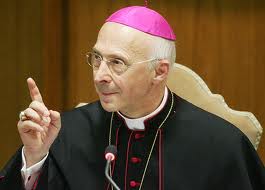
Cardinal Angelo Bagnasco, Archbishop of Genoa, made headlines last year for a ripping attack on then-Prime Minister Silvio Berlusconi and other Italian leaders as unethical role models.

He’s “fairly savvy about both secular politics and the media,” writes National Catholic Reporter Vatican specialist John Allen.

Church historian Matthew Bunson, calls Bagnasco, 69, former professor of metaphysics and contemporary atheism “an intellectual heavyweight” who speaks multiple languages, and takes strong stands on doctrine.

But the biggest boost may come from Bagnasco’s role as two-time president of the Italian bishops conference. Italians hold about a fourth of the seats in the College of Cardinals that will choose the next pope.

Cardinal Marc Ouellet, the Canadian-born former Archbishop of Quebec, now heads the powerful Congregation of Bishops, a “great spot for great spot for making friends and influencing people,” by choosing the global leadership of the Church, says Allen. He describes Ouellet, 68, as a veteran in dealing with the secularized West, someone smart and intellectual with “a cosmopolitan resume,” says Allen.

Ouellet is close to the late pope in theological thinking and someone who could bring a strong hand to the curia (the Vatican bureaucracy).

“The electors could get a traditional pick still say, ‘Hey, we’re innovators. We went to North America!’ He’s the eye-popping choice.” says David Gibson, author of several books on the Catholic Church including a biography of Pope Benedict XVI.

Cardinal Gianfranco Ravasi, elevated to cardinal in 2010 and head of the Pontifical Council for Culture, is so smart, says Allen, “if you were picking a quiz bowl team in the College of Cardinals, most people would start with Ravasi.”

Allen calls him “a master communicator who could take the world by storm. He can ignite rich, solid commitment to Catholic orthodoxy without ever coming off as a scold.”

The Italian-born Biblical scholar has the advantage of being based in Rome. Cardinals in the curia, the church’s governing bureaucracy, get to meet many of the electors that cardinals in far-flung posts scarcely know.

Still, Allen sees hurdles for Ravasi, who, at age 69 has never been a diocesan bishop. “Some would wonder if there were substance beneath the charm. He spends a lot more time talking to the outside world than within the church. Some see him as trying too hard. That’s off-putting.”

Cardinal Leonardo Sandri, 70, the head of the Vatican’s office for the Eastern Catholics and a longtime Vatican diplomat, would be the first pope from South America, the center of global Catholicism today, if he were chosen.

“He’s prayerful, well-liked around the world and very much aware, because of his diplomatic experience, of the global dimensions of the Church,” says church historian Matthew Bunson.

He may be best known in his role as No. 2 in the Vatican Secretary of State’s office. Sandri was the person who read the public announcement that Pope John Paul II had died in April 2005.

However, Sandri’s age, his lifelong background in the church bureaucracy, and his reserved demeanor may work against him, says Bunson.

Cardinal Angelo Scola, Archbishop of Milan, leads Bunson’s list as “an Italian with the intellectual chops for the job” who would bring Benedict’s enthusiasm for “recapturing Catholic excitement in Europe.”

Benedict moved him from another high profile post, Venice, in July, 2011, thereby giving this Vatican insider a perch at Europe’s largest diocese. Milan and Venice together have produced five popes in the last 100 years.

A top scholar on Islam and Christian-Muslim dialog, Scola, 70, is “well positioned for dealing with the challenges of secularism and materialism in the West,” says Bunson.

Scola once said: “Our job now has to be to help people to remember God. People suffer from a kind of amnesia about God and we have to remind them to reawaken God in their hearts and in their minds.”

Complete Article HERE!

Cardinal Mahony used cemetery money to pay sex abuse settlement

By Harriet Ryan

The Archdiocese of L.A. took $115 million from its cemeteries’ maintenance fund in 2007, nearly depleting it. The move seems legal, but it was not announced, and relatives of the dead were not told.

Pressed to come up with hundreds of millions of dollars to settle clergy sex abuse lawsuits, Cardinal Roger M. Mahony turned to one group of Catholics whose faith could not be shaken: the dead.

Under his leadership in 2007, the Archdiocese of Los Angeles quietly appropriated $115 million from a cemetery maintenance fund and used it to help pay a landmark settlement with molestation victims.

The church did not inform relatives of the deceased that it had taken the money, which amounted to 88% of the fund. Families of those buried in church-owned cemeteries and interred in its mausoleums have contributed to a dedicated account for the perpetual care of graves, crypts and grounds since the 1890s.

Mahony and other church officials also did not mention the cemetery fund in numerous public statements about how the archdiocese planned to cover the $660-million abuse settlement. In detailed presentations to parish groups, the cardinal and his aides said they had cashed in substantial investments to pay the settlement, but they did not disclose that the main asset liquidated was cemetery money.

In response to questions from The Times, the archdiocese acknowledged using the maintenance account to help settle abuse claims. It said in a statement that the appropriation had “no effect” on cemetery upkeep and enabled the archdiocese “to protect the assets of our parishes, schools and essential ministries.”

Under cemetery contracts, 15% of burial bills are paid into an account the archdiocese is required to maintain for what church financial records describe as “the general care and maintenance of cemetery properties in perpetuity.”

Day-to-day upkeep at the archdiocese’s 11 cemeteries and its cathedral mausoleum is financed by cemetery sales revenue separate from the 15% deposited into the fund, spokeswoman Carolina Guevara said. Based on actuarial predictions, it would be at least 187 years before cemeteries are fully occupied and the church started to draw on the maintenance account, she said.

“We estimate that Perpetual Care funds will not be needed until after the year 2200,” Guevara wrote in an email.

The church’s use of fund money appears to be legal. State law prohibits private cemeteries from touching the principal of their perpetual care funds and bars them from using the interest on those funds for anything other than maintenance. Those laws, however, do not apply to cemeteries run by religious organizations.

Mary Dispenza, who received a 2006 settlement from the archdiocese over claims of molestation by her parish priest in the 1940s, said her great-uncle and great-aunt are buried in Calvary Cemetery in East L.A.

“I think it’s very deceptive,” she said of the way the appropriation was handled. “And I think in a way they took it from people who had no voice: the dead. They can’t react, they can’t respond.”

The fund dates to the tenure of Bishop Francis Mora, who opened Calvary in 1896. An official archdiocese history published in 2006 recounts how the faithful of Mora’s era were assured their money was “in the custody of an organization of unquestionable integrity and endurance” — the Catholic Church.

Over the next century, the archdiocese built more cemeteries, and each person laid to rest meant a new deposit into the maintenance account. By the time of the sex abuse settlement, there were cemeteries from Pomona to Santa Barbara and $130 million in the fund. Church officials removed $114.9 million in October 2007.

Complete Article HERE!

Women priests set to ordain Roman Catholic from Toledo

BY TK BARGER

Deacon Beverly Bingle, a 68-year-old Roman Catholic woman from Toledo, will be ordained a priest by Roman Catholic Womenpriests today.

Her ordination at 2 p.m. at First Unitarian Church of Toledo, 3205 Glendale Ave., will not be recognized by the Diocese of Toledo, however.

After she was ordained a deacon on Sept. 13, the diocese stated her participation “in an invalid and illicit attempted ordination” meant she was automatically excommunicated from the Roman Catholic Church.

The diocese has released a similar statement in advance of today’s ceremony, reminding that Deacon Bingle is excommunicated and that Ann Klonowski, a woman from the Diocese of Cleveland who will be ordained a deacon at the same ceremony today, will lose her standing in the church.

However, the Reverend Bingle, as she can be called with today’s ordination by Bishop Joan Houck of Roman Catholic Womenpriests, not only will participate in the ceremony; on Sunday, she will start holding weekly services as a priest for the Holy Spirit Catholic Community, a church she’s starting that will meet at Unity of Toledo, 3535 Executive Pkwy., at 5:30 p.m. Sundays. Ash Wednesday services are set for 5:30 p.m. Wednesday.

“The whole excommunication thing, I don’t accept,” she said. “Neither do the members of the church. People are literally fighting over who gets to give me communion every day. It’s beautiful.”

She attends despite controversy.

“I go to Mass daily, or at least try to,” she said. “That’s my most important prayer, is the Mass, the assembly of the people of God acknowledging that they are the body of Christ, and that we are called to make a difference in the world. I go various places. I normally go to Corpus Christi [in Toledo]. I’m still a member, and they can’t take away my baptism. I just go and I sit there at Mass, and and I will receive communion. Somebody will break a host and give me one surreptitiously, or I’ll receive it before or after. I drive a good distance sometimes to go to Mass where nobody knows me.”

Knowing Roman Catholics do not welcome women into the priesthood, why did she pursue this dissident path rather than finding another denomination?

“Roman Catholic Womenpriests calls it prophetic obedience,” the she said. “I am obedient to God and that requires me to speak out against injustice, and when God says, ‘Do this,’ I do. I feel I’m called [to be a Roman Catholic priest]. Our purpose is renewed priesthood in a renewed church. We can only renew from where we are.”

She started on a more traditional route to Catholic ministry with the Toledo diocese’s five-year deacon-training program. “I started in, and I did two years [of study.] This would have been the early ’90s. At the end of the second year, they handed out this paper. One of the questions was ‘Do you want to be ordained a deacon?’ I said yes — what did I know? Well, I was told that I didn’t have ‘the equipment’ and I was not allowed to continue in the program. I guess they expected that [as a woman], I would have known to say no, but then I would have lied.”

She continued to work for the church, though. She was the pastoral associate at Most Blessed Sacrament Parish until she retired in 2011. “As an employee of the Catholic parish,” she said, “I did everything except sacraments at one time or another.”

Priests traditionally administer sacraments, such as blessing the host for communion, performing weddings, and leading other sacred acts.

The Reverend Bingle says she doesn’t believe she will be mystically transfigured with the bestowal of priesthood or as the actions of her hands invoke God’s blessing. “It’s God’s actions, the spirit of God in the community transforming us and the elements of the Eucharist into Christ’s holiness, but we’re Christ, [all people] are,” she said.

She is jumping into parish ministry by starting the Holy Spirit Catholic Community. “I never thought of myself as starting a church,” she said, “and in a lot of senses, the church is already there. I’m just going to hopefully allow those folks who have been dissatisfied, alienated by the [Roman Catholic] hierarchy, they’ll see a place to come. There’s a lot of people who might be able to walk into a community that is renewed, a community that understands that they were abused by priests; that understands that their kid couldn’t go to a Catholic school because he had a handicap — that we got fixed; or parents who won’t go because their kids are gay, ‘their kids can’t go, so I won’t go.’ That’s what keeps me going. Those folks, they need a church, they need a place to go.”

There is the possibility she could preside in a Roman Catholic church, she said. “I’ve had a Catholic church in the diocese contact me about saying Mass for them when they can’t find a pastor,” she said, laughing. “I wish I could say who they are, but I can’t.”

Complete Article HERE!

New Polish film tackles homosexuality in Catholic Church

By Gareth Jones

Polish director Malgoska Szumowska tackles the controversial topic of homosexuality in the Roman Catholic priesthood in her film “In the Name of” that had its world premiere on Friday but she said her aim was not to deliver a political message.

“In the Name of”, the first of 19 competition entries to screen at this year’s Berlin film festival, focuses on a priest’s struggle with his sexuality while working with troubled youths in a deprived corner of rural Poland where drug and alcohol abuse are commonplace.

Director Malgoska Szumowska poses during a photocall to promote the movie “In the name” at the 63rd Berlinale International Film Festival in Berlin February 8, 2013. REUTERS/Fabrizio Bensch

The film takes a swipe at the Catholic Church, which still wields huge influence in Poland, and Szumowska said she expects Polish conservatives to react negatively, but she said her main concern was to depict the loneliness of a priest’s life.

“They (the Catholic Church) don’t want to change anything. The church does not fit in with modern society,” Szumowska told a news conference after the screening.

“Out of this conflict only bad things happen. I think they are extremely closed and intolerant… But I am not a politician or an intellectual,” she added.

“We did not want to make a movie about an oppressive church… We wanted to make a movie about love.”

The priest Adam, played by Andrzej Chyra, has a good rapport with the dope-smoking, hard-talking young men in his care, playing soccer and swimming in a lake with them. He wards off his growing sexual frustration with long runs in the forest.

After rejecting the advances of a young woman parishioner Ewa, Adam strikes up a friendship with the taciturn son of a simple local family who returns his affection.

In one of the more memorable scenes in a film characterized by furtive glances, whispered confessions and a tense mood that swings swiftly from joy to despair, Adam dances with a portrait of the Pope to loud music after downing a bottle of vodka.

“It is hard to imagine a more lonely person than a priest… I spoke to many priests and they told me that it is very hard,” said Szumowska.

“I wanted to understand my character (Adam), not judge him,” she told the news conference where she was joined by Chyra and Mateusz Kosciukiewicz who played his young lover.

CHANGING TIMES

“We have very strong discussions now in Poland, about the church, about homosexuality. We now have priests leaving the church,” she said.

The film’s premiere comes just weeks after the Polish parliament rejected draft laws that would have given limited legal rights to homosexual couples in a move that disappointed many younger, urban Poles with liberal views about sex.

And yet Poland – whose parliament includes its first transsexual lawmaker – is changing.

“It was not hard getting money to make the film. The Polish Film Institute is not afraid of controversial issues. Poland is a democracy and you can say whatever you want,” she said.

Szumowska, 39, is a graduate of the famous Lodz film school where some of Poland’s greatest directors including Andrzej Wajda and Roman Polanski also studied.

Asked why she thought there were so many films from former communist central and eastern Europe screening at this year’s Berlin festival, Szumowska said it may be because of the rapid pace of change in a region that has had to embrace capitalism and democracy in a short period of time.

“Everything is still fresh… There are so many things going on, always we have strong discussions. We are always talking about who we are,” she said.

Though somber in tone – one of the boys hangs himself after a homosexual affair with another boy – “In the Name of” ends on a disconcertingly ambiguous note, showing the object of Adam’s love joining a seminary to train as a priest.

“The ending is ironic and kind of confusing but realistic,” said Szumowska.

Complete Article HERE!

Gomez, Mahony and the ‘Sodano Rule’

By John L. Allen Jr.

This column probably ought to carry a warning label: “The following piece of writing contains an apples-and-oranges comparison that may be hazardous to your intellectual health.” I’m going to compare two fights among senior churchmen, but the purpose is not to suggest they’re identical. Rather, it’s to understand what makes them different.


The first term of comparison is the tension between Archbishop Jose Gomez of Los Angeles and his predecessor, Cardinal Roger Mahony. On Jan. 31, Gomez announced that Mahony would “no longer have any administrative or public duties” because of failures to protect children from abuse, documented in files released by the archdiocese. That triggered an open letter to Gomez from Mahony acknowledging mistakes, but insisting he went on to make Los Angeles “second to none” in keeping children safe.

Mahony remains a priest and bishop in good standing, and he really hasn’t had any administrative role since stepping down in March 2011. The practical effect of the action thus is limited, but symbolically it amounts to what Jesuit Fr. Tom Reese has called a “public shaming.”

So far, the Vatican hasn’t said much other than it’s paying attention and clarifying that the action applies only to Los Angeles.

Behind door No. 2 lies the highly public spat in 2010 between Cardinal Christoph Schönborn of Vienna, Austria, and Italian Cardinal Angelo Sodano, a former Secretary of State and still the dean of the College of Cardinals.

For those whose memories may have dimmed, a series of clerical abuse scandals exploded across Europe in early 2010, which among other things cast a critical spotlight on Benedict XVI’s personal record. Sodano created a media sensation in April 2010 by calling that criticism “petty gossip” during the Vatican’s Easter Mass.

In a session with Austrian journalists not long afterward, Schönborn not only said Sodano had “deeply wronged” abuse victims, but he also charged that Sodano had blocked an investigation of Schönborn’s disgraced predecessor, Cardinal Hans Hermann Gröer, who had been accused of molesting seminarians and monks and who resigned in 1995. Schönborn reportedly said that then-Cardinal Joseph Ratzinger, now Pope Benedict XVI, wanted to take action, but he lost an internal Vatican argument to Sodano.

Schönborn apparently thought that session was off the record, but the content leaked out anyway.

In that case, the Vatican hardly restricted itself to a dry “no comment.” Instead, Schönborn was summoned for a one-on-one with Benedict, and afterward, both Sodano and Cardinal Tarcisio Bertone, the current Secretary of State, joined the conversation. When it was over, the Vatican issued a statement widely seen as a rebuke to Schönborn — among other things, pointedly reminding him that it’s not up to him to pass judgment on a fellow cardinal.

“It should be remembered that in the church, when there are accusations against a cardinal, competence rests solely with the pope,” it said.

One might call this the “Sodano Rule”: When it comes to cardinals, keep your hands off and leave it to the boss.

Hence the obvious question: Why doesn’t the Sodano Rule apply to Gomez? So far, no one has summoned him for a knuckle-rapping session, and the Vatican declined a chance to reiterate that cardinals are accountable only to the pope. The working assumption is that Gomez informed Rome of his plans, and apparently no one asked him to back down.

I can think of six factors that might help account for the contrast.

First, Schönborn had no authority over Sodano, who doesn’t live in Vienna. Mahony, however, resides in Los Angeles, having moved back to his childhood parish of St. Charles Borromeo in North Hollywood. Moreover, Mahony had no intention of keeping a low profile. He wanted to help lead the charge in Los Angeles and nationally on immigration reform.

Canonically speaking, Gomez has the right to determine who can play public roles on behalf of the church in his own jurisdiction, even if no one probably envisioned that codicil being wielded against a prince of the church.

Second, the 68-year-old Schönborn studied under Benedict XVI when the future pope was a theology professor and is widely perceived as a papal protégé. He made his comments about Sodano in the context of defending the pope’s record. Thus the initial suspicion in many quarters was that Schönborn was speaking for the pope, that his attack on Sodano represented Benedict’s thinking, expressed through one of his closest friends and allies.

Gomez does not have the same close relationship with Benedict XVI, so there’s not the same tendency to assume he’s acting as a mouthpiece for the papal apartment. As a result, the Vatican likely doesn’t feel the same pressure to get involved.

Third, and with no disrespect to Mahony, Sodano is simply a bigger target.

Sodano was the second-most-powerful official in the church under Pope John Paul II, and he remains dean of the College of Cardinals, which means he would preside over the college when Benedict dies. Although Sodano’s reputation has taken a beating, especially over his long-running defense of the late Mexican Fr. Marcial Maciel Degollado, founder of the Legionaries of Christ, he still has a lot of Vatican friends.

Mahony, by way of contrast, is seen as a relatively liberal prelate somewhat out of sync with the ethos under John Paul II and Benedict XVI. Although he’s an active member of three Vatican departments — the Congregation for Eastern Churches, the Council for Social Communications, and the Prefecture for the Economic Affairs — he doesn’t have anything like Sodano’s base of support to push back.

Fourth, precisely because Sodano was a key aide to John Paul II, criticism of his record functions as a proxy for calling John Paul’s legacy into question. In 2010, the Vatican was preparing to beatify John Paul II, just as they’re now getting ready for his canonization. In that context, anything that smacks of tarnishing the late pope’s memory is dicey stuff, especially if the critique is perceived as coming from the sitting pope through one of his friends.

Mahony was never part of John Paul’s inner circle, so criticism of him doesn’t carry quite the same sting.

Fifth, perhaps the Vatican learned something from the way it handled things two years ago. Whatever the intent, the fact that Schönborn was hauled on the carpet came off as punishment for being outspoken about the sex abuse crisis and was taken by critics as another chapter in denial. If the Vatican were to wade in now in support of Mahony, even if the principle involved was a cardinal’s unique relationship with the pope rather than his record on abuse cases, it would probably leave a similar bad aftertaste.

Of course, the Vatican has a mixed record in terms of learning the right lessons from previous PR disasters, but maybe this is one instance in which they’ve concluded that discretion is the better part of valor.

Sixth, and most basically, the culture of the church is evolving in the direction of greater accountability. Yes, it’s happening under external pressure, and yes, it’s taking an awfully long time. Nonetheless, the wheels are slowly grinding in the direction of the idea that when someone drops the ball, there need to be consequences.

This week marks the one-year anniversary of an international summit on the sex abuse crisis at Rome’s Gregorian University co-sponsored by several Vatican departments. At that session, then-Msgr. Charles Scicluna of the Congregation for the Doctrine of the Faith said it’s “simply not acceptable” for bishops to fail to act when reports of abuse surface, and that “we need to use the tools that canonical law and tradition give us for the accountability of bishops.” Sciculna since has been made a bishop in Malta and a member of the doctrinal congregation, and one could view the situation in Los Angeles as a trial run for Scicluna’s position.

How all this will play out isn’t clear. Vatican culture abhors public tiffs between senior prelates, fearing that it projects disunity. If the tensions between Gomez and Mahony metastasize, Rome may feel compelled to step in.

For now, however, it would seem the Sodano Rule comes with an asterisk: Only the pope can judge a cardinal — unless there are good reasons to let somebody else do it.

Complete Article HERE!

MPs vote 400 to 175 to pass same-sex marriage bill

by Scott Roberts

MPs have voted 400 to 175 in supporting the government’s Marriage (Same Sex Couples) Bill – a majority of 225 votes – following an afternoon of heated debate in the House of Commons.

About 140 Conservative MPs are thought to have voted against the plans.

Former children’s minister and Conservative MP Tim Loughton told the BBC that he believed “140 or so” of his party colleagues had voted against the plans, along with “a small rump of Labour MPs” and “four Lib Dem MPs”.

He added: “Apparently there’s 132 Conservative MPs that voted in favour, so I think what we’re going to see is that more Conservative MPs voted against this legislation than for it.”

The bill would enable same-sex couples to get married in both civil and religious ceremonies, where a religious institution had formally consented, in England and Wales.

It would also allow couples who had previously entered into civil partnerships to convert their relationship into a marriage.

Just before the vote, Prime Minister David Cameron said: “Today is an important day. I am a strong believer in marriage. It helps people commit to each other and I think it is right that gay people should be able to get married too.

“This is, yes, about equality. But it is also about making our society stronger.

“I know there are strong views on both side of the argument – I accept that. But I think this is an important step forward for our country.”

Ahead of the vote, Culture Secretary and Minister for Equalities, Maria Miller, told MPs: “What marriage offers us all is a lifelong partner to share our journey; a loving stable relationship to strengthen us and a mutual support throughout our lives.”

She added: ”I believe this is something that should be embraced by more couples. The depth of feeling, love and commitment is no different between same-sex couples than opposite-sex couples.”

Mrs Miller insisted religious freedom would be protected and that no faith organisations would be forced to marry gay couples.

She dismissed concerns from Tory opponents that the European Court of Human Rights could order British churches to marry gay couples.

“It is simply inconceivable that the court would require a faith group to conduct same-sex marriages in breach of its own doctrines” – not my words but the words of the eminent QCs, Lord Pannick, Baroness Kennedy and Lord Lester,” said Mrs Miller.

Labour’s Shadow Home Secretary Yvette Cooper welcomed Mrs Miller statement.

The Labour MP said in the Commons: “Call us hopeless romantics, call it the triumph of hope over experience, but most of us think it is wonderful when people love each other and want to make that long-term commitment.

“So why would we want to stop a loving couple getting married just because they are gay?”

The bill will now proceed to a parliamentary committee for further scrutiny.

Complete Article HERE!

The Magdalene Laundries explained

What were the Magdalene Laundries?

Institutions where women were sent if they were regarded as “fallen women”.

Who was sent there?

The women who were committed to these homes included women who conceived out of wed lock, wards of state and so-called ‘promiscuous and flirtatious’ women.

Parents, social workers, judges, priests and members of the Gardai could recommend a woman to be sent to these workhouses.


Who ran the institutions in Ireland?

Four Catholic religious orders: The Sisters of Mercy, The Sisters of Our Lady of Charity, The Sisters of Charity, The Good Shepherd Sisters.

Why were they called laundries?

The institutions ran laundries and the women were used as unpaid labour.

Where were the laundries?

Laundries were located all over the country, sometimes outside of towns.

Who were these women?

No proper records were kept and the ‘inmates’ had their real names removed and were given a one-letter name or a number.

How long did the laundries operate in the country?

From 1922 to 1996, but some of the laundries operated as orphanages previously.

When did the last laundry close?

The Sisters of Our Lady of Charity Laundry on Sean McDermott Street in Dublin city centre closed in October 1996.

How many women were sent to the laundries?

No known figures as records were not kept, but an estimated 30,000.

How many children were adopted from the laundries?

Again, this is unclear but it is believed over 2,000 children ‘exported’ from the laundries to new homes, mainly to wealthy families in the US, usually for a payment from the families.

What do campaigners want?

The campaign group, Justice for Magdalenes, have fought for 10 years bring justice to Magdalene Laundry survivors. The group wants apology from the State for the abuse perpetrated towards girls and women in the laundries, a compensation scheme for survivors and the adoption and a statutory inquiry.

Why?

Campaigners claim there is evidence of State involvement and the State sent women to these institutions as a means of dealing with various social problems, such as illegitimacy, poverty, domestic, youth crime, infanticide and sexual abuse – at home and also by clerical orders.

What international pressure has come on the State?

The UN Committee Against Torture criticised successive government’s failure to apologise or compensate as of yet.

LA Cardinal Mahony ‘stripped of duties’ over sex abuse

A retired Los Angeles cardinal accused of mismanaging a child sex abuse crisis has been stripped of all administrative and public duties by his successor.

Retired Cardinal Roger Mahony, 76, has apologised for his “failure”, Archbishop Jose Gomez said on Thursday.


The Los Angeles archdiocese, the largest in the US, has released thousands of pages of files on priests accused of child molestation.

Cardinal Mahony retired in 2011, having run the archdiocese for 25 years.

In 2007 Los Angeles paid $660m (£415m) to alleged victims of abuse, the largest sex abuse payout on record.

Cardinal Mahony has publicly apologised for mistakes he made handling the clerical sex abuse issue.
‘They failed’

“I find these files to be brutal and painful reading,” Archbishop Gomez said in a statement. “The behaviour described in these files is terribly sad and evil.

“There is no excuse, no explaining away what happened to these children. The priests involved had the duty to be their spiritual fathers and they failed.”

He added that Bishop Thomas Curry, former vicar of the clergy who handled the cases of accused priests, had stepped down from his post as bishop of Santa Barbara.

The 12,000 pages of documents were released after Church records on 14 priests were unsealed as part of a civil case.

They showed both Bishop Curry and Cardinal Mahony had helped to shield accused priests from investigation in the 1980s.

A Church expert said the “very unusual” punishment showed how seriously the US Catholic hierarchy was taking the case.

“To tell a cardinal he can’t do confirmations, can’t do things in public, that’s extraordinary,” Jesuit scholar the Reverend Thomas Reese, a Georgetown University fellow, told the Los Angeles Times.

But a victims’ support group said Cardinal Mahony’s reprimand was too little, too late.

“When [Cardinal Mahony] had real power, and abused it horribly, he should have been demoted or disciplined by the Church hierarchy, in Rome and in the US,” said David Clohessy, director of the Survivors Network of Those Abused by Priests.

“But not a single Catholic cleric anywhere had the courage to even denounce him. Shame on them.”

The Catholic Church in the US has been embroiled in a series of child sex scandals over the past two decades.

A Church-commissioned report said more than 4,000 US priests had faced sexual abuse allegations since the early 1950s, in cases involving more than 10,000 children – mostly boys.

Complete Article HERE!

Mahony responds to ban: ‘Not once’ did successor raise questions

File under: It’s gettin’ nasty! The secret internal power struggle is beginning to seep into the public domain. There is no way that Gomez would attack Mahony without the explicit authorization of B-16. The pope is throwing Mahony under the bus. His thinking…better to sacrifice a cardinal and a bishop (Curry) than have this whole thing skink up the Vatican. This is SOOO fascinating. Regular folk, like us, almost never get to see this kind of ecclesiastical fight to the death. The long knives are out!

By: Joshua J. McElwee

Cardinal Roger Mahony, the retired archbishop of Los Angeles who was barred from public ministry by his successor over his handling of sex abuse, has issued a rare public response to the action.

Writing an open letter to Archbishop Jose Gomez, the archdiocese’s current leader, Mahony states that during his leadership the archdiocese became “second to none in protecting children and youth.”

“When you were formally received as our Archbishop on May 26, 2010, you began to become aware of all that had been done here over the years for the protection of children and youth,” Mahony writes to Gomez in the letter, which Mahony has made available on his personal blog.

“You became our official Archbishop on March 1, 2011 and you were personally involved with the Compliance Audit of 2012 — again, in which we were deemed to be in full compliance,” Mahony continues.

“Not once over these past years did you ever raise any questions about our policies, practices, or procedures in dealing with the problem of clergy sexual misconduct involving minors.”

Mahony, who became archbishop of Los Angeles in 1985 and was made a cardinal in 1991, was replaced by Gomez in 2011.

Typically seen as shying away from public criticisms of their peers, Catholic bishops rarely issue public responses to one another’s actions.

In a letter outlining his decision to ask Mahony to stay away from public ministry in LA, Gomez wrote Thursday that Mahony had failed to protect young people from sexually abusive priests.

The Gomez letter accompanied a release of extensive files concerning Los Angeles priests who had abused minors, most involving abuse that had occurred decades ago.

“I find these files to be brutal and painful reading. The behavior described in these files is terribly sad and evil. There is no excuse, no explaining away what happened to these children. The priests involved had the duty to be their spiritual fathers and they failed,” Gomez wrote.

“My predecessor, retired Cardinal Roger Mahony, has expressed his sorrow for his failure to fully protect young people entrusted to his care,” he added. “Effective immediately, I have informed Cardinal Mahony that he will no longer have any administrative or public duties.”

For his part, Mahony states in his letter to Gomez that Mahony’s understanding of sex abuse evolved over the years.

“Nothing in my own background or education equipped me to deal with this grave problem,” states Mahony. “In two years [1962 – 1964] spent in graduate school earning a Master’s Degree in Social Work, no textbook and no lecture ever referred to the sexual abuse of children. While there was some information dealing with child neglect, sexual abuse was never discussed.”

Writing of the era of the documents from the 1980s, Mahony writes that he began implementing “policies and procedures to guide all of us in dealing with allegations of sexual misconduct” in 1986.

He was given advice, Mahony states, “to remove priests from active ministry if there was reasonable suspicion that abuse had occurred, and then refer them to one of the several residential treatment centers across the country for evaluation and recommendation.”
“We were never told that, in fact, following these procedures was not effective, and that perpetrators were incapable of being treated in such a way that they could safely pursue priestly ministry,” Mahony states.

“I have stated time and time again that I made mistakes, especially in the mid-1980s,” Mahony writes.

“Unfortunately, I cannot return now to the 1980s and reverse actions and decisions made then. But when I retired as the active Archbishop, I handed over to you an Archdiocese that was second to none in protecting children and youth.”

Complete Article HERE!